Economy
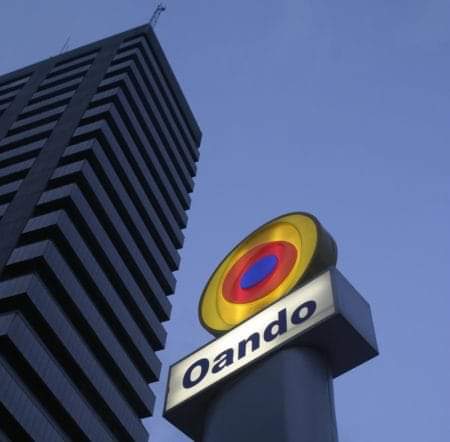
Oando Given Fair Hearing, Sanctions Won’t be Reversed–SEC
By Modupe Gbadeyanka
The Securities and Exchange Commission (SEC) has reacted to reports that it never gave Oando Plc any chance to defend the allegations levelled against it following a forensic audit conducted on the company.
In a statement signed by the management, SEC said Oando was given the opportunity to react to the infractions discovered from the audit, but their responses were not just satisfactory.
The commission noted that the sanctions against the company and its senior officials were mainly to protect investors and uphold the integrity of the Nigerian capital market.
It hinted that the punishment will not likely be reversed because doing so could work against federal government’s agenda to build strong institutions and promote the transparency and integrity of the Nigerian capital market, especially given that, these are preconditions for attracting foreign investors to the Nigerian capital market.
“The attention of the SEC has been drawn to various reports questioning the regulatory authority of the SEC, and insinuating lack of due process in the investigations of Oando Plc.
“To put the records straight, the SEC hereby states as follows:
“1. Fair hearing is a paramount and fundamental principle, which the Commission as a law abiding agency adheres to in all its investigative processes.
“2. In the course of the investigations, communications e.g. letters and phone calls were exchanged and meetings held between the Commission and Oando Plc, requesting for its comments and explanations on issues relating to the investigations. The findings of the Commission was communicated to the Group Chief Executive Officer of Oando Plc by a letter dated July 10, 2017.
“3. The Commission subsequently engaged Deloitte & Touche to conduct a Forensic Audit of the activities of Oando Plc. In the course of conducting the audit, Deloitte & Touche held regular sessions with members of the Board and senior management of Oando Plc, and afforded them the opportunity to provide explanations on issues relating to the investigation.
“4. The Commission confirms that Oando Plc was given sufficient opportunity of being heard and accorded several opportunities to rebut the issues revealed by the investigation. The responses given by Oando Plc, were however considered unsatisfactory; prompting, the decision by the Commission to penalize the company and some of the individuals related to it for violations of securities laws.
“5. The actions of the Commission were properly effected pursuant to the provisions of the Investments & Securities Act (ISA) 2007 and the SEC Rules and Regulations made pursuant to the ISA 2007.
“6. These facts have been properly articulated in the court process filed at the Federal High Court by the Commission in response to the suit instituted by the Group Chief Executive Officer and Deputy Group Chief Executive officer of Oando Plc.
“7. As the Apex Regulator of the Nigerian capital market, the Commission has a mandate to protect investors.
“8. The Commission’s recent action on Oando Plc aligns with the above cardinal mandate, as the directive for the removal of persons from the board of Oando Plc and the appointment of an interim management team to temporarily steer the affairs of the company is to protect investors and preserve stakeholder value.
“9. Failure or refusal of the Commission to act in the face of the serious issues thrown up by the investigations or to reverse its directives, would undermine the Federal Government’s agenda to build strong institutions and promote the transparency and integrity of the Nigerian capital market, especially given that, these are preconditions for attracting foreign investors to the Nigerian capital market,” SEC said in the statement.
Economy
Investors Lose N3.1bn as NASD Exchange Remains Red
By Adedapo Adesanya
The NASD Over-the-Counter (OTC) Securities Exchange entered a third straight day of losses after it fell by 0.12 per cent on Wednesday, June 10.
The depletion trimmed the market capitalisation further by N3.1 billion to N2.590 trillion from N2.593 trillion, and cut the NASD Unlisted Security Index (NSI) by 5.19 points to 4330.12 points from 4,335.31 points.
11 Plc lost N22.21 during the session to finish at N221.00 per share versus the previous day’s N243.21 per share, MRS Oil Plc depreciated by N6.90 to N158.10 per unit from N165.00 per unit, and Central Securities Clearing System (CSCS) Plc decreased by N2.81 to N78.32 per share from N81.13 per share.
On the flip side, FrieslandCampina Wamco Nigeria Plc went up by N9.27 to N183.08 per unit from N173.81 per unit, Nitrox Industrial Gases Plc added N1.92 to its value to close at N23.80 per share compared with the preceding day’s N21.88 per share, and Food Concepts Plc gained 10 Kobo to exchange at N2.58 per unit, in contrast to Tuesday’s closing price of N2.48 per unit.
At the close of business, the volume of securities traded by investors contracted by 92.6 per cent to 117,374 units from 1.6 million units, and the value of securities moderated by 80.5 per cent to N12.2 million from N62.3 million, while the number of deals increased by 4.9 per cent to 43 deals from 41 deals.
Great Nigeria Insurance (GNI) Plc finished the day as the most traded stock by value on a year-to-date basis with 3.4 billion units worth N8.4 billion, followed by Infrastructure Credit Guarantee (Infracredit) Plc with 2.3 billion units traded for N6.5 billion, and CSCS Plc with 65.2 million units exchanged for N4.4 billion.
GNI Plc also closed the session as the most traded stock by volume on a year-to-date basis with 3.4 billion units valued at N8.4 billion, followed by Infracredit Plc with 2.3 billion units transacted for N6.5 billion, and Resourcery Plc with 1.1 billion units sold for N415.7 million
Economy
Naira Crashes to N1,362.05/$1 at Official Window After N1.50 Loss
By Adedapo Adesanya
The Naira fell against the United States Dollar by N1.50 or 0.11 per cent in the Nigerian Autonomous Foreign Exchange Market (NAFEX) to sell at N1,362.05/$1 on Wednesday, June 10, compared with the N1,360.55/$1 it traded on Tuesday.
Also, the local currency lost N4.33 against the Pound Sterling in the official window yesterday to trade at N1,827.33/£1 versus the preceding day’s N1,823.00/£1, and depreciated against the Euro by N1.74 to quote at N1,575.35/€1, in contrast to N1,573.61/€1 of the previous session.
However, at the GTBank forex desk, the Naira gained N3 against the US Dollar to sell at N1,370/$1 versus N1,373/$1, and at the parallel market, it remained unchanged at N1,380/$1.
Updated data from the Central Bank of Nigeria (CBN) showed that foreign reserves surged further due to additional inflows from various sources. Nigeria’s gross external reserves increased to $50.439 billion, its highest level since March 2026, reflecting sustained inflows from oil revenue and other FX sources.
Also, the International Monetary Fund (IMF) has said increased confidence in the Naira, supported by lower and more stable inflation, would encourage households, businesses and investors to hold more local currency assets and reduce reliance on foreign currencies.
The global lender, in a recent assessment, stressed the importance of strengthening the CBN’s operational framework and aligning liquidity management operations more closely with monetary policy objectives.
In the cryptocurrency market, there were recoveries from recent losses as US headline inflation rose an expected 0.5 per cent in May, but the beat on the core rate — which cuts out food and energy costs — pleased markets. The core rate, though, rose just 0.2 per cent in May against forecasts for 0.3 per cent.
The print reinforces the view that the US Federal Reserve will keep interest rates at 350-375 basis points at its June 17 meeting, but is likely to increase rates by 25 basis points by the end of the year.
Cardano (ADA) went up by 2.4 per cent to $0.1647, Bitcoin (BTC) rose by 2.3 per cent to $62,794.09, Binance Coin (BNB) jumped 1.8 per cent to $596.23, Ethereum (ETH) grew by 1.7 per cent to $1,658.12, and Solana (SOL) also soared by 1.7 per cent to $65.23.
Further, Dogecoin (DOGE) appreciated by 1.5 per cent to $0.0849, Ripple (XRP) expanded by 0.4 per cent to $1.11, and TRON (TRX) increased by 0.05 per cent to $0.3218, while the US Dollar Tether (USDT) lost 0.10 per cent to close at $0.9989, and the US Dollar Coin (USDC) declined by 0.01 per cent to $0.9997.
Economy
Oil Prices Jump as Iran Shuts Down Strait of Hormuz
By Adedapo Adesanya
Oil prices jumped early on Thursday as Iran declared the critical energy chokepoint, the Strait of Hormuz, closed after the US launched additional strikes against the Middle East oil producer.
Brent futures rose $1.48 or 1.59 per cent to $94.58 per barrel, and the US West Texas Intermediate (WTI) crude climbed $1.71 or 1.90 per cent to $91.74 a barrel.
Iran’s top joint military command announced the closure of the Strait of Hormuz on Thursday, including oil tankers and commercial ships, saying any vessel attempting passage will be shot at.
Market analysts noted that the renewed escalation in fighting prompted oil prices to rally in early morning trading.
On Wednesday, the US military said on X that commercial ships continue to transit in and out of the strait. It also said no US warships have been struck in the strait, after Iran’s state media reported US ships near the waterway were targeted by missiles and drones.
US forces began launching additional strikes against multiple targets in Iran on Wednesday, the latest in an escalating exchange of attacks that threaten to reignite a full-scale war, which was paused in early April when the two sides agreed to a fragile ceasefire.
Defence Secretary Pete Hegseth held a press briefing announcing further attacks on Iran, saying, “If we need to negotiate with bombs, we’ll negotiate with bombs.” US Central Command later described those attacks as targeting “Iranian military surveillance capabilities, communication systems, and air defence sites across Iran.”
In response to the attacks, Iran’s top joint military command then announced that the Strait was closed to all shipping.
President Donald Trump said the strikes would stop shortly, but that they would continue if Iran’s leaders did not sign an agreement with the US immediately.
Iran’s months-long blockade of the strait, which normally carries a fifth of global oil and gas shipments, has kept oil prices elevated.
The latest exchange of strikes between the US and Iran marks the most significant escalation in the conflict since both countries agreed to a fragile ceasefire in April. Since then, oil inventories have drained dramatically, and no tangible breakthroughs have been announced.
Crude oil inventories in the US decreased by 7.2 million barrels during the week ending June 5, according to new data from the Energy Information Administration (EIA). The EIA’s data release follows figures that were released by the American Petroleum Institute (API) a day earlier, which reported that crude oil inventories saw a draw of 9.119 million barrels in the period.
-
Feature/OPED6 years agoDavos was Different this year
-
Travel/Tourism10 years ago
Lagos Seals Western Lodge Hotel In Ikorodu
-
Showbiz3 years agoEstranged Lover Releases Videos of Empress Njamah Bathing
-
Banking8 years agoSort Codes of GTBank Branches in Nigeria
-
Economy3 years agoSubsidy Removal: CNG at N130 Per Litre Cheaper Than Petrol—IPMAN
-
Banking3 years agoSort Codes of UBA Branches in Nigeria
-
Banking3 years agoFirst Bank Announces Planned Downtime
-
Sports3 years agoHighest Paid Nigerian Footballer – How Much Do Nigerian Footballers Earn