Connect with us

Economy

Oil Prices Jump After European Central Bank Rate Cuts

Published

on

oil prices driving up Trump

By Adedapo Adesanya

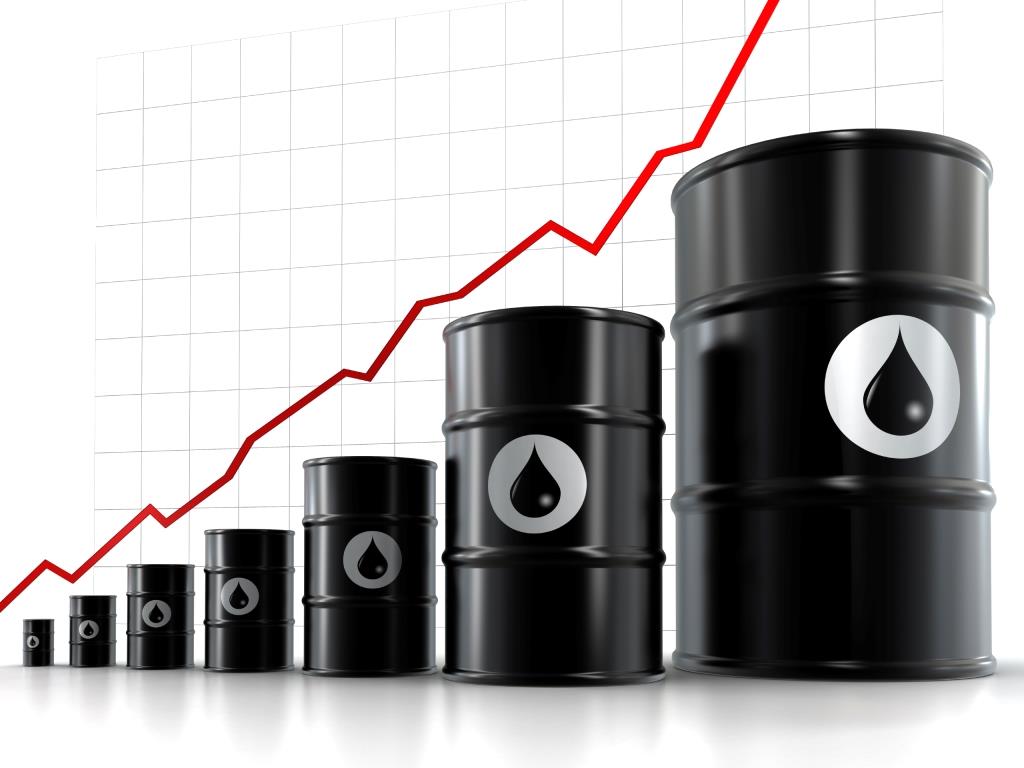
Oil prices increased by about 2 per cent on Thursday after the European Central Bank (ECB) opted to cut interest rates, with the market hoping the US Federal Reserve would follow suit.

The price of Brent crude futures went up by $1.46 or 1.86 per cent to finish at $79.87 a barrel and the US West Texas Intermediate (WTI) crude futures gained $1.48 or 2 per cent to trade at $75.55 a barrel.

Yesterday, the ECB went ahead with its first interest rate cut since 2019, citing progress in tackling inflation but cautioning the fight was far from over.

With Thursday’s move, the ECB lowered its bank deposit rate to 3.75 per cent from a record 4.0 per cent. It joins the central banks of Canada, Sweden and Switzerland in undoing some of the steepest streaks of interest rate hikes in recent history.

Analysts now see the European rate cuts as a likely precursor to US Federal Reserve rate cuts.

In the US, economists predict the Federal Reserve will cut rates in September as indications show that the world’s largest oil producer’s 2 per cent inflation target is still far behind.

Meanwhile, the number of Americans filing new claims for unemployment benefits rose last week, and first-quarter unit labour costs rose by less than previously thought and despite the cooling number, it is unlikely to push the Fed to start rate cuts.

The ministers in the Organisation of the Petroleum Exporting Countries and its allies (OPEC+) reassured investors the latest oil output agreement could change depending on the market.

On Thursday, Saudi Energy Minister Prince Abdulaziz bin Salman stated that OPEC+ has the option to halt or reverse production increases if it determines that the market is not robust enough.

On his part, Mr Alexander Novak, the Deputy Prime Minister of Russia, stated that the group may modify the agreement if necessary. He also attributed the post-meeting price decline to “speculative factors” and a misinterpretation of the agreement.

The allies agreed on Sunday to extend most production cuts into 2025 but left room for voluntary cuts from eight members to be unwound gradually.

Some of the market stakeholders note that the OPEC+ decision to phase out some output cuts, combined with strong fuel supplies, has driven oil prices lower.


Adedapo Adesanya is a journalist, polymath, and connoisseur of everything art. When he is not writing, he has his nose buried in one of the many books or articles he has bookmarked or simply listening to good music with a bottle of beer or wine. He supports the greatest club in the world, Manchester United F.C.

Click to comment

Leave a Reply

Your email address will not be published. Required fields are marked *

Economy

Dangote Refinery Delays Overseas Listing for at Least Three Years

Published

on

david bird dangote refinery

By Adedapo Adesanya

Dangote Petroleum Refinery will not pursue an overseas listing until it has established at least three years of proven production and financial performance, its chief executive, Mr David Bird, has said.

Mr Bird said the decision would allow the refinery to build a stronger operational track record before seeking an international listing that could support a higher valuation.

London has been mentioned as a possible destination for the refinery’s eventual foreign listing, although Mr Bird said the company would focus on its planned Nigerian initial public offering (IPO) in the near term.

The refinery is preparing for an October IPO on the Nigerian Exchange that could become Africa’s largest, with the oil firm seeking to encourage broad participation from Nigerians.

“We really want to drive participation,” Mr Bird told Reuters. “The mandate of the IPO was to be the people’s IPO.”

The refinery has submitted an application to the Securities and Exchange Commission for a potential $5 billion IPO, according to a source cited by the publication, although the final size of the offer has not been determined.

However, Mr Bird declined to comment on the proposed IPO size or the refinery’s valuation.

The company raised $2.5 billion in a private placement in July, a transaction that valued the refinery at about $40 billion. Africa Finance Corporation, which led a group of strategic investors in the deal, said the placement was 3.7 times oversubscribed.

Mr Bird said investor interest in the IPO had been strong during pre-marketing and the private placement, while preparations remained on schedule.

The refinery, owned by Mr Aliko Dangote, is also planning to double its refining capacity to 1.4 million barrels per day within three years, with the expansion expected to be funded partly through the IPO and debt.

The organisation currently supplies most of Nigeria’s gasoline and diesel demand and all of the country’s jet fuel needs.

It is also planning to establish a similar structure in Kenya to serve the East African market.

Continue Reading

Economy

Airtel Mulls UK Listing of Mobile Payments Unit in Dollars

Published

on

Airtel 5G licence auction

By Adedapo Adesanya

Airtel Africa Plc is considering listing its mobile payments subsidiary, Airtel Money, in US Dollars when it debuts on the London Stock Exchange (LSE) later this year, in a move that could make it one of the few companies to pursue a Dollar-denominated listing in the UK market.

According to Bloomberg, the group is evaluating whether to price Airtel Money’s shares in US Dollars rather than British Pounds Sterling to align with its reporting currency, citing people familiar with the matter.

The publication also reported that more banks have been invited to work on the deal, including lenders based in Africa and the Middle East.

The business is reportedly targeting a valuation of about $10 billion, which would make it the largest new flotation in London since July 2021, when British fintech Wise was valued at nearly £9 billion in a landmark direct listing.

Earlier this month, Mr Gopal Vittal, executive vice-chair of Bharti Airtel, said the company’s finance business has “achieved meaningful scale”, with quarterly revenue now exceeding $400 million.

He said the business has been growing by 25 per cent annually on a constant-currency basis. The opportunity remains significant, as nearly 65 per cent of adults across Airtel’s African markets still do not have access to formal bank accounts.

Airtel Money has a wide presence in Africa, including Kenya, Nigeria and Tanzania. Unlike in India, where Airtel operates its finance business as a payments bank, Airtel Money in Africa operates independently of the banking system. In Nigeria, Airtel Money operates through its licensed subsidiary known as SmartCash Payment Service Bank Limited

The service allows customers to transfer money through the mobile network, pay bills, and make international payments through virtual cards.

Airtel believes a London listing would give Airtel Money access to a broader base of investors than a listing in India or other places previously considered, including the United Arab Emirates (UAE).

Airtel Africa, which operates in 14 countries and is dual-listed in London and Lagos, is majority-owned by Indian billionaire, Mr Sunil Mittal, through Bharti Enterprises.

The company is also expanding its financial services business in India. In February, it secured a licence from the Reserve Bank of India to operate as a non-banking finance company (NBFC).

The licence allows the business to expand its operations, disburse loans, offer microcredit products and develop other financial solutions. Airtel also has access to digital data from its telecoms business, which it can use to improve its financial products.

Following the NBFC licence, Airtel announced a $2.2 billion (Rs200 billion) capitalisation plan for its finance arm.

A London listing would therefore mark a major step for Airtel Money, transforming it from a small unit within the telecoms business into a separately valued company with room to expand across Africa and India.

The UK is also strategically important to Mr Mittal, who is now the largest shareholder in British Telecom with a 24.95 per cent stake. Airtel Money’s planned listing would give the billionaire a second major footprint in the London market.

Continue Reading

Economy

11 Plc, CSCS Lift NASD OTC Bourse by 0.27%

Published

on

11 plc NASD

By Adedapo Adesanya

The duo of 11 Plc and Central Securities Clearing System (CSCS) Plc helped flip the NASD Over-the-Counter (OTC) Securities Exchange from a three-day losing streak to a 0.27 per cent gain on Thursday, August 13.

11 Plc, which used to be known as Mobil Nigeria, garnered N22.28 to close at N245.03 per unit compared with the preceding day’s N222.75 per unit, and CSCS Plc appreciated by N3.76 to N109.76 per share from N106.00 per share.

The gains offset the N10.00 loss recorded by FrieslandCampina Wamco Nigeria Plc, closing at N160.00 per unit compared with N170.00 per unit it finished at midweek.

When the bourse closed for the day, the market capitalisation increased by N7.31 billion to N2.727 trillion from N2.720 trillion, and the NASD Security Index (NSI) went up by 12.17 points to 4,544.20 points from 4,532.03 points.

Yesterday, the volume of securities exchanged by investors skyrocketed by 1,173.8 per cent to 1.9 million units from 150,340 units, the value of securities jumped by 1,029.5 per cent to N210.8 million from N18.7 million, and the number of deals soared by 6.3 per cent to 34 deals from 32 deals.

Great Nigeria Insurance (GNI) Plc remained the most active stock by value on a year-to-date basis, with 3.4 billion units worth N8.4 billion, followed by Infrastructure Credit Guarantee (Infracredit) Plc with 2.3 billion units valued at N6.5 billion, and CSCS Plc with 79.1 million units exchanged for N5.7 billion.

GNI Plc also closed the day as the most traded stock by volume on a year-to-date basis, with 3.4 billion units sold for N8.4 billion, followed by Infracredit Plc with 2.3 billion units transacted for N6.5 billion, and Resourcery Plc with 1.1 billion units traded for N415.7 million.

Continue Reading