Connect with us

Economy

Onyema Seeks Collective Effort to Improve Nigerian Markets

Published

on

By Dipo Olowookere

Chief Executive Officer of the Nigerian Stock Exchange (NSE) Mr Oscar Onyema, has called on stakeholders in the financial and capital markets in the country to come together for the development of the markets.

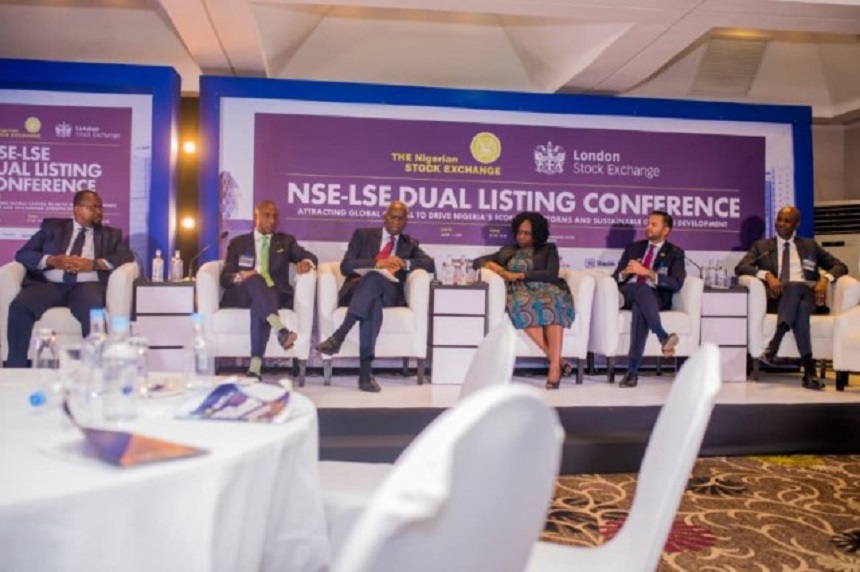
Mr Onyema made this call last Friday while delivering his address at the 5th edition of NSE-LSE Dual Listing Conference, which took place at Wheat baker Hotel, Ikoyi, Lagos.

The event brought together companies keen to explore a London/Lagos dual listing, corporate finance experts, lawyers, capital market operators, regulators, government officials, media and thought leaders, featured key​notes addresses, presentations and panel discussions, who brainstormed on ‘Attracting Global Capital to Drive Nigeria’s Economic Reforms and Sustainable Growth Development.’

According to Mr Onyema, “creating and sustaining the growth trajectory of our exchanges, capital markets, financial markets, economies and the continent as a whole, requires a strong commitment from each and every one of us here today.

“It is not an easy journey, but it is one we have no choice but to embark upon, individually and collectively, in order to guarantee our competitive advantage in today’s interconnected world.

“We must use this opportunity to partner with each other, to enable us further unlock our growth potential, and advance the development of our financial and capital markets.”

The NSE chief said at the conference that the partnership between the local bourse and its London counterpart (the London Stock Exchange) was a deliberate and strategic alliance that will boost capital formation.

“The partnership was geared at encouraging seamless cross-border access between both markets. It would also create larger liquidity pool, greater competitiveness for investors, enhance capacity and promote diversity of investment products to meet the needs of a wide range of investors and issuers.

“This is evidenced by the FGN Sovereign FX denominated $1 billion Eurobond on the Nigerian Stock Exchange and London Stock Exchange recently, and a strong pipeline of corporate Eurobonds.”

Dr Doyin Salami, Senior Fellow/Associate Professor, Lagos Business School, Pan Atlantic University, gave an excellent presentation on “the Nigerian Economics and Business Environment: Implications for the Capital Market in an Unfolding Election Cycle”, where he posed two important fundamentals for Nigeria- the role of private capital and the role of the price mechanism.

British Deputy High Commissioner, Laure Beaufils spoke on the UK-Nigeria partnership and the importance of capital markets for Nigeria’s long term development. She noted that the UK is committed to supporting Nigeria’s economic growth.


Dipo Olowookere is a journalist based in Nigeria that has passion for reporting business news stories. At his leisure time, he watches football and supports 3SC of Ibadan. Mr Olowookere can be reached via [email protected]

Click to comment

Leave a Reply

Your email address will not be published. Required fields are marked *

Economy

e-Invoicing: NRS Begins Compliance Monitoring for Large Taxpayers

Published

on

NRS nigeria large taxpayers

By Modupe Gbadeyanka

The Nigeria Revenue Service (NRS) has announced the commencement of compliance monitoring activities for large taxpayers under the National e-Invoicing and Electronic Fiscal System (EFS) regime.

A statement issued on Monday and signed by the agency’s chairman, Mr Zacch Adedeji, advised corporate organisations that have yet to adopt this system to do so on or before July 31, 2026.

Recall that on February 17, 2026, NRS issued an implementation timeline for the mandatory adoption of the EFS, also known as the Merchant Buyer Solution (MBS), by large taxpayers.

They were asked to complete the process of onboarding, integration, testing, and commence invoice transmission to the NRS e-invoicing platform in accordance with the prescribed implementation framework.

The compliances include the completion of onboarding on the NRS MBS; the successful integration of taxpayer systems through approved Access Point Providers (APPs) and/or Systems Integrators (SIS); the completion of all required validation and testing activities; the active transmission of invoices to the NRS e-invoicing platform in line with approved standards and guidelines; and the receipt of only compliant e-invoices with a valid Invoice Reference Number (IRN) from suppliers.

Ahead of the deadline, the NRS has commenced compliance monitoring activities to assess the level of adherence to the e-invoicing mandate across the large taxpayer segment.

Those that have not completed the process have been asked to conclude all outstanding onboarding and integration activities and commence invoice transmission before the compliance deadline.

The organisation warned that failure to comply would trigger regulatory and enforcement actions in accordance with the provisions of the relevant tax laws and regulations.

Continue Reading

Economy

Operational Challenges Shrink Transcorp Power H1 2026 Earnings, Profit

Published

on

Transcorp Power

By Aduragbemi Omiyale

Transcorp Power Plc suffered declines in its revenue and profit in the first half of this year; details of the company’s financial statements for the period ended June 30, 2026, have revealed.

The losses were attributed to recurring transmission line vandalism, which materially constrained the organisation’s ability to evacuate available generation capacity.

Business Post reports that earnings contracted in the first six months of this year to N181.97 billion from the N205.81 billion recorded in the same period of last year, while profit before tax moderated to N54.99 billion from N58.73 billion.

However, on a year-to-date basis, total assets went up to N619.02 billion from N563.48 billion in December 2025, as shareholders’ funds grew to N189.34 billion from N183.40 billion in FY 2025, while retained earnings soared to N140.90 billion from N123.41 billion in FY 2025.

It was observed that the increase in receivables and borrowings largely drove the expansion in the balance sheet during the period.

Also, the firm’s gross margin expanded to 38.4 per cent from 34.7 per cent in H1 2025, operating margin increased to 30.6 per cent from 28.5 per cent, and PBT margin rose to 30.2 per cent from 28.5 per cent, reflecting cost optimisation efforts and disciplined financial management, positioning the company to continue delivering sustainable value for shareholders.

“Our H1 2026 performance is a reflection of the resilience of our business operations despite significant sector-wide existential challenges.

“Regrettably, recurring transmission line vandalisation materially constrained our ability to evacuate available generation capacity.

“Nonetheless, we continued to deliver strong profitability, maintain operational efficiency, and strengthen our balance sheet,” the chief executive of Transcorp Power, Mr Peter Ikenga, stated.

“We remain committed to working with relevant stakeholders to put an end to transmission line vandalisation and to further improving operational performance, power generation supply reliability, and creating sustainable value for our shareholders. We remain highly confident that we will recover lost ground in H1 2026 and finish FY 2026 stronger than FY 2025,” he added.

Continue Reading

Economy

Market Participants Transact 2.819 billion Stocks Worth N182.5bn in Five Days

Published

on

Stock Investors

By Dipo Olowookere

A total of 2.819 billion stocks worth N182.499 billion exchanged hands in 226,729 deals on the floor of the Nigerian Exchange (NGX) Limited last week, in contrast to the 3.648 billion stocks valued at N220.568 billion transacted in 251,861 deals a week earlier.

From this, financial shares accounted for 2.006 billion units sold for N99.697 billion in 96,171 deals, contributing 71.17 per cent and 54.63 per cent to the total trading volume and value, respectively.

Consumer goods equities traded 178.863 million units worth N7.872 billion in 26,637 deals, and energy stocks recorded a turnover of 151.237 million units valued at N38.309 billion in 16,879 deals.

First Holdco, FCMB, and Access Holdings accounted for 939.402 million units worth N57.673 billion in 19,051 deals, contributing 33.33 per cent and 31.60 per cent to the total trading volume and value, respectively.

Business Post reports that the performance indicators were mixed in the five-day trading week, as the All-Share Index (ASI) depreciated by 0.14 per cent to 243,462.13 points, while the market capitalisation appreciated by 0.39 per cent to N157.057 trillion.

All other indices finished higher except the main board, consumer goods, energy, Lotus II, industrial goods, growth, and sovereign bond indices, which fell by 1.54 per cent, 0.15 per cent, 0.11 per cent, 0.40 per cent, 6.26 per cent, 0.09 per cent, and 0.33 per cent, respectively, while the commodity index closed flat.

Forty-four shares gained weight in the week versus 60 shares of the preceding week, 35 equities depreciated versus 28 equities in the previous week, and 67 stocks closed flat versus 58 stocks of the earlier week.

The best-performing stock was First Holdco, which gained 38.66 per cent to trade at N95.95. Thomas Wyatt expanded by 27.16 per cent to N3.09, Fidelity Bank grew by 15.00 per cent to N21.85, Learn Africa grew by 14.44 per cent to N10.30, and UBA chalked up 10.98 per cent to close at N45.50.

The worst-performing stock was BUA Cement after giving up 18.99 per cent to quote at N275.60, Red Star Express shed 18.53 per cent to end at N20.00, International Energy Insurance declined by 15.27 per cent to N4.66, C&I Leasing dropped 13.28 per cent to N5.55, and PZ Cussons crashed by 10.06 per cent to N80.95.

Continue Reading