Connect with us

Economy

Panic Selling Crashes Dollar to N800/$1 at Black Market

Published

on

Access Bank PTA requests

By Dipo Olowookere

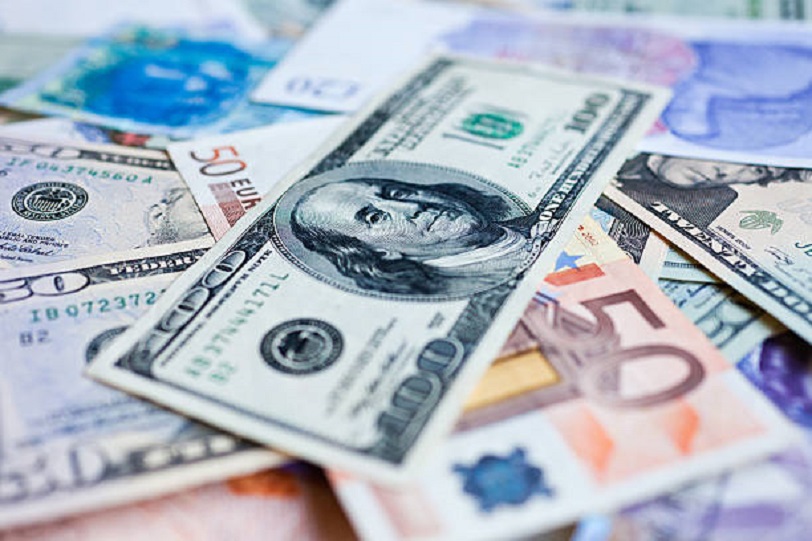
The value of the Dollar to the Naira crashed at the black market on Wednesday to N800/$1, Business Post reports.

This was caused by panic selling from some customers who had earlier hoarded the foreign currency in anticipation that the local currency would continue to weaken in the foreign exchange (FX) market.

It was observed that most forex hawkers in Lagos were reluctant to buy the Dollars from their customers because they are not certain if the value would further move downward.

In the previous trading session, the Naira was exchanged to a Dollar at the parallel market at N940$1 until it (domestic currency) was strengthened by N140 to N800/$1 on Wednesday afternoon.

Also, in the peer-to-peer (P2P) segment of the FX market, the Naira quickly gained N64 against the greenback this afternoon to sell at N860/$1 compared with the N924/$1 it was traded yesterday.

Recall that on Monday, the acting Governor of the Central Bank of Nigeria (CBN), Mr Folashodun Shonubi, warned that speculators would regret mopping up Dollars from the market to put pressure on the Naira.

He said the exchange rate of the parallel market was not being “driven by pure economic demand and supply but are topped by speculative demand from people,” noting that his team would move quickly to save the local currency from its woes.

This may have triggered the panic selling of Dollars as a few FX traders at the Olugbede Model Market informed this newspaper they were being careful with the “sudden” inflow of Dollars into the market today.


Dipo Olowookere is a journalist based in Nigeria that has passion for reporting business news stories. At his leisure time, he watches football and supports 3SC of Ibadan. Mr Olowookere can be reached via [email protected]

Economy

Oil Prices Crash 7% on Hopes of US-Iran Peace Deal

Published

on

Oil Prices fall

By Adedapo Adesanya

Oil prices fell nearly 7 per cent on Monday as optimism grew that the United States and ‌Iran were moving closer to a peace deal that would reopen the Strait of Hormuz.

Brent crude futures were down by $7.24 or almost 7 per cent to $96.30 a barrel, and the US West Texas Intermediate (WTI) crude futures decreased by $6.30 or 6.5 per cent to trade ​at $90.88 per barrel.

Comments by President Donald Trump that diplomatic negotiations with Iran are advancing eased market fears of severe energy supply disruptions due to the Middle East conflict.

This is as a top negotiator of Iran, and its foreign minister was in Doha ​for talks with Qatar’s prime minister on a potential deal with the US to end the three-month-old ⁠war

Recently, both countries have downplayed expectations for an immediate peace agreement to end their three-month-old war, backing away from claims of an imminent breakthrough.

President Trump later revealed that he has instructed negotiators not to rush the process, asserting that the US naval blockade on Iranian ports will remain in full effect until a finalised accord is certified and signed.

Also, the US Secretary of State Marco Rubio has affirmed that the US government will exhaust diplomatic channels, also warning that it will handle Iran in “another way” if a good agreement cannot be secured, hinting at a potential return to active war.

The deal outlines a process to fully reopen the vital global shipping lane without tolls, resolving the global energy crunch. Iran would receive targeted sanctions relief and the gradual unfreezing of up to $20 billion to $25 billion in assets currently held in foreign banks.

Even if ⁠a peace deal is reached, analysts expect a return to normal oil flows through the strait will take months, while damaged oil and gas facilities are repaired. There is currently a supply shortfall of up to 11 million ​barrels per day of crude oil that does not go away immediately, even if a deal is reached soon.

Ship-tracking data showed three Liquefied Natural Gas (LNG) tankers passed through the ​strait in recent days, heading to Pakistan, China and India, as well as a supertanker with Iraqi crude for China after being stranded for nearly three months.

Continue Reading

Economy

Nigeria Records 3.89% GDP Growth in Q1 2026

Published

on

4.03% GDP Growth

By Adedapo Adesanya

Nigeria’s economic growth rate eased in the first quarter of 2026 to 3.89 per cent year-on-year, as a slowdown in the oil sector offset gains recorded in the non-oil sector.

The economy, measured by Gross Domestic Product (GDP), slowed in the first three months of this year from the 4.07 per cent recorded in the previous quarter (Q4 2025), according to data released by the National Bureau of Statistics (NBS) on Monday. However, it was higher than the 3.13 per cent recorded in the first quarter of 2025.

In the first quarter of 2026, Nigeria recorded an average daily oil production of 1.55 million barrels per day, lower than 1.62 million barrels per day in the same quarter of 2025 and lower than the 1.58 million barrels per day in the fourth quarter of 2025.

The real growth of the oil sector was 2.57 (year-on-year) in Q1 2026, indicating an increase of 0.70 per cent compared with the 1.87 per cent in the corresponding quarter of 2025.

However, growth decreased by 4.22 per cent compared to 6.79 per cent in Q4 2025, and on a quarter-on-quarter basis, the oil sector recorded a growth rate of 9.31 per cent.

For the non-oil sector, it contributed 96.08 per cent to the nation’s GDP between January and March 2026, versus 96.03 per cent in the same period of last year and lower than 97.13 per cent in the fourth quarter of last year.

During the quarter under review, agriculture grew by 3.15 per cent. The growth of the industry sector stood at 3.50 per cent versus 3.42 per cent in the first quarter of last year, while the services sector recorded a growth of 4.31 per cent, in contrast to 4.33 per cent in the same quarter of 2025.

In terms of share of the GDP, the services sector contributed 57.73 per cent compared to 57.50 per cent in the first quarter of 2025.

In the quarter under review, aggregate GDP at basic price stood at N110.79 trillion in nominal terms, higher than N94.1 trillion in the first quarter of 2025 by 17.79 per cent.

Continue Reading

Economy

CPPE Warns Against Rising Push for Petrol Importation

Published

on

CPPE Muda Yusuf Customs Duty Exchange Rate

By Adedapo Adesanya

The Centre for the Promotion of Private Enterprise (CPPE) has warned that Nigeria must not forgo its commitment to boosting domestic refining capacity amid growing advocacy for the importation of petroleum products.

In a statement, the centre explained that Nigeria must, therefore, avoid drifting into a policy regime that undermines domestic production in the name of competition or liberalisation.

The Chief Executive Officer (CEO) of the think tank, Mr Muda Yusuf, in a press release, warned that Nigeria is signalling to investors what happens if a multi-billion-dollar Dangote refinery investment of continental significance is confronted with regulatory uncertainty and policy headwinds.

The development comes as the management of the refinery has approached the court to battle against regulators, including the Nigerian National Petroleum Company (NNPC) and the Nigerian Midstream and Downstream Petroleum Regulatory Authority (NMDPRA), over their decision to allow importation.

The dispute stems from a lawsuit filed by Dangote Refinery against the Attorney-General of the Federation, Mr Lateef Fagbemi, over fuel import licences granted to six marketers and the state oil company. The case has since widened the debate around local refining, market competition and the future direction of Nigeria’s downstream petroleum industry.

According to the centre, the increased call speaks to the very architecture of Nigeria’s economic philosophy, the future of industrialisation, the resilience of the macroeconomy and, ultimately, the preservation of the country’s economic sovereignty.

“No nation has ever imported its way to industrial greatness. Prosperous economies are built on production, refining, manufacturing, value addition and the strengthening of domestic productive capacity.

“Countries that become excessively dependent on imports inevitably export jobs, weaken domestic industries, erode local investments and mortgage their economic sovereignty.

“Nigeria must therefore avoid drifting into a policy regime that undermines domestic production in the name of competition or liberalisation,“ Mr Yusuf noted.

Continue Reading

Trending