Connect with us

Economy

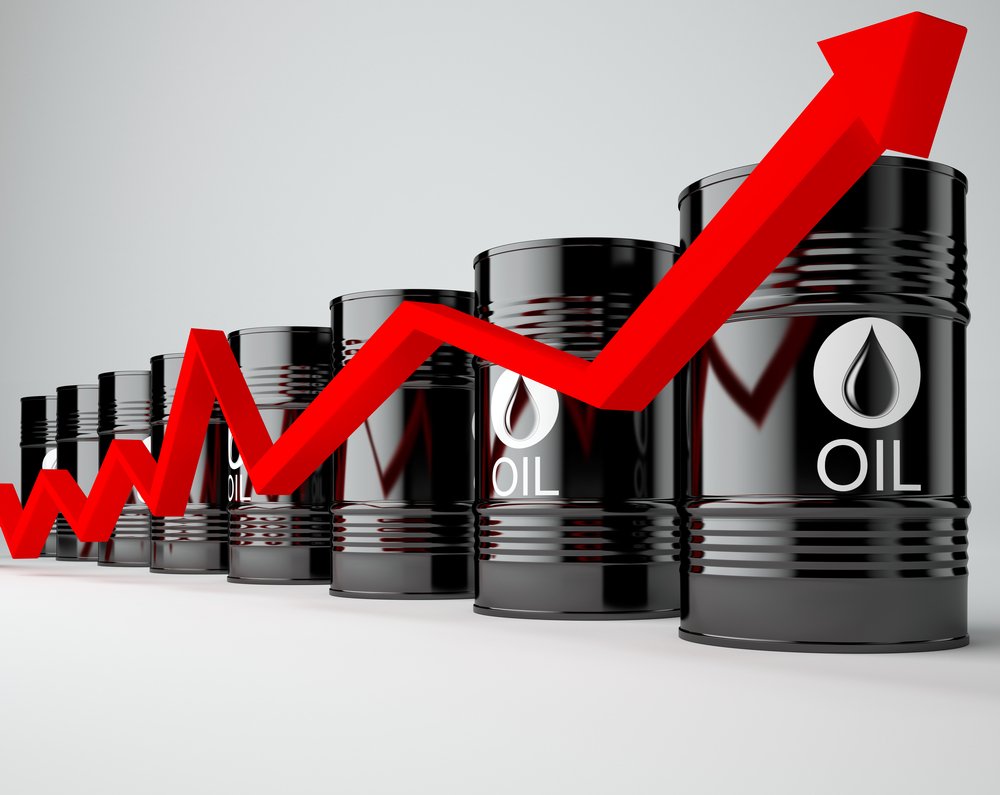
Positive Global Economic Forecasts Buoy Oil Prices

Published

on

oil prices cancel iran deal

By Adedapo Adesanya

Oil prices rose on Tuesday as a higher global economic growth forecast and escalating tensions in the Middle East offset concerns about Chinese demand.

As a result, Brent crude gained 47 cents to settle at $82.87 a barrel and the US West Texas Intermediate (WTO) crude appreciated by $1.04 to quote at $77.82 per barrel.

The International Monetary Fund (IMF) raised its forecast for global economic growth, upgrading the outlook for the top two largest economies, the US and China, on faster-than-expected easing of inflation.

The lender forecasts global growth of 3.1 per cent in 2024, up 20 basis points of a percentage point from its October forecast, and said it expected unchanged growth of 3.2 per cent in 2025.

While the US is expected to rise by 2.1 per cent, China’s GDP is expected to grow by 4.6 per cent in 2024.

Global trade is expected to expand by 3.3 per cent in 2024 and 3.6 per cent in 2025, well below the historical average of 4.9 per cent, with gains weighed down by thousands of fresh trade restrictions.

Both crude contracts had fallen by more than $1 on Monday as a deepening real estate crisis in China fuelled concerns over demand in the world’s biggest crude consumer after a Hong Kong court ordered the liquidation of property company China Evergrande Group.

Market analysts note that while there are still concerns about China, the fundamentals from a supply risk standpoint showed bullish signs.

The continuing conflict in the Middle East also provided support to the oil market as US President, Mr Joe Biden, said he has made up his mind on how to respond to a drone attack on American soldiers.

Although he was light on details, the American President said the decision came after consultations as he weighs punishing Iran-backed militias without triggering a wider war.

On the supply side, the US began reimposing sanctions on Venezuela this week after the country’s top court upheld a ban blocking the candidacy of the leading opposition hopeful in a presidential election later this year.

Saudi Aramco, the state oil company of the world’s largest exporter, said it had received a directive from the Saudi energy ministry to maintain its maximum sustainable capacity at 12 million barrels per day and not to continue increasing it to 13 million barrels per day.

The Organisation of the Petroleum Exporting Countries and its allies known as OPEC+ will meet on February 1. However, the meeting is unlikely to bring a decision on the group’s oil policy for April but analysts are hoping it could shed some light on production plans.

Adedapo Adesanya is a journalist, polymath, and connoisseur of everything art. When he is not writing, he has his nose buried in one of the many books or articles he has bookmarked or simply listening to good music with a bottle of beer or wine. He supports the greatest club in the world, Manchester United F.C.

Economy

Naira Crashes to N1,380/$ at Official Market, N1,390/$1 at Black Market

Published

on

forex black market

By Adedapo Adesanya

Pressure is beginning to mount on the Nigerian Naira in the different segments of the foreign exchange (FX) market despite an oil windfall triggered by the Middle East crisis.

On Monday, April 27, the domestic currency further weakened against the United States Dollar in the Nigerian Autonomous Foreign Exchange Market (NAFEX) by N16.47 or 1.2 per cent to N1,380.71/$1 from the previous day’s N1,364.24/$1.

It was not different against the Pound Sterling in the same market window, as it lost N16.04 to trade at N1,863.76/£1 versus Monday’s closing rate of N1,847.72/£1, and against the Euro, it slipped by N12.72 to close at N1,615.01/€1 versus N1,602.29/€1.

The Naira also depreciated against the Dollar at the black market yesterday by N5 to quote at N1,390/$1 compared with the previous price of N1,385, and at the GTBank forex counter, it further crashed by N9 to settle at N1,379/$1 compared with the preceding session’s N1,370/$1.

The continued decline of the Naira comes as traders increasingly seek other safe-haven currencies amid continued global disruptions.

The benefit awash in the global market is making foreign portfolio investors stay short in Nigerian markets. Despite this, the daily FX publication released showed that interbank turnover rose to $98.829 million across 78 deals, up from $76.65 million.

Meanwhile, the cryptocurrency market remained cautious, with Bitcoin (BTC) trading at $77,216.66 despite surging oil prices and geopolitical tensions over a potential extended US naval blockade of the Strait of Hormuz.

Analysts say the supply overhang has finally dried up, and the sellers who were spooked by macro shifts or quantum fears have already exited, leaving the market much thinner on the sell-side.

Investors will await decisions made by central banks this week. The US Federal Reserve will announce its rate decision later on Wednesday, while the European Central Bank (ECB) follows on Thursday.

Ethereum (ETH) gained 1.5 per cent to trade at $2,324.59, Dogecoin (DOGE) chalked up 1.4 per cent to sell for $0.1016, Solana (SOL) appreciated by 0.6 per cent to $84.85, Cardano (ADA) grew by 0.5 per cent to $0.2483, and Binance Coin (BNB) advanced by 0.2 per cent to $627.15.

However, TRON (TRX) depreciated by 0.6 per cent to $0.3224, and Ripple (XRP) lost 0.03 per cent to sell at $1.39, while the US Dollar Tether (USDT) and the US Dollar Coin (USDC) were unchanged at $1.00 each.

Continue Reading

Economy

Oil up 3% as Hormuz Disruption Outweighs UAE OPEC Exit

Published

on

Oil Licensing Round

By Adedapo Adesanya

Oil was up by nearly 3 per cent on Tuesday as persistent worries about supply constraints from the closed Strait of Hormuz continued, with Brent futures for June rising by $3.03 or 2.8 per cent to $111.26 a barrel, and the US West Texas Intermediate (WTI) crude futures growing by $3.56 or 3.7 per cent to $99.93 a barrel.

An earlier round of negotiations between the United States and Iran collapsed last week after face-to-face talks failed.

Ship-tracking data showed significant disruptions in the region, with six Iranian oil tankers forced to turn back due to the US blockade, but some traffic is still moving.

Prices trimmed some of the advances after the United Arab Emirates (UAE), the fourth-largest producer in the Organisation of the Petroleum Exporting Countries (OPEC), said on Tuesday it would exit the group on this Friday, May 1, 2026.

This dealt a blow to the oil-exporting group and its de facto leader, Saudi Arabia.

The UAE could quickly ⁠add between 1 million and 1.5 million barrels per day of output. However, with the Strait of Hormuz effectively closed, analysts said that there’s nowhere for that supply to go.

The UAE joined OPEC in 1967, but tension with Saudi Arabia over production quotas has been building for years.

Under the OPEC+ deal, the country has been held to roughly 3 million barrels per day while sitting on capacity above 4 million. It has been pushing toward 5 million barrels per day by 2027, and that target is hard to achieve with quotas built around someone else’s view of the market.

The war in Yemen broke whatever was left of diplomatic patience.

President Donald Trump said he was unhappy with the latest Iranian proposal to end the war. The proposal would avoid addressing the nuclear programme until hostilities cease and Gulf shipping disputes are resolved.

The Idemitsu Maru, ‌a Panama-flagged ⁠tanker carrying 2 million barrels of Saudi oil, and an LNG tanker managed by the Abu Dhabi National Oil Company (ADNOC) crossed the Strait on Tuesday, shipping data showed.

Vortexa data showed that the amount of crude oil held around the world on tankers that have been stationary for at least seven days rose to 153.11 million barrels as of April 24.

The American Petroleum Institute (API) estimated that crude oil inventories in the United States fell by 1.79 million barrels in the week ending April 24. The official data from the US Energy Information Administration (EIA) will be released later on Wednesday.

Continue Reading

Economy

Nigerian Stock Market Rebounds 2.30% Amid Cautious Trading

Published

on

Nigerian Stock Market

By Dipo Olowookere

The Nigerian Exchange (NGX) Limited returned to winning ways on Tuesday after it closed higher by 2.30 per cent amid cautious trading.

Yesterday, investor sentiment at the Nigerian stock market was weak after finishing with 37 price gainers and 40 price losers, indicating a negative market breadth index.

It was observed that the industrial goods sector rose by 4.86 per cent, the energy index appreciated by 4.66 per cent, and the consumer goods segment soared by 2.74 per cent. They offset the 1.38 per cent loss recorded by the banking counter and the 0.20 per cent decline printed by the insurance sector.

At the close of business, the All-Share Index (ASI) was up by 5,137.90 points to 228,740.19 points from 223,602.29 points, and the market capitalisation went up by N3.308 trillion to N147.278 trillion from N143.970 trillion.

The trio of FTN Cocoa, Industrial and Medical Gases, and Lafarge Africa gained 10.00 per cent each to sell for N5.50, N39.60, and N324.50, respectively, while Austin Laz grew by 9.71 per cent to N3.73, and Aradel Holdings jumped 9.52 per cent to N1,840.00.

On the flip side, UBA lost 10.00 per cent trade at N44.55, Trans-Nationwide Express slipped by 9.99 per cent to N6.40, NASCON crashed by 9.18 per cent to N187.90, Jaiz Bank depreciated by 8.93 per cent to N8.01, and Berger Paints crumbled by 8.66 per cent to N68.00.

Yesterday, market participants traded 908.0 million equities valued at N68.2 billion in 72,886 deals compared with the 678.2 million equities worth N44.1 billion transacted in 82,838 deals on Monday, showing a drop in the number of deals by 12.01 per cent, and a spike in the trading volume and value by 33.88 per cent and 54.65 per cent, respectively.

Continue Reading

Trending