Economy
Renewed Bargain Hunting Lifts Local Stock Exchange by 0.17%
By Dipo Olowookere
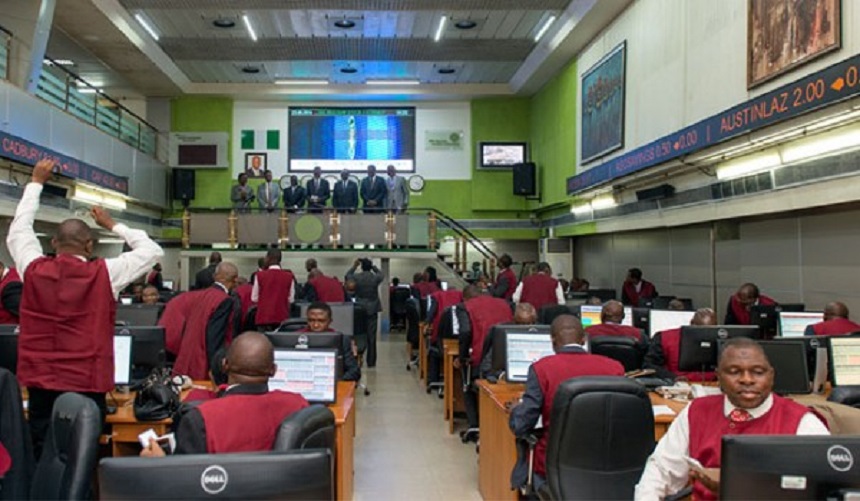
The local stock exchange appreciated by 0.17 per cent on Wednesday on renewed bargain-hunting in industrial goods and insurance equities.
The insurance sector grew in the midweek session by 1.58 per cent, the industrial goods space appreciated by 0.95 per cent and the consumer goods counter rose by 0.01 per cent, while the banking index depreciated by 0.27 per cent, with the energy sector closing flat.
At the close of trading activities, the All-Share Index (ASI) of the Nigerian Exchange (NGX) Limited increased by 115.87 points to 67,100.49 points from 66,984.62 points, and the market capitalisation expanded by N64 billion to N36.865 trillion from N36.801 trillion.
Investor sentiment was slightly bullish yesterday after the market breadth index ended in the positive region with 18 price gainers and 17 price losers.
Thomas Wyatt topped the gainers’ chart after it rose by 9.81 per cent to N2.35, DAAR Communications improved by 9.52 per cent to 23 Kobo, Cornerstone Insurance appreciated by 6.45 per cent to N1.65, Transcorp increased by 5.41 per cent to N6.43, and Union Bank gained 5.30 per cent to trade at N6.95.
Conversely, Omatek topped the losers’ chart after it depreciated by 8.33 per cent to close at 44 Kobo, Oando shed 8.08 per cent to N9.10, Africa Prudential declined by 7.80 per cent to N6.50, Caverton lost 6.92 per cent to finish at N1.48, and Consolidated Hallmark Insurance dropped 6.25 per cent to sell at N1.05.
The activity chart was mixed on Wednesday, as the trading value went down by 42.31 per cent, the number of deals crashed by 13.25 per cent, while the trading volume surged by 59.40 per cent.
A total of 410.3 million shares valued at N4.5 billion exchanged hands in 5,637 deals during the trading day versus the 257.4 million shares worth N7.8 billion traded in 6,498 deals on Tuesday.
Neimeth led the activity table yesterday for selling 163.2 million equities worth N259.5 million, Access Holdings exchanged 39.0 million stocks for N611.8 million, Zenith Bank transacted 32.3 million shares valued at N1.0 billion, Fidelity Bank traded 23.5 million shares worth N194.2 million, and UBA exchanged 19.8 million equities for N341.2 million.
Economy
Naira Firms to N1,357/$1 at NAFEX, Trades Flat at N1,395/$1 at Black Market
By Adedapo Adesanya
The Naira-US Dollar exchange rate remained unchanged in the black market segment of the foreign exchange (FX) market on Thursday, August 13, at N1,395/$1.
But at the GTBank forex desk, the Nigerian currency gained N3 against the greenback during the session to settle at N1,367/$1, in contrast to Wednesday’s rate of N1,370/$1.
Similarly, the local currency further appreciated against the Dollar in the Nigerian Autonomous Foreign Exchange Market (NAFEM) yesterday by N2.93 or 0.22 per cent to trade at N1,357.65/$1 compared with the previous day’s N1,360.58/$1.
Equally, the Nigerian Naira improved its value against the Pound Sterling at the official market by N6.94 to quote at N1,834.05, in contrast to the preceding session’s N1,840.99/£1, and against the Euro, it firmed up by N5.01 to close at N1,567.00/€1 versus Wednesday’s N1,572.01/€1.
Data from the Central Bank of Nigeria (CBN) revealed that interbank FX transactions plunged by 53 per cent to $79.097 million from $168.758 million, as banks recorded a sharp cutback in customers’ US dollar demand, with the number of deals down to 98 from 190.
The apex bank announced the removal of restrictions preventing financial institutions that accessed its Standing Lending Facility (SLF) from participating in primary government securities transactions and FX.
Under a revised framework, institutions that accessed the CBN’s discount window will no longer lose access to the facility because of their participation in the NAFEM or primary auctions of government securities.
As for the cryptocurrency market, prices fell as the expected US inflation report failed to push the asset beyond its established trading range.
The US Bureau of Labour Statistics reported that headline inflation rose 0.1 per cent month over month in July and slowed to 3.4 per cent annually from 3.5 per cent in June. Core CPI, which excludes food and energy, increased 0.2 per cent during the month and 2.5 per cent from a year earlier.
Cardano (ADA) lost 1.3 per cent to close at $0.1821, TRON (TRX) also shrank by 1.3 per cent to $0.3335, Solana (SOL) fell by 1.0 per cent to $75.60, Dogecoin (DOGE) also declined by 1.0 per cent to $0.06981, Bitcoin (BTC) dropped 0.9 per cent to sell at $63,152.59, Ethereum (ETH) dipped by 0.8 per cent to $1,877.07, Binance Coin (BNB) slumped by 0.7 per cent to $608.42, and Ripple (XRP) depreciated by 0.5 per cent to $1.00, while the US Dollar Tether (USDT) and the US Dollar Coin (USDC) remained unchanged at $1.00 apiece.
Economy
Nigeria’s Stock Exchange Gives up 0.39% on Weak Investor Sentiment
By Dipo Olowookere
Weak investor sentiment further crumbled Nigeria’s stock exchange by 0.39 per cent on Thursday, as sell-offs persisted.
Data showed that all the major sectors of the Nigerian Exchange (NGX) Limited ended in the red, with the consumer goods index down by 1.22 per cent. The industrial goods space retreated by 0.75 per cent, the insurance segment depreciated by 0.55 per cent, the banking sector tumbled by 0.27 per cent, and the energy counter receded by 0.07 per cent.
At the close of business, the All-Share Index (ASI) went down by 949.71 points to 243,017.38 points from 243,967.09 points, and the market capitalisation dipped by N613 billion to N156.881 trillion from N157.494 trillion.
Unilever Nigeria led the losers’ chart after it depleted by 9.97 per cent to N118.30, Chellarams dropped 9.66 per cent to close at N10.75, NDIF slumped by 9.55 per cent to N147.70, DAAR Communications crashed by 9.25 per cent to N1.57, and Cornerstone Insurance slipped by 9.09 per cent to N5.00.
On the flip side, International Energy Insurance topped the gainers’ log after it grew by 10.00 per cent to N4.84, John Holt expanded by 9.89 per cent to N10.00, Trans-Nationwide Express rose by 9.75 per cent to N2.59, SUNU Assurances gained 8.48 per cent to settle at N3.58, and NEM Insurance appreciated by 6.25 per cent to N34.00.
Business Post reports that there were 16 appreciating stocks and 41 depreciating stocks, representing a negative market breadth index.
Yesterday, 4.2 billion equities worth N50.7 billion were transacted in 41,454 deals versus the 1.5 billion equities valued at N20.9 billion that exchanged hands in 39,085 deals at midweek.
This indicated that the trading volume, value, and number of deals surged by 180.00 per cent, 142.58 per cent, and 6.06 per cent, respectively.
Cornerstone Insurance was the busiest equity on Thursday, with a turnover of 3.6 billion units valued at N18.4 billion, VFD Group exchanged 151.8 million units worth N1.9 billion, Chams sold 33.8 million units for N153.7 million, First Holdco transacted 28.3 million units worth N3.9 billion, and CMFC traded 24.6 million units valued at N78.2 million.
Economy
Crude Oil Slips 2% on Weak Demand, Rising US Stockpiles
By Adedapo Adesanya
Crude oil declined by more than 2 per cent on Thursday as investors focused on signs of weaker global demand and a sharp build in inventories in the United States.
Brent futures finished $1.91 or 2.15 per cent lower to $87.07 a barrel, while the US West Texas Intermediate (WTI) crude lost $2.02 or 2.4 per cent to close at $81.25 a barrel.
Investors weighed data from the US Energy Information Administration on Wednesday that showed commercial crude oil inventories in the world’s largest oil producer made their largest weekly gain since January 2023 as exports slumped. Crude inventories rose by 17.4 million barrels to 424.4 million in the week ended August 7, their highest since June 5, the EIA said.
This comes as the Organisation of the Petroleum Exporting Countries (OPEC) lowered its world oil demand growth forecast for 2026 to 580,000 barrels per day in its monthly oil market report.
The International Energy Agency (IEA) also said it expected a contraction of 1.6 million barrels per day in consumption this year, versus a drop of 1 million barrels per day forecast last month, with demand curtailed by higher prices and restricted supply due to the US-Israeli war with Iran.
Pressure came after a report that Yemen’s Houthi militant group attacked an Aramco refinery in Saudi Arabia’s Jazan with two drones on Thursday. News of the attacks sent diesel cracks to an all-time high as the Jazan refinery has the capacity to produce 250,000 barrels per day of ultra-low sulfur diesel.
Despite the recent decline, supply disruptions in the Middle East and the Black Sea region continued to support oil prices, with the US and Iran making competing claims over the Strait of Hormuz, through which about 20 per cent of global oil supply passed before the start of the Iran war.
Iran said once again that the strait is under its control on Thursday, a day after President Donald Trump said the US had “total control” of the waterway.
Prices have spiked and crashed so many times due to negotiations, threats, Iranian attacks on tankers, American blockades on Iran’s oil exports, and numerous pledges of “strong responses” from both sides.
Adding to market tightness, Russia’s seaborne oil product exports fell sharply in July after Ukrainian drone attacks led to unplanned maintenance at key domestic refineries. In the Russian city of Orsk, an oil refinery that was hit by a Ukrainian drone strike two days ago has been forced to shut down, and repairs could take up to six months.