Economy
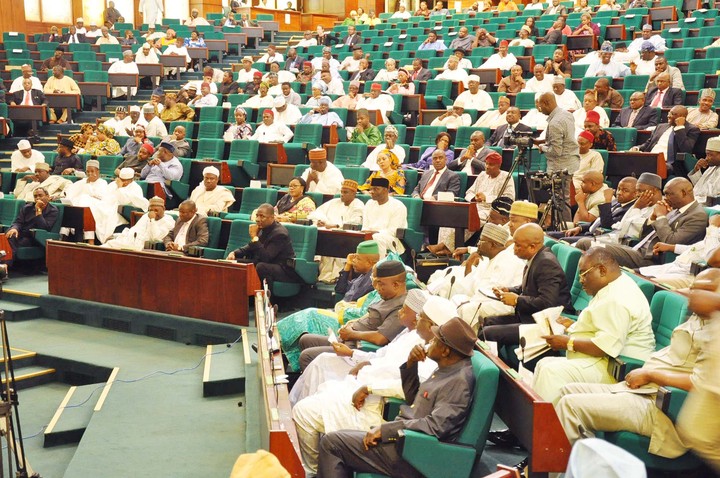
Reps Summon Emefiele Over Forex Allocation

By Modupe Gbadeyanka
Central Bank of Nigeria (CBN) Governor, Mr Godwin Emefiele, has been directed by the House of Representatives ad hoc committee on the review of price of petroleum to appear before it in person to answer some questions.
Mr Emefiele is needed to explain how the apex bank allocated foreign exchange to oil marketers for importation of petroleum products into the country from 2015 till date.
Giving the order on Monday, Chairman of the ad hoc committee, Mr Raphael Igbokwe, said the CBN governor must come along with details of all beneficiaries of forex allocation from 2015 to date including the banks that process the money.
He is also to come with criteria in accessing and allocating forex to the oil marketers.
The committee explained that Mr Emefiele was needed in person because his representative, Dr Alvan Ikokun, who is the bank’s Director of Financial Market Department, was not competent to answer the question.
The questioning comes as Nigeria Navy accused importers of diverting petroleum products meant for Nigeria to neighbouring countries and bring same back to the country because of multiple charges by government agencies.
The representative of Nigerian Navy, Director Marine at Naval Headquarters, Navy Commodore Preston Efedue, informed the lawmakers that, “I have asked the marketers one on one why they are discharging in Lome and not in Lagos, they said it was due to various charges being charged by the supervising agencies at the port are too numerous.”
But the committee said it was working towards ensuring that Nigerians are not paying more than what they ought to pay for the petroleum product.
Economy
Brent Falls Below $72 as Hormuz Shipping Reassures Oil Markets
By Adedapo Adesanya
Crude prices fell by more than 3 per cent on Friday as oil tankers kept exiting the Strait of Hormuz, easing supply concerns the day after a cargo vessel was hit near Oman.
Brent crude futures settled at $71.99 a barrel, down $3.27 or 4.34 per cent, while the US West Texas Intermediate (WTI) finished at $69.23 a barrel, down $2.69 or 3.74 per cent. Week-on-week, the Brent benchmark fell 10.86 per cent while the US WTI fell 9.62 per cent.
Prior to the agreement on a 60-day ceasefire, markets worried supplies would fall short of demand, but those fears seem to be passing.
Crude transits through the Strait of Hormuz rose to the highest weekly tally since the onset of the US-Iran conflict this week, with more than 16 million barrels passing through the waterway this Wednesday-Thursday, raising hopes of a full, gradual reopening.
This happened despite Iran firing at a Taiwanese cargo ship, raising fears that Hormuz transit could be choked off again. Iran’s IRG fired several drones at the Taiwan-owned Ever Lovely cargo ship, reportedly attempting to cross the Hormuz through “unauthorised routes,” damaging the vessel’s bridge some 7 miles off the Omani coast on Thursday.
The attack on the ship prompted the United Nations’ shipping agency to pause its voluntary evacuation scheme to enable hundreds of stranded ships and thousands of seafarers to sail out of the Gulf through the strait.
On Friday, Iran reasserted its right to control shipping through the Strait of Hormuz and warned Gulf states against siding with the US.
Many ships have been switching on their public automatic identification system (AIS) tracking transponders, but some may have gone undetected due in part to major disruption of AIS signals, as well as ships not showing their movements through the strait. That makes it difficult to estimate the complete volume of shipments.
Chinese crude oil imports this month are on course to book an even weaker month than May, according to Kpler data, which sees the daily average at just 6.4 million barrels.
According to media reports, Iraq has considered leaving the Organisation of the Petroleum Exporting Countries (OPEC) if the oil group does not allow it to significantly increase its crude production quotas, currently at 4.378 million barrels per day, a claim which the Iraqi Oil Ministry subsequently denied and called ‘premature’.
Economy
Odu’a Investment Eyes N1trn Asset Base by 2030, Posts N23.58bn Pre-Tax Profit
By Adedapo Adesanya
Odu’a Investment Company Limited has unveiled an ambitious plan to grow its asset base to N1 trillion by 2030, following a record financial performance that saw the conglomerate post a N23.58 billion Profit Before Tax (PBT) for the 2025 financial year.
The target was announced at the company’s 44th Annual General Meeting (AGM), held on Friday at the newly redeveloped Premier Hotel in Ibadan, where shareholders, representatives of the six South-West states and other stakeholders also witnessed the conclusion of the four-year tenure of the chairman, Mr Bimbo Ashiru.
Presenting the 2025 financial results, Mr Ashiru said the group had been strategically repositioned despite a challenging macroeconomic environment, laying a solid foundation for its long-term growth ambitions.
According to the results, operating revenue increased by 78 per cent to N20.22 billion from N11.34 billion recorded in 2024, while profit before tax surged by 410 per cent to N23.58 billion from N4.62 billion in the previous year.
The impressive earnings were largely driven by N18.81 billion in fair value gains on investment properties and strong gains from the bullish performance of the Nigerian Exchange (NGX), where it trades its stock.
Mr Ashiru described the year as one of significant strategic milestones that have permanently repositioned the investment group.
Among the highlights was the completion of the extensive redevelopment of the historic Premier Hotel, Ibadan, which was commissioned on the eve of the AGM and is expected to commence full operations in the fourth quarter of 2026.
The organisation also marked the 60th anniversary of Cocoa House in July 2025, reinforcing its commitment to preserving iconic assets while unlocking greater commercial value.
In another milestone, Agusto & Co. upgraded Odu’a Investment’s credit rating from A+ to Aa- with a stable outlook, reflecting the company’s improved financial discipline and treasury management.
Speaking at the AGM, the Managing Director, Mr Abdulrahman Yinusa, disclosed that the company has commenced the process of obtaining its first international credit rating from a leading global rating agency, adding that the move would enhance access to international debt capital markets and attract foreign direct investment as part of the group’s long-term growth strategy.
The company also presented its first fully consolidated financial statements, providing shareholders with a comprehensive view of the financial position of the holding company and all its subsidiaries.
The AGM also marked a leadership transition as Mr Ashiru completed his four-year tenure as Group Chairman.
In his valedictory address, he reflected on the transformation achieved between 2022 and 2026, noting that Odu’a Investment had evolved from being “asset rich, cash poor” into a strategy-driven organisation that is both asset and cash-rich.
He thanked the governors of the six South-West states, members of the Board, past and present Group Managing Directors, subsidiary boards and management, and staff for their support throughout his tenure.
Although stepping down as chairman, Mr Ashiru will remain on the board as a director until 2028, providing continuity as the group pursues its vision of building a N1 trillion asset portfolio by 2030.
Economy
Nigeria Accesses $1.5bn from UAE Lender’s $5bn Swap Deal
By Adedapo Adesanya
Nigeria has received the first tranche of its $5 billion derivatives financing arrangement with the First Abu Dhabi Bank (FAB), the United Arab Emirates’ largest lender.
According to a Bloomberg report published on Friday, the federal government drew about $1.5 billion over the past two weeks through a Total Return Swap (TRS) transaction with the lender.
The report stated that Nigeria will provide naira-denominated securities valued at 133.3 per cent of the loan amount as collateral for the transaction, while international financial institutions continue to express concerns about the risks associated with such derivative-based financing structures.
The financing is expected to support the government’s debt management strategy by replacing more expensive borrowings while helping finance the country’s fiscal deficit.
The first tranche is priced at 395 basis points above the Secured Overnight Financing Rate (SOFR), rising to SOFR plus 400 basis points thereafter.
The transaction further expands Nigeria’s financial relationship with First Abu Dhabi Bank, which had earlier provided about $1.2 billion to support the construction of a section of the ongoing Lagos-Calabar Coastal Highway.
The swap deal has come with much scrutiny from critics and international organisations. Recall that the International Monetary Fund (IMF), after a consultation visit, warned Nigeria against the deal, noting that such transactions are often opaque and complex.
“Our view is that the transactions in these types of structures carry risks. Usually they are opaque, so the terms are not always very transparent when we reviewed these instruments across countries,” according to the IMF’s mission chief in Nigeria, Mr Christian Ebeke.
Mr Ebeke said Nigeria could instead issue eurobonds to finance its deficits or other means to raise funding, including on concessional terms.
The Senate in April gave its approval to the agreement put forward by President Bola Tinubu, who said his administration intends to use proceeds from the total return swap to refinance expensive debt and pay for infrastructure.
-
Feature/OPED6 years agoDavos was Different this year
-
Travel/Tourism10 years ago
Lagos Seals Western Lodge Hotel In Ikorodu
-
Showbiz3 years agoEstranged Lover Releases Videos of Empress Njamah Bathing
-
Banking8 years agoSort Codes of GTBank Branches in Nigeria
-
Economy3 years agoSubsidy Removal: CNG at N130 Per Litre Cheaper Than Petrol—IPMAN
-
Banking3 years agoSort Codes of UBA Branches in Nigeria
-
Banking3 years agoFirst Bank Announces Planned Downtime
-
Sports3 years agoHighest Paid Nigerian Footballer – How Much Do Nigerian Footballers Earn