Connect with us

Economy

Residents Rush Lake Rice at Sale Centres

Published

on

By Modupe Gbadeyanka

Residents of Lagos State on Thursday besieged the various sale centres across the state to buy the much-anticipated LAKE Rice, with vast majority of the people lauding the initiative of government to introduce the commodity at a critical time of the Yuletide season.

LAKE Rice, which is locally produced, came into being following a partnership between Lagos and Kebbi States, and was aimed at ensuring food security as well as to showcase the ability of Nigeria to become a producing nation.

Governor Akinwunmi Ambode and his Kebbi State counterpart, Mr Atiku Bagudu had launched the rice on Wednesday in Lagos, describing the development as a great and historic moment not just for the two states but the country at large.

As promised by Lagos State government, the rice was sold for N12,000 per 50kg; N6000 for 25kg; and N2,500 for 10kg.

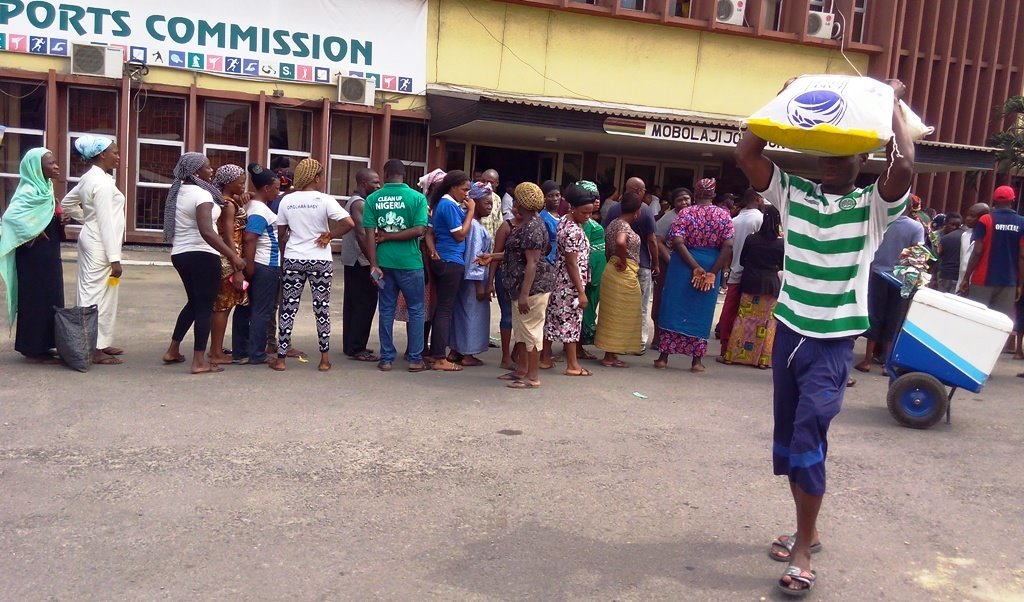
When our correspondent visited some of the designated centres listed for the sale of the rice, it was discovered that the commodity was available for sale with people queuing in an orderly manner and waiting for their turn to buy.

In Oshodi, residents had besieged the Ikeja Grammar School in Bolade, Oshodi, the selling point for the sale of the LAKE Rice.

Speaking to journalists shortly after successfully purchasing his bag of rice, a resident, Mr Alanran Muyideen Kehinde said he was glad to be among the first.

He also urged Lagosians to patronise LAKE Rice as a means to guard against the incident of purchasing adulterated rice.

“I feel very happy, I feel encouraged. I also thank the state government for giving us the opportunity because when we go outside, we know the cost of rice, but we thank the Lagos State Governor for this opportunity and we hope that more would be made available so that the process of purchasing would be easier.

“With the issue of plastic rice flooding the market, this is a safer option because we can trust the source,” he said.

Another resident, Mrs Alebiousu Olufunmilayo, said the cost of the LAKE Rice was pocket friendly.

“I will like to tell Lagosains that this is for real. If they get to any of the centres, they should queue orderly and they will get the rice,” she said.

At Mobolaji Johnson Sports Centre (Rowe Park) in Yaba, residents were seen queuing orderly to buy the commodity at government approved prices.

An elated resident, Mrs Alabi Aminat, who spoke to journalists after buying the product, said the development was a thing of joy, as there was no discrimination of any sort in the sale of the commodity.

“I got here this morning and I was told I could pay through the POS and I did. The process was free and fair and the most commendable aspect is that the people in charge of selling the rice are not particular about whether you work with Lagos State government or you belong to any tribe or creed, as long as you are a resident of the state, you are entitled to buy.

“I was allowed to buy one bag and I got 50kg at the N12,000 price earlier announced by the government. They just told us to stay on the queue and when it is your turn, you will be asked to pay and take away your rice. It’s as simple as that,” she said.

At the Teslim Balogun Stadium, there were complaints of late arrival of the commodity, but it was eventually sold in the afternoon.

Some residents however urged the government to sustain the sale of the rice beyond the yuletide season.


Modupe Gbadeyanka is a fast-rising journalist with Business Post Nigeria. Her passion for journalism is amazing. She is willing to learn more with a view to becoming one of the best pen-pushers in Nigeria. Her role models are the duo of CNN's Richard Quest and Christiane Amanpour.

Click to comment

Leave a Reply

Your email address will not be published. Required fields are marked *

Economy

DMO Allots N929.3bn to Investors in July FGN Bond Sales

Published

on

FGN Bonds

By Aduragbemi Omiyale

The Debt Management Office (DMO) on Monday allotted bonds worth N929.3 billion to investors from the N1.7 trillion bids it received from subscribers.

The exercise, which took place on Monday, July 20, 2026, was oversubscribed by market participants, reflecting the confidence investors have in the government’s ability to redeem the debt instrument on maturity.

On offer for sale for the July auction was N1.2 trillion worth of the FGN bonds, but the DMO allotted below this, despite receiving bids above the offer.

The papers were offered in 10-year, 15-year, and 20-year tenors, at N400 billion each.

For the decade-old note, investors staked N444.47 billion, but the debt office sold N245.73 billion at an 18.34 per cent coupon rate. For the one and a half-decade-old paper, bids valued at N518.00 billion were received by the DMO, with a non-competitive bid of N50.00 billion, with N302.13 billion allotted to investors at 18.40 per cent, and for the two-decade paper, the DMO got competitive bids of N665.19 billion and N381.46 billion was sold to bondholders at 18.35 per cent.

Continue Reading

Economy

Nigeria’s External Reserves Hit $52.5bn, Cover Nine Months of Imports

Published

on

Nigeria's external reserves

By Adedapo Adesanya

The Governor of the Central Bank of Nigeria (CBN), Mr Yemi Cardoso, disclosed that Nigeria’s external reserves had risen to $52.5 billion, enough to finance about nine months of imports.

He disclosed this on Tuesday at the end of the 306th meeting of the Monetary Policy Committee (MPC) held in Abuja, where the Monetary Policy Committee (MPC) retained the benchmark interest rate at 26.50 per cent as well as the standing facilities corridor at +50/-450 basis points around the MPR.

Similarly, the Cash Reserve Requirement (CRR) was maintained at 45 per cent for Deposit Money Banks, 16 per cent for Merchant Banks, and 75 per cent for non-Treasury Single Account (TSA) public sector deposits.

Speaking on FX developments, the central banker said at the $52 billion level, the country’s external reserves were significantly above the internationally recommended threshold of three months of import cover.

On the Naira exchange rate, Mr Cardoso said the foreign exchange market had deepened and was now operating on a transparent willing-buyer, willing-seller basis.

He said the apex bank remained committed to maintaining a liquid and functional foreign exchange market, adding that daily market turnover sometimes exceeded $1 billion.

According to him, the long-term stability of the naira would depend on key economic fundamentals, including increased oil exports, foreign direct investment, and improved domestic productivity to reduce dependence on imports.

He also added that the MPC welcomed the federal government’s renewed commitment to stronger policy coordination, particularly collaboration between fiscal and monetary authorities, which he said had helped reduce the impact of the Middle East crisis on the Nigerian economy.

Mr Cardoso said members of the committee also commended efforts to improve crude oil production and urged relevant agencies to intensify reforms in other sectors, including solid minerals, to boost government revenue.

On the regulatory forbearance granted to banks during the COVID-19 period, he reiterated that this had been discontinued because it had served its purpose.

According to him, the policy had “outlived its time” and was no longer necessary in assessing the health of the banking sector.

“Forbearance, we felt, had outlived its time. Many of you will recall this is something that came as a result of COVID. And now we are in 2026; we did not see the reason why that should continue to form part of the analysis of the banking system,” he said.

Mr Cardoso explained that banks had begun recalibrating their portfolios following the end of the policy, leading to a temporary reduction in outstanding risk assets.

He, however, assured that the development was part of a transition towards a stronger and more sustainable credit environment.

“It reflects a transition to a more sustainable and better quality credit environment, which is what we all want. We don’t want unanticipated shocks that come in a boom-and-bust fashion,” he said.

Continue Reading

Economy

FrieslandCampina Leads to NASD OTC Exchange to 1.17% Growth

Published

on

FrieslandCampina

By Adedapo Adesanya

The NASD Over-the-Counter (OTC) Securities Exchange extended its recent positive run by 1.17 per cent on Tuesday, July 21, triggered by appreciation seen in four bellwethers.

Leading the pack was FrieslandCampina Wamco Nigeria Plc, which added N12.00 to its value to close at N153.15 per share compared with the previous day’s N141.15 per share. NASD Plc appreciated by N1.90 to N36.00 per unit from N34.10 per unit, Food Concepts Plc improved by 23 Kobo to N2.48 per share from N2.25 per share, and Afriland Properties Plc grew by a marginal 1 Kobo to N15.01 per unit from N15.00 per unit.

As a result, the market capitalisation of the bourse increased by N30.40 billion to N2.637 trillion from Monday’s N2.606 trillion, and the NASD Security Index (NSI) gained 50.70 points to finish at 4,393.97 points, in contrast to the 4,343.27 points it ended a day earlier.

The unlisted securities exchange recorded a price loser yesterday, and it was Geo-Fluids Plc, which shed 1 Kobo to settle at N2.30 per share versus N2.31 per share.

During the trading day, the volume of securities traded by market participants on Tuesday dropped 99.4 per cent to 322,147 units from the previous day’s 52.6 million units, the value of securities dipped by 89.8 per cent to N19.4 million from the preceding session’s N191.2 million, and the number of deals contracted by 3.6 per cent to 27 deals from 28 deals.

Great Nigeria Insurance (GNI) Plc ended the day as the most traded stock by value on a year-to-date basis, with 3.4 billion units traded for N8.4 billion, followed by Infrastructure Credit Guarantee (Infracredit) Plc with 2.3 billion units transacted for N6.5 billion, and Central Securities Clearing System (CSCS) Plc with 75.4 million units exchanged for N5.3 billion.

GNI Plc also closed the day as the most traded stock by volume on a year-to-date basis, with 3.4 billion units worth N8.4 billion, followed by Infracredit Plc with 2.3 billion units valued at N6.5 billion, and Resourcery Plc with 1.1 billion units sold for N415.7 million.

Continue Reading