
Economy
Sachet Alcohol Ban: NECA Demands Respect for Due Process


By Adedapo Adesanya
The Nigeria Employers’ Consultative Association (NECA) has expressed concern over the renewed enforcement of a ban on the production and sale of alcoholic beverages in sachets and small PET bottles by the National Agency for Food and Drug Administration and Control (NAFDAC).
The group’s director general, Mr Wale-Smatt Oyerinde, warned that the action of the agency could have adverse economic and governance consequences.
NECA is the organisation expressing worry of this issue after the Manufacturers Association of Nigeria (MAN) raised concerns about it earlier this week.
Mr Oyerinde said the enforcement contradicts a directive from the Office of the Secretary to the Government of the Federation dated December 15, 2025, which suspended the ban, as well as a March 14, 2024 resolution of the House of Representatives calling for restraint and broader stakeholder engagement.
The NECA chief said the continued enforcement is already disrupting legitimate businesses, unsettling ongoing investments, and putting thousands of jobs at risk, while weakening confidence in Nigeria’s regulatory environment.
According to Mr Oyerinde, regulation should be based on evidence, proportionality and the rule of law. He noted that the affected products were tested, registered and periodically revalidated under NAFDAC’s regulatory procedures, with alcohol content clearly labelled in line with internationally recognised Alcohol by Volume standards.
He added that underage drinking is primarily an enforcement issue at the retail level rather than a packaging issue, and called for stricter licensing, monitoring, and sanctions for erring retailers rather than a blanket ban on certain product formats.
NECA boss also warned that sachet and small-pack formats reflect affordability realities for many adult consumers, and that eliminating them could push demand into informal, unregulated markets, increasing public health risks and shrinking the formal economy.
He further expressed concern that enforcement efforts are focused on a regulated segment of the beverage industry while more dangerous illicit narcotics and abused pharmaceuticals continue to circulate widely among young people.
On the economic impact, NECA said the wines and spirits value chain supports significant direct and indirect employment across manufacturing, packaging, distribution, transportation, retail and agriculture.
It cautioned that sudden regulatory actions could threaten livelihoods, reduce government revenue and undermine investor confidence.
Addressing environmental concerns, NECA said plastic waste issues should be tackled through improved waste management, recycling systems and extended producer responsibility frameworks, rather than selective product bans.









By Adedapo Adesanya
The Governor of the Central Bank of Nigeria (CBN), Mr Yemi Cardoso, has revealed that diaspora remittances into Nigeria have surged to $600 million monthly, tripling from previous levels and signalling renewed investor and market confidence.
Speaking at the recently held 2026 Monetary Policy Forum in Abuja, Mr Cardoso described the sharp increase as a key indicator of improving economic fundamentals driven by ongoing reforms.
“Diaspora remittances have risen from $200 million to $600 million monthly, with a target of $1 billion by end-2026,” he said at the gathering, linking the growth to improved foreign exchange policies and rising trust in the financial system.
“FX market confidence is improving, with verified backlogs cleared and parallel market premium below 2 per cent,” Mr Cardoso stated.
The CBN Governor emphasised that Nigeria’s economic recovery is being driven by coordinated policy actions across sectors.
“Macroeconomic stability in Nigeria is a shared responsibility requiring strong collaboration between fiscal authorities, banks, and the private sector,” he noted.
Mr Cardoso added that broader reforms are beginning to yield results, pointing to easing inflation and stronger fiscal discipline.
“Inflation is trending downward, reflecting disciplined and data-driven monetary policy,” he said.
He also highlighted a significant reduction in government reliance on central bank financing.
“Ways and Means advances declined from N26.95 trillion in 2023 to N2.84 trillion in 2026,” he disclosed.
According to him, Nigeria has “turned a corner” through tighter monetary policy, FX reforms, and banking sector recapitalisation.
Also speaking, the Minister of Finance, Mr Wale Edun, commended the alignment between fiscal and monetary authorities.
He praised the “strong fiscal-monetary policy coordination amongst stakeholders,” noting that such synergy is critical for sustaining growth.
The stronger remittances into the economy will help alleviate pressures in the FX market as well as make investments into the country attractive, as investors will be able to extract their funds, since they are not tied to stringent conditions.

By Adedapo Adesanya
The first trading session in April 2026 at the NASD Over-the-Counter (OTC) Securities Exchange ended on a negative note, with four securities inflicting a 0.91 per cent loss on the trading platform on Wednesday, April 1.
11 Plc led the losers’ chart after it went down by N28.50 to close at N256.50 per share compared with the previous day’s N285.00 per share, FrieslandCampina Wamco Nigeria Plc dropped N5.24 to trade at N92.81 per unit versus N98.05 per unit, Food Concepts Plc depreciated by 28 Kobo to N2.72 per share from N3.00 per share, and UBN Property Plc lost 22 Kobo to sell at N1.98 per unit versus Tuesday’s closing price of N2.20 per unit.
The losses posted by the securities weakened the NASD Unlisted Security Index (NSI) by 37.24 points to 4,062.87 points from 4,100.11 points, and depleted the market capitalisation by N22.28 billion to N2.430 trillion from N2.453 trillion.
Business Post reports that there were two price gainers yesterday, led by Central Securities Clearing System (CSCS) Plc, which rose by N1.51 to N80.00 per share from N78.68 per share, and Industrial and General Insurance (IGI) increased by 2 Kobo to 57 Kobo per unit versus 52 Kobo per unit.
During the session, the volume of transactions ballooned by 6,153.8 per cent to 3.2 billion units from 50.8 million units, and the value of trades surged by 3,533.5 per cent to N8.3 billion from N226.9 million, while the number of deals decreased by 38.8 per cent to 30 deals from 49 deals.
The bourse recorded a new most traded stock by value (year-to-date), which was Great Nigeria Insurance (GNI) Plc, recording a turnover of 3.2 billion units valued at N8.2 billion. CSCS Plc was pushed to the second spot with 56.9 million units exchanged for N3.9 billion, and Okitipupa Plc in third with 27.5 million units traded for N1.8 billion.
GNI Plc also ended the day as the most traded stock by volume (year-to-date) with 3.2 billion units worth N8.2 billion, Resourcery Plc moved to the next position with 1.1 billion units valued at N415.7 million, and Infrastructure Guarantee Credit Plc occupied the third spot with 400 million units sold for N1.2 billion.

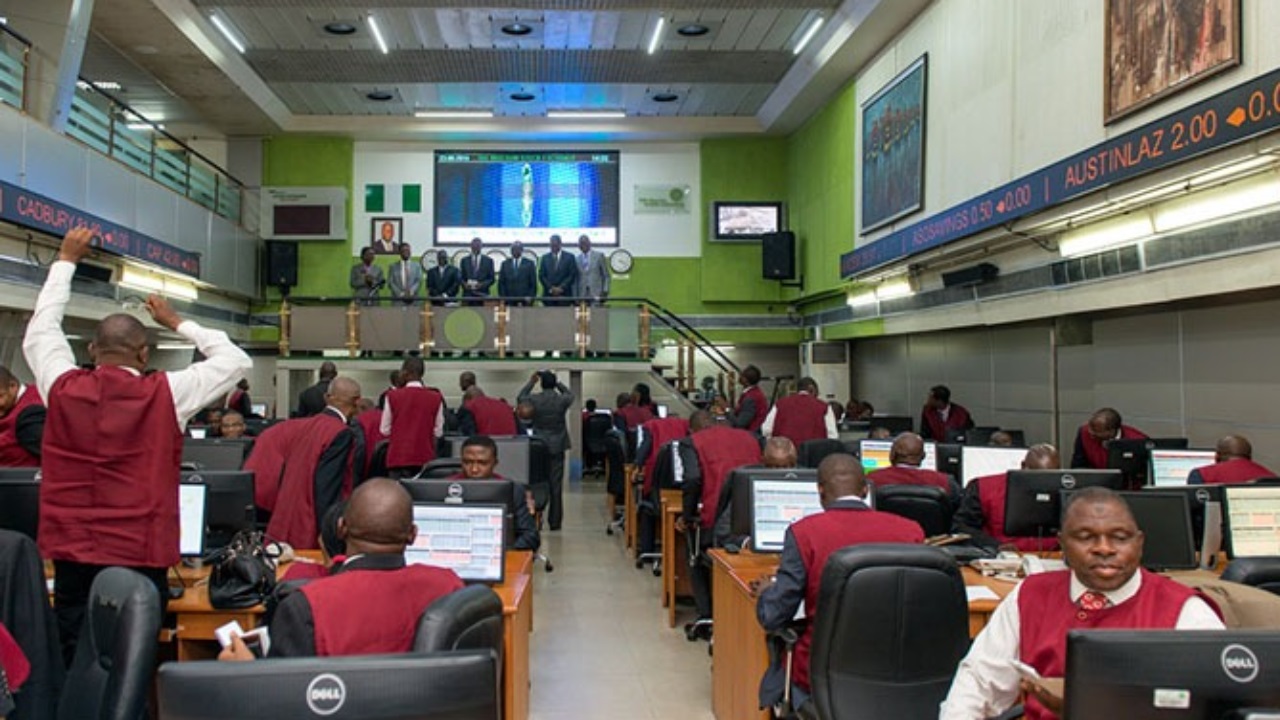
By Dipo Olowookere
The bulls refused to back down, tightening their grip on the Nigerian Exchange (NGX) Limited on Wednesday by 0.21 per cent despite bearish investor sentiment.
Data from the bourse showed that 27 price gainers and 40 price losers at midweek, representing a negative market breadth index.
The consumer goods index was down by 1.56 per cent, and the energy sector lost 0.05 per cent to profit-taking.
However, the banking space expanded by 3.21 per cent, the insurance counter improved by 0.23 per cent, and the industrial goods landscape grew by 0.01 per cent.
Consequently, the All-Share Index (ASI) chalked up 415.77 points to settle at 201,703.55 points compared with the previous session’s 201,287.78 points, and the market capitalisation went up by N599 billion to N129.809 trillion from N129.210 trillion.
UPDC REIT appreciated by 10.00 per cent to N7.70, International Energy Insurance grew by 9.91 per cent to N3.55, RT Briscoe expanded by 8.81 per cent to N10.50, Mutual Benefits improved by 7.58 per cent to N4.40, and Zenith Bank soared by 7.52 per cent to N103.00.
Conversely, Omatek lost 10.00 per cent to trade at N1.98, Nestle Nigeria also declined by 10.00 per cent to sell for N3,055.50, FTN Cocoa dropped 9.97 per cent to settle at N5.33, Chams dipped by 9.79 per cent to N3.96, and May and Baker slumped 9.74 per cent to N34.30.
Yesterday, investors transacted 815.5 million shares worth N33.3 billion in 52,641 deals compared with the 887.7 million shares valued at N35.6 billion traded in 53,436 deals on Tuesday, indicating a shortfall in the trading volume, value, and number of deals by 8.13 per cent, 6.46 per cent, and 1.49 per cent, respectively.
Wema Bank topped the activity chart with 77.8 million stocks sold for N2.0 billion, GTCO exchanged 73.7 million equities worth N9.0 billion, Access Holdings transacted 62.9 million shares valued at N1.6 billion, First Holdco traded 59.4 million equities for N3.0 billion, and Zenith Bank exchanged 49.7 million stocks valued at N5.2 billion.












-
 Feature/OPED6 years ago
Davos was Different this year
-
Travel/Tourism10 years ago
Lagos Seals Western Lodge Hotel In Ikorodu
-

 Showbiz3 years ago
Estranged Lover Releases Videos of Empress Njamah Bathing
-
 Banking8 years ago
Sort Codes of GTBank Branches in Nigeria
-

 Economy3 years ago
Subsidy Removal: CNG at N130 Per Litre Cheaper Than Petrol—IPMAN
-

 Banking3 years ago
Sort Codes of UBA Branches in Nigeria
-

 Banking3 years ago
First Bank Announces Planned Downtime
-

 Sports3 years ago
Highest Paid Nigerian Footballer – How Much Do Nigerian Footballers Earn