Economy
SEC, Others Working to Improve Nigeria’s Policy Environment to Attract Investors
By Aduragbemi Omiyale
The Securities and Exchange Commission (SEC) has said it was working hard with other agencies to improve Nigeria’s policy environment so as to make it more attractive to investors.
According to the Director-General of the agency, Mr Lamido Yuguda, efforts are being made to position the capital market as a viable platform for getting long-term funds for infrastructure development, among others.
He said working with a think-tank group like the Nigerian Economic Summit Group (NESG) could fast-track the development of effective policies that will drive economic growth.
“Our collective economic power is bigger than the government and in many countries, you find out that the capital market is actually funding the government.
“When you save, the finance is used to create economic value that actually enhances your standard of living and this is a win-win. You get financial returns and also get utility from the investments and this is actually achievable,” the DG said when a team from NESG visited him in Abuja at the weekend.
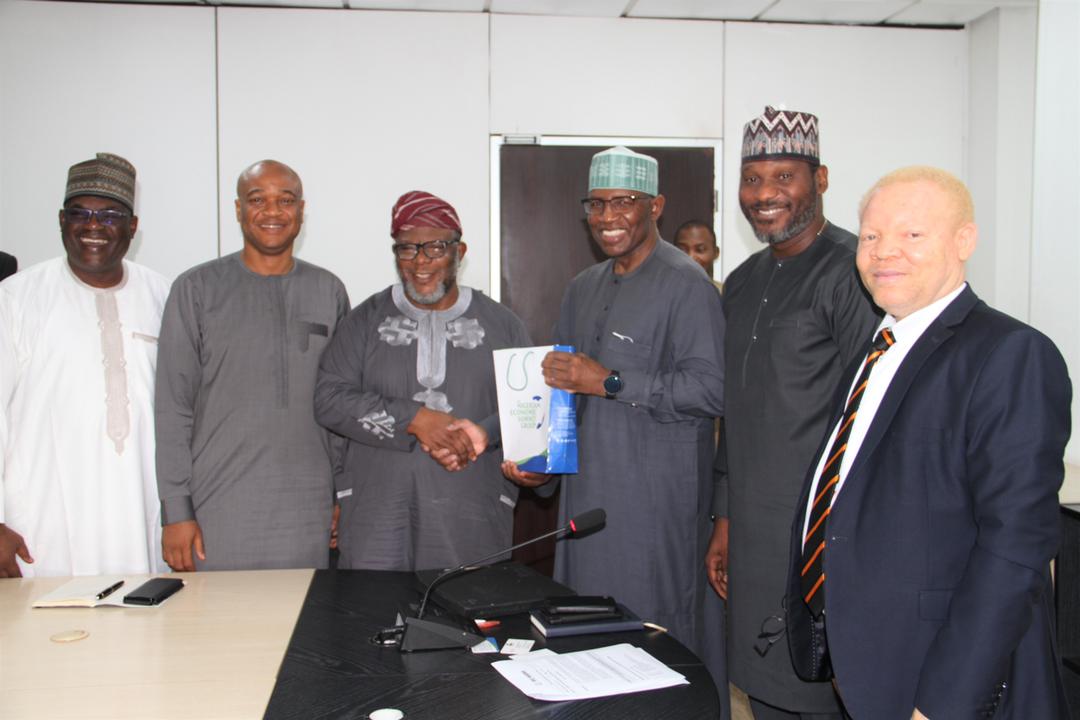
The organisation was at the commission’s office to seek collaboration towards the development of the economy, which Mr Yuguda was happy about.
“On the capital market, it is a welcome development that we are talking with the NESG for there is something that really needs to happen in this country.
“When you look at our policy environment, in many areas, it is not conducive for the return of capital to investors and we are working hard to tackle this,” the SEC DG noted.
He stated that the telecommunications companies are successful because no one is getting the services for free as everyone pays.
“We all pay for the services, no one is getting the services for free. But when we move on our roads, we say no we do not want to pay for it. In other countries, people pay for their roads and they are happy doing that because the roads are good.
“We need to have collaboration with a group like NESG. Once we are able to put things right, investors will be willing to put in money and there will be returns,” Mr Yuguda stated.
In his remarks, Chief Executive Officer of NESG, Mr Laoye Jaiyeola, expressed worry that the banking sector is being over-stressed by borrowers, urging the governments and corporates organisations to look towards the capital market for their funding needs.
Mr Jaiyeola stated that transactions can be restructured to raise bonds, bills and all of those things that will fund whatever it is that needs to be funded without going through banks.
“The securities market needs to take the bull by the horn otherwise we are going to be in perpetual debt as a Nation and that will not help us. That is one of the reasons we say let’s re-engage, how can we get an Investments and Securities Act that will ensure that the needed funding for development in Nigeria is given priority and then we can fund Nigeria for a longer-term.
“The short-term funding cannot help us; we need to begin to move to long-term. We are passionate about it and we need to raise these funds for the needed development funding for Nigeria,” he stated.
Responding to the call for a robust ISA, the Executive Commissioner for Legal and Enforcement at SEC, Mr Reginald Karawusa, stated that efforts are being made toward this.
According to him, the law was signed by late President Musa YarÁdua in 2007, which makes it 15 years old now. He said SEC set up an industry-wide committee to rework the law, adding that several market experts were involved in redrafting it with inputs from stakeholders.
“A draft was tabled to the 8th assembly. Unfortunately, the assembly left before passing the Bill. Getting the bill passed will be a major thing for the capital market.
“There are new provisions that will strengthen the SEC to effectively regulate to make us a top-notch regulator to increase the number of products.
“There is also a provision that will enable us to play with National Savings Scheme, which is another major gate changer if the Bill becomes passed. Therefore, any support we can get from the NESG will be appreciated,” he stated.
Economy
Dangote Refinery Targets $5bn in Landmark IPO Due in October
By Adedapo Adesanya
Dangote Petroleum Refinery is preparing to raise about $5 billion through an initial public offering (IPO) expected to conclude in October, in what could become the largest stock market listing in Africa’s history.
The company has already submitted an initial application to the Securities and Exchange Commission (SEC), with approval expected in the coming weeks. Once authorised, the refinery is expected to release its prospectus in September ahead of the public offer.
The primary listing will be on the Nigerian Exchange (NGX) Limited, although investors across Africa are expected to participate through structured investment instruments rather than a dual listing.
The proceeds will be used to expand the capacity of the 700,000-barrels-per-day refinery in Lagos and possibly support plans to replicate the project in Kenya as Dangote seeks to deepen Africa’s energy independence.
The proposed IPO comes after the refinery benefited from increased demand for refined products during the recent Iran conflict, supplying jet fuel across Africa and into Western Europe as global shortages disrupted markets.
As per Reuters, stock exchanges in South Africa, Kenya, Egypt, Ghana and Rwanda have held discussions with advisers to the transaction as interest in the offering continues to build across the continent.
Kenya alone could account for as much as $500 million of the targeted capital raise, driven largely by demand from institutional investors, including pension funds, the publication reported.
While the company is targeting a $5 billion raise, the final amount will depend on the outcome of the SEC’s review. If achieved, the offering would represent more than four per cent of the Nigerian Exchange’s current market capitalisation.
The IPO follows a $2.5 billion private placement completed last month, in which a six per cent stake in the refinery was sold, implying a valuation of about $40 billion.
That valuation, however, would place the refinery well above several listed global refining companies. Turkey’s Tupras, which operates a similar combined refining capacity across four facilities, has a market value of roughly $12 billion, while US-listed HF Sinclair, with a comparable processing capacity, is valued at around $16 billion.
Although the NGX generally requires companies on its main board to maintain a minimum free float of 20 per cent, there have been exceptions. Dangote Cement, for instance, currently has a free float of just over 12 per cent.
The publication also reported that investors outside Nigeria are likely to gain exposure through instruments such as global depositary receipts or exchange-traded products linked to the Nigerian-listed shares, rather than through a cross-listing on other African exchanges.
The founder of the 700,000-barrels-per-day capacity plant, Mr Aliko Dangote, said in April that the refinery aims to increase production capacity to 1.4 million barrels per day.
Mr Dangote is also pursuing plans to build another refinery in Lamu along Kenya’s coast in partnership with other East African governments, although it remains unclear whether part of the IPO proceeds will be allocated to that project valued at an estimated $17 billion.
Economy
NASD OTC Exchange Appreciates 0.89%
By Adedapo Adesanya
The NASD Over-the-Counter (OTC) Securities Exchange rallied by 0.89 per cent on Tuesday, August 4 amid renewed buying interest in unlisted stocks.
During the session, the market capitalisation added N24.07 billion to end at N2.739 trillion compared with Tuesday’s N2.715 trillion, while the NASD Security Index (NSI) gained 40.11 points to quote at 4,563.96 points compared with the preceding day’s 4,523.85 points.
The NASD OTC Exchange ended the trading session with two price losers and three gainers, led by Central Securities Clearing System (CSCS) Plc, which chalked up N7.80 to close at N119.80 per unit versus the previous session’s N112.00 per unit. Afriland Properties Plc increased its value by N1.27 to N23.95 per share from N22.68 per share, and Nitrox Industrial Gases Plc expanded by N1.15 to N21.15 per unit from N20.00 per unit.
On the flip side, FrieslandCampina Wamco Nigeria Plc slid by N8.64 to sell at N144.00 per share compared with the previous day’s N152.64 per share, and 11 Plc dipped by 1 Kobo to end at N225.00 per unit, in contrast to Monday’s closing price of N225.01 per unit.
Tuesday’s trading data showed that the volume of securities rose by 9.0 per cent to 1.6 million units from 1.5 million units, and the number of deals climbed by 6.5 per cent to 33 deals from 31 deals, while the value of securities dropped by 26.9 per cent to N47.6 million from N65.2 million.
At the close of trades, Great Nigeria Insurance (GNI) Plc remained the most traded stock by value on a year-to-date with 3.4 billion units worth N8.4 billion, followed by Infrastructure Credit Guarantee (Infracredit) Plc with 2.3 billion units valued at N6.5 billion, and CSCS Plc with 76.9 million units exchanged for N5.5 billion.
GNI Plc also closed the session as the most traded stock by volume on a year-to-date with 3.4 billion units transacted for N8.4 billion, followed by Infracredit Plc with 2.3 billion units sold for N6.5 billion, and Resourcery Plc with 1.1 billion units transacted for N415.7 million.
Economy
Nigerian Stocks Shed 0.38 per cent as Sell-Offs Persist
By Dipo Olowookere
A 0.38 per cent loss was suffered by Nigerian stocks on Tuesday on the back of continued selling pressure from investors embarking on profit-taking.
Data from the Nigerian Exchange (NGX) Limited showed that the contraction was influenced by the 1.78 per cent decline recorded by the insurance sector, the 0.24 per cent slip printed by the consumer goods index, and the 0.09 per cent drop posted by the energy space, offsetting the 0.75 per cent growth achieved by the banking sector and the 0.21 per cent growth recorded by the industrial goods segment.
Investor sentiment was weak during the trading day, as the bourse ended with 13 price gainers and 40 price losers, representing a negative market breadth index.
LivingTrust Mortgage depreciated by 10.00 per cent to N3.42, Multiverse also shed 10.00 per cent to N22.95, McNichols dropped 9.92 per cent to N5.45, Thomas Wyatt dipped by 9.87 per cent to N3.56, and Eterna lost 8.57 per cent to trade at N33.00.
On the flip side, AVA Capital improved by 9.94 per cent to N9.95, Livestock Feeds expanded by 9.71 per cent to N8.65, Neimeth increased by 8.43 per cent to N9.00, AIICO gained 3.47 per cent to settle at N4.18, and Oando grew by 3.30 per cent to N36.00.
A total of 1.6 billion equities valued at N28.7 billion exchanged hands in 54,160 deals yesterday versus the 923.0 million equities worth N37.9 billion traded in 72,544 deals on Monday, indicating a 73.35 per cent surge in the trading volume, a 24.27 per cent decline in the trading value, and a 25.34 per cent slip in the number of deals.
The busiest stock was Japaul, which transacted 904.4 million units for N2.7 billion. Sterling Holdings sold 54.0 million units valued at N431.9 million, FCMB exchanged 49.5 million units worth N545.9 million, Chams traded 44.9 million units for N199.2 million, and Neimeth sold 42.4 million units worth N327.8 million.
Business Post reports that the All-Share Index (ASI) gave up 927.70 points to 244,802.83 points from 245,730.53 points, and the market capitalisation receded by N599 billion to N158.016 trillion from N158.615 trillion.