

Economy
Senate Moves to Protect Local Retail Business Owners

By Adedapo Adesanya
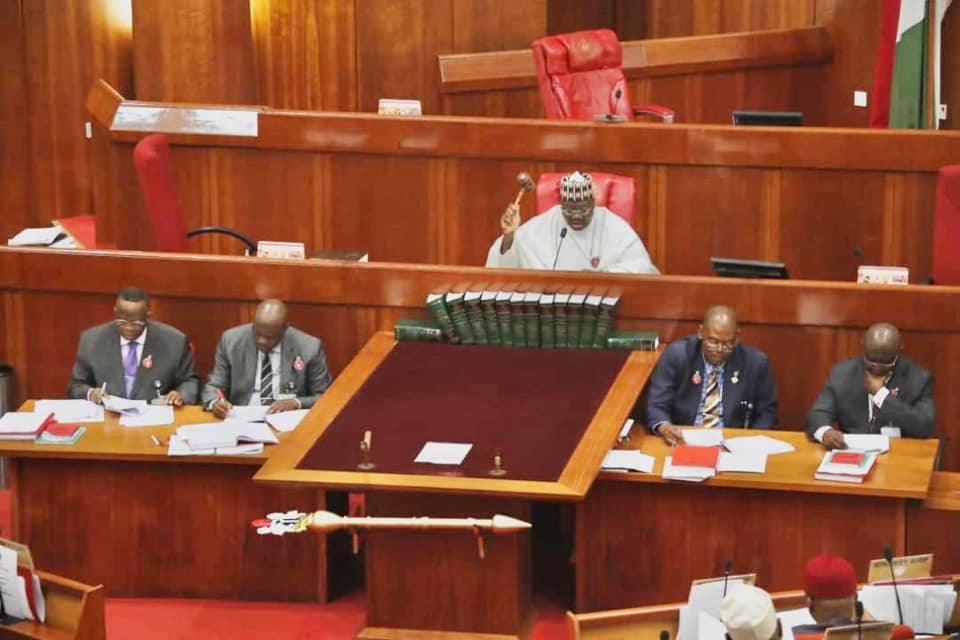
The Nigerian Senate has taken a step to protect local retail business owners, who are getting threatened by the dominance of foreigners.
To achieve this goal, the upper chamber of the National Assembly is reviewing the Indigenous Act and it has charged its Committee on Trade and Investment to look into the matter critically.
In addition, the red arm of the parliament said it will also review other extant policies and institute a legal framework that will provide incentives and protect indigenous retail business investors in the country’s organised sector.
The decision to take this step followed a motion by Senator Ifeanyi Ubah, which called the attention of the legislative arm of government to the “urgent need to investigate the economic and security implication of an unregulated Nigerian retail sector and consider appropriate legislative measures to incentivize and protect indigenous retail traders.”
The Senate called on governments at all levels to put in place acceptable measures to protect traditional or open markets retailers to avoid contravention of environmental and health safety standards, promote revenue collection and prevent harassment constant disruption of retail trade activities by government revenue collectors or environmental and health enforcement officers.
It further mandated its committee on Trade and Investment to engage the Ministry of Trade and investment and other relevant stakeholders with a view to receiving a briefing on the extant policy and legal framework on retail trade in Nigeria and the protection offered to indigenous retail investors and report back within two weeks.
The Senate also asked the committee to engage local retailers on ways to further protect their interests as well as invite foreign retailers to ascertain their legal status.
Mr Ubah in his lead debate noted that the Nigerian retail sector remains unregulated with dire economic and security implications.
He said the Chinese, Indians and Lebanese companies have taken over the retail business from indigenous retailers in markets like Balogun Market, Trade Fair, ASPAMDA, Alaba, Coker, Computer Village, Dei -Dei Market, among others.
He said the foreign investors have shifted from production and wholesaling to retailing, observing that since independence, Nigerian retail businesses have been offering employment to Nigerians and generating revenue to the government via taxes.
He further said many African countries, including ECOWAS member states, such as Ghana, have policies and legislative measures in place to offer minimum protection to indigenous retail traders.
He argued that extant policies and legal frameworks at both national and sub-regional levels do not offer any minimum protection to indigenous retail business operators.
He said the implication was that the organised retail business in Nigeria made up of multiple branch supermarkets, shopping malls were dominated by foreigners through their popular retail outlets.
He expressed concern that if measures were not taken via the enactment of extant protective laws and policies, foreigners may continue to dominate the sector.
Seconding the motion, Mr Francis Fadahunsi, while congratulating the sponsor of the motion, frowned at the domination of the nation’s retail markets by foreign investors saying that government has to take steps to check such anomaly.
The Senate in its further resolutions on the motion called on governments at all levels to put in place acceptable measures to protect traditional or open market retailers to avoid contravention of environmental and health safety standards.




By Dipo Olowookere
The presence of the bulls further strengthened the Nigerian Exchange (NGX) Limited on Tuesday, as the performance indices further gained 0.19 per cent.
The nation’s stock market survived profit-taking witnessed in the banking sector during the session, which crashed its index by 0.02 per cent.
This loss was offset by the gains recorded by the other sectors, with the insurance segment chalking up 0.49 per cent. The consumer goods space appreciated by 0.47 per cent, the industrial goods counter expanded by 0.04 per cent, and the energy sector rose by 0.03 per cent.
At the close of business, the All-Share Index (ASI) was elevated by 475.60 points to 246,659.56 points from 246,183.96 points, and the market capitalisation improved by N307 billion to N159.119 trillion from N158.812 trillion.
The market breadth index was positive yesterday after the bourse finished with 34 price gainers and 22 price losers, implying strong investor sentiment.
UPDC REIT grew by 9.86 per cent to N11.70, Thomas Wyatt advanced by 9.73 per cent to N3.72, Ikeja Hotel climbed 9.53 per cent to N46.55, The Initiates went up by 9.52 per cent to N33.95, and Neimeth increased by 9.47 per cent to N9.25.
Conversely, Mecure depreciated by 9.95 per cent to N76.95, Haldane McCall dropped 9.86 per cent to trade at N3.29, CMFC declined by 9.85 per cent to N3.02, Trans-Nationwide Express lost 9.68 per cent to close at N2.80, and Academy Press shrank by 9.38 per cent to N5.80.
The activity level was mixed during the session, as investors traded 932.5 million equities worth N49.3 billion in 50,059 deals versus the 851.6 million equities valued at N49.6 billion transacted in 56,873 deals a day earlier.
This showed that the trading volume soared by 9.50 per cent, the trading value moderated by 0.61 per cent, and the number of deals retreated by 11.98 per cent.
The busiest equity for the day was Access Holdings, which sold 336.6 million units for N8.7 billion. FCMB exchanged 88.8 million units worth N1.0 billion, First Holdco transacted 72.7 million units valued at N7.7 billion, Zenith Bank traded 37.4 million units for N4.4 billion, and UBA transacted 32.1 million units worth N1.5 billion.

By Aduragbemi Omiyale
Thirty-one companies on Tuesday emerged as winners of the 2025 licensing round of the Nigerian Upstream Petroleum Regulatory Commission (NUPRC).
The energy firms competed to take control of 50 oil and gas blocks put on offer by the Nigerian government.
They were among the 143 companies that submitted 200 bids for the oil facilities drawn from diverse terrains, including the Niger Delta Onshore, Niger Delta Shallow Water, Niger Delta Deep Offshore, Benin Basin Onshore, Anambra Basin Onshore, Chad Basin Onshore and Benue Trough.
Business Post gathered that investors, however, were only interested in 37 out of the 50 oil blocks put up for sale by the NUPRC. This is the first time in Nigeria’s energy history that frontier basins would attract such a level of investor interest.
The organisations that won the bids include SSonic Petroleum Limited (PPL 2A29), CFP Pipeline and Flowlines (2A30), Dutchford E&P Limited (2A32), Attabanson Global Company Limited (2A33 and PPL 901), Rosem Energy Limited (2A38), Pivot-GIS Limited (2A39), Network E&P (2A40), Asharami (2A41), LexOil (2A42), BVOF (2A43), GupscoEnergy Limited (2A44 and 2A51), Saratoga (2A45), Volante (2A46), Concept-Reel Petroleum Services Limited (2A47 and 2A55), Clinton Oil Field (2A48 and 2A62) and Nuway Oaklane Limited (2A49).
Others are Ramec (2A50), Italia (2A53), Blueridge E&P (2A54), Up Energies Limited (2A56), AYM Shafa (2A57), Blackrock Holdings Limited (2A58), Funtay Integrated Business Limited (2A59), Riparian Development and Production Limited (2A60), Nikstallis (2A61 and PPL 900), Stardeep Petroleum (PPL 2010), Dakoda & U Limited (PPL308 and PPL 800), Southborne Oil and Gas Limited (PPL 902), Lanaka Petroleum (PPL 903) HighbanResources Limited (PPL 700), Eyre Energy Limited (PPL 801).

By Adedapo Adesanya
Oil prices rose roughly 2 per cent on Tuesday as investors reacted to mounting concerns that escalating hostilities between the United States and Iran and threats by Yemen’s Houthis to blockade Saudi Arabia could disrupt global energy supplies.
Brent futures rose $1.79 or 2.0 per cent to $91.01 a barrel, while the US West Texas Intermediate (WTI) crude gained $1.68 or 2.0 per cent to settle at $84.91 per barrel.
US forces bombed targets in the south and west of Iran while Iran targeted American sites in Bahrain, Kuwait and Jordan and at least one tanker was hit in the Strait of Hormuz.
Supply concerns resurfaced with the Strait essentially closed again and tanker traffic at multi-month lows, to the level from before the ceasefire between the US and Iran, which appears to be over at the moment.
Prices could go much higher if the renewed conflict drags on for a few more months, as the world has now drained a lot of the buffers that had kept oil surges in check between March and May.
Drained strategic and commercial inventories in many key oil-consuming economies, including the US, are setting the stage for further oil price rallies during the busiest oil demand season.
The just-declared Houthi blockade on Saudi maritime shipping has already begun to witness ill-effects, as reports emerge of two oil tankers having made U-turns while initially en route toward the Suez Canal. It was reported that their crews received threats from Houthi militants in Yemen.
The two oil tankers, which loaded Saudi crude for China and India, made U-turns in the Red Sea and headed toward the Suez following the warning from the militia.
Meanwhile, Kuwait’s power and desalination plants caught fire for a second straight day as US and Iran traded strikes for a tenth day.
As Russia’s war with Ukraine expands beyond Ukraine’s borders, the Caspian Pipeline Consortium (CPC) has stopped receiving oil from Kazakhstan after suspending loadings on Monday due to attacks on oil tankers at its Black Sea terminal.
