Economy
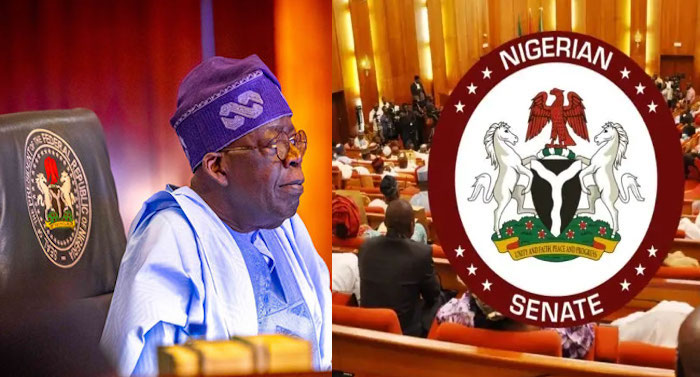
Senate Okays Tinubu’s N1.15tn Domestic Loan for 2025 Budget Deficit
By Adedapo Adesanya
The Senate has approved President Bola Tinubu’s request to raise N1.15 trillion from the domestic debt market to cover the deficit in the country’s 2025 budget.
The approval followed the adoption of a report by the Senate Committee on Local and Foreign Debt during plenary on Wednesday.
The committee noted that the 2025 Appropriation Act provides for a total expenditure of N59.99 trillion, an increase of N5.25 trillion over the initial N54.74 trillion proposed by the Executive.
This expansion created a total budget deficit of N14.10 trillion, of which N12.95 trillion had already been approved for borrowing, leaving an unfunded deficit of approximately N1.15 trillion (N1,147,462,863,321).
Last week (November 4), President Tinubu formally wrote to the lawmakers requesting a fresh N1.15 trillion in borrowing for the 2025 fiscal year, with a month left for the year to end.
He stated that it would bridge the funding gap and ensure full implementation of government programs and projects under the 2025 fiscal plan.
In a related development, a motion by Mr Abdul Ningi was adopted, directing the Senate Committee on Appropriations to intensify oversight to ensure that the borrowed funds are properly implemented and used strictly for their intended purposes.
This follows approval by the Senate and the House of Representatives approved to obtain $2.347 billion in fresh foreign loans, including a $500 million debut Sovereign Sukuk, to finance part of the 2025 budget deficit and refinance Nigeria’s maturing Eurobonds.
Last week, the $2.25 billion Eurobond was oversubscribed by 470 per cent with investors taking advantage of positive signals in the Nigerian economy.
Regardless of this, there is mounting public concern over Nigeria’s rising debt stock, which has climbed to over N152.40 trillion ($99 billion) as of mid-2025, according to figures from the Debt Management Office (DMO).
The federal government alone accounts for over 92 per cent of Nigeria’s public debt at N141.08 trillion, with N64.49 trillion as external debt and N76.59 trillion as local debt. States account for 7.4 per cent at N11.32 trillion as per the debt office.
Economy
FrieslandCampina Wamco, CSCS Lift NASD OTC Market by 1.05%
By Adedapo Adesanya
The duo of FrieslandCampina Wamco Nigeria Plc and the Central Securities Clearing System (CSCS) Plc boosted the NASD Over-the-Counter (OTC) Securities Exchange by 1.05 per cent on Monday, May 11.
FrieslandCampina Wamco added N13.07 to sell N146.00 per share versus the previous price of N132.98 per share, and CSCS Plc rose by 10 Kobo to close at N76.00 per unit compared with last Friday’s N75.90 per unit.
As a result, the market capitalisation increased by N26.20 billion to N2.514 trillion from N2.488 trillion, and the NASD Unlisted Security Index (NSI) went up by 48.80 points to 4,202.57 points from 4,158.77 points.
The volume of securities bought and sold by market participants decreased by 55.2 per cent yesterday to 236,921 units from 528,891 units, the value of securities slid by 51.5 per cent to N16.5 million from N34.0 million, and the number of deals contracted by 20 per cent to 20 deals from 25 deals.
Great Nigeria Insurance (GNI) Plc ended the day as the most traded stock by value on a year-to-date basis, with 3.4 billion units traded for N8.4 billion, followed by CSCS Plc with 60.5 million units exchanged for N4.1 billion, and Okitipupa Plc with 27.8 million units transacted for N1.9 billion.
GNI Plc also closed the session as the most traded stock by volume on a year-to-date basis with 3.4 billion units worth N8.4 billion, followed by Resourcery Plc with 1.1 billion units valued at N415.7 million, and Infrastructure Guarantee Credit Plc with 400 million units sold for N1.2 billion.
Economy
FX Pressure Weakens Naira to N1,373/$ at Official Market
By Adedapo Adesanya
The Naira opened the week on a negative note on Monday after it depreciated against the US Dollar in the Nigerian Autonomous Foreign Exchange Market (NAFEX) by 0.86 per cent or N11.77 to sell for N1,373.16/$1 compared with the preceding session’s value of N1,361.39/$1.
It also weakened against the Pound Sterling in the official market during the session by N17.39 to quote at N1,871.07/£1 versus last Friday’s rate of N1,853.68/£1, and against the Euro, it slumped by N15.78 to close at N1,618.41/€1 versus N1,602.63/€1.
At the black market, the Nigerian currency lost N5 against the Dollar yesterday, settling at N1,385/$1 compared with the previous rate of N1,380/$1. At the GTBank forex desk, it depreciated by N3 to sell at N1,375/$1 compared with the previous value of N1,372/$1.
Nigeria’s external reserves have fallen below $48.4 billion as of May 8, driven by interventions and external obligations by the Central Bank of Nigeria (CBN). In the first three weeks of April, the country’s FX reserves lost about $731 million.
Softer liquidity conditions have also dampened foreign investors’ appetite, with data from the FMDQ Securities Exchange showing that total foreign exchange inflows declined by 30.1 per cent month-on-month to $2.86 billion in April from $4.09 billion in March. Out of this, foreign inflows weakened by 21.9 per cent to $1.63 billion from $2.09 billion in March.
As for the cryptocurrency market, prices were largely up as global equity markets and other risk assets came under pressure. Rising oil prices, higher treasury yields and renewed US-Iran tensions, along with a key inflation report from the world’s largest economy due on Tuesday, applied pressure.
Binance Coin (BNB) jumped 1.5 per cent to $662.80, Solana (SOL) appreciated by 0.9 per cent to $96.63, Dogecoin (DOGE) added 0.7 per cent to close at $0.1104, Bitcoin (BTC) improved by 0.5 per cent to $81,221.78, and Ripple (XRP) gained 0.5 per cent to sell at $1.46.
On the flip side, Ethereum (ETH) went down by 0.9 per cent to $2,310.49, Cardano (ADA) weakened by 0.4 per cent to $0.2776, and TRON (TRX) slid by 0.3 per cent to $0.3487, the US Dollar Tether (USDT) and the US Dollar Coin (USDC) closed flat at $1.00 each.
Economy
Crude Oil Prices Climb 2% as Middle East Ceasefire Prospects Fade
By Adedapo Adesanya
Crude oil prices rose more than 2 per cent on Monday after US President Donald Trump said the ceasefire with Iran was “on life support,” leaving the Strait of Hormuz largely closed with no clear end in sight to the war.
Brent crude futures went up by $2.92 or 2.88 per cent to $104.21 a barrel, while the US West Texas Intermediate (WTI) crude futures increased by $2.65 or 2.78 per cent to settle at $98.07 a barrel.
President Trump on Monday said the ceasefire with Iran was “on life support,” after dismissing Iran’s response to a US peace proposal as “stupid.”
This came after the US floated a proposal aimed at reopening negotiations with Iran. The Middle East country on Sunday released a response focused on ending the war on all fronts, including one where America’s top ally, Israel, is fighting Iran-backed Hezbollah militants.
Iran also demanded compensation for war damage, emphasised its sovereignty over the strait, and called on the US to end its naval blockade, guarantee no further attacks, lift sanctions and remove a ban on Iranian oil sales.
After this, President Trump dismissed the offer in a social media post as “totally unacceptable.”
He also emphasised that the US continues to monitor Iran’s enriched uranium stockpiles via Space Force surveillance and warned of further strikes if a real end to the nuclear issue is not reached.
The war has impacted oil output by the Organisation of the Petroleum Exporting Countries (OPEC) as it declined to its lowest level since 2000, with production falling by 830,000 barrels per day to an average of 20.04 million barrels per day in April, according to a Reuters survey published Monday.
Kuwait, Saudi Arabia, and Iraq all saw significant output decreases as they were forced to shut in production due to the war, which started in late February.
The United Arab Emirates (UAE) was the only Gulf member that was able to increase production in April. The UAE was able to leverage the Fujairah terminal on the Gulf of Oman to bypass the bottleneck, allowing it to export more crude than its peers. The Emirate is targeting a production capacity of 5 million barrels per day by 2027 after it exited OPEC and OPEC+ this month.
-
Feature/OPED6 years agoDavos was Different this year
-
Travel/Tourism10 years ago
Lagos Seals Western Lodge Hotel In Ikorodu
-
Showbiz3 years agoEstranged Lover Releases Videos of Empress Njamah Bathing
-
Banking8 years agoSort Codes of GTBank Branches in Nigeria
-
Economy3 years agoSubsidy Removal: CNG at N130 Per Litre Cheaper Than Petrol—IPMAN
-
Banking3 years agoSort Codes of UBA Branches in Nigeria
-
Banking3 years agoFirst Bank Announces Planned Downtime
-
Sports3 years agoHighest Paid Nigerian Footballer – How Much Do Nigerian Footballers Earn