Economy
Setback for Nigeria’s 2025 Revenue Projection as Brent Now $60 Per Barrel
By Adedapo Adesanya
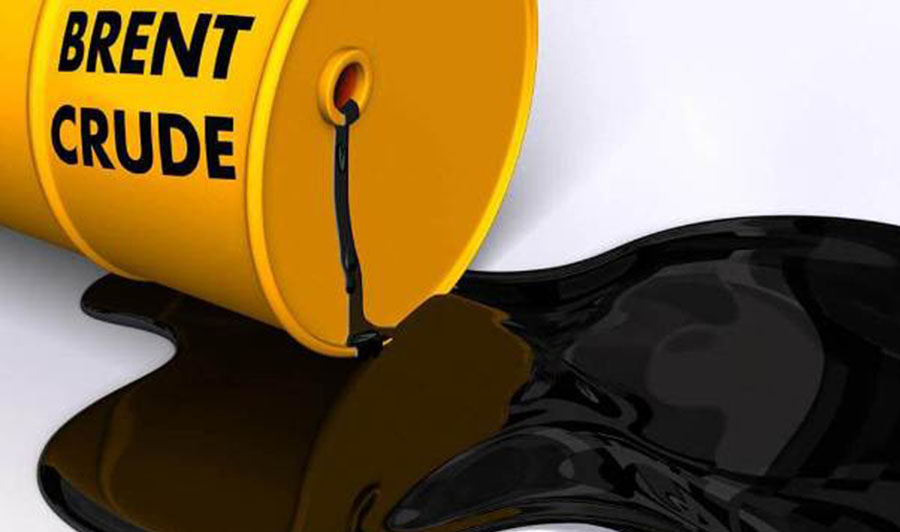
The latest signals from the global crude oil market suggest a rocky road for Nigeria’s 2025 budget as Brent oil price falls to $60 per barrel over a United States-triggered trade war.
Last Thursday, US President Donald Trump announced higher-than-expected tariffs across the board, with tariffs on China the highest. Nigeria, which exports a limited number of goods to the US, including crude oil, was hit with a 14 per cent increase in tariffs.
Since then, President Trump has announced additional tariffs on China, which are 104 per cent as of Wednesday, April 9, the day that the tariffs on all other countries, including the members of the EU, took effect.
China, on Wednesday, hit back at the 104 per cent US tariffs and hiked additional duties on American products to 84 per cent. The Asian country vowed to continue responding to Mr Trump’s tariffs as investors now see a trade war and recession as almost unavoidable.
The global markets have reacted with oil plummeting amid concerns of a recession and reduced demand for oil.
Nigeria is not exempt as it faces a higher shortfall from revenues amid dwindling oil prices, a development that will make it difficult to back the N54.99 trillion budget.
In the budget, the oil price benchmark was put at $75 per barrel with a crude production target of 2.06 million barrels and an exchange rate projection of N1,400 per Dollar.
Analysts expressed concerns regarding the feasibility of these assumptions – particularly the oil production target which currently stands around 1.5 million barrels per day and exchange rate around N1,600 per Dollar.
Calculations show that based on current realities, at the current $60 per barrel, Nigeria daily deficit will fall to around N85 billion even at an exchange rate of N1,400 based on the 2025 budget assumptions.
This will likely impact the revenue that will be remitted as the entire revenue doesn’t go into the coffers of the Nigerian government which receives only taxes and royalties and get other revenues from flaring penalties and Production Sharing Contract (PSC) profits.
Over the weekend, the Central Bank of Nigeria (CBN) admitted that oil prices had weakened to around $65 at the time and noted that this presented challenge to oil exporters like Nigeria.
“Crude oil prices have also weakened – declining by over 12% to approximately US$65.50 per barrel – presenting new dynamics for oil-exporting countries such as Nigeria,” the CBN statement added.
In light of this development, with prices now weaker, financing Nigeria’s budget will one of President Bola Tinubu’s pressing challenges.
Economy
Dangote Raises Investment in Ethiopia to $4bn, Promises Food Security
By Modupe Gbadeyanka
Nigerian businessman, Mr Aliko Dangote, has increased his investment in Ethiopia to over $4 billion from $2.5 billion.
During a high-profile visit hosted by Prime Minister Abiy Ahmed, the business mogul informed newsmen in Gode, in Ethiopia’s Somali region, that the expanded scope includes critical infrastructure such as a 110-kilometre pipeline, a 120MW power plant, a polypropylene packaging facility, and a two-million-tonne NPK blending plant, among other new components.
The richest man in Africa described Ethiopia as a key strategic destination for Dangote Group’s long-term investments.
“In total, our declared and signed investments in Ethiopia now exceed $4 billion. This makes Ethiopia the second-largest recipient of our investments in Africa, accounting for nearly nine per cent of our continental outlay between now and 2030,” he said.
He also reaffirmed his commitment to boosting food security across Africa through large-scale fertiliser investments, declaring that the continent has the capacity to feed itself and become a net exporter of agricultural products.
Speaking on the strategic importance of fertiliser in agricultural productivity, Mr Dangote noted that Africa’s food insecurity challenges are largely due to limited access to key inputs.
Africa holds immense agricultural potential, yet continues to grapple with food insecurity due to limited access to fertiliser. Through our investments, we are committed to reversing this trend by boosting productivity, empowering farmers, and advancing a sustainable path to food self-sufficiency,” he stated as he was accompanied to inspect the site of the proposed fertiliser plant, where construction activities are already underway.
He added that his organisation’s ambition, though bold, is achievable with sustained investment in fertiliser production and agricultural infrastructure.
“Africa has the capacity to feed itself and even export to the rest of the world. Our fertiliser investments across the continent are designed to unlock that potential and secure a prosperous future for our people,” Mr Dangote noted.
He further commended Prime Minister Abiy Ahmed’s leadership and vision for economic transformation, saying he is “driving development beyond expectations, but such progress requires strong private sector collaboration. We are proud to partner with Ethiopia to help build one of Africa’s most dynamic economies in the coming decade.”
In his remarks, Mr Ahmed described his guest as a trusted partner and commended the pace of work on the fertiliser project, which he said aligns with Ethiopia’s broader development priorities.
He emphasised that the project would significantly boost domestic fertiliser production, reduce dependence on imports, and provide critical support to millions of Ethiopian farmers.
According to the Prime Minister, the fertiliser plant will also create extensive employment opportunities, strengthen the industrial value chain, and reinforce Ethiopia’s position as an emerging agro-industrial hub in Africa.
“This type of large-scale investment demonstrates the power of strong collaboration between government and the private sector,” he said. “Expanding such partnerships will accelerate economic growth, attract further investment, and improve the livelihoods of our people.”
The Dangote fertiliser initiative is widely seen as a transformative step toward reshaping Africa’s agricultural landscape, with the potential to enhance productivity, reduce import dependence, and drive inclusive economic growth across the continent.
Economy
FrieslandCampina Wamco, Three Others Raise NASD OTC Exchange by 1.41%
By Adedapo Adesanya
The NASD Over-the-Counter (OTC) Securities Exchange closed higher by 1.41 per cent on Friday, May 15, supported by four securities on the platform.
During the session, FrieslandCampina Wamco Plc added N14.24 to its share price to sell for N159.00 per unit, in contrast to the previous day’s N144.76 per unit.
Further, Central Securities and Clearing System (CSCS) Plc appreciated by N1.34 to N72.34 per share from N71.00 per share, Geo-Fluids Plc improved its price by 4 Kobo to N2.94 per unit from N2.90 per unit, and Industrial and General Insurance (IGI) Plc gained 1 Kobo to trade at 61 Kobo per share compared with Thursday’s closing price of 60 Kobo per share.
As a result, the NASD Unlisted Security Index (NSI) rose by 58.20 points to 4,188.41 points from 4,130.21 points, and the market capitalisation soared by N34.82 billion to N2.506 trillion from N2.471 trillion on Thursday.
During the session, the volume of trades went up by 180.8 per cent to 1.2 million units from 417,349 units, and the value of transactions increased by 29.8 per cent to N29.8 million from N23.2 million, while the number of deals fell by 22.6 per cent to 24 deals from 31 deals.
Great Nigeria Insurance (GNI) Plc ended the day as the most traded stock by value on a year-to-date basis with 3.4 billion units sold for N8.4 billion, followed by CSCS Plc with 60.8 million units exchanged for N4.1 billion, and Okitipupa Plc with 27.9 million units valued at N1.9 billion.
GNI Plc also closed the session as the most traded stock by volume on a year-to-date basis with 3.4 billion units worth N8.4 billion, followed by Resourcery Plc with 1.1 billion units transacted for N415.7 million, and Infrastructure Guarantee Credit Plc with 400 million units traded for N1.2 billion.
Economy
Profit-taking Sinks Nigeria’s Equity Market by 0.76% as Bears Take Control
By Dipo Olowookere
The bears overpowered the Nigerian Exchange (NGX) Limited on Friday, sinking it further by 0.76 per cent when the closing gong was struck by 4 pm.
The nation’s flagship equity market was under selling pressure during the session, as investors booked profits after the shares witnessed price appreciation in the past trading sessions.
The energy sector was the most impacted, as it shed 4.43 per cent. The consumer goods index declined by 0.90 per cent, the banking counter decreased by 0.15 per cent, and the industrial goods sector lost 0.08 per cent, while the insurance counter gained 2.42 per cent, which was not enough to salvage the situation.
Consequently, the All-Share Index (ASI) contracted by 1,912.19 points to 250,330.92 points from 252,243.11 points, and the market capitalisation moderated by 1.225 trillion to N160.444 trillion from N161.669 trillion.
Zichis was the worst-performing stock for the session after it gave up 9.97 per cent to close at N29.43, FTN Cocoa slipped by 9.95 per cent to N8.96, The Initiates slumped by 9.90 per cent to N32.30, LivingTrust Mortgage Bank tumbled by 9.88 per cent to N3.83, and International Energy Insurance dropped 9.71 per cent to trade at N2.79.
The best-performing stock was ABC Transport, which grew by 10.00 per cent to N6.27. May and Baker also appreciated by 10.00 per cent to N47.30, SCOA Nigeria surged by 9.98 per cent to N33.05, Trans-Nationwide Express expanded by 9.97 per cent to N7.06, and DAAR Communications jumped 9.76 per cent to N2.25.
Yesterday, investors traded 1.1 billion shares worth N44.3 billion in 65,744 deals compared with the 1.0 billion shares valued at N41.6 billion transacted in 74,822 deals a day earlier. This indicated a dip in the number of deals by 12.13 per cent, and a rise in the trading volume and value by 10.00 per cent and 6.49 per cent, respectively.
Chams was the busiest equity for the day, with 328.5 million units sold for N1.1 billion. UBA traded 61.6 million units worth N2.7 billion, First Holdco transacted 58.7 million units valued at N4.2 billion, Secure Electronic Technology exchanged 51.9 million units worth N45.0 million, and Access Holdings traded 51.8 million units valued at N1.3 billion.
-
Feature/OPED6 years agoDavos was Different this year
-
Travel/Tourism10 years ago
Lagos Seals Western Lodge Hotel In Ikorodu
-
Showbiz3 years agoEstranged Lover Releases Videos of Empress Njamah Bathing
-
Banking8 years agoSort Codes of GTBank Branches in Nigeria
-
Economy3 years agoSubsidy Removal: CNG at N130 Per Litre Cheaper Than Petrol—IPMAN
-
Banking3 years agoSort Codes of UBA Branches in Nigeria
-
Banking3 years agoFirst Bank Announces Planned Downtime
-
Sports3 years agoHighest Paid Nigerian Footballer – How Much Do Nigerian Footballers Earn