
Economy
Shell Gives Nigerian Offshore Gas Deal to Halliburton

By Adedapo Adesanya
Shell Nigeria Exploration and Production Company has given US-based Halliburton an integrated drilling contract to work on the oil major’s $2 billion shallow-water HI offshore gas project in Nigeria.
According to reports, the financial terms of the deal, awarded by Shell, were not disclosed.
Halliburton, based in Houston, said it will deploy remote operations and automated technologies for the work.
In October, Shell announced HI, located in Nigeria’s Oil Mining Licence (OML) 144. The UK major operates the HI project with a 40 per cent working interest alongside its local partner, Sunlink Energies and Resources, which owns a 60 per cent stake.
The project, when completed, will supply 350 million standard cubic feet (approximately 60 thousand barrels of oil equivalent) of gas per day at peak production to Nigeria LNG (NLNG; Shell interest 25.6 per cent), which produces and exports liquefied natural gas (LNG) to global markets.
According to a statement, production is expected to begin before the end of this decade.
At the time of the announcement, Mr Peter Costello, Shell’s Upstream President, said that “This Upstream project will help Shell grow our leading Integrated Gas portfolio, while supporting Nigeria’s plans to become a more significant player in the global LNG market.”
The gas will be sent to the delayed Train 7 of the Nigeria Liquefied Natural Gas (NLNG) plant, currently being built by a Saipem-led consortium.
The increase in feedstock to NLNG, via the Train 7 project that aims to expand the Bonny Island terminal’s production capacity, is in line with Shell’s plans to grow its global LNG volumes by an average of 4-5 per cent per year until 2030.






By Adedapo Adesanya
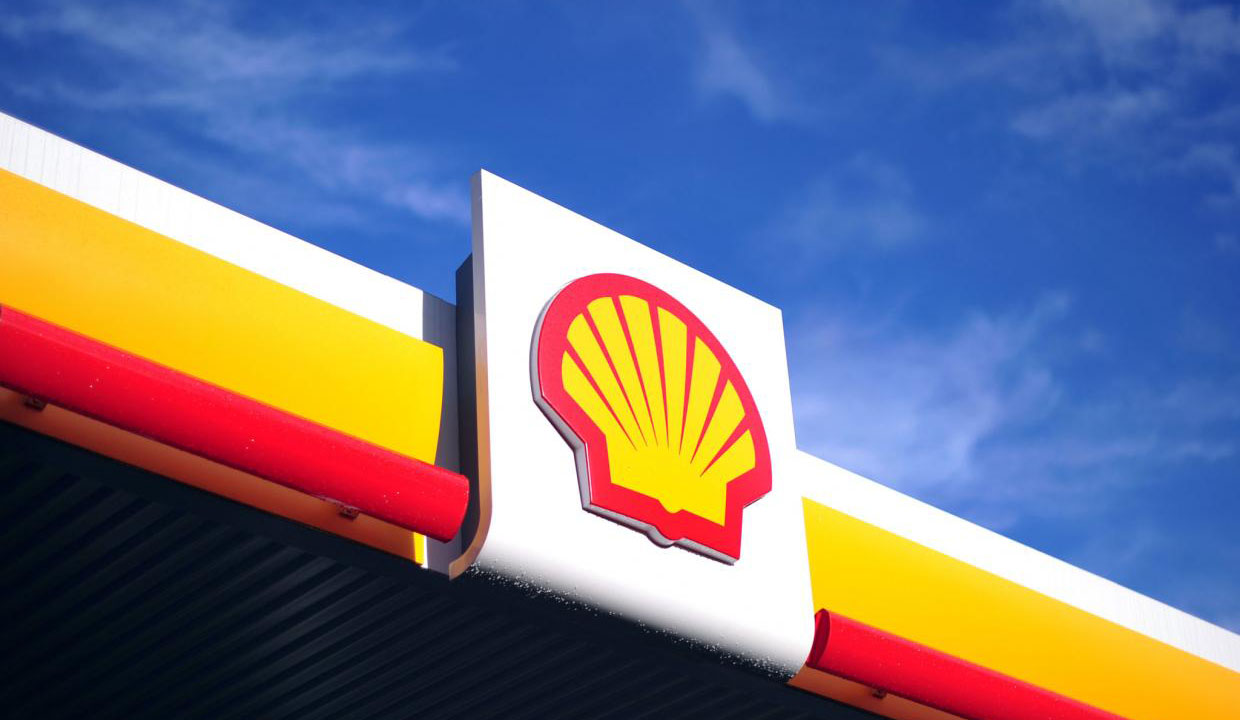
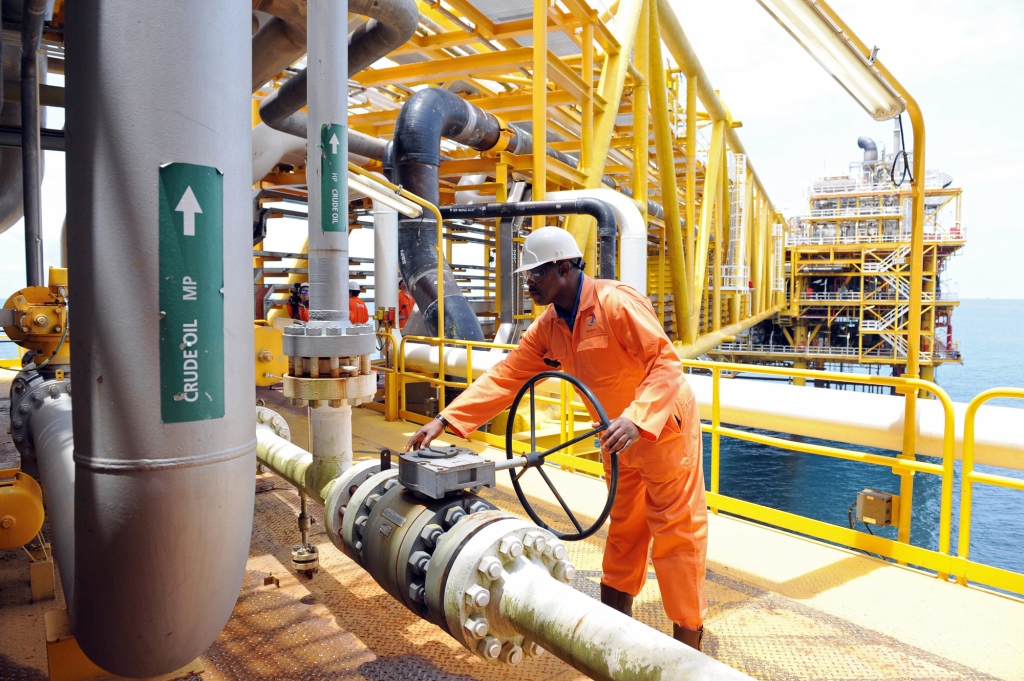
Brent oil price increased by 1.3 per cent or $1.48 to $114.00 per barrel on Monday as the Iran war entered its fifth week, with President Donald Trump threatening to destroy the Islamic Republic’s oil wells.
Brent has soared about 55 per cent in March, a record for the contract, dating back to its inception in 1988. The previous monthly record was a 46 per cent gain in September 1990 during the first Gulf War.
Also, the US West Texas Intermediate (WTI) futures were up $3.45 or 3.5 per cent to $103.09 a barrel, as Mr Trump vowed to target power plants and Kharg Island unless the Strait of Hormuz was reopened. Iran’s effective closure of the Strait of Hormuz, a chokepoint for roughly a fifth of global oil and gas supplies, continues to be a point of focus.
In an interview with the Financial Times on Sunday, the US president said his preferred option in Iran would be to “take the oil,” likening it to the country’s actions in Venezuela, where the US effectively gained control over the country’s oil sector after the capture of its leader, Nicolás Maduro.
His remarks come as the conflict between the US, Israel, and Iran entered another week, with attacks spreading across the region, heightening risks to energy infrastructure and driving a sharp rally in crude prices.
Previously, the American president said he would pause attacks on Iran’s energy network until April 6 and that the US and Iran have been meeting “directly and indirectly”, but Iran described US proposals to end a month of war in the Middle East as “unrealistic, illogical and excessive” and unleashed more missiles on Israel.
Meanwhile, US Treasury Secretary Scott Bessent said on Monday that the global oil market is well supplied, with more boats travelling through the Strait of Hormuz. Two Chinese container ships sailed through the strait on their second attempt to leave the Gulf after turning back on Friday.
Market analysts noted that the potential for further disruption through the Bab el-Mandeb Strait, a key shipping channel linking the Gulf of Aden to the Red Sea, could push prices even higher.
Yemen’s Houthis said Saturday they had launched missiles at Israel, marking their first direct involvement in the US- Israel war against Iran.
Prices eased a bit after the Group of Seven (G7) finance leaders signalled readiness to act to stabilise energy markets. Alongside their central banks, they indicated readiness to take “all necessary measures” to safeguard energy market stability and limit broader economic spillovers from recent volatility.

By Adedapo Adesanya
The Nigerian National Petroleum Company (NNPC) Limited has marked a major milestone with the introduction and successful lifting of 950,000 barrels of Cawthorne Blend crude into the global market, a move aimed at boosting Nigeria’s production output and supporting its quota targets.
The feat was achieved through the FSO Cawthorne vessel, Nigeria’s first new crude oil terminal in 50 years, according to a statement by the Sahara Group on Monday, as the company said it welcomed the development.
It was recently reported that the country would introduce a new light sweet crude called Cawthorne in March. The launch of the new grade is part of Nigeria’s broader push to lift production, which has been constrained for years by crude oil theft, pipeline vandalism, and security challenges in the Niger Delta.
Cawthorne crude, which has an API gravity of 36.4, is similar in quality to Nigeria’s flagship Bonny Light, a grade widely valued by refiners for its high yields of gasoline and diesel.
The introduction of the grade could increase Nigeria’s crude and condensate supply from about 1.65 million barrels per day to roughly 1.7 million barrels per day for the rest of the year, depending on operational stability and market demand.
“Over the weekend, the first shipment of 950,000 barrels from FSO Cawthorne, Nigeria’s newest oil terminal, was initiated following its licensing and gazetting by the Nigerian Upstream Petroleum Regulatory Commission (NUPRC)”, the statement read in part.
FSO Cawthorne serves as a critical offshore production support asset, providing storage and offtake capabilities for crude produced from OML 18 and nearby producing assets.
On its part, Sahara Group, a global energy and infrastructure conglomerate, reiterated the strategic role of FSO Cawthorne in strengthening Nigeria’s energy security through its reliable production, storage, and evacuation infrastructure.
Sahara Group also recognised the advanced technologies deployed on FSO Cawthorne, noting that the facility incorporates cutting‑edge systems supported by artificial intelligence‑enabled monitoring and robust QHSE frameworks, enhancing operational efficiency, asset integrity, safety performance, and environmental stewardship.
Sahara commended NNPC for its leadership of Oil Mining Lease (OML) 18 and surrounding assets in the eastern Niger Delta, where Sahara Group is a joint operator and joint venture partner, noting that the company’s collaborative approach continues to drive continuous improvement and value delivery across Nigeria’s upstream sector.
Mr Tosin Etomi, Head, Commercial and Planning at Asharami Energy (a Sahara Group Upstream company), said the crude lifting from FSO Cawthorne represents a defining moment for the asset, the OML 18 partnership, and the wider oil and gas sector.
“The successful commencement of crude lifting from FSO Cawthorne is a significant milestone for the OML 18 partnership and a strong demonstration of what can be achieved through shared vision, technical discipline and committed collaboration,” Mr Etomi said.
Mr Etomi noted that the milestone aligns with Sahara Group’s broader upstream strategy, which is focused on building a resilient, scalable, and responsible production portfolio anchored on strong partnerships, asset optimisation, and long‑term value creation.
“The transition of FSO Cawthorne into active export is consistent with our upstream growth strategy, prioritising operational excellence, indigenous participation and infrastructure capable of sustainably supporting Nigeria’s production ambitions,” he said.
He noted that Sahara Group’s upstream portfolio includes a growing oilfield services division, which is redefining innovation, efficiency, and sustainability in the sector.
“Our expanding oilfield services capabilities are integral to our upstream vision, enabling smarter operations, improved efficiencies, and responsible resource development,” Etomi said.
“Sustainable social impact interventions and community participation have been key drivers of our upstream success, and we remain committed to aligning our operations with the highest global environmental, social, and governance standards.”
Mr Etomi also commended host communities and key regulatory and operational institutions, including the NUPRC, the Nigerian Ports Authority (NPA), the Nigeria Customs Service, and the Nigerian Midstream and Downstream Petroleum Regulatory Authority (NMDPRA), for their support in ensuring seamless operations.


By Aduragbemi Omiyale
The national scale long-term rating of BBB+(NG) and the short-term issuer rating of A2(NG) assigned to Champion Breweries Plc have been affirmed by GCR Ratings.
The rating agency, in a statement, also disclosed that the brewery firm’s outlook on the ratings has been upgraded to stable from rating watch evolving.
The outlook was revised by GCR after the successful acquisition of the Bullet brand by Champion Breweries, while sustaining leverage metrics within those consistent with the current rating level despite the spike in debt.
The outlook reflects the expectation that Champion Breweries’ expanded business profile would support strong earnings growth and cash generation, which could offset the emerging strain on gearing and liquidity.
It was also noted that the affirmed ratings of Champion Breweries were underpinned by strong earnings quality and expected product and geographical diversification following the recent acquisition. These strengths are partly offset by the ramp-up of debt for working capital and partial funding of the acquisition, though gearing metrics remain modest.
Last month, Champion Breweries completed the acquisition of the Bullet brand from UK-incorporated Sun Mark International Limited through a special purpose vehicle (SPV), namely EnjoyBerv (Netherlands).
Under the shareholding agreement, Champion Breweries owns 80 per cent while Sun Mark retains a minority interest in the SPV.
The company’s product portfolio is, therefore, expanded from two limited-reach brands previously to a more diversified base with multiple offerings.
The Bullet brand’s multi-market presence across West and Central African markets, combined with its sizeable share of the regional ready-to-drink energy segment, further strengthens the assessment of the company’s competitive position.
However, the realisation of the expected synergy from the acquisition is dependent on the effective management of execution and integration risks, including supply chain management and the company’s ability to consolidate access to Bullet’s dominant markets.






-
 Feature/OPED6 years ago
Davos was Different this year
-
Travel/Tourism10 years ago
Lagos Seals Western Lodge Hotel In Ikorodu
-

 Showbiz3 years ago
Estranged Lover Releases Videos of Empress Njamah Bathing
-
 Banking8 years ago
Sort Codes of GTBank Branches in Nigeria
-

 Economy3 years ago
Subsidy Removal: CNG at N130 Per Litre Cheaper Than Petrol—IPMAN
-

 Banking3 years ago
Sort Codes of UBA Branches in Nigeria
-

 Banking3 years ago
First Bank Announces Planned Downtime
-

 Sports3 years ago
Highest Paid Nigerian Footballer – How Much Do Nigerian Footballers Earn