

Economy
Starting and Managing a Profitable Catfish Farming Business in Nigeria

By Sodeinde Temidayo David
I’m sure you know that catfish farming in Nigeria has become one of the most commonly practised fish farming businesses, with a lot of back benefits. The high demand and consumption of fish have made the business very profitable if well-managed.
Catfish farming has become one of the fastest-growing areas of animal food production. Gone were the days when the only means of getting fish was by catching it in the local rivers, ponds or from fishermen. About half of the fish consumed in Nigeria are now raised in artificial environments.
If you are looking forward and aspiring to start a catfish farming business of your own, you have come to the right post. This article will provide you with not just starting the business, but also give you a guide to managing the business to maximise profit and answer the questions you have in mind.
Information in this publication was gathered from Business Post researchers, personal experiences and resources from fish farmers and experts in the field and I have endeavoured to make this writing very detailed. You might just want to keep away everything that might distract you for now.
What You Need To Know Before Venturing into the Business
Before you venture into catfish farming, take note that this business is broad, and like every other business, one needs to take risks. Catfish farming comes in different specialisations which are subdivided as businesses on their own. These include feed production, hatching, growing production to targeted sizes, marketing and distribution. This also comes with the responsibility to test water PH, feed the fishes, sorting and grading of the fishes into different sizes, and also include other jobs and monitoring to bolster the growth of production.
This might seem like something difficult to comprehend, especially when you are not familiar with fish farming. It’s just that knowing and applying the right cultural practices in fish farming is very essential for success.
There is more to catfish farming than purchasing fingerlings, stocking them in a tank, and feeding them till they get to the size for sale. Well, those are just the basic stuff and I assure you that when you relax and read in calmness, you will discover all that it takes to establish, manage and make profit in a catfish farming.
What You Should Consider Before Investing
Do you have the qualities and attitude of an entrepreneur? Since farming is a type of self-employment, before you make any investment in the business, the first consideration should be your interest. This might come with other attributes like dedication, time commitment and motivation.
Starting a catfish farming business requires effort, dedication, and most importantly passion, and it is the interest of an entrepreneur that will determine whatever mission and vision for the business.
If you have an interest and you think you are ready for fish farming, make sure you know what you are about to venture into.
To start rearing catfish with an aim for success, one would have to consider the size of the farm, size of production, capital, intended number of stock, location, pond, market, species of fish, including water availability and legal issues (tax, regulatory agencies, etc).
When a person has little or no knowledge in fish farming and is ready to put in all for it, the business also has a way of educating about itself in a hard manner. Acquiring knowledge will not be a problem if you are still reading this, and I also recommend additional training (you should try working on a farm even if it would be for free just to gather experience) no one can take away your knowledge.
The good news is that one can do other businesses and still run a successful fish farm. Even civil and public servants can venture into fish farming, a business that does not bridge the public service rule.
Basic Requirements to Start a Catfish Farm
Just like every other business, there are requirements needed to start a catfish farm which depends on the type of scale in target based on capital.
To start and run a fish farm is not as difficult as it is when you have this knowledge. Establishing a farm for success varies on the size and vision of the entrepreneur. It may be small scale, medium scale, or large scale.
A small scale can contain a maximum of 50,000 pieces of the startup sizes, a medium will take between 50,000 and 100,000 pieces and anything more than that means that is a large scale establishment.
Fish farming is easy to carry out as compared to other complicated modes of farming. The only thing someone need is a piece of land and a constant source of water. But before this, you will have to have a blueprint of your startup, which should be based on your capital. Knowing the amount on hand, then you can manage expenses for the basic requirements.
Securing a piece of land is the first set towards having a fish farm, and the great advantage of this is that the land does not need any special treatment and clearing as long as it is plain terrain. This also includes establishment in any good location, it could even be in an estate since fish doesn’t cause any environmental disturbance but this still depends on an agreement with the neighbours.
All you have to do is just look for a land where you can get it cheap and buy, and the size depends on the capacity you wants to manage, the bigger the space, the more fish you can rear, and also decides the amount of return you should expect. I recommend half plot if it would be an average fish farm.
After securing land, a pond is needed for the rearing of the fish and this is where you will need experts, just for the construction and plumbing works! You can get a specification from what you see on other farms and the expert will give his advice and knowledge. This is where things get tricky because it’s the quality of a pond that determines a long term fish farming business.
So, you can’t just use any regular plumber or construction engineers, rather get one specialized in this business. You don’t want to start the business to begin to see your fishes on the ground or add to the numbers in the ocean.
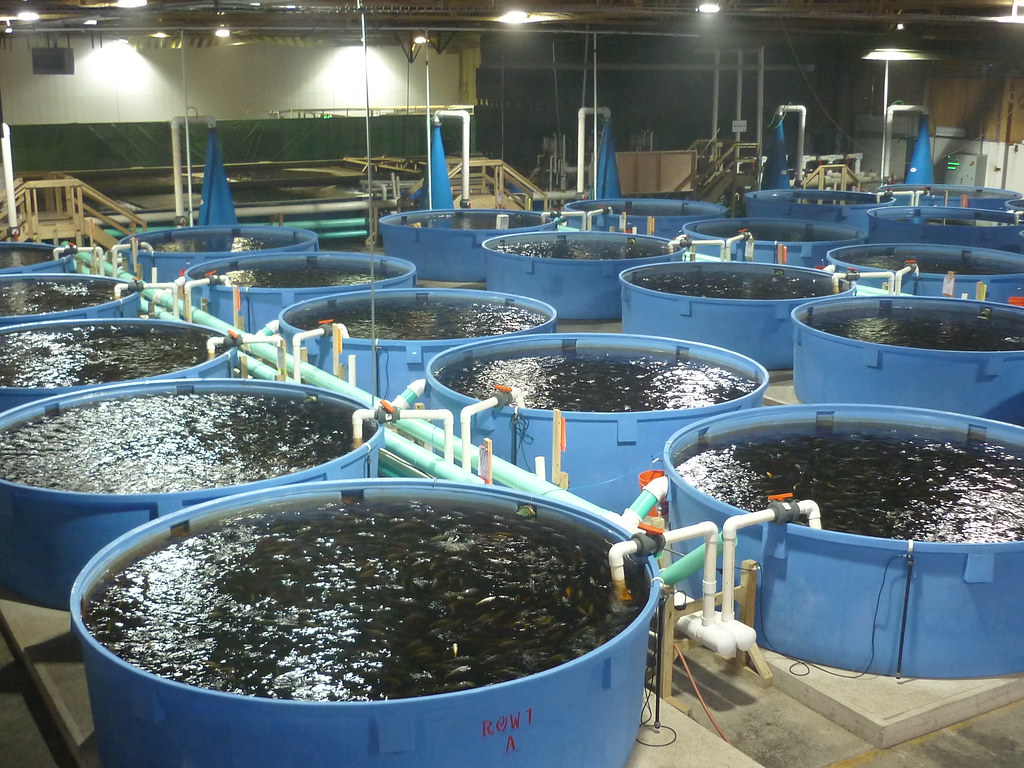
There are different kinds of ponds system for catfish farming, which also varies in different designs. However, the most common types used in Nigeria and easy to manage are plastic ponds, tarpaulin ponds, concrete ponds, and earthen ponds.
Choosing a pond system might require one to seek expert advice when the individual is not familiar with the system, as there are other factors needed to be considered based on the focused phase of production.
In absence of a sizeable piece of land for big ponds, tanks and drums can be used for a small startup. One might as well use old ponds as long as it is properly washed and fumigated.
Setting up the ponds is not difficult, but one must ensure a proper drainage system, this is where the plumbing work has to be done and monitored properly.
This includes having a water source and channel inlets to the ponds, as the adequate water supply is very vital for a fish farm and lack of it may result in a tragedy because water needs to be changed at regular intervals. Naturally, available sources of water such as wells, boreholes and river water are the most suitable. Other sources like rainwater and tap water from the chemically treated source are not recommended for the rearing of fish.
You will also need to install an overhead tank, which will serve as a water reservoir from which water is supplied to the ponds. This has to be through a good plumbing system for convenient water flow and supply in the farm.
Cost of Starting a Catfish Farming Business
Setting up a fish farm requires more careful planning and much capital input. To meet all the basic requirements to start a small scale fish farm, this can cost between N500,000 and N4 million, depending on the land cost, type of pond, pond size, number of stock, type of production, other equipment and facilities.
Staring with a plastic pond is cheaper as all you have to do is to buy the already made pond and set it up with good plumbing and waterworks. Other types of ponds that require construction may require a range amount of N200,000 to N500,000, with plumbing expenses.
A good water source like the borehole should cost nothing less than N300,000, depending on the location and the other costs are managing and feeding expenses, which can cost up to N1 million.
A big farm would require extra expense on employees and other workers. Also, since we are in a world of technology, one might want to spend more on technology equipment, website and software to grow the business, doing specific programs like payroll, social media management.
Starting the Business
After having the land, pond, an overhead tank and a good water channel, then you are ready to stock and become a big-time fish farmer. All you just have to do is to get your startup size of a good species, this could be Fries (newly hatched fish), fingerlings (Catfish aged 0-4 weeks) or Juveniles (Catfish aged 4-8 weeks) and could be got from another farm that specializes in supplying them, and make sure your fishes are from a healthy source.
In Nigeria, commonly grown catfish species include Clarias gariepinus, Heterobranchus bidorsalis, and a hybrid of Clarias and Heterobranchus (Heteroclarias). These breeds are the best to rear for growing if properly managed because they have fast-growth, are prone to disease and adapt to our environment. But you just have to make sure that your stock won’t be too crowded for the available space.
Above all, you will need to have a business plan and marketing strategy. A good strategy might require you to join an association of fish farmers, as it unlocks opportunities of getting buyers, suppliers, workforce, production monitoring, advice and support. Joining a good association can also make you make access government support and grants for fish farmers.
For beginners just starting the business, I recommend the stock of Juveniles, rather than Fingerlings, for better management and because they are less sensitive to the water PH.
Managing the Business
Managing a fish farm is the main business and this would require all available resources, time and labour. It is the proper management of the farm that will determine the number of output and the success of the production.
Managing a fish farm starts from pond management, how secure the pond is and how vulnerable it is to pests and diseases. When starting the business with a new pond, ensure that the pond chemicals are neutralised to protect the health and growth of fishes. This concerns the users of tarpaulin or plastic ponds.
The safest way to ensure that a pond will cause no harm is to wash the pond with salt and fill it with water for five days before stocking in the pond. This can also boost water quality. For an earthen pond user, applying fertilizer after constructing the pond will make the soil fertile. If the soil of your pond is not fertile, then it will hamper the health and proper growth of fish.
Also, make sure there is no hole in the pond and that it is strong enough not to fall apart. A good water flow direction will also help a pond lasts longer. There should be a downward slope direction to the outlet.
Being assured that the pond is eligible and safe for use, water quality has to be monitored and if not properly managed, it could lead to a disaster. Water management is very important in a fish farming business, as fishes live, breathe, feed, grow, and excrete wastes in the water, and are, therefore, totally susceptible to changes in water quality. For fish to maintain an optimum level of health, avoid stress or disease then the water quality of the water must be monitored and controlled, as a fish life is dependent on the water it lives in for all needs.
Catfish become stressed when key water quality parameters such as temperature, pH, alkalinity, hardness nitrogenous waste, dissolved oxygen and salinity are not kept with specified thresholds.
Knowing the quality of your water source is very important and could be tested with water testing kits like the water pH meter.
The measure of the alkalinity or acidity of water is expressed by its pH value. The pH value ranges from 0 to 14, with pH 7 indicating that the water is neutral, while a value smaller than 7 indicate acidity and a value greater than 7 notes alkalinity. Fish production can be greatly affected by excessively low or high pH.
Young age fishes like the fries, fingerlings and juveniles are more sensitive than adults. Waters ranging in pH from 6.5 to 8.5 at sunrise are generally the most suitable for growing fish, and extreme pH values can even kill your fish. Most cultured fish will die in waters with pH below 4.5 and 10 or above.
The key is to keep soil pH at 6.5 or above, which will usually maintain water pH, hardness, and alkalinity at desirable levels.
Pond water with unfavourable PH for fish production can be corrected by the use of water-soluble fertiliser which will ensure that your water pH and acidity are within acceptable limits and a necessary part of managing the alkalinity, hardness, and pH of the water.
If the pH is below 6.5 at sunrise, proving that it is acidic, then you will have to use lime and alkaline fertilisers that do not cause hardness problems in treated water, like the soda ash (sodium carbonate) and sodium hydroxide which would raise the pH of water when injected into a water system.
Note that this is always done with caution and should have a measurement according to the quantity of the water and the reactions of the fish should be monitored. Ammonium hydroxide, calcium hydroxide (lime) or magnesium hydroxide can also be used. To be on the safe side, I recommend sodium bicarbonate because it is not harsh on fish.
If the pH is above 8.5 at sunrise, showing that it is too alkaline, you can lower the pH with the use of acid fertilisers like phosphoric acid, hydrochloric acid (HCI), nitric acid or carbon dioxide can be used, in addition to sulfuric.
To run a profitable fish farm, you should be able to properly manage the feeding of fish. Catfish eat two times a day, morning and evening and water would have to be changed regularly (averagely once in two days) since feeding would lead to excretion and it is risky for catfish to live in unchanged water.
You should also adopt sorting and grading of fishes, as this act of separating fishes into categories of their various physical growth will create more space and uniformity. For this, you will need a labour force.
The dynamic aspect about fish is that the same fish of the same age, birth origin, feed and same pond may not grow at the same rate. One might be very big while the other very small. This is why sorting is important, to separate big fish from the small fish and put them into separate ponds. If not done, the bigger fish may eat the smaller fish or prevent them from eating well.
Fish farms are easy to maintain as long as the fish are fed good nutritional feed and you make sure the ponds are secured, the farmer is assured of a good harvest.
You should monitor the health of your fishes and the fish pond should be protected from predators. Daily scouting should be done and suspected fishes should be isolated from the pond to avoid spreading diseases all over the pond.
Fish diseases can be treated by using salt, potassium permanganate solution, chemicals, and drugs for veterinary uses. Above all, prevention is better than treatment.
If you are successful in managing the business, then you could as well mix things up and venture into another phase of production.
Knowing the Phases of Production
After stocking your preferred number of fingerlings, the way you manage it will determine the phase of products suitable for you, but this could also be by choice. Different phases of catfish production vary according to size.
Catfish becomes ready for sale when it has an average weight size of 300 to 400 grams. This is called the mélange production, the raising of catfish from fingerlings to three months to meet the size for those that smoke and sell.
Table Size Production is the raising of catfish from fingerlings to an average weight size of 500 to 700 grams, usually from 4 to 5 months from fingerlings.
This follows the grow-out stage, an average size of 1kg upward. At this stage, the fishes are in their bigger sizes and are at least six months old.
Broodstock Production is an exclusive part of the business, as it is the raising of catfish for the specific purpose of becoming a parent stock for the hatchery. They are usually raised for over a year.
Bottom-line
The catfish market is readily available both locally and internationally. Major urban centres in Nigeria are readily available markets for fish. For large-scale fish farmers, the international market is available. The fish market is growing, and Nigeria has had to import fish from China because the demand exceeds the supply and this has also made us witness Chinese farmers coming to Nigeria for large scale catfish production.
The government in recent years have been giving technical support to fish farmers. Being an agricultural sector that has not been fully utilized, the Nigerian government is also committed to making sure that more Nigerians take to the rearing of fish for both small scale and commercial use.
The good news is that there is still more room for growth and investing in this sector. The sector is still growing. Catfish farmers could easily combine it with other fish species.



Pingback: Business Post Nigeria – SDavidPrince