Economy
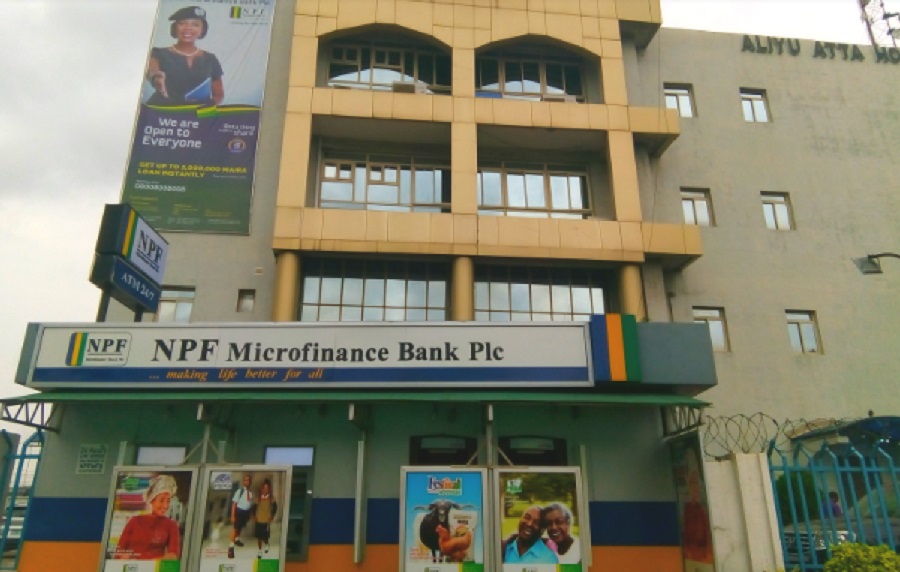
Subscriptions for NPF Microfinance Bank Rights Issue, Public Offer Begin
By Dipo Olowookere
New and existing investors interested in buying shares of NPF Microfinance Bank Plc now have the opportunity to do so as the company has commenced its rights issue and public offer.
Recall that in 2018, the company, at its 24th Annual General Meeting (AGM) held in Kano, had expressed its intention to raise fresh capital through a public offering.
A year later, the organisation said the funds, which would be used for the smooth running of the company, would be sourced from rights issue or public offer by creating additional 3 billion shares.
Business Post has now confirmed that the firm is raising the fresh capital via a rights issue and public offer, with 2,286,657,766 units allotted for the former and 713,342,234 units for the latter.
Subscriptions for the NPF Microfinance Bank rights issue and public offer commenced last Thursday and will end this Wednesday. The stock would be sold at N1.50, lower than N1.73 it closed today, Monday, June 28, 2021.
“Trading license holders and the investing public are hereby notified that NPF Microfinance Bank Plc’s rights issue and public offer opened for subscription on Thursday, June 24, 2021, further to the approval of the Securities and Exchange Commission (SEC),” a notice from the Nigerian Exchange (NGX) Limited said.
It was disclosed that under the rights issue, the company will issue one new ordinary share for every one ordinary share held as at May 17, 2021.
Economy
Dangote Plans New Refinery in Tanzania for East African Region
By Adedapo Adesanya
African businessman, Mr Aliko Dangote, has announced plans to build a new oil refinery in Tanzania, as the war in Iran exposes the continent’s over-reliance on fuel imports from the Middle East.
The project will include a pipeline that links the Kenyan port city of Mombasa to the northeastern Tanzanian harbour of Tanga, where the facility will be situated, Kenyan President William Ruto said at an Africa Finance Corp summit in Nairobi on Thursday.
The refinery will process crude from countries, including the Democratic Republic of Congo and South Sudan, he said at the forum.
“We are discussing that we are going to have a joint refinery in Tanga to benefit all of us,” Mr Dangote said at the forum on Thursday. “My commitment today here is that we will lead the refinery. We’ll make sure that that refinery is built within the next four to five years.”
The plans to build the facility in Tanzania coincide with Mr Dangote’s $40-billion expansion of his industrial empire, aimed at more than doubling capacity at his 650,000 barrel-a-day plant in Lagos.
“I can give commitment to the two presidents that were here, if they will support the refinery, we’ll build the identical one that we have in Nigeria,” Mr Dangote said on a panel discussion that included President Ruto and Ugandan President Yoweri Museveni.
Kenyan President confirmed the ongoing discussions with the Nigerian billionaire, saying the proposed project.
“Aliko is telling us that the private sector and the government can discuss a refinery in Tanzania, a joint refinery to benefit all of us. The oil will take on board the oil from Kenya, DRC, and even Uganda. We just need to construct a pipeline from Tanga to Mombasa, and the finished product will come by the already built pipeline we have in Uganda,” he said.
He said countries should avoid pursuing individual gains and instead collaborate in shaping policies that benefit the East African market.
The announcement on the oil refinery in Tanzania comes after the Nairobi Securities Exchange (NSE) Chief Executive Officer, Mr Frank Mwiti, said on April 12 that discussions had been held on how the NSE and other African exchanges could support what may become Africa’s largest initial public offering (IPO).
Dangote’s IPO is aimed at expanding Mr Dangote’s refinery business and is estimated at about $22 billion.
The planned offering is expected to float between 5 per cent and 10 per cent of the refinery’s equity. Analysts estimate the refinery’s valuation at between $40 billion and $50 billion.
The share sale targets up to $5 billion, which will make it the largest IPO ever conducted on an African stock exchange.
Economy
Manufacturers Push for Transparency in Naira-for-Crude Pricing Policy
By Adedapo Adesanya
The Manufacturers Association of Nigeria (MAN) has urged the federal government to ensure total transparency in the domestic pricing matrix in line with the Naira-for-Crude policy.
Speaking in a new interview with a Nigerian newspaper, New Telegraph, the Director-General of the manufacturing body, Mr Segun Ajayi-Kadir, said that the government should ensure that local refineries received their full, unhindered daily crude quotas without bureaucratic bottlenecks.
The Naira-for-Crude policy introduced in October 2024 is a strategic initiative to boost local refining and reduce pressure on foreign exchange reserves. The policy directs the Nigerian National Petroleum Company (NNPC) to sell crude oil to local refineries, notably the Dangote Petroleum Refinery, in Naira, with a focus on stabilising the local currency and reducing reliance on USD for energy imports.
“The federal government should mandate total transparency in the domestic pricing matrix and ensure that local refineries receive their full, unhindered daily crude quotas without bureaucratic bottlenecks.
“The true macroeconomic benefit of this policy must be allowed to materialise for the end consumer and the productive sector,” he told the paper.
According to Mr Ajayi-Kadir, while the implementation of crude oil sales in Naira to local refineries is a landmark structural victory, its current execution requires unmitigated optimisation.
His comments come on the back of recent worries by Dangote Refinery and other smaller refiners not getting enough crude feedstock to serve their structures. This has led to an increase in crude importation from other countries at a premium, which is in turn making fuels expensive.
Analysts note that most of Nigeria’s crude production is already tied to export contracts as the country sells a large share of its oil through long-term agreements with international oil companies via joint ventures. These contracts, often priced in Dollars, are hard to redirect even as local refiners need supply.
He also urged the government to accelerate the Presidential Compressed Natural Gas (CNG) initiative by heavily subsidising the conversion of commercial and industrial transport fleets as part of the effort to roll out alternative energy aggressively.
He said that logistics accounted for a massive chunk of consumer goods inflation, adding that shifting from Premium Motor Spirit (PMS) and diesel to abundant, locally sourced CNG was the ultimate inflation-buster.
Economy
NASD Exchange Gains 0.88% as CSCS, FrieslandCampina Lead Advancers
By Adedapo Adesanya
Four price gainers extended kept the NASD Over-the-Counter (OTC) Securities Exchange in the green territory by 0.88 per cent on Wednesday, April 22.
The advancers were led by Central Securities Clearing System (CSCS) Plc, which went up by N3.33 to close at N66.48 per share compared with the preceding day’s N63.15 per share. FrieslandCampina Wamco Plc added N1.79 to sell at N99.00 per unit versus N97.21 per unit, Afriland Properties Plc appreciated by 16 Kobo to N16.00 per share from N15.84 per share, and UBN Property Plc rose by 7 Kobo to N2.25 per unit from N2.18 per unit.
Consequently, the market capitalisation chalked up N12.99 billion to close at N2.375 trillion compared with Tuesday’s N2.354 trillion, and the NASD Unlisted Security Index (NSI) increased by 34.69 points to 3,969.96 points from 3,935.27 points.
At midweek, the value of securities traded by investors surged by 11,468.9 per cent to N21.5 million from N5.7 million, the volume of securities ballooned by 708.1 per cent to 49.5 million units from 185,420 units, and the number of deals soared by 21.7 per cent to 28 deals from 23 deals.
At the close of business, Great Nigeria Insurance (GNI) Plc was the most traded stock by value on a year-to-date basis with 3.4 billion units sold for N8.4 billion, trailed by CSCS Plc with 58.9 million units exchanged for N3.9 billion, and Okitipupa Plc with 27.8 million units traded for N1.9 billion.
GNI Plc also ended the trading session as the most traded stock by volume on a year-to-date basis with 3.4 billion units worth N8.4 billion, followed by Resourcery Plc with 1.1 billion units transacted for N415.7 million, and Infrastructure Guarantee Credit Plc with 400 million units valued at N1.2 billion.
-
Feature/OPED6 years agoDavos was Different this year
-
Travel/Tourism10 years ago
Lagos Seals Western Lodge Hotel In Ikorodu
-
Showbiz3 years agoEstranged Lover Releases Videos of Empress Njamah Bathing
-
Banking8 years agoSort Codes of GTBank Branches in Nigeria
-
Economy3 years agoSubsidy Removal: CNG at N130 Per Litre Cheaper Than Petrol—IPMAN
-
Banking3 years agoSort Codes of UBA Branches in Nigeria
-
Banking3 years agoFirst Bank Announces Planned Downtime
-
Sports3 years agoHighest Paid Nigerian Footballer – How Much Do Nigerian Footballers Earn