Connect with us

Economy

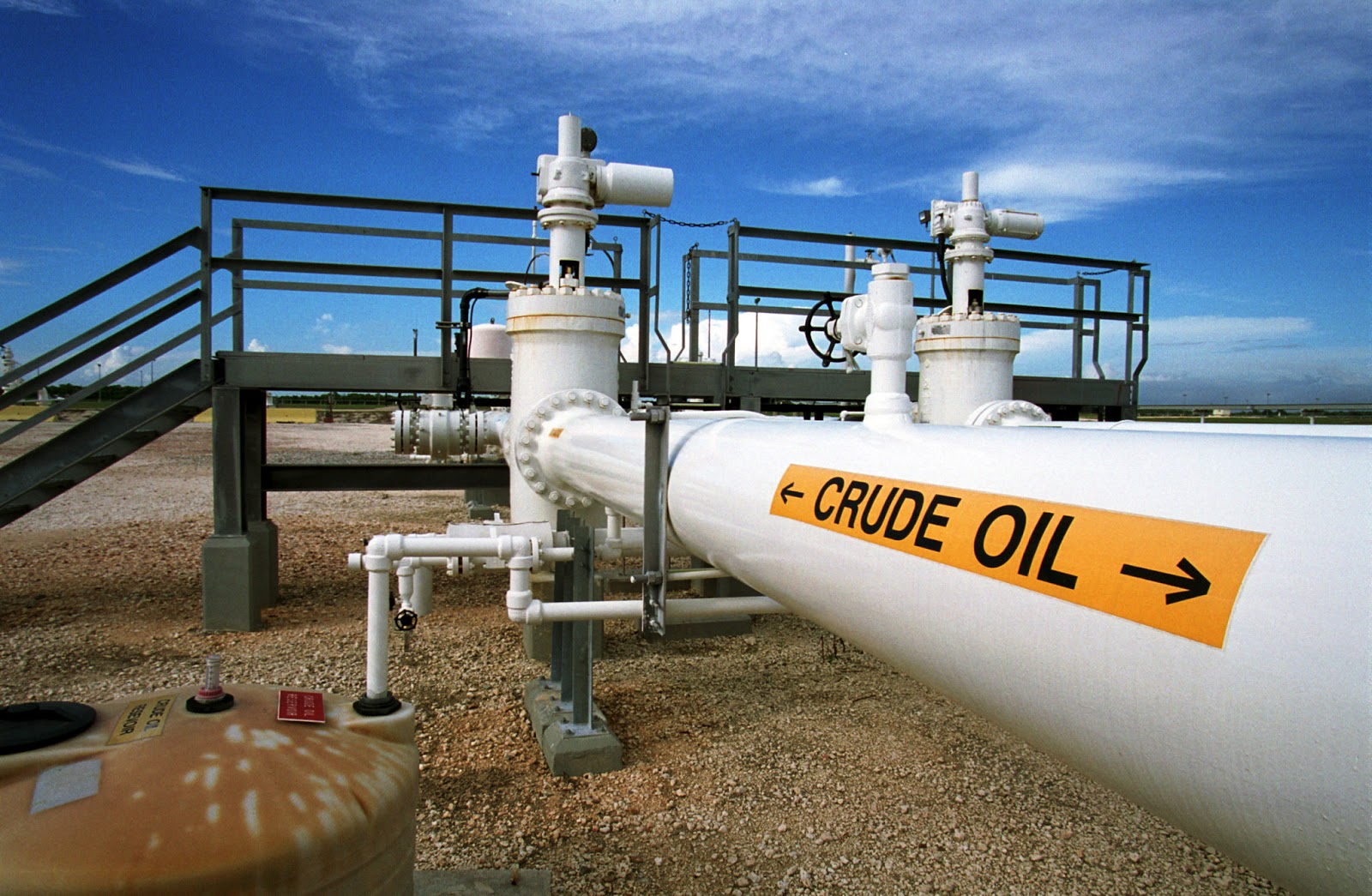
Supply Fears Weigh on Crude Oil Prices

Published

on

crude oil prices

By Adedapo Adesanya

Oil prices, having climbed to a 13-month peak last month, continued to slide at the global market and on Tuesday, they further depreciated.

This was caused by expectations that the Organisation of the Petroleum Exporting Countries and its allies (OPEC+) may be set to increase global supply.

As a result, the price of the Brent crude further lost 96 cents or 1.51 per cent to trade at $62.73 per barrel, while the West Texas Intermediate (WTI) crude dropped 91 cents or 1.50 per cent to sell at $59.73 per barrel.

OPEC+ had last year agreed to reduce the volume of oil it produces in an effort to prop up prices as strict public health measures coincided with an unprecedented fuel demand shock.

This week’s supply decision comes at a time when oil prices have rebounded to pre-virus levels, production in the U.S. has taken a hit from freezing storms and the coronavirus pandemic continues to cloud the outlook.

OPEC’s de facto leader Saudi Arabia has publicly encouraged allied partners to remain extremely cautious on production policy, warning the group to ensure effectiveness as it seeks to navigate the ongoing COVID-19 crisis.

Non-OPEC leader, Russia, meanwhile, has indicated it wants to push ahead with a supply increase.

Analysts broadly expect OPEC+ to hike output from current levels, but questions remain over how much exactly and which countries will be affected.

The alliance initially agreed to cut oil production by a record of 9.7 million barrels per day last year, before easing cuts to 7.7 million and eventually 7.2 million from January.

In addition, Saudi Arabia has since taken on voluntary cuts of 1 million barrels per day from the beginning of February through March.

The reality is pointing to the fact that Russia will likely be allowed to increase output further while Saudi Arabia will return some or even all of its 1 million barrels per day unilateral cut.

Analysts expect OPEC+ to discuss allowing as much as 1.3 million barrels per day back into the market on Thursday.


Adedapo Adesanya is a journalist, polymath, and connoisseur of everything art. When he is not writing, he has his nose buried in one of the many books or articles he has bookmarked or simply listening to good music with a bottle of beer or wine. He supports the greatest club in the world, Manchester United F.C.

Click to comment

Leave a Reply

Your email address will not be published. Required fields are marked *

Economy

11 Plc, CSCS Lift NASD OTC Bourse by 0.27%

Published

on

11 plc NASD

By Adedapo Adesanya

The duo of 11 Plc and Central Securities Clearing System (CSCS) Plc helped flip the NASD Over-the-Counter (OTC) Securities Exchange from a three-day losing streak to a 0.27 per cent gain on Thursday, August 13.

11 Plc, which used to be known as Mobil Nigeria, garnered N22.28 to close at N245.03 per unit compared with the preceding day’s N222.75 per unit, and CSCS Plc appreciated by N3.76 to N109.76 per share from N106.00 per share.

The gains offset the N10.00 loss recorded by FrieslandCampina Wamco Nigeria Plc, closing at N160.00 per unit compared with N170.00 per unit it finished at midweek.

When the bourse closed for the day, the market capitalisation increased by N7.31 billion to N2.727 trillion from N2.720 trillion, and the NASD Security Index (NSI) went up by 12.17 points to 4,544.20 points from 4,532.03 points.

Yesterday, the volume of securities exchanged by investors skyrocketed by 1,173.8 per cent to 1.9 million units from 150,340 units, the value of securities jumped by 1,029.5 per cent to N210.8 million from N18.7 million, and the number of deals soared by 6.3 per cent to 34 deals from 32 deals.

Great Nigeria Insurance (GNI) Plc remained the most active stock by value on a year-to-date basis, with 3.4 billion units worth N8.4 billion, followed by Infrastructure Credit Guarantee (Infracredit) Plc with 2.3 billion units valued at N6.5 billion, and CSCS Plc with 79.1 million units exchanged for N5.7 billion.

GNI Plc also closed the day as the most traded stock by volume on a year-to-date basis, with 3.4 billion units sold for N8.4 billion, followed by Infracredit Plc with 2.3 billion units transacted for N6.5 billion, and Resourcery Plc with 1.1 billion units traded for N415.7 million.

Continue Reading

Economy

Naira Firms to N1,357/$1 at NAFEX, Trades Flat at N1,395/$1 at Black Market

Published

on

paying remittances in Naira

By Adedapo Adesanya

The Naira-US Dollar exchange rate remained unchanged in the black market segment of the foreign exchange (FX) market on Thursday, August 13, at N1,395/$1.

But at the GTBank forex desk, the Nigerian currency gained N3 against the greenback during the session to settle at N1,367/$1, in contrast to Wednesday’s rate of N1,370/$1.

Similarly, the local currency further appreciated against the Dollar in the Nigerian Autonomous Foreign Exchange Market (NAFEM) yesterday by N2.93 or 0.22 per cent to trade at N1,357.65/$1 compared with the previous day’s N1,360.58/$1.

Equally, the Nigerian Naira improved its value against the Pound Sterling at the official market by N6.94 to quote at N1,834.05, in contrast to the preceding session’s N1,840.99/£1, and against the Euro, it firmed up by N5.01 to close at N1,567.00/€1 versus Wednesday’s N1,572.01/€1.

Data from the Central Bank of Nigeria (CBN) revealed that interbank FX transactions plunged by 53 per cent to $79.097 million from $168.758 million, as banks recorded a sharp cutback in customers’ US dollar demand, with the number of deals down to 98 from 190.

The apex bank announced the removal of restrictions preventing financial institutions that accessed its Standing Lending Facility (SLF) from participating in primary government securities transactions and FX.

Under a revised framework, institutions that accessed the CBN’s discount window will no longer lose access to the facility because of their participation in the NAFEM or primary auctions of government securities.

As for the cryptocurrency market, prices fell as the expected US inflation report failed to push the asset beyond its established trading range.

The US Bureau of Labour Statistics reported that headline inflation rose 0.1 per cent month over month in July and slowed to 3.4 per cent annually from 3.5 per cent in June. Core CPI, which excludes food and energy, increased 0.2 per cent during the month and 2.5 per cent from a year earlier.

Cardano (ADA) lost 1.3 per cent to close at $0.1821, TRON (TRX) also shrank by 1.3 per cent to $0.3335, Solana (SOL) fell by 1.0 per cent to $75.60, Dogecoin (DOGE) also declined by 1.0 per cent to $0.06981, Bitcoin (BTC) dropped 0.9 per cent to sell at $63,152.59, Ethereum (ETH) dipped by 0.8 per cent to $1,877.07, Binance Coin (BNB) slumped by 0.7 per cent to $608.42, and Ripple (XRP) depreciated by 0.5 per cent to $1.00, while the US Dollar Tether (USDT) and the US Dollar Coin (USDC) remained unchanged at $1.00 apiece.

Continue Reading

Economy

Nigeria’s Stock Exchange Gives up 0.39% on Weak Investor Sentiment

Published

on

exposure to Nigerian stocks

By Dipo Olowookere

Weak investor sentiment further crumbled Nigeria’s stock exchange by 0.39 per cent on Thursday, as sell-offs persisted.

Data showed that all the major sectors of the Nigerian Exchange (NGX) Limited ended in the red, with the consumer goods index down by 1.22 per cent. The industrial goods space retreated by 0.75 per cent, the insurance segment depreciated by 0.55 per cent, the banking sector tumbled by 0.27 per cent, and the energy counter receded by 0.07 per cent.

At the close of business, the All-Share Index (ASI) went down by 949.71 points to 243,017.38 points from 243,967.09 points, and the market capitalisation dipped by N613 billion to N156.881 trillion from N157.494 trillion.

Unilever Nigeria led the losers’ chart after it depleted by 9.97 per cent to N118.30, Chellarams dropped 9.66 per cent to close at N10.75, NDIF slumped by 9.55 per cent to N147.70, DAAR Communications crashed by 9.25 per cent to N1.57, and Cornerstone Insurance slipped by 9.09 per cent to N5.00.

On the flip side, International Energy Insurance topped the gainers’ log after it grew by 10.00 per cent to N4.84, John Holt expanded by 9.89 per cent to N10.00, Trans-Nationwide Express rose by 9.75 per cent to N2.59, SUNU Assurances gained 8.48 per cent to settle at N3.58, and NEM Insurance appreciated by 6.25 per cent to N34.00.

Business Post reports that there were 16 appreciating stocks and 41 depreciating stocks, representing a negative market breadth index.

Yesterday, 4.2 billion equities worth N50.7 billion were transacted in 41,454 deals versus the 1.5 billion equities valued at N20.9 billion that exchanged hands in 39,085 deals at midweek.

This indicated that the trading volume, value, and number of deals surged by 180.00 per cent, 142.58 per cent, and 6.06 per cent, respectively.

Cornerstone Insurance was the busiest equity on Thursday, with a turnover of 3.6 billion units valued at N18.4 billion, VFD Group exchanged 151.8 million units worth N1.9 billion, Chams sold 33.8 million units for N153.7 million, First Holdco transacted 28.3 million units worth N3.9 billion, and CMFC traded 24.6 million units valued at N78.2 million.

Continue Reading