Economy
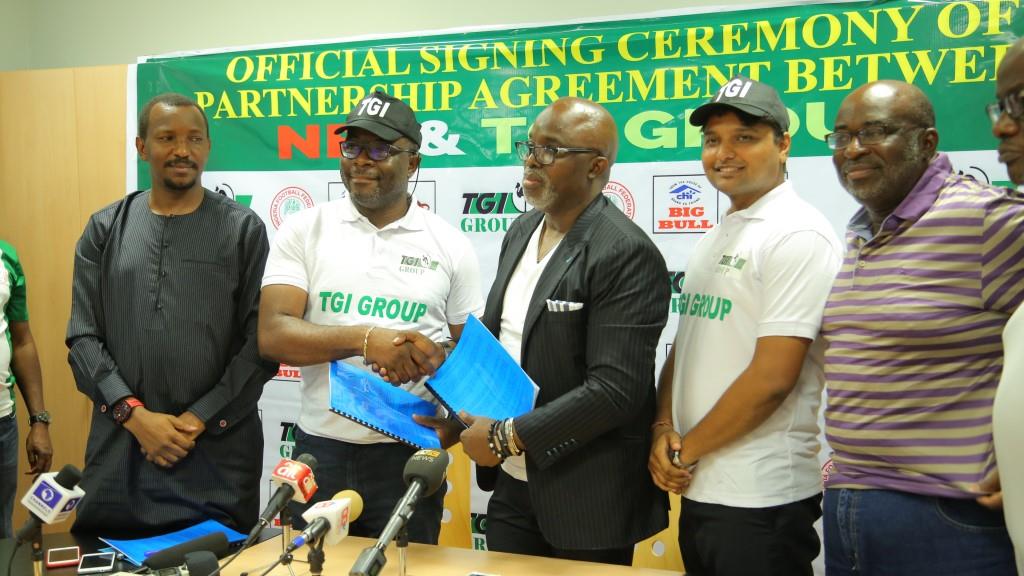
TGI Group Seals Food Sponsorship Deal With NFF
By Modupe Gbadeyanka
An international investment and holding company with diversified interests and investments in Nigeria, Ghana, Republic of Benin, Morocco, UAE, South Africa, India and several other emerging markets, Tropical General Investments (TGI) Group, has announced a landmark agreement with the Nigerian Football Federation (NFF) to support the senior national football teams, in their quest to win laurels for Nigeria.
At a joint press briefing which took place at the Godswill Akpabio International Stadium in Uyo on Friday, the NFF unveiled the TGI Group as the official food sponsor of the Super Eagles for the next three years.
TGI Group is the parent company of WACOT Limited, Chi Limited and other companies, producers of household brands such as Big Bull Rice, CHIVITA, Hollandia Yoghurt and Renew Starch.
“We are enormously ecstatic to come on board as supporters of the Nigerian football national teams,” said Mr Onyekachi Onubogu, the Executive Director of TGI Group who represented the Group Managing Director, Mr Rahul Savara, “the sponsorship is a further demonstration of the commitment of our business to the development of Nigeria in all facets.”
“We strongly believe in our investments in the Agricultural value chain and its impact on the socio-economic development of Nigeria and this new partnership we are starting with the Nigerian Football Federation will allow us to expand our footprint to the development of football in the country.
“We are resolutely committed to increasing our investments in the Nigerian economy, increasing employment and local content while supporting the communities we operate in”.
Continuing, Mr Onubogu said, “The TGI Group has over three decades of experience in building local and regional sustainable businesses in fast moving consumer goods (FMCG), agriculture, agro-allied, healthcare, chemicals, etc.
He also disclosed that because of the agreement between his company and NFF, the TGI Group will be allowed to reward the best Nigerian player with the ‘Man of the Match’ award on the days of all qualifying matches.
It would be recalled that Vice President Yemi Osinbajo recently commissioned the integrated WACOT Rice Mill in Argungu, Kebbi State. The Vice President also commissioned the Edo State Fertilizer and Chemical Company Limited (ESFCCL), managed by WACOT Limited.
While emphasizing the unifying role of soccer in Nigeria, Mr Onubogu stated that the goal of his conglomerate is to ensure that the Super Eagles does not only qualify for the 2018 World Cup but that the team puts up an unprecedented impressive performance at the competition in Russia.
Speaking on behalf of the NFF, the President, Mr Amaju Pinnick commended the TGI Group for their timely support for the Senior National Male Football team while also appealing to other corporate organizations to emulate the gesture.
He further disclosed that with the sponsorship by TGI, the Board and Management of NFF are better convinced that the goal of participating and excelling in the 2018 World Cup by the Super Eagles will be a reality.
His words, “The coming on board of the TGI Group is going to be a tremendously exciting development for the team.
“The opportunity to have the support of TGI Group and the reward for the ‘Man of the Match’ will have a huge benefit, putting the team in the best place possible to achieve our goals.
“We also talk a lot about creating memories and no doubt working with TGI Group will create some fantastic memories.”
Economy
Senate Passes Bill to Rename NAICOM as Insurance Regulatory Commission
By Adedapo Adesanya
The Senate has passed a bill to repeal and re-enact the law establishing the National Insurance Commission (NAICOM), paving the way for the regulatory agency to be renamed the Insurance Regulatory Commission (IRC).
The legislation, titled the Insurance Regulatory Commission (Establishment) Bill, 2026, was passed after the Senate considered and adopted the report of its committee on banking, insurance and other financial institutions.
The Chairman of the committee, Mr Adetokunbo Abiru, the senator representing Lagos East, who presented the report, stated that the proposed legislation was necessary because the existing National Insurance Commission Act of 1997 had become outdated and no longer reflected the realities of Nigeria’s evolving insurance industry or global regulatory standards.
According to the Senate, the decision to change the Commission’s name was informed by the need to eliminate confusion associated with the existing designation and to better reflect the institution’s regulatory mandate within Nigeria’s insurance industry.
The bill also provides legal protection for the commission and its officers against adverse claims arising from the lawful execution of their statutory duties.
However, he noted that the commission’s enabling law had become obsolete, exposing significant regulatory gaps that required urgent legislative intervention.
‘The current National Insurance Commission Act 1997 is outdated and does not adequately address the emerging economic growth, needs and development of the insurance business,” the lawmaker said.
He explained that the new legislation seeks to strengthen the independence of the commission by empowering it to make regulatory decisions without undue influence in the country’s insurance sector.
According to him, the bill also enhances the commission’s authority to exchange information and collaborate with domestic and international regulatory bodies, issue regulations, guidelines, standards and directives on insurance-related matters, and intervene more effectively in financially distressed insurance companies to protect policyholders and preserve financial stability.
This marks yet another move to strengthen the country’s insurance sector following the enactment of the Nigerian Insurance Industry Reform Act (NIIRA) of 2025 and the industry-wide recapitalisation exercise, which will wrap up by July 31.
Economy
143 Firms Jostle for 50 Oil, Gas Blocks at NUPRC Commercial Bid Conference
By Adedapo Adesanya
About 143 companies that successfully passed the technical and prequalification stages of the Nigerian Upstream Petroleum Regulatory Commission’s (NUPRC) 2025 Licensing Round will, today, compete for 50 oil and gas blocks at the commercial bid conference in Abuja, the final stage in the allocation process for the assets.
The commission said only the prequalified companies have been invited to attend the event, which will hold at the Conference Centre of the Transcorp Hilton Hotel, Abuja, stressing that participation is strictly by invitation.
The commercial bid conference will determine the successful bidders for oil and gas assets located across Nigeria’s producing and frontier basins.
The 50 blocks comprise 16 onshore blocks and 18 shallow water blocks in the Niger Delta, one deep offshore block, three onshore blocks in the Benin Basin, four in the Anambra Basin, four in the Chad Basin, and four in the Benue Trough.
According to the commission, the winning bids will be determined through a transparent evaluation process based on clearly defined commercial parameters. These include the signature bonus offered by bidders, the proposed work programme commitment and the level of performance security provided. The final selection will be based on a weighted technical and commercial score.
The licensing round is being conducted under the provisions of the Petroleum Industry Act (PIA) 2021, which requires a transparent and competitive process for the award of petroleum assets.
NUPRC had announced the commencement of the 2025 Licensing Round on November 11, 2025, before opening the online bid portal on December 1, 2025, to enable interested companies to register and participate in the exercise.
To ensure prospective investors fully understood the requirements, the commission organised a pre-bid conference on January 14, 2026, at Eko Hotels and Suites, Lagos. The event provided detailed explanations on the licensing guidelines and bidding procedures to registered participants and other stakeholders.
Registration and submission of prequalification documents closed on February 27, 2026, while the prequalification evaluation was completed on March 16, 2026.
NUPRC disclosed that 286 companies initially submitted applications for prequalification.
Following the evaluation process, 196 companies were cleared to participate in the technical and commercial bid stages.
The prequalified 143 companies eventually submitted a total of 200 bids for the available oil and gas blocks. These companies are now set to compete at the commercial bid conference, where the financial offers will be opened and evaluated to determine the eventual winners.
The licensing round is expected to attract fresh investment into Nigeria’s upstream petroleum sector, boost exploration activities across both producing and frontier basins, increase crude oil and gas reserves, and support the country’s drive to grow production and government revenue.
It also underscores the regulator’s commitment to implementing a transparent, competitive and investor-friendly licensing regime under the Petroleum Industry Act.
Economy
CBN Retains Interest Rate at 26.5% as MPC Holds All Policy Parameters
By Adedapo Adesanya
The Monetary Policy Committee (MPC) of the Central Bank of Nigeria (CBN) has retained all key monetary policy parameters following the conclusion of its two-day meeting on July 21, 2026, on Tuesday, maintaining its tight monetary policy stance to curb inflation and support macroeconomic stability.
According to the Governor of the apex bank, Mr Yemi Cardoso, who chaired the committee, the Monetary Policy Rate (MPR), which serves as the benchmark interest rate, remains at 26.50 per cent. The MPC also retained the asymmetric corridor around the MPR at +50 basis points and -450 basis points.
In addition, the Cash Reserve Ratio (CRR) for commercial banks was left unchanged at 45.00 per cent, while the CRR for merchant banks remains at 16.00 per cent. The committee also retained the CRR on non-Treasury Single Account (Non-TSA) public sector deposits at 75.00 per cent, with the liquidity ratio at 30.00 per cent.
The decision reflects the apex bank’s continued commitment to containing inflationary pressures through a restrictive monetary policy while safeguarding the resilience of Nigeria’s financial system amid ongoing macroeconomic adjustments.
By keeping all policy tools unchanged, the MPC signalled its intention to continue managing excess liquidity in the banking sector and maintain stability in financial markets.
The move is also expected to provide greater policy certainty for investors and businesses monitoring the country’s monetary policy direction.
The latest decision also means borrowing costs are likely to remain elevated in the near term as the central bank continues to prioritise price stability over monetary easing.
Analysts had expected the CBN committee to retain the rate after Nigeria’s headline inflation came in at 15.91 per cent as of June 2026, marking a slight decline from 15.93 per cent in May.
However, even as overall price growth has moderated significantly compared to previous periods, food inflation remains a persistent challenge, accelerating to 17.52 per cent in June.