

Economy
Top 3 Bitcoin DeFi Platforms You Should Check Out
Bitcoin DeFi is a relatively new concept that leverages Bitcoin layers and smart contracts to build decentralized financial applications. These DeFi platforms offer a variety of financial services, including lending, borrowing, trading, and more.
Unlike traditional finance, Bitcoin DeFi operates on a decentralized network, eliminating the need for banks, brokers, and other centralized institutions, while allowing anyone with an internet connection and a digital wallet to participate in the crypto markets.
3 Leading DeFi Platforms Built on Bitcoin
Bitcoin doesn’t natively support smart contracts, but layer 2 solutions like Rootstock (RSK), Build on Bitcoin (BoB), and Stacks bring smart contract capabilities to Bitcoin.
These platforms integrate Bitcoin’s robust security with the flexibility of decentralized applications (dApps), enabling DeFi functionality like those found on Ethereum. This enables consumers to access services like lending, borrowing, and trading. They can even buy runes tokens and other new tokens built on Bitcoin through these platforms.
While DeFi platforms built on Bitcoin perform different functions based on why the platform was built, they fill vital consumer needs or gaps in the ecosystem.
Let’s look at the three leading Bitcoin DeFi platforms to see what the market leaders in the ecosystem have to offer.
Sovryn
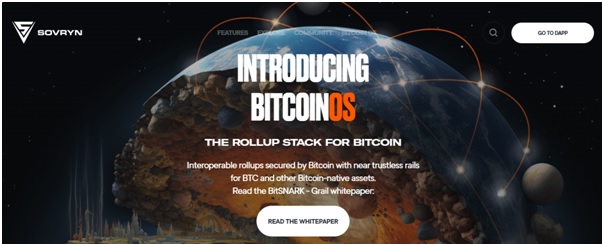
Sovryn is a decentralized finance platform built on Rootstock (RSK) and Build on Bitcoin (BoB). The platform provides a broad suite of DeFi services to Bitcoin users, empowering them to trade, earn interest, and access liquidity using BTC directly.
Sovryn offers users several core DeFi services, including:
- Decentralized trading: Sovryn supports decentralized spot and margin trading. Users can trade directly from their wallets with no need for intermediaries, maintaining full control of their assets.
- Lending and borrowing: Sovryn allows Bitcoin holders to earn interest by lending their BTC or borrowing funds using BTC as collateral. The lending protocol operates in a decentralized manner, meaning the platform acts as a facilitator but not a custodian.
- Liquidity provision: Users can provide liquidity to Sovryn’s decentralized exchange and earn rewards, typically in the form of trading fees or the platform’s native token, SOV.
- Staking: Sovyrn users can also earn staking rewards by depositing SOV.
Pros
- Offers a wide range of decentralized financial services
- Leverages Bitcoin’s security, making it less vulnerable to attacks
- Non-custodial, so users retain control of their private keys and assets
Cons
- Might be complex for new users
ALEX
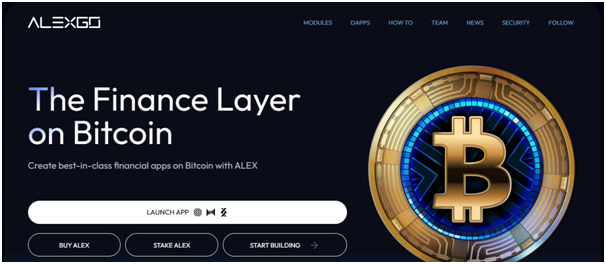
ALEX is a DeFi platform built on the Stacks blockchain, a layer 2 protocol that connects to Bitcoin. ALEX seeks to build a comprehensive DeFi ecosystem where users can trade, lend, and borrow Bitcoin-based assets on Stacks.
The platform’s DeFi services include:
- Decentralized trading: ALEX offers a decentralized exchange (DEX) allowing permissionless trading of Bitcoin-backed assets, including stablecoins and other cryptocurrencies. The platform supports spot trading with a focus on maintaining liquidity for Bitcoin users.
- Lending and borrowing: Through ALEX, users can lend assets to earn interest or borrow against their Bitcoin holdings. These decentralized lending services are a key feature for users who want to access liquidity without selling their BTC.
- Yield farming and staking: ALEX provides opportunities for yield generation, where users can earn rewards by staking assets and providing liquidity to the platform’s pools.
Pros
- Supports a wider range of tokens than other Bitcoin DeFi platforms
- Benefits from an increasingly integrated ecosystem as Stacks keeps developing
Cons
- Relatively slower than other networks, impacting trading speeds and overall user experience
- Complex for new users
Velar
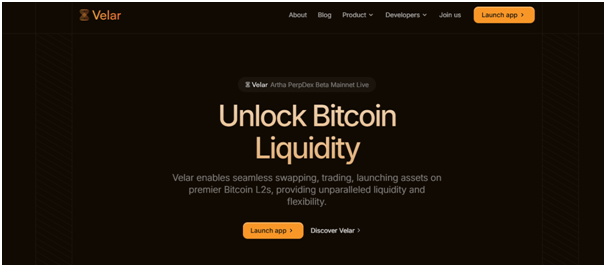
Velar is a newcomer to the Bitcoin DeFi scene, aiming to bring advanced decentralized finance functionality to Bitcoin users in a seamless and scalable way.
Built on Stacks, Velar offers decentralized trading, token launches and more.
Velar’s key features include:
- Decentralized lending and borrowing: Velar’s primary focus is providing efficient lending and borrowing services for bitcoin and other assets. Users can lock up their bitcoin to borrow other assets or lend out bitcoin to earn interest.
- Synthetic asset creation: Velar also enables the creation of synthetic assets, which are tokenized versions of real-world assets that track the value of their physical counterparts. This feature allows users to gain exposure to traditional markets while operating within a decentralized Bitcoin DeFi ecosystem.
- Liquidity pools: Like other DeFi platforms, Velar allows users to provide liquidity to decentralized pools and earn rewards.
Pros
- Synthetic assets on the platform offer more diverse ways to interact with the platform and manage their portfolios
- Benefits from Bitcoin’s security while maintaining faster transaction speeds than the Bitcoin base layer.
- User-friendly interface making DeFi services accessible even to new users
Cons
- Lower liquidity compared to more established DeFi platforms
- May be too complex for new users
Wrapping Up
Bitcoin DeFi is still in its early stages, but platforms like Sovryn, ALEX, and Velar are proving that decentralized financial services can thrive on Bitcoin.
Whether you’re looking for non-custodial trading, decentralized lending, or even exposure to synthetic assets, each of these platforms brings something unique to the table.
Whether you’re a long-time Bitcoin holder or new to DeFi, these platforms are worth exploring as you dive into the future of decentralized finance on Bitcoin.
Economy
OTC Securities Exchange Sustains Bullish Run With 1.18% Appreciation
By Adedapo Adesanya
The NASD Over-the-Counter (OTC) Securities Exchange extended rallied by 1.18 per cent on Friday, May 8, its fifth in a row for this week.
During the session, the market capitalisation increased by N28.96 billion to N2.488 trillion from N2.459 trillion, and the NASD Unlisted Security Index (NSI) jumped by 48.39 points to 4,158.77 points from the 4,110.38 points recorded a day earlier.
The growth witnessed yesterday was spurred by the gains recorded by six securities, led by 11 Plc, which chalked up N11.00 to sell at 221.10 per unit versus Thursday’s closing price of N210.10 per unit. FrislandCampina Wamco Nigeria Plc added N10.26 to close at N132.98 per share compared with the previous day’s N127.06 per share, and Central Securities Clearing System (CSCS) Plc rose by N2.82 to N75.90 per unit from N73.08 per unit.
In addition, Lighthouse Financial Services Plc appreciated by 7 Kobo to 86 Kobo per share from 81 Kobo per share, UBN Property Plc climbed higher by 5 Kobo to N2.25 per unit from N2.20 per unit, and First Trust Mortgage Bank Plc gained 2 Kobo to close at N2.32 per share, in contrast to the previous session’s N2.30 per share.
Conversely, Geo-Fluids Plc went down by 20 Kobo to N2.90 per unit from N3.10 per unit, and Afriland Properties Plc lost 5 Kobo to end at N16.95 per share versus N17.00 per share.
The volume of transactions for the session surged by 41.8 per cent to 528,891 units from 372,916 units, and the value grew by 11.4 per cent to N34.0 million from N30.4 million, while the number of deals slid by 7.4 per cent to 25 deals from 27 deals.
The most traded stock by volume on a year-to-date basis was Great Nigeria Insurance (GNI) Plc, with 3.4 billion units worth N8.4 billion. Resourcery Plc occupied the second spot after trading 1.1 billion units valued at N415.7 million, and the third position was occupied by Infrastructure Guarantee Credit Plc with 400 million units sold for N1.2 billion.
The most traded stock by value on a year-to-date basis was GNI Plc with 3.4 billion units transacted for N8.4 billion, followed by CSCS Plc with 60.5 million units exchanged for N4.1 billion, and Okitipupa Plc with 27.8 million units traded for N1.9 billion.
Economy
Demand for Dangote Cement, Others Lifts Stock Exchange by 2.10%
By Dipo Olowookere
The local stock exchange reversed the previous day’s loss, with a 2.10 per cent surge on Friday as a result of demand for large-cap equities like Dangote Cement, First Holdco and others.
It was observed that apart from the insurance counter, which shed 0.37 per cent, every other sector closed higher yesterday.
The industrial goods index expanded by 7.26 per cent, the banking segment increased by 3.35 per cent, the consumer goods industry rose by 0.21 per cent, and the energy sector soared by 0.14 per cent.
Consequently, the All-Share Index (ASI) of the Nigerian Exchange (NGX) Limited improved by 5,041.22 points to 244,775.83 points from 239,734.61 points, and the market capitalisation added N3.235 trillion to settle at N157.094 trillion compared with the preceding session’s N153.859 trillion.
The quintet of Neimeth, Cadbury Nigeria, LivingTrust Mortgage Bank, Mecure, and Dangote Cement led the advancers’ table on Friday, with 10.00 per cent growth each to quote at N9.90, N72.60, N3.52, N72.60, and N1,088.00, respectively.
On the flip side, the duo of UAC Nigeria and Industrial and Medical Gases lost 10.00 per cent each to sell for N171.00 and N42.30, respectively, as Eterna declined by 9.93 per cent to N33.55, Learn Africa slipped by 9.89 per cent to N8.20, and Deap Capital tripped by 9.69 per cent to N5.50.
The most active stock for the day was VFD Group, with a turnover of 102.9 million units valued at N1.1 billion. FCMB transacted 99.4 million units worth N1.1 billion, UBA traded 94.5 million units for N3.8 billion, Access Holdings exchanged 85.4 million units worth N2.0 billion, and Zenith Bank sold 46.5 million units valued at N5.8 billion.
At the close of trades, market participants traded 1.1 billion units worth N55.0 billion in 69,996 deals, in contrast to the 1.8 billion units valued at N72.2 billion transacted in 81,131 deals a day earlier, showing a crash in the trading volume, value, and number of deals by 38.89 per cent, 23.82 per cent, and 13.73 per cent, respectively.
Economy
Naira Loses N5.54 Against Dollar at NAFEX
By Adedapo Adesanya
The Naira fell against the US Dollar by N5.54 or 0.41 per cent to N1,361.39/$1 from N1,355.85/$1 in the Nigerian Autonomous Foreign Exchange Market (NAFEX) on Friday, May 8.
The domestic currency also depreciated against the Pound Sterling in the official market during the session by N8.50 to trade at N1,853.68/£1 compared with the previous day’s N1,845.18/£1, and against the Euro, it lost N9.37 to sell for N1,602.63/€1 versus N1,593.26/€1.
However, at the GTBank FX desk, the Nigerian Naira appreciated against the US Dollar yesterday by N3 to quote at N1,372/$1 compared with Thursday’s closing value of N1,375/$1, and at the parallel market, it traded flat at N1,380/$1.
Despite the volatile outcome of the local currency, it remained within the expected trading range, reflecting sustained FX stabilisation efforts by the Central Bank of Nigeria (CBN), supported by improved liquidity, stronger autonomous inflows, and better price discovery.
Traders point to further gains for the Naira into the coming week, thanks to Dollar supply from foreign investors, exporters and oil companies, while demand is moderate. Nigerian yields are still attractive for foreign investors, serving as a basis for more (FX) flows coming to Nigeria.
Meanwhile, the country’s external reserves dropped by 3.4 per cent to $48.32 billion, from a 2009 high of $50.02 billion recorded on March 11.
In the cryptocurrency market, prices rallied after worries eased, following fresh US airstrikes in Iran that initially sparked a surge in oil prices and a broader risk-off move across crypto markets.
Bitcoin (BTC) added 0.8 per cent to sell at $80,212.54, Solana (SOL) gained 6.5 per cent to sell at $93.76, Cardano (ADA) appreciated by 5.1 per cent to $0.2749, Dogecoin (DOGE) grew by 3.7 per cent to $0.1102, and Ripple (XRP) rose by 3.1 per cent to $1.42.
Further, Binance Coin (BNB) jumped 2.3 per cent to $650.16, Ethereum (ETH) expanded by 1.6 per cent to $2,315.48, and TRON (TRX) increased by 0.1 per cent to $0.3515, while the US Dollar Tether (USDT) and the US Dollar Coin (USDC) remained unchanged at $1.00 apiece.
-
Feature/OPED6 years agoDavos was Different this year
-
Travel/Tourism10 years ago
Lagos Seals Western Lodge Hotel In Ikorodu
-
Showbiz3 years agoEstranged Lover Releases Videos of Empress Njamah Bathing
-
Banking8 years agoSort Codes of GTBank Branches in Nigeria
-
Economy3 years agoSubsidy Removal: CNG at N130 Per Litre Cheaper Than Petrol—IPMAN
-
Banking3 years agoSort Codes of UBA Branches in Nigeria
-
Banking3 years agoFirst Bank Announces Planned Downtime
-
Sports3 years agoHighest Paid Nigerian Footballer – How Much Do Nigerian Footballers Earn

