Connect with us

Economy

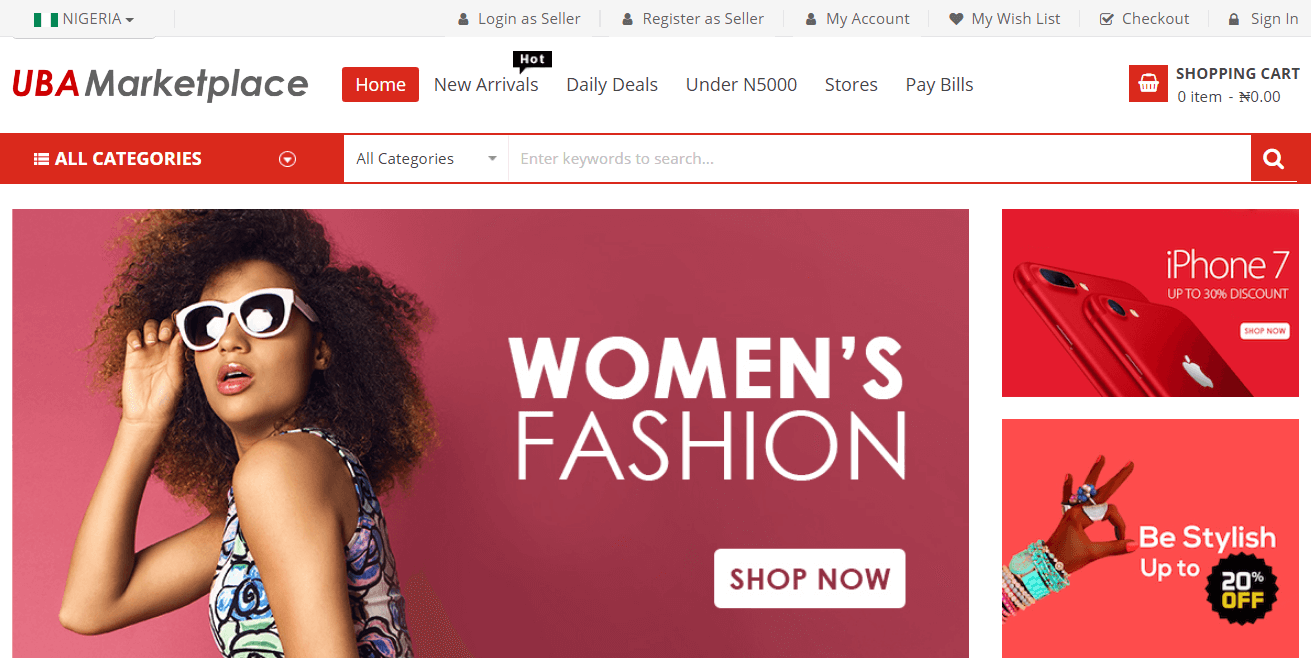
UBA Marketplace 2019 Kicks Off Friday

Published

on

By Adedapo Adesanya

Africa’s leading financial institution, United Bank for Africa (UBA) Plc is set to play host to over 20,000 visitors, 100 small and medium enterprises and leading private and public sector players from across Africa, at the continent’s biggest entrepreneurial fair tagged #theUBAmarketplace2019 in Abuja, Nigeria.

The event which is scheduled to hold on July 26th and 27th 2019, on the sideline of the Tony Elumelu Entrepreneurship Forum, the largest gathering of the entrepreneurship ecosystem in Africa, will host businesses and business owners in various industries ranging from food, fashion, beauty, home/interior and gadgets.

The event will offer plenary sessions and discussions on the small and medium scale enterprises (SMEs) sector and the relevance of financing.  The plenary sessions will highlight entertainment and music industries. Likewise, fashion, a big cultural and revenue attraction on the continent, will be showcased with the designs of 10 leading African labels.

At the master-class sessions to be held during the UBAmarketplace2019, small and medium scale businesses will have opportunity to network and get solutions to some of the challenges they face in running their businesses.

Also, selected beneficiaries of the Tony Elumelu Foundation will be presented a platform to pitch their businesses with a grand prize of a grant, courtesy of UBA.

The Group Managing Director, Kennedy Uzoka, speaking about the event, stated “UBA has always been at the forefront of entrepreneurship across Africa, undertaking many projects aimed at contributing to supporting Africa’s growth and economic integration. The birth of the UBAmarketplace and this entrepreneurial fair is a testament to our commitment to African SMEs”

Uzoka added that with the fair, UBA seeks to touch base with small business owners while positively affecting the lives of entrepreneurs doing business in its countries of operations and beyond’.

“I think everyone realises the fact that we need to prioritise the private sector. We need to encourage entrepreneurship and the youths. This is the driving factor and the major reason why we are organizing an event of this magnitude’ he said.

UBA’s REDTV will light up the Redzone at the UBA marketplace with entertainment featuring Africa’s star boy Wizkid; DJ Cuppy and many more.


Adedapo Adesanya is a journalist, polymath, and connoisseur of everything art. When he is not writing, he has his nose buried in one of the many books or articles he has bookmarked or simply listening to good music with a bottle of beer or wine. He supports the greatest club in the world, Manchester United F.C.

Click to comment

Leave a Reply

Your email address will not be published. Required fields are marked *

Economy

Sell-Offs in GTCO, First Holdco Crash NGX All-Share Index by 0.62%

Published

on

NSE All-Share Index

By Dipo Olowookere

The local stock exchange remained in the red on Friday after it further depreciated by 0.62 per cent due to panic sell-offs in some bellwether equities.

NAHCO lost 10.00 per cent to trade at N148.50, Royal Exchange depreciated by 10.00 per cent to N1.53, GTCO slumped by 9.97 per cent to N115.55, First Holdco dropped 9.84 per cent to quote at N55.00, and Neimeth slipped by 9.60 per cent to N28.12.

On the flip side, Deap Capital increased by 9.89 per cent to N4.89, RT Briscoe expanded by 9.62 per cent to N13.10, International Energy Insurance advanced by 7.43 per cent to N5.06, Jaiz Bank gained 7.14 per cent to sell for N9.00, and Living Trust Mortgage Bank rose by 5.26 per cent to N4.00.

During the session, the energy index chalked up 2.35 per cent, but this was not enough to lift the Nigerian Exchange (NGX) Limited when the closing gong was struck by 4 pm to signify the close of trading activities.

This was because the banking sector lost 4.41 per cent, the insurance counter shed 1.52 per cent, the industrial goods space declined by 0.71 per cent, and the consumer goods segment tumbled by 0.13 per cent.

Consequently, the All-Share Index (ASI) contracted by 1,463.45 points to 235,941.27 points from 237,404.92 points, and the market capitalisation retreated by M939 billion to N151.327 trillion from N152.266 trillion.

The activity chart was topped by Access Holdings, which posted a turnover of 65.0 million shares valued at N1.5 billion. Zenith Bank sold 35.2 million stocks worth N3.9 billion, Sterling Holdings exchanged 28.4 million equities for N217.8 million, UBA transacted 16.3 million shares valued at N650.7 million, and GTCO traded 14.0 million stocks worth N1.8 billion.

In all, investors transacted 440.4 million equities for N24.7 billion in 50,273 deals, in contrast to the 691.6 million equities valued at N116.9 billion traded in 50,025 deals on Thursday, implying an uptick in the number of deals by 0.50 per cent, and a decrease in the trading volume and value by 36.32 per cent and 78.87 per cent, respectively.

Continue Reading

Economy

Naira Crashes to N1,370/$ at Official Market, N1,390/$1 at Black Market

Published

on

forex Black Market

By Adedapo Adesanya

The Naira again depreciated against the United States Dollar by N7.16 or 0.53 per cent in the Nigerian Autonomous Foreign Exchange Market (NAFEX) on Friday, June 19, to N1,370.46/$1 from the previous day’s N1,363.30/$1.

In the same vein, the Nigerian currency lost N9.07 against the Pound Sterling at the official market yesterday to trade at N1,814.76/£1 compared with Thursday’s closing price of N1,805.69/£1, and crashed against the Euro by N6.43 to settle at N1,571.50/€1 versus N1,565.07/€1.

Also, the Naira weakened against the greenback in the black market during the session by N5 to sell for N1,390/$1, in contrast to the preceding day’s N1,385/$1, and at the GTBank FX desk, it shed N3 to close at N1,376/$1 versus N1,373/$1.

The official market’s FX liquidity has been facing pressure over the last three trading sessions, contributing to a decline in the official exchange rate due to rising demand for foreign payments.

FX reserves rose to $51.03 billion, the highest level since January 20, 2009, according to data obtained from the Central Bank of Nigeria (CBN). The figure also represents the highest since the beginning of the year and under the administration of the current Governor of CBN, Mr Yemi Cardoso.

The latest figure underscores the steady strengthening of Nigeria’s external buffers, which continues to reinforce investor confidence in the Nigerian economy and support exchange rate stability.

Meanwhile, the cryptocurrency market was mixed, with Bitcoin (BTC) up by 0.8 per cent to $63,225.80 after trading activity was relatively subdued due to a US federal holiday, as the absence of stock and bond market activity led to quieter conditions across crypto markets, even though digital assets continue to trade around the clock.

Further, TRON (TRX) also gained 0.8 per cent to sell at $0.3230, Binance Coin (BNB) jumped 0.5 per cent to $579.84, and Ethereum (ETH) appreciated by 0.1 per cent to $1,704.23.

On the flip side, Ripple (XRP) declined by 0.9 per cent to $1.13, Cardano (ADA) shed 0.8 per cent to trade at $0.1611, Solana (SOL) fell by 0.1 per cent to $69.23, and Dogecoin (DOGE) slipped by 0.1 per cent to $0.0831, while the US Dollar Tether (USDT) and the US Dollar Coin (USDC) remained unchanged at $1.00 each.

Continue Reading

Economy

Brent Rises to $80 as Israel, Hezbollah Agree Ceasefire

Published

on

Brent crude oil price

By Adedapo Adesanya

Brent crude gained 66 cents or 0.53 per cent to sell for $80.38 per barrel ​on Friday after Israel and Hezbollah agreed on a ceasefire in Lebanon, though Iran set conditions for using the vital Strait of Hormuz.

Also, the US West Texas Intermediate (WTI) crude was up 94 cents or 1.23 per cent to $77.54 per barrel, amid light trading volumes due to the US Juneteenth holiday.

In spite of Friday’s gains, Brent was down about 8 per cent week-over-week, ​reflecting a significant easing of supply concerns in the wake of the US-Iran deal to end the war.

Gulf producers were preparing to raise exports after Israel and Hezbollah agreed to a ceasefire, ​which began on Friday.

Israel and Hezbollah agreed to halt fighting in southern Lebanon after days of escalating clashes threatened to derail the fragile US-Iran peace process, reducing the risk that the first major test of the agreement would turn into its first major failure.

At least four tankers carrying crude, oil products and liquefied petroleum gas (LNG) entered the ​Strait of Hormuz on Friday, heading for Iraqi Gulf ports. However, despite the uptick in activity, Iran signalled ⁠tighter control over shipping.

Iran’s Persian Gulf Strait Authority said “no vessel is permitted to pass through the Strait of Hormuz without a valid ​passage permit issued by the PGSA”.

Concerns also remain as a planned meeting between Iranian and American officials in Switzerland on Friday was postponed, with arrangements underway for talks in the coming days.

Iran’s Foreign Ministry said the meeting was no longer urgent because a memorandum of understanding on ending the war had already been signed digitally between the two sides.

Analysts expect ​the deal to release more than 85 million ​barrels of oil stranded in the ⁠Middle East Gulf into global markets. The agreement also includes the lifting of US sanctions on Iranian oil, which would add more supply.

However, recovery in flows of supply that transits Hormuz and production after the US-Iran ​deal could take several months.

On the demand front, the Organisation of the Petroleum Exporting Countries (OPEC) said in its 2026 World Oil Outlook that world ​demand will rise to 113.3 million barrels per day in 2030 from 105.1 million barrels per day in 2025.

Continue Reading

Trending