Connect with us

Economy

Uganda Commissions East Africa’s Largest Solar Plant

Published

on

By Dipo Olowookere

A solar power plant has been inaugurated on Monday, December 12, 2016, in Soroti, Uganda amid pomp and pageantry.

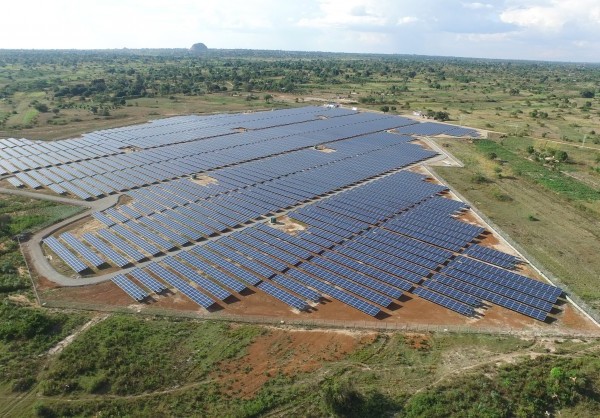
It is made up of 32,680 photovoltaic panels and the new 10 megawatt facility is the country’s first grid-connected solar plant and will generate clean, low-carbon, sustainable electricity to 40,000 homes, schools and businesses in the area.

Located on a 33 acre plot of land in Soroti District, the power plant has the potential to increase its net output capacity by a further 20MW of solar energy. At peak construction the plant had over 120 local workers involved, including engineers recruited and trained by Access Power and EREN RE.

Present at the commissioning today were Minister of State for Energy, D’Ujanga Simon, together with representatives of Access Power, EREN RE and donors.

The project was developed under the Global Energy Transfer Feed in Tariff, a dedicated support scheme for renewable energy projects managed by Germany’s KfW Development Bank in partnership with Uganda’s Electricity Regulatory Agency (ERA) and funded by the governments of Norway, Germany, the United Kingdom and the European Union.

The GET FiT programme helps renewable energy sources become more affordable and therefore more accessible in Eastern Africa.

The $19 million Soroti Solar Plant is in part funded by the European Union – Africa Infrastructure Trust Fund through the GET FiT Solar Facility equivalent to 8.7 million euros in the form of result-based premium payments per kWh of delivered electricity.

The project is financed by a mix of debt and equity with the senior debt facility being provided by FMO, the Netherlands Development Bank, and the Emerging Africa Infrastructure Fund (EAIF).

Ambassador Kristian Schmidt, European Union Head of Delegation to Uganda said in his speech: “Uganda is a good place to invest in solar energy. The regulatory framework is conducive and Government rightly recognises Uganda’s energy future must be renewable. It is great that this is now triggering private sector interest in solar power generation. The European Union is proud that our grant contribution ensures the realisation of the Soroti Solar Plant, and I hope this is only just the beginning for many more to come.”

The ERA Chief Executive Officer, Eng. Ziria Tibalwa noted, “that the Access Solar Uganda 10MW grid connected solar P.V project we are launching today is so far the largest in the East African region. We are so proud of this outcome of our stable and favorable regulatory environment that has produced such a leading project in the East African Region. We congratulate Access Solar and the people of Uganda upon this milestone.”

David Corchia, CEO, EREN RE, stated: “Soroti solar plant is an excellent textbook example of how collaboration among key local and international stakeholders can result in the successful execution and completion of such a ground breaking project and in tangible progress in the spread of renewable energy across Africa. We wish to express our gratitude and thanks to the organizations and individuals who made the construction of the largest solar power plant in East Africa possible. As a global renewable energy Independent Power Producer we take this opportunity to reaffirm our commitment to the African power sector and we look forward to replicating this model in many other African countries in other districts in Uganda and across the region.”

Reda El Chaar, Executive Chairman, Access Power declared, “We are thrilled to have been given the opportunity to work with our European and Ugandan partners to bring to reality this flagship solar power plant. Soroti raises the bar on what can be achieved through teamwork and we look forward to more collaborative efforts to expand the footprint of clean energy across this mighty continent.”

Jennie Barugh, Head DFID Uganda on the impact of GET FiT:  “As an outward-looking nation, the UK fully supports Uganda in its effort to become a middle income country, with bilateral support of £110m this year. Power is an important enabler of development. GET FiT has helped to demonstrate the success of private sector led renewable energy projects; reducing costs to the government and increasing supply to help the people of Uganda to improve livelihoods and economic empowerment, especially for women and girls, so they can stand on their own two feet. Uganda has led the way in this sector and we expect other African nations to learn from and build on the successes of GET FiT. The Soroti plant is also one of the eight renewable energy projects in Uganda to have benefited from the UK Aid supported Emerging Africa Infrastructure Fund (EAIF) – part of the multilateral Private Infrastructure Development Group (PIDG).  The UK is committed to supporting and improving the lives of Ugandans – with the vast majority (80%) living without access to clean modern energy – helping Uganda leave aid dependency behind.”

Linda Broekhuizen, CIO of FMO Dutch development bank, underlines the importance of the project: “FMO is a proud supporter of this project. Renewable energy projects like these are fully in line with our aim to positively affect peoples’ lives by supporting development, creating jobs and providing clean and sustainable energy to Uganda.”

Oscar Kang’oro, a Non-Executive Director of the Emerging Africa Infrastructure Fund (EAIF) confirms EAIF’s commitment to supporting solar and small hydro power projects in Uganda: “EAIF is fully engaged in Uganda and to date financed 8 renewable energy projects in the country, including Soroti. I particularly want to congratulate Access and EREN on their vision and enterprise. Our funders at the UK government’s DFID, at The Netherlands DGIS, Switzerland’s SECO and Sweden’s SIDA, see the great benefits that small and renewable generating capacity can bring, particularly in rural and semi-rural areas. This can unlock economic potential, create new economic development opportunities, grow the productivity of public services and improve energy security. Most importantly, the arrival in a district of more dependable and more affordable electricity can transform and enhance the lives of many thousands of men, women and children.”


Dipo Olowookere is a journalist based in Nigeria that has passion for reporting business news stories. At his leisure time, he watches football and supports 3SC of Ibadan. Mr Olowookere can be reached via [email protected]

Economy

NASD OTC Exchange Inches Up 0.03% as CSCS Outshines Four Price Decliners

Published

on

Nigerian OTC securities exchange

By Adedapo Adesanya

Central Securities Clearing System (CSCS) Plc bested four price decliners on the NASD Over-the-Counter (OTC) Securities Exchange on Monday, April 27. The alternative stock market opened the week bullish during the session with a 0.03 per cent uptick.

According to data, the security depository company added N2.61 to its share price to close at N76.26 per unit compared with the preceding session’s N78.87 per unit.

As a result, the market capitalisation of the platform increased by N820 million to N2.425 trillion from N2.424 trillion, and the NASD Unlisted Security Index (NSI) gained 1.38 points to finish at 4,053.97 points compared with the 4,052.58 points it ended last Friday.

The four price losers were led by NASD Plc, which slumped by N3.80 to sell at N34.70 per share versus N38.50 per share. FrieslandCampina Wamco Nigeria Plc fell by N1.45 to N98.10 per unit from N99.55 per unit, Food Concepts Plc slid by 27 Kobo to N2.43 per share from N2.70 per share, and Geo-Fluids Plc dipped by 9 Kobo to N2.91 per unit from N3.00 per unit.

The value of securities transacted by market participants went down by 82.0 per cent to N7.4 million from N41.3 million units, the volume of securities declined by 28.5 per cent to 319,831 units from 447,403 units, and the number of deals dropped by 34.1 per cent to 29 deals from 44 deals.

Great Nigeria Insurance (GNI) Plc was the most active stock by value on a year-to-date basis with 3.4 billion units worth N8.4 billion, followed by CSCS Plc with 59.6 million units sold for N4.0 billion, and Okitipupa Plc with 27.8 million units exchanged for N1.9 billion.

Also, GNI Plc was the most traded stock by volume on a year-to-date basis with 3.4 billion units valued at N8.4 billion, followed by Resourcery Plc with 1.1 billion units traded for N415.7 million, and Infrastructure Guarantee Credit Plc with a turnover of 400 million units worth N1.2 billion.

Continue Reading

Economy

Naira Opens Week Weaker at N1,364/$ at NAFEX After N5.80 Loss

Published

on

NAFEX Rate

By Adedapo Adesanya

The first trading day of the week in the currency market was bearish for the Naira in the Nigerian Autonomous Foreign Exchange Market (NAFEX) on Monday, April 27.

Yesterday, it lost N5.80 or 0.43 per cent against the United States Dollar to trade at N1,364.24/$1, in contrast to the N1,358.44/$1 it was traded last Friday.

In the same vein, the Nigerian currency depreciated against the Pound Sterling in the official market by N13.70 to close at N1,847.72/£1 versus the preceding session’s N1,834.02/£1, and slumped against the Euro by N11.56 to sell at N1,602.29/€1 versus N1,590.73/€1.

Also, the Nigerian Naira tumbled against the greenback during the trading day by N5 to quote at N1,385/$1 compared with the previous rate of N1,380/$1, and at the GTBank FX desk, it traded flat at N1,370/$1.

The poor performance of the domestic currency could be attributed to liquidity shortage at the official currency market on Monday, which came amid surging demand for international payments. At $76.50 million, interbank liquidity printed higher across 79 deals, up from the $43.572 million reported on Friday.

Nigeria’s gross external reserves declined to $48.45 billion amid a month-long decline in inflows, amid uncertainties in the global commodity market. The depletion of foreign reserves could be partly attributed to the Central Bank of Nigeria’s intervention in the FX market.

The market remains perturbed by persistent concerns over liquidity constraints, policy transparency, and weakening confidence in Nigeria’s FX market, while boosters, including oil prices, continue to look rocky due to stalled discussions and unclear ceasefire negotiations between the US and Iran.

A look at the cryptocurrency market, Bitcoin (BTC) has been rejected near $79,000 three times in eight sessions, leaving the level as the de facto ceiling of its current trading range even as major cryptocurrencies trade lower over the past day. It lost 0.9 per cent to sell at $77,003.61.

Analysts say that upcoming US Federal Reserve policy decisions and top tech firms’ earnings this week could provide the catalyst to push bitcoin decisively above $80,000.

The market also continued to weigh Iran’s interim deal proposal to reopen the Strait of Hormuz, which failed to advance over the weekend. The White House said US officials were discussing the latest Iranian proposal but maintained “red lines” on any deal to end the eight-week war.

Solana (SOL) dropped 1.8 per cent to $84.25, Ripple (XRP) went down by 1.6 per cent to $1.39, Ethereum (ETH) depreciated by 1.3 per cent to $2,290.00, Binance Coin (BNB) declined by 0.5 per cent to $625.18, and Cardano (ADA) fell by 0.2 per cent to $0.2480.

However, Dogecoin (DOGE) rose by 2.0 per cent to $0.1002, and TRON (TRX) appreciated by 0.2 per cent to $0.3242, while the US Dollar Tether (USDT) and the US Dollar Coin (USDC) remained unchanged at $1.00 apiece.

Continue Reading

Economy

NASCON Targets Deeper Cost Optimisation, Accelerated Digital Transformation, Others

Published

on

NASCON AGM shareholders

By Aduragbemi Omiyale

One of the leading salt makers in Nigeria, NASCON Allied Industries Plc, has set its eyes on some strategies aimed to deliver more value to shareholders.

The chief executive of the company, Mrs Aderemi Saka, said efforts are being made to surpass the performance of last year.

In the 2025 financial year, the organisation recorded a 27 per cent growth in revenue, while post-tax profit grew by over 100 per cent to N33.5 billion, with the earnings per share (EPS) expanding by 115 per cent to N12.41 from N5.77 Kobo in the previous year.

The impressive performance, attributed to a clear strategic vision, disciplined execution and sustained focus on cost-saving initiatives across production, logistics and fleet management, resulted in a 200 per cent increase in dividend payout to shareholders to N6 per share.

Mrs Saka, at the firm’s Annual General Meeting (AGM) in Lagos, said the strategic priorities for the coming year include deeper cost optimisation, expanded market penetration, strengthened energy diversification and sustainability initiatives, as well as accelerated digital transformation and process automation.

Earlier, the chairman of NASCON, Mr Olakunle Alake, informed shareholders that the achievements for last year were due to improved operational efficiency, strict cost management and the dedication of the company’s workforce.

“The operating environment in 2025 was characterised by economic volatility, persistent inflation and structural changes across key sectors. Yet, NASCON remained resilient and strategically focused, delivering outstanding value to shareholders,” Mr Alake said.

He noted that operational sustainability remains a core pillar of the organisation’s strategy, stressing that during the year, NASCON introduced Compressed Natural Gas (CNG) trucks into its logistics fleet to reduce fuel costs and minimise exposure to diesel price volatility.

In addition, the company’s state-of-the-art salt refinery, its largest production facility, now runs entirely on natural gas, significantly boosting efficiency while reinforcing NASCON’s commitment to environmental sustainability.

A director in the organisation, Mrs Tonya Lawani, emphasised that the firm remains firmly committed to the principles that have driven its excellent performance, noting that NASCON approaches the new financial year from a position of strength, with further opportunities for growth and improvement.

Speaking on behalf of shareholders, Mr Faruk Umar expressed strong confidence in the company’s trajectory, citing NASCON’s rising share price, which recently crossed the N100 mark, and projecting further appreciation.

He commended the quality of the Board and management team, noting that strong leadership and recent executive appointments have positioned the entity to deliver even greater value to all stakeholders.

Continue Reading

Trending