Economy
UN Deputy Scribe Urges Developing Countries to Embrace Green Bond

By Modupe Gbadeyanka
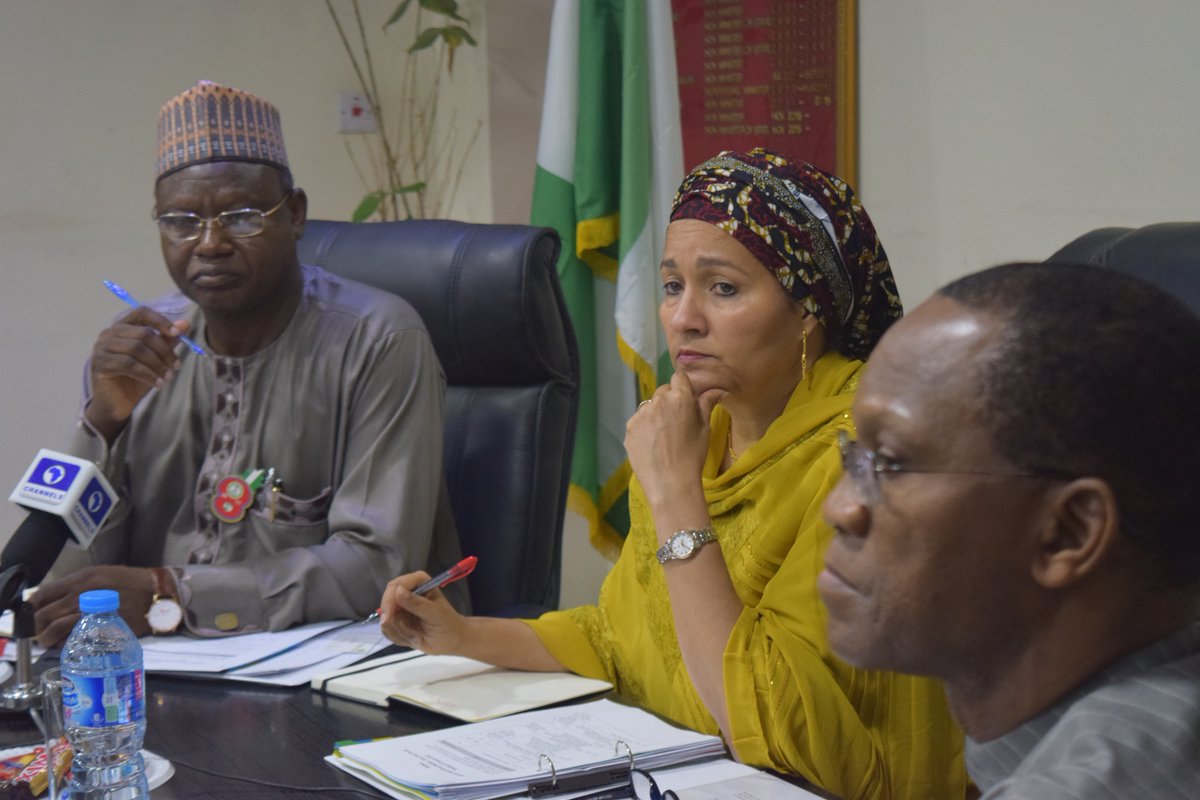
Deputy Secretary-General of the United Nations, Mrs Amina Mohammed, has advised developing countries to take advantage of the Green Bond market in financing some projects.
The former Nigeria’s Minister of Environment said her experience of the Green Bond in Nigeria was an “exciting initiative to use, to leverage, the implementation of the Nationally Determined Contributions (NDC).
Mrs Mohammed, while addressing members of the press in New York on Tuesday, noted that the “sovereign Green Bond, which will be the first ones issued at the end of March in emerging countries is very exciting, and I think that the model that should be taken there is that countries themselves need to go through a process that strengthens integration and that they institutionally can then rise to the opportunities of other financing coming into the international Green Bond market.”
She described the initiative as “huge”, stressing that it has “brought in a lot of the private sector into this, in a way, I think, that is constructive and gets government providing the enabling environment but the private sector really taking things to scale.
“It has to be about jobs and our economies improving in Africa, so yes, I do think that that is important.”
The UN Deputy Scribe also used the occasion to express her total commitment to the vision of the Secretary General of the global body, Mr
António Guterres.
Mrs Mohammed, while thanking Mr Guterres for the privilege to work with him, said she will be “focusing primarily on helping (her boss) to reposition sustainable development at the United Nations and as he has stated, sustainable development is an end in itself but it is also the best way that we feel that we can achieve universal peace.”
She further stated that, “I’m attaching great importance to the promise of leaving no one behind, so starting with those that are furthest behind, really looking to see how we can address that in a robust manner that brings everyone into the sustainable development agenda, addressing gender barriers that we’ve seen constantly; that we have achieved some success in that, not enough.
“We need to go to scale at this point. We also need to empower youth, agents of peace and development.
“I can say that in the recent 15 months that I have been home, after helping to shape the 2030 Agenda, youth have been the greatest challenge that we have faced but also the greatest potential to finding solutions for peace and development.
“I will be supporting the SG in the comprehensive review of the UN development system; this will be in close consultation with Member States.
“We have the advantage that the three major agendas that we agreed in 2015, were really from an inclusive process where Member States owned it and lead on it.
“And so supporting them to get an ambitious response at the country level is one that I believe will have a much easier task than we would have had previously, so therefore, those consultations will be given utmost priority.
“We shall become as the United Nations much more fit for purpose.”
Commenting on the $4 billion famine drive, Mrs Mohammed said, “We need to be ahead of the curve and not behind it, and so we do press for the support we need in those four countries.
“This famine is not just going to be limited to them if we don’t address it in a very urgent way. I think that the results that we saw in Oslo recently are warming and I think that this is showing that there is a way forward on some of this.
“We need to listen to some of the issues that were raised there.
“Again, bringing agencies and partnerships together in a much more coordinated and coherent manner, will help us get further, leveraging resources from different constituencies now, different partnerships in a global agenda, this is becoming more complex, but it is bringing in more returns and so again, we are not taking our foot off the urgency pedal, it is really urgent that we get much more, much more quickly, but so far the [outings?] have proved to be positive.”
Economy
NGX Group Advances Investor Education Drive with Digital Retail Engagement Initiative
Nigerian Exchange Group has intensified its investor education drive through a digital engagement initiative aimed at improving financial literacy and deepening retail participation in the Nigerian capital market.
The Group recently hosted an X Space session themed Follow the Fundamentals: A Beginner’s Guide to the Stock Market, reaching over 5,000 users, largely young Nigerians, first-time investors, and retail market participants seeking to better understand investment opportunities in the capital market.
Featuring social media investment influencer Omiete Inko-Tariah, alongside representatives from Nigerian Exchange Limited and NGX Regulation Limited, the session demystified key concepts around market operations, investor protection, and safe participation. Beyond education, it served as an open forum where retail investors engaged directly with market stakeholders on issues of confidence, transparency, and accessibility.
Speaking on the initiative, Clifford Akpolo, Head, Group Communications and Partnerships at NGX Group, said: “Deepening retail participation is critical to building a more resilient, inclusive, and sustainable capital market. At NGX Group, we believe financial literacy is not just an educational responsibility; it is a strategic imperative for strengthening investor confidence, improving market accessibility, and expanding long-term wealth creation opportunities for Nigerians. Through digital platforms like this, we are leveraging innovation to connect with the next generation of investors and democratize access to market knowledge.”
The initiative forms part of NGX Group’s broader sustainability agenda under its Community pillar, which focuses on advancing financial literacy, inclusion, and economic empowerment through education-driven and stakeholder-focused programmes.
Following the success of this edition, NGX Group plans to sustain similar engagements as part of its ongoing commitment to strengthening investor confidence, deepening retail participation, and building a more resilient and inclusive investment ecosystem.
Economy
NGX Posts Turnover of 7.772 billion Equities Worth N374bn in Five Days
By Dipo Olowookere
A total turnover of 7.772 billion equities worth N374.040 billion in 402,945 deals was recorded by the Nigerian Exchange (NGX) Limited last week compared with the 7.075 billion equities worth N324.351 billion traded in 474,436 deals a week earlier.
Data from the stock exchange showed that the financial services industry led the activity chart with 4.774 billion shares valued at N196.352 billion in 153,515 deals, contributing 61.43 per cent and 52.49 per cent to the total trading volume and value, respectively.
The ICT segment followed with 1.118 billion stocks worth N57.825 billion in 44,622 deals, and the services sector transacted 601.745 million equities for N6.984 billion in 27,653 deals.
First Holdco, UBA, and Chams accounted for 2.195 billion shares worth N99.820 billion in 30,056 deals, contributing 28.24 per cent and 26.69 per cent to the total trading volume and value, respectively.
Berger Pains led the gainers’ chart after gaining 55.57 per cent to trade at N168.95, SCOA Nigeria improved by 45.92 per cent to N33.05, DAAR Communications expanded by 42.41 per cent to N2.25, Fidson rose by 32.52 per cent to N136.50, and Learn Africa grew by 32.32 per cent to N10.85.
On the flip side, Zichis led the losers’ table after it gave up 11.78 per cent to settle at N29.43, The Initiates declined by 10.03 per cent to N32.30, NPF Microfinance Bank depreciated by 10.00 per cent to N5.76, NCR Nigeria shed 10.00 per cent to quote at N179.10, and Custodian Investment crashed by 9.52 per cent to N81.25.
At the close of transactions in the five-day trading week, 74 equities appreciated versus 69 equities in the previous week, 24 stocks depreciated versus 36 stocks a week earlier, and 48 shares closed flat versus 41 shares of the preceding week.
Last week, the All-Share Index (ASI) gained 2.27 per cent to finish at 250,330.92 points, and the market capitalisation chalked up 2.13 per cent to end at N160.444 trillion.
Similarly, all other indices finished higher apart from the energy, sovereign bond, and commodity indices, which fell by 1.19 per cent, 0.08 per cent and 0.80 per cent, respectively.
Economy
CPPE Warns CBN Against Further Rate Hikes as MPC Meeting Kicks Off
By Adedapo Adesanya
The Centre for the Promotion of Private Enterprise (CPPE) has urged policymakers to adopt a cautious approach to further interest rate hikes, warning that rising political spending ahead of the 2027 elections and growing geopolitical tensions could complicate monetary policy decisions.
The Monetary Policy Committee (MPC) of the central bank will hold its 305th meeting starting Monday, May 19 (today) to Tuesday, May 20, after which the monetary policy decisions will be announced.
The centre said while inflation control remains critical, excessive monetary tightening could weaken credit growth, discourage private investment and slow Nigeria’s fragile economic recovery.
Last week, the National Bureau of Statistics (NBS) said the country’s inflation increased to 15.69 per cent in April amid the impact of the continued tension in the Middle East.
According to the chief executive of CPPE, Mr Muda Yusuf, the MPC will need to carefully weigh domestic economic realities alongside global developments before taking any decision on rates.
He stated that geopolitical tensions involving the United States, Israel and Iran were already fueling uncertainty in the global energy market, with rising crude oil prices expected to increase domestic energy, logistics and production costs, noting that the global developments could further intensify inflationary pressures within the Nigerian economy.
On the domestic front, Mr Yusuf said signs of rising liquidity linked to preparations for the 2027 general elections are becoming more evident, explaining that political spending by candidates and parties, combined with increasing allocations from the Federation Account Allocation Committee (FAAC) to state governments, could create fresh liquidity management and inflation challenges for monetary authorities.
“Indications of increased liquidity related to the upcoming 2027 elections are becoming more prominent. Political spending from candidates and parties, coupled with enhanced disbursements from FAAC to state governments, presents important considerations for liquidity management and inflation control,” he said.
Mr Yusuf stated that, given the current environment, there is a strong possibility that the MPC may either retain the current policy stance or opt for only moderate tightening.
The CPPE warned that sustained high interest rates could hurt economic growth, weaken industrial productivity and undermine job creation and acknowledged the need to manage inflation expectations
The centre argued that Nigeria’s inflation challenges are largely supply-driven, particularly due to high energy costs, logistics bottlenecks and structural inefficiencies, limiting the effectiveness of aggressive monetary tightening.
According to Mr Yusuf, monetary tightening is generally more effective in tackling demand-pull inflation than supply-side inflation.
He stressed that higher interest rates could increase borrowing costs for businesses, reduce manufacturing competitiveness, constrain small and medium-scale enterprises and discourage investment at a time when the economy requires stronger productivity growth.
The CPPE also warned that elevated rates could heighten the risk of loan defaults and place additional pressure on businesses already struggling with high operating costs.
Mr Yusuf advocated a more balanced and development-focused monetary policy framework suited to the realities of emerging economies like Nigeria, where infrastructure gaps, weak productive capacity, unemployment and financing constraints remain major challenges.
He maintained that sustainable disinflation in Nigeria would depend more on supply-side reforms, energy security, improved logistics, stable exchange rates and increased domestic refining capacity than solely on aggressive monetary tightening.
“The primary focus should be on fostering investor confidence, encouraging productive investments, enhancing output growth and improving the economy’s supply-side capacity while remaining attentive to inflation management,” he said.
-
Feature/OPED6 years agoDavos was Different this year
-
Travel/Tourism10 years ago
Lagos Seals Western Lodge Hotel In Ikorodu
-
Showbiz3 years agoEstranged Lover Releases Videos of Empress Njamah Bathing
-
Banking8 years agoSort Codes of GTBank Branches in Nigeria
-
Economy3 years agoSubsidy Removal: CNG at N130 Per Litre Cheaper Than Petrol—IPMAN
-
Banking3 years agoSort Codes of UBA Branches in Nigeria
-
Banking3 years agoFirst Bank Announces Planned Downtime
-
Sports3 years agoHighest Paid Nigerian Footballer – How Much Do Nigerian Footballers Earn