Economy
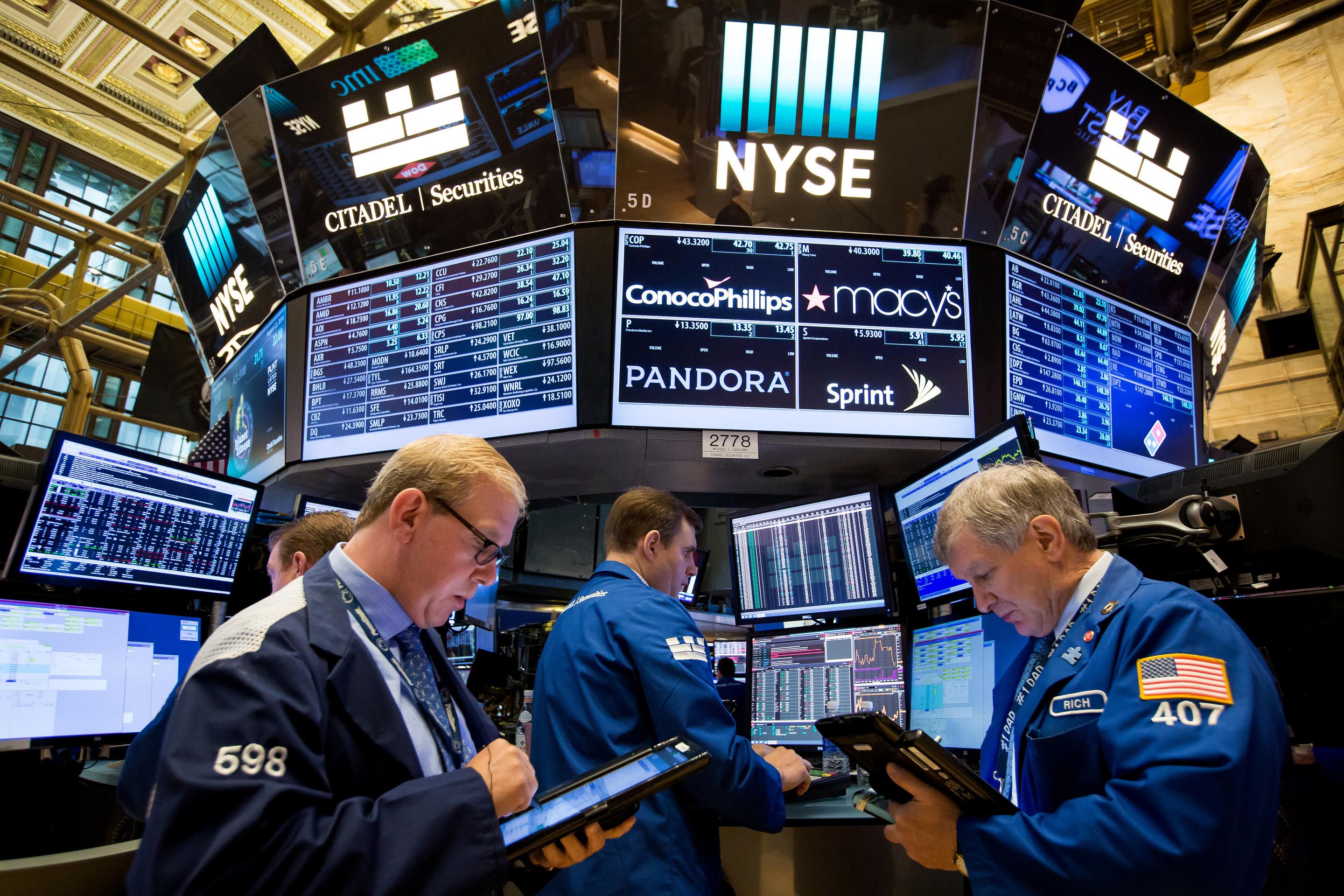
US Stocks Open Higher on Upbeat Jobs Data
By Investors Hub
The major U.S. index futures are currently pointing to a higher lower opening on Friday, as much stronger than expected jobs data washed away concerns about the economic outlook.
The futures climbed more firmly into positive territory following the release of a closely watched Labor Department report showing much stronger than expected job growth in the month of October.
The Labor Department said non-farm payroll employment climbed by 128,000 jobs in October compared to economist estimates for an increase of about 89,000 jobs.
The report also showed substantial upward revisions to job growth in September and August, with revised data showing employment jumped by 180,000 jobs and 219,000 jobs, respectively.
With the upward revisions, employment gains in September and August combined were 95,000 more than previously reported.
Despite the stronger than expected job growth, the report said the unemployment rate inched up to 3.6 percent in October from 3.5 percent in September. The uptick matched economist estimates.
The unemployment rate crept up from the nearly 50-year low hit in the previous month as a 325-person jump in the size of the labor force more than offset a 241,000-person increase in the household survey measure of employment.
After ending Wednesday’s trading moderately higher, stocks moved mostly lower over the course of the trading day on Thursday. With the drop on the day, the S&P 500 pulled back off Wednesday’s record closing high.
The major averages staged a recovery attempt going into the close but remained stuck in the red. The Dow slid 140.46 points or 0.5 percent to 27,046.23, the Nasdaq edged down 11.62 points or 0.1 percent to 8,292.36 and the S&P 500 fell 9.21 points or 0.3 percent to 3,037.56.
The pullback on Wall Street came amid renewed uncertainty about the potential for a long-term U.S.-China trade deal.
Optimism about phase one of a trade deal contributed to recent strength on Wall Street, but a new report from Bloomberg said Chinese officials are casting doubts about reaching a comprehensive long-term trade agreement.
People familiar with the matter told Bloomberg that Chinese officials have warned in private conversations that they are unwilling to budge on the thorniest issues.
In an apparent effort to calm the markets, President Donald Trump tweeted shortly before the start of trading that the U.S. and China are working on a new site to sign phase one of the trade deal.
Trump and Chinese President Xi Jinping had been due to meet and potentially sign the deal at the APEC summit in Chile, but the Chilean President recently called off the summit due to unrest in the country.
“China and the USA are working on selecting a new site for signing of Phase One of Trade Agreement, about 60% of total deal, after APEC in Chile was canceled do to unrelated circumstances,” Trump tweeted. “The new location will be announced soon. President Xi and President Trump will do signing!”
In a separate tweet, Trump also claimed Democrats’ “Impeachment Hoax” is hurting the stock markets as the House voted to approve a resolution that establishes the procedure for the next phase of an impeachment inquiry.
Upbeat earnings news helped limit the downside for the markets, however, with Apple (AAPL) and Facebook (FB) posting notable gains after reporting better than expected quarterly results.
On the U.S. economic front, the Labor Department released a report showing a modest increase in first-time claims for U.S. unemployment benefits in the week ended October 26th.
The report said initial jobless claims rose to 218,000, an increase of 5,000 from the previous week’s revised level of 213,000.
Economists had expected jobless claims to inch up to 215,000 from the 212,000 originally reported for the previous week.
A separate report from the Commerce Department showed personal income and spending both increased in line with economist estimates in the month of September.
The report said personal income increased by 0.3 percent in September after climbing by an upwardly revised 0.5 percent in August.
Meanwhile, the Commerce Department said personal spending edged up by 0.2 percent, matching the revised uptick seen in August.
Computer hardware stocks turned in some of the market’s worst performances on the day, dragging the NYSE Arca Computer Hardware Index down by 1.8 percent.
Western Digital (WDC) led the sector lower after the hard drive maker reported better than expected fiscal first quarter results but provided disappointing guidance and announced the retirement of its CEO Steve Milligan.
Significant weakness was also visible among oil service stocks, as reflected by the 1.5 percent drop by the Philadelphia Oil Service Index. The weakness in the oil service sector came amid a notable decrease by the price of crude oil.
Steel stocks also saw considerable weakness amid uncertainty about a U.S.-China trade deal, moving notably lower along with transportation, chemical and financial stocks.
On the other hand, gold stocks bucked the downtrend, resulting in a 2.7 percent jump by the NYSE Arca Gold Bugs Index. The index ended the session at its best closing level in over a month. The rally by gold stocks came amid a sharp increase by the price of the precious metal.
Economy
FrieslandCampina Wamco, CSCS Lift NASD OTC Market by 1.05%
By Adedapo Adesanya
The duo of FrieslandCampina Wamco Nigeria Plc and the Central Securities Clearing System (CSCS) Plc boosted the NASD Over-the-Counter (OTC) Securities Exchange by 1.05 per cent on Monday, May 11.
FrieslandCampina Wamco added N13.07 to sell N146.00 per share versus the previous price of N132.98 per share, and CSCS Plc rose by 10 Kobo to close at N76.00 per unit compared with last Friday’s N75.90 per unit.
As a result, the market capitalisation increased by N26.20 billion to N2.514 trillion from N2.488 trillion, and the NASD Unlisted Security Index (NSI) went up by 48.80 points to 4,202.57 points from 4,158.77 points.
The volume of securities bought and sold by market participants decreased by 55.2 per cent yesterday to 236,921 units from 528,891 units, the value of securities slid by 51.5 per cent to N16.5 million from N34.0 million, and the number of deals contracted by 20 per cent to 20 deals from 25 deals.
Great Nigeria Insurance (GNI) Plc ended the day as the most traded stock by value on a year-to-date basis, with 3.4 billion units traded for N8.4 billion, followed by CSCS Plc with 60.5 million units exchanged for N4.1 billion, and Okitipupa Plc with 27.8 million units transacted for N1.9 billion.
GNI Plc also closed the session as the most traded stock by volume on a year-to-date basis with 3.4 billion units worth N8.4 billion, followed by Resourcery Plc with 1.1 billion units valued at N415.7 million, and Infrastructure Guarantee Credit Plc with 400 million units sold for N1.2 billion.
Economy
FX Pressure Weakens Naira to N1,373/$ at Official Market
By Adedapo Adesanya
The Naira opened the week on a negative note on Monday after it depreciated against the US Dollar in the Nigerian Autonomous Foreign Exchange Market (NAFEX) by 0.86 per cent or N11.77 to sell for N1,373.16/$1 compared with the preceding session’s value of N1,361.39/$1.
It also weakened against the Pound Sterling in the official market during the session by N17.39 to quote at N1,871.07/£1 versus last Friday’s rate of N1,853.68/£1, and against the Euro, it slumped by N15.78 to close at N1,618.41/€1 versus N1,602.63/€1.
At the black market, the Nigerian currency lost N5 against the Dollar yesterday, settling at N1,385/$1 compared with the previous rate of N1,380/$1. At the GTBank forex desk, it depreciated by N3 to sell at N1,375/$1 compared with the previous value of N1,372/$1.
Nigeria’s external reserves have fallen below $48.4 billion as of May 8, driven by interventions and external obligations by the Central Bank of Nigeria (CBN). In the first three weeks of April, the country’s FX reserves lost about $731 million.
Softer liquidity conditions have also dampened foreign investors’ appetite, with data from the FMDQ Securities Exchange showing that total foreign exchange inflows declined by 30.1 per cent month-on-month to $2.86 billion in April from $4.09 billion in March. Out of this, foreign inflows weakened by 21.9 per cent to $1.63 billion from $2.09 billion in March.
As for the cryptocurrency market, prices were largely up as global equity markets and other risk assets came under pressure. Rising oil prices, higher treasury yields and renewed US-Iran tensions, along with a key inflation report from the world’s largest economy due on Tuesday, applied pressure.
Binance Coin (BNB) jumped 1.5 per cent to $662.80, Solana (SOL) appreciated by 0.9 per cent to $96.63, Dogecoin (DOGE) added 0.7 per cent to close at $0.1104, Bitcoin (BTC) improved by 0.5 per cent to $81,221.78, and Ripple (XRP) gained 0.5 per cent to sell at $1.46.
On the flip side, Ethereum (ETH) went down by 0.9 per cent to $2,310.49, Cardano (ADA) weakened by 0.4 per cent to $0.2776, and TRON (TRX) slid by 0.3 per cent to $0.3487, the US Dollar Tether (USDT) and the US Dollar Coin (USDC) closed flat at $1.00 each.
Economy
Crude Oil Prices Climb 2% as Middle East Ceasefire Prospects Fade
By Adedapo Adesanya
Crude oil prices rose more than 2 per cent on Monday after US President Donald Trump said the ceasefire with Iran was “on life support,” leaving the Strait of Hormuz largely closed with no clear end in sight to the war.
Brent crude futures went up by $2.92 or 2.88 per cent to $104.21 a barrel, while the US West Texas Intermediate (WTI) crude futures increased by $2.65 or 2.78 per cent to settle at $98.07 a barrel.
President Trump on Monday said the ceasefire with Iran was “on life support,” after dismissing Iran’s response to a US peace proposal as “stupid.”
This came after the US floated a proposal aimed at reopening negotiations with Iran. The Middle East country on Sunday released a response focused on ending the war on all fronts, including one where America’s top ally, Israel, is fighting Iran-backed Hezbollah militants.
Iran also demanded compensation for war damage, emphasised its sovereignty over the strait, and called on the US to end its naval blockade, guarantee no further attacks, lift sanctions and remove a ban on Iranian oil sales.
After this, President Trump dismissed the offer in a social media post as “totally unacceptable.”
He also emphasised that the US continues to monitor Iran’s enriched uranium stockpiles via Space Force surveillance and warned of further strikes if a real end to the nuclear issue is not reached.
The war has impacted oil output by the Organisation of the Petroleum Exporting Countries (OPEC) as it declined to its lowest level since 2000, with production falling by 830,000 barrels per day to an average of 20.04 million barrels per day in April, according to a Reuters survey published Monday.
Kuwait, Saudi Arabia, and Iraq all saw significant output decreases as they were forced to shut in production due to the war, which started in late February.
The United Arab Emirates (UAE) was the only Gulf member that was able to increase production in April. The UAE was able to leverage the Fujairah terminal on the Gulf of Oman to bypass the bottleneck, allowing it to export more crude than its peers. The Emirate is targeting a production capacity of 5 million barrels per day by 2027 after it exited OPEC and OPEC+ this month.
-
Feature/OPED6 years agoDavos was Different this year
-
Travel/Tourism10 years ago
Lagos Seals Western Lodge Hotel In Ikorodu
-
Showbiz3 years agoEstranged Lover Releases Videos of Empress Njamah Bathing
-
Banking8 years agoSort Codes of GTBank Branches in Nigeria
-
Economy3 years agoSubsidy Removal: CNG at N130 Per Litre Cheaper Than Petrol—IPMAN
-
Banking3 years agoSort Codes of UBA Branches in Nigeria
-
Banking3 years agoFirst Bank Announces Planned Downtime
-
Sports3 years agoHighest Paid Nigerian Footballer – How Much Do Nigerian Footballers Earn