Connect with us

Economy

Value of Traded Stocks Drops in One Week as Index Sheds 1.60%

Published

on

Nigerian Stocks

By Modupe Gbadeyanka

It was another four-day trading week as the Federal Government of Nigeria declared Monday, April 2, 2018 as a public holiday for the Easter celebrations.

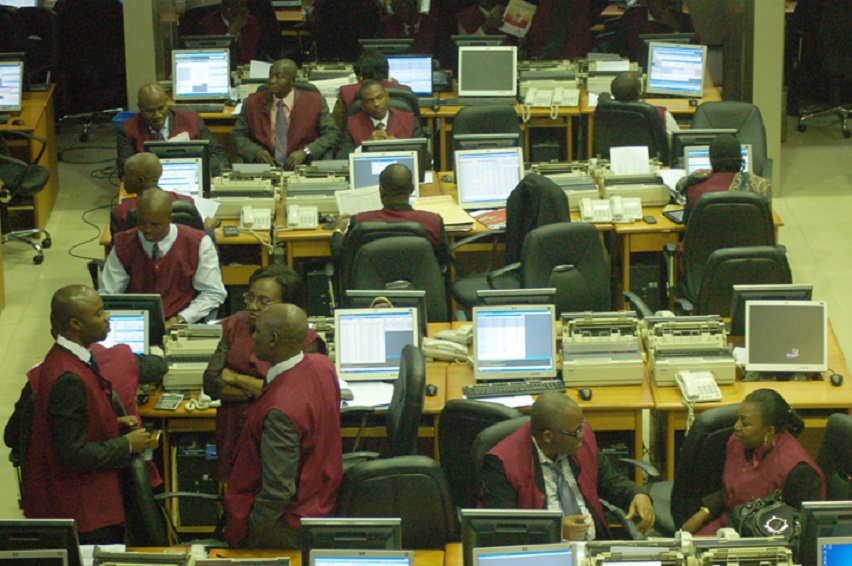
During the week, the total volume and value of equities transacted by investors on the floor of the Nigerian Stock Exchange (NSE) depreciated.

Business Post reports that a total turnover of 1.765 billion shares worth N26.562 billion were traded in 20,265 deals in contrast to a total of 2.328 billion shares valued at N28.927 billion executed last week in 25,530 deals.

The Financial Services Industry measured by volume led the activity chart with 1.468 billion shares valued at N18.707 billion traded in 12,850 deals; thus contributing 83.18 percent and 70.43 percent to the total equity turnover volume and value respectively.

The Conglomerates Industry followed with 127.882 million shares worth N623.871 million in 971 deals, while the third place was occupied by Consumer Goods with a turnover of 69.868 million shares worth N6.189 billion in 2,930 deals.

Trading in the top three equities; namely Zenith Bank, Access Bank and United Bank for Africa measured by volume accounted for 543.758 million shares worth N9.739 billion in 3,533 deals, contributing 30.81 percent and 36.66 percent to the total equity turnover volume and value respectively.

In the week, the All-Share Index and market capitalization depreciated by 1.60 percent to close at 40,841.14 points and N14.753 trillion respectively.

Similarly, all other indices finished lower during the week.

A total of 19 equities appreciated in price during the week, lower than 40 of the previous week, while 53 equities depreciated in price, higher than 40 equities of the previous week, and 99 stocks equities remained unchanged higher than 91 equities recorded in the preceding week.

Also traded during the week were a total of 125,282 units of Exchange Traded Products (ETPs) valued at N2.835 million executed in 11 deals, compared with a total of 15,293 units valued at N254,840.00 that was transacted last week in 16 deals.

Furthermore, a total of 4,457 units of Federal Government Bonds valued at N4.247 million were traded this week in 13 deals, compared with a total of 21,583 units valued at N22.868 million transacted last week in 16 deals.


Modupe Gbadeyanka is a fast-rising journalist with Business Post Nigeria. Her passion for journalism is amazing. She is willing to learn more with a view to becoming one of the best pen-pushers in Nigeria. Her role models are the duo of CNN's Richard Quest and Christiane Amanpour.

Click to comment

Leave a Reply

Your email address will not be published. Required fields are marked *

Economy

Brent Falls Below $80 Per Barrel on Claims of US-Iran Talks Progress

Published

on

brent crude oil

By Adedapo Adesanya

Brent crude dropped below $80 per barrel, precisely losing $4.41 or 5.3 per cent to settle at $79.36 a barrel on Tuesday, after comments ‌by officials from the United States and Qatar raised hopes for a diplomatic resolution to the Iran war, which could improve oil flows through the Strait of Hormuz.

Also, the US West Texas Intermediate (WTI) futures depreciated by $4.57 or 5.7 per cent to trade at $75.77 a barrel.

US Secretary of State Marco Rubio said on Tuesday there was progress in talks with Iran and Oman about moving more ​ships through the strait, but a final agreement was yet to be reached.

Also, Treasury Secretary Scott Bessent ⁠had said earlier on Tuesday that a deal with Iran to reopen the strait could come as soon as Tuesday or Wednesday.

Qatar’s Foreign ​Ministry spokesperson Majed al-Ansari said efforts to secure a diplomatic resolution to the war were continuing.

Qatar said it has discussed with US President Donald Trump ways to reduce escalation and converge viewpoints between the US and Iran.

Meanwhile, the latest round of US-facilitated talks between Israel and Lebanon began on Tuesday and will continue through Thursday.

Amid this, Iran still wants control over inbound shipping and visibility over outbound traffic through the Strait of Hormuz, with the ability ​to intervene if necessary, as part of a plan being discussed with Oman to reopen the ​strategic waterway.

Market analysts noted that the prospect of a diplomatic solution to the conflict ​has helped remove some of the geopolitical risk premium in oil prices. If negotiations between the US and Iran make meaningful progress, the market could continue pricing in a ‌lower probability ⁠of supply disruptions.

Disruptions to shipping through the strait, through which a fifth of global oil and gas flowed before the war, have forced Middle Eastern nations to cut oil output sharply. The world has lost more than 2.6 billion barrels of oil since the Iran war began in February.

Shipping traffic at the key Gulf waterways of Bab el-Mandeb and the Strait of Hormuz remained unchanged at ⁠the start ​of the week.

The American Petroleum Institute (API) estimated that crude oil inventories in the US rose by 2.69 million barrels in the week ending July 30. Commercial crude oil inventories excluding the SPR have lost just over 58 million barrels over the last sixteen weeks, with US crude inventories down just 7.2 million for the year, according to API data.

Official data from the US Energy Information Administration (EIA) will be released later on Wednesday.

Continue Reading

Economy

Oando H1 2026 Revenue Soars 20% to N2.1trn, Profit Rises 8% to N68.6bn

Published

on

oando stocks

By Aduragbemi Omiyale

One of the leading local energy firms, Oando Plc, delivered an impressive financial performance in the first six months of 2026, according to details of its results filed to the Nigerian Exchange (NGX) Limited.

Between January and June 2026, revenue surged by 20 per cent to N2.1 trillion from N1.7 trillion in the same period of 2025, driven by growth in the Exploration & Production and Trading segments of the business.

Also, the net profit grew by 8 per cent year-on-year to N68.6 billion from N63.3 billion, supported by improved operating profits and tax credits.

It was observed that the organisation deepened its domestic gas monetisation portfolio with the commencement of long-term gas supply of 11.2 MMscfd to the newly commissioned 60 MW Bayelsa Independent Power Plant.

“The first half of 2026 marks an important inflexion point in Oando’s journey. Over the past two years, our priority has been to successfully integrate one of the most significant upstream acquisitions in Africa and unlock the full value of our expanded portfolio. The progress achieved during the period demonstrates that we are now delivering the operational and financial outcomes expected from that transformation,” the chief executive of Oando, Mr Adewale Tinubu, stated.

Commenting further on the results, Mr Tinubu said, “Operational efficiency underpinned our performance during the period as we strengthened asset integrity, improved facility reliability and reinforced security across our operating areas, resulting in average facility uptime of 92 per cent while reducing production operating costs by 18 per cent to $16.83 per boe.”

“Our development programme also gathered significant momentum during the period as we successfully drilled and completed two land development wells, with an additional land well currently being drilled, while mobilising a second drilling rig to accelerate activity across our operated portfolio.

“In parallel, we continued an extensive programme of rig-less well interventions designed to restore production, sustain plateau output and mitigate natural field decline. Together, these activities increased average production to 42,789 boepd, representing 16 per cent year-on-year growth.

“This translated into a stronger financial performance, with revenue increasing by 20 per cent to N2.1 trillion, while the business generated N179.5 billion in operating cash, improving liquidity. Profit after tax also increased by 8 per cent to N68.6 billion, reflecting the overall improvement in operating performance during the period,” he pointed out.

The Oando chief also said, “Looking ahead in 2026, our priorities remain firmly centred on completing our seven-well drilling programme and portfolio-wide well intervention campaign while delivering production of circa 50,000 boepd.

“Beyond 2026, our identified inventory of 62 development wells, supported by 55 planned well interventions, provides a clear pathway towards our medium-term production ambition of approximately 100,000 boepd.

“Furthermore, we shall execute an intensive fundraising and balance sheet restructuring programme to optimise our capital structure, strengthen our financial position, improve working capital, enhance financial flexibility and ensure the business is appropriately funded to accelerate growth and maximise long-term shareholder value.

“We have built a resilient operating platform and established a clear roadmap for growth. Our focus is now on translating our significant opportunities into higher production, a stronger balance sheet and superior long-term returns for our shareholders.”

Continue Reading

Economy

PalmPay Hits $1bn Valuation, Eyes Hong Kong IPO

Published

on

PalmPay

By Adedapo Adesanya

Africa-focused fintech company PalmPay has joined the ranks of unicorn startups after attaining a valuation of more than $1 billion, as the digital payment platform prepares for a potential initial public offering (IPO) in Hong Kong.

According to a report by Bloomberg on Tuesday, citing people familiar with the matter, the Hong Kong-headquartered company is in advanced discussions to raise about $200 million in a new funding round that would cement its unicorn status and support its next phase of expansion.

The planned fundraising comes as PalmPay accelerates its growth strategy across Africa and Asia, while positioning itself for a public listing that could become one of the most significant fintech IPOs involving an Africa-focused company in recent years.

PalmPay’s move follows a period of rapid growth in Nigeria, where it has become one of the country’s largest digital financial services providers. Alongside OPay and Moniepoint, the company forms the trio that dominates Nigeria’s retail digital payments and agency banking market, a segment driven by millions of point-of-sale (POS) transactions processed daily.

With PalmPay’s latest valuation milestone, all three leading Nigerian fintechs have now achieved unicorn status. While OPay has previously disclosed plans to pursue a listing in the United States, Moniepoint has remained focused on expanding its banking and business services without publicly indicating IPO ambitions.

Founded in 2019 after securing a Mobile Money Operator (MMO) licence from the Central Bank of Nigeria (CBN), PalmPay has built one of the country’s fastest-growing fintech ecosystems. The company says it now serves more than 35 million registered users and over 600,000 merchants, supported by an extensive network of more than 500,000 mobile money agents nationwide.

The platform offers a broad suite of financial services, including peer-to-peer transfers, bill payments, airtime purchases, savings, credit products, merchant payment solutions and agency banking services. PalmPay says it processes as many as 15 million transactions daily, reflecting the increasing adoption of digital payments across Nigeria.

Beyond its home market, the fintech has expanded into Tanzania, Ghana, and Bangladesh, underscoring its ambition to become a leading emerging-market digital bank. Industry analysts view the expansion as part of a broader strategy to diversify revenue streams while replicating its Nigerian success in other underbanked markets.

PalmPay has attracted backing from prominent global investors, including Taiwanese semiconductor manufacturer MediaTek and smartphone maker Transsion Holdings, whose Tecno, Infinix and itel brands command significant market share across Africa. Their support has helped PalmPay leverage smartphone penetration to drive financial inclusion through mobile-first banking services.

As part of efforts to strengthen its leadership ahead of its next growth phase, PalmPay recently appointed Mr Samuel Oluyemi as Chief Operating Officer (COO) for its Nigerian business. Mr Oluyemi joined the company after more than two decades at the Nigeria Inter-Bank Settlement System (NIBSS), where he played key roles in developing the country’s digital payments infrastructure.

If completed, the fundraising and eventual Hong Kong listing would further underscore growing international investor confidence in African fintech companies despite a more cautious global venture capital environment. The proceeds are expected to support PalmPay’s geographical expansion, deepen its product offerings, invest in technology infrastructure and strengthen its competitive position in Africa’s rapidly evolving digital financial services industry.

Continue Reading