Economy
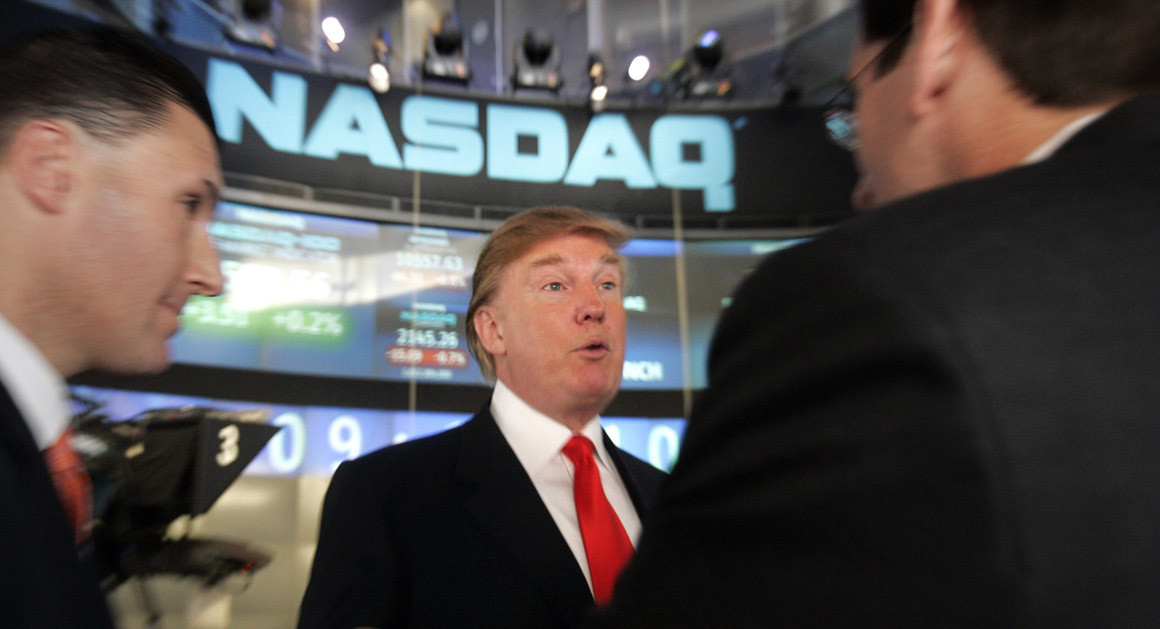
Wall Street Open Bullish on Upbeat Citigroup Earnings
By Investors Hub
The major U.S. index futures are currently pointing to a higher opening on Monday, with stocks likely to extend last week’s run to new record highs.
A positive reaction to earnings news from Citigroup (C) may generate some early buying interest, as the financial giant is moving moderately higher in pre-market trading.
Citigroup kicked off the earnings season by reporting second quarter earnings of $1.95 per share compared to analyst estimates for $1.81 per share. The company also reported stronger than expected revenue growth.
Traders may be reluctant to make substantial moves, however, as a slew of other big-name companies are due to report their quarterly results in the coming days.
Goldman Sachs (GS), Johnson & Johnson (JNJ), JPMorgan (JPM), Kraft Heinz (KHC), IBM (IBM), Microsoft (MSFT), and America Express (AXP) are among the companies due to report their results this week.
Closely watched reports on retail sales, industrial production, homebuilder confidence and housing starts are also likely to attract attention over the next few days.
Extending the upward trend seen over the past few sessions, stocks moved mostly higher during the trading day on Friday. With the continued upward move, the major averages all ended the session at new record closing highs.
The major averages saw further upside going into the close, finishing the day at their best levels of the session. The Dow jumped 243.95 points or 0.9 percent to 27,332.03, the Nasdaq climbed 48.10 points or 0.6 percent to 8,244.14 and the S&P 500 rose 13.86 points or 0.5 percent to 3,013.77.
For the week, the Dow surged up by 1.5 percent, while the Nasdaq and the S&P 500 advanced by 1 percent and 0.8 percent, respectively.
The markets continued to benefit from renewed optimism about the Federal Reserve lowering interest rates as soon as its next meeting later this month.
Congressional testimony from Fed Chairman Jerome Powell indicating crosscurrents, such as trade tensions and concerns about global growth, have continued to weigh on the U.S. economic outlook helped spark the resurgence in optimism about a rate cut.
Powell’s remarks triggered an upward trend on Wall Street that lifted the Dow above the 27,000 level for the first time ever.
Trading activity was somewhat subdued, however, as traders brace for the unofficial start of earnings season next week.
Citigroup (C), Goldman Sachs (GS), Johnson & Johnson (JNJ), JPMorgan (JPM), Wells Fargo (WFC), IBM (IBM), Netflix (NFLX), Microsoft (MSFT), and American Express (AXP) are among the slew of companies due to report their quarterly results.
Meanwhile, traders largely shrugged off a report from the Labor Department showing U.S. producer prices unexpectedly edged higher in the month of June.
The Labor Department said its producer price index for final demand inched up by 0.1 percent in June, matching the uptick seen in May. Economists had expected producer prices to come in unchanged.
Excluding food and energy prices, core producer prices climbed by 0.3 percent in June after rising by 0.2 percent in May. Core prices had been expected to show another 0.2 percent increase.
“The small gain in producer prices in June suggests the increase in tariffs on $200bn of imports from China has yet to generate a pick-up in inflation and confirms that underlying domestic inflationary pressures remain subdued,” said Michael Pearce, Senior U.S. Economist at Capital Economics.
He added, “That should help ease any fears, following the June CPI figures released yesterday, that underlying consumer price inflation will rise back above 2%.”
Transportation stocks moved sharply higher over the course of the trading session, driving the Dow Jones Transportation Average up by 2.4 percent. With the jump, the average ended the session at its best closing level in two months.
Significant strength was also visible among semiconductor stocks, as reflected by the 1.9 percent gain posted by the Philadelphia Semiconductor Index.
Chemical, gold and steel stocks also saw notable strength on the day, moving higher along with most of the other major sectors.
On the other hand, pharmaceutical stocks extended the sell-off seen in the previous session, dragging the NYSE Arca Pharmaceutical Index down by 2 percent to its lowest closing level in over a month.
Economy
Cadbury Nigeria, Others Shrink Equity Market by 1.41%
By Dipo Olowookere
The refusal of the bears to give the bulls a chance further depleted the Nigerian Exchange (NGX) Limited by 1.41 per cent on Thursday.
Persistent selling pressure left the equity market depressed at the close of business yesterday, with profit-taking still witnessed in the financial services sector.
The All-Share Index (ASI) decreased by 3,397.80 points to 237,404.92 points from 240,802.72 points, and the market capitalisation shrank by N2.179 trillion to N152.266 trillion from N154.445 trillion.
Africa Prudential dropped 10.00 per cent to trade at N11.70, Cadbury Nigeria lost 10.00 per cent to finish at N62.10, Tripple Gee crashed by 10.00 per cent to N3.60, John Holt depreciated by 9.93 per cent to N12.25, and McNichols stumbled by 9.33 per cent to N6.80.
On the other side, Legend Internet grew by 9.52 per cent to N5.75, NPF Microfinance Bank gained 9.18 per cent to settle at N5.35, Transcorp advanced by 7.32 per cent to N44.00, Neimeth improved by 7.03 per cent to N9.90, and DAAR Communications added 5.29 per cent to trade at N1.79.
Analysis of the price movement log indicated that the mood remained bearish, as Customs Street ended with 15 price gainers and 39 price losers, representing a negative market breadth index.
The activity level went up yesterday after investors bought and sold 691.6 million stocks worth N116.9 billion in 50,025 deals, in contrast to the 663.0 million stocks valued at N40.0 billion transacted in 51,143 deals on Wednesday. This showed that the trading volume increased by 4.31 per cent, the trading value surged by 192.25 per cent, and the number of deals decreased by 2.19 per cent.
First Holdco was the busiest equity during the trading day, with a turnover of 115.8 million units valued at N7.1 billion. Access Holdings traded 109.7 million units for N2.5 billion, Dangote Cement exchanged 71.5 million units for N83.4 billion, Japaul transacted 26.0 million units worth N83.6 million, and FCMB sold 25.9 million units valued at N285.9 million.
Economy
Brent Nears $80 on Fresh Doubt About US-Iran Ceasefire
By Adedapo Adesanya
Oil prices rose on Thursday after American Vice President JD Vance warned Israel against further attacks on Iran-backed Hezbollah in Lebanon, raising doubts about the durability of the US-Iran ceasefire agreement.
Brent crude futures settled at $79.85 a barrel after chalking up 30 cents or 0.38 per cent, while the US West Texas Intermediate (WTI) crude futures gained 19 cents or 0.25 per cent to finish at $76.60 a barrel.
US Vice President JD Vance on Thursday issued an extraordinary rebuke to Israeli critics of the Iran deal, warning them not to alienate their “only powerful ally” left in the world.
The deal gives negotiators 60 days to reach an agreement on the status of Iran’s nuclear programme and set up a $300 billion reconstruction fund for Iran and other financial incentives.
Mr Vance told members of Israeli Prime Minister Benjamin Netanyahu’s cabinet to “wake up and smell the reality,” amid growing tensions between Netanyahu and US President Donald Trump.
Market analysts noted that the statements about Israel may have put things back on edge, as the two countries jointly launched the war on Iran on February 28.
Ultimately, oil markets will be focused on what happens in the Strait of Hormuz, through which 20 per cent of the world’s oil flowed before the start of the war.
Analysts expect a gradual recovery in flows through the Strait of Hormuz, while industry experts have cautioned that prices may not plummet as demand recovers and inventories are refilled.
Investment bank Goldman Sachs expects Gulf exports to normalise to pre-war levels by the end of July, with crude production recovering by October. The bank estimates that a normalisation in exports to pre-war levels might be achieved with a 13 million barrel-per-day increase in Hormuz flows from current levels to around 70 per cent of pre-war levels.
Markets will be watching closely in the coming week to see exactly how much oil begins to flow, especially Iranian oil, which will no longer be sanctioned thanks to the latest ceasefire agreement.
China, the world’s second-largest oil consumer, is forecast to consume 753 million metric tons of petrol in 2026, down 4.9 per cent from 2025 amid a pivot to new energy and high oil prices.
Economy
FG Releases Transition Guidelines for Tax Acts 2025
By Modupe Gbadeyanka
The transition guidelines on the Tax Acts 2025 to provide direction to taxpayers, tax practitioners, revenue authorities and other stakeholders on how to address various issues arising from the old regime to the new framework have been released by the federal government.
The framework was issued on Thursday via a statement signed by the Director of Press Relations in the Federal Ministry of Finance, Efe Ovuakporie.
The guidelines set out the process for transition from the repealed tax laws to the new tax framework effective January 1, 2026.
Under the guidelines, the Tax Acts 2025, comprising the Nigeria Revenue Service (Establishment) Act, the Nigeria Tax Act, the Nigeria Tax Administration Act, and the Joint Revenue Board (Establishment) Act, apply from the respective commencement dates as enacted in each law. In particular, January 1, 2026, for the Nigeria Tax Act, 2025.
Tax liabilities, assessments, audits, investigations, disputes and enforcement actions relating to periods before that date will be treated under the repealed tax laws, the notice stated.
Tax returns relating to accounting periods ending before January 1, 2026, will be filed under the previous tax laws, while returns relating to accounting periods ending from January 1, 2026, onward will be administered under the new tax framework.
The document also covers the treatment of income taxes, transaction taxes, development levies, tax incentives, exemptions, record-keeping obligations and transactions that span both the old and new tax regimes.
Existing tax incentives and exemptions granted under the repealed laws will remain in place until their expiration dates. New applications and pending requests, however, will be considered under the provisions of the Tax Acts 2025.
The Minister of Finance and Coordinating Minister of the Economy, Mr Taiwo Oyedele, described the Tax Acts 2025 as a significant milestone in Nigeria’s tax reform programme, noting that the Guidelines set out how existing obligations, ongoing matters and future transactions will be treated under the new regime.
According to the Minister, the guidelines are anchored on three key principles – clarity, fairness and administrative certainty, adding that they are intended to promote uniform implementation and support effective administration across the Nigeria Revenue Service, State Internal Revenue Services, the FCT Internal Revenue Service, Local Government Revenue Committees, tax practitioners and taxpayers nationwide.
-
Feature/OPED6 years agoDavos was Different this year
-
Travel/Tourism10 years ago
Lagos Seals Western Lodge Hotel In Ikorodu
-
Showbiz3 years agoEstranged Lover Releases Videos of Empress Njamah Bathing
-
Banking8 years agoSort Codes of GTBank Branches in Nigeria
-
Economy3 years agoSubsidy Removal: CNG at N130 Per Litre Cheaper Than Petrol—IPMAN
-
Banking3 years agoSort Codes of UBA Branches in Nigeria
-
Banking3 years agoFirst Bank Announces Planned Downtime
-
Sports3 years agoHighest Paid Nigerian Footballer – How Much Do Nigerian Footballers Earn