Education
45 Student-Led Startups Win N2.2bn from FG Ventures Initiative
By Adedapo Adesanya
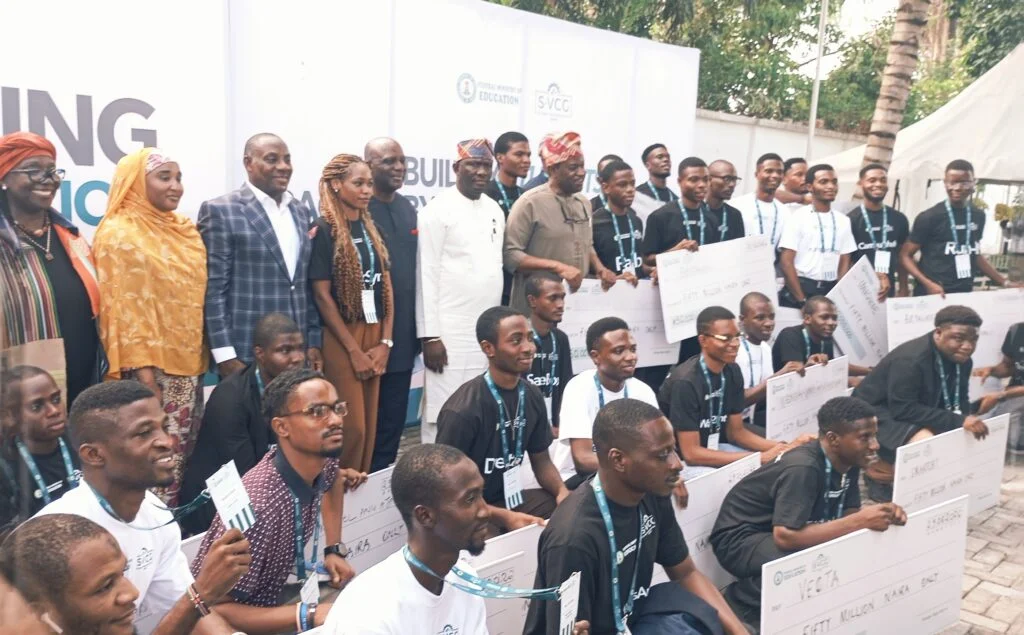
Forty-five student-led ventures emerged as beneficiaries of a total pool of N2.2 billion in grants at the 2026 Student Venture Capital Grant (S-VCG) Finalist Bootcamp.
The programme of the federal government marks a significant boost to youth innovation under its entrepreneurship drive, announced earlier this year.
At the bootcamp’s closing ceremony and awards presentation held at the United Nations Development Programme (UNDP) office in Ikoyi, Lagos, the winners emerged after a rigorous selection process involving 65 finalists and assessment by a 12-member expert panel.
Speaking at the event, the Minister of Education, Mr Tunji Alausa, said the initiative underscores the government’s commitment to transforming tertiary institutions into centres of innovation, entrepreneurship and practical problem-solving.
He described the S-VCG programme as a key pillar of President Bola Tinubu’s Renewed Hope Agenda, aimed at enabling students to convert ideas into viable businesses.
Mr Alausa noted that each beneficiary can access up to N50 million in equity-free funding, alongside mentorship, incubation support and digital tools.
He added that the programme attracted more than 30,000 applications from 404 tertiary institutions nationwide, reflecting the growing culture of innovation among Nigerian youth.
Also speaking, the Minister of Communications and Digital Economy, Mr Bosun Tijani, commended participants for leveraging technology to develop solutions to real-world challenges.
He urged them to build scalable, tech-driven ventures capable of contributing to national development.
Also speaking, Minister of State for Education, Mrs Suwaiba Sa’id Ahmad, praised the finalists’ resilience and creativity, noting that initiatives like S-VCG are critical to nurturing problem-solving skills and fostering an entrepreneurial mindset among students.
Chairman of the Senate Committee on Tertiary Education and TETFund, Mr Muntari Dandutse, called for sustained investment in youth innovation to strengthen Nigeria’s knowledge-based economy.
On his part, the National Project Coordinator of the Special Programmes Operations and Implementation Unit, Mr Adebayo Onigbanjo, outlined the structure and long-term objectives of the programme, stating that it is designed to equip students with the resources and confidence needed to build sustainable ventures.
Education
Platform School Ipaja Clinches 2026 Ecobank Chess Championship
By Aduragbemi Omiyale
The secondary school category of the 2026 Ecobank National Schools Team Chess Championship has been won by Platform School, Baruwa, Ipaja, after defeating Dayspring School.
The competition was sponsored by Ecobank Nigeria, in partnership with SchoolMate, Newcross, Exploration & Production Limited, GZI Limited, Frutta and the Nigeria Chess Federation (NCF).
The contest attracted over a thousand students from schools across the country to the Ecobank Pan African Centre (EPAC) in Lagos.
Platform School clinched the first spot after six rounds with 16 match points, edging Dayspring School, which also finished unbeaten but settled for second place on tiebreaks. King’s College Lagos claimed third position after an impressive campaign.
The result further strengthened the growing rivalry between Platform School and Dayspring School. Platform School won the maiden edition of the Ecobank-sponsored championship before Dayspring School emerged as champions in the second edition. Platform School, however, bounced back strongly by reclaiming the title in the third edition and has now secured back-to-back titles after winning the fourth edition. Meanwhile, Dayspring School have now recorded consecutive second-place finishes following their triumph in the second edition.
In the primary category, Chess in Slums Africa delivered a dominant performance, winning all six matches to finish with a perfect score of 18 match points. First Baptist Group of Schools also finished with a perfect win record but settled for second place on tiebreaks, while Jareb Private School, Ogun, finished third. The event witnessed remarkable performances from young players, further highlighting the rapid growth of grassroots chess development in Nigeria.
The Primary Category title was especially significant for Chess in Slums Africa, as the team received celebrations and support on-site from Tunde Onakoya, whose presence added excitement and inspiration to the young players during the close of the championship and the closing ceremony.
Speaking about the event, the Head of Educational and Social Services at Ecobank, Mr Kunle Adewoyi, urged the students to strive hard to become Grand Masters in the near future.
“There are Grand Masters in Kenya, Rwanda and some other African countries, but, sadly, we don’t have any in Nigeria at the moment. It is our prayer that some of these students will become one in the near future,” he stated.
Mr Adewoyi said that Ecobank was particular about chess sponsorship because it helps in the development of the kids.
The Vice President of the Nigerian Chess Federation, Mr Adeyinka Adewale, was full of praise for Ecobank and other partners for sponsoring the tournament, just as he promised that next year’s edition will be bigger and better.
Education
Bunmi Adedayo Foundation Unveils N1bn Plan for Teachers, Students
By Modupe Gbadeyanka
For the next 10 years, a Nigerian non-profit organisation focused on public education reform, The Bunmi Adedayo Foundation (BAF), intends to train 10,000 additional teachers and 500 school leaders, reach at least 1 million more learners through accelerated foundational literacy and numeracy programmes, expand digital learning access to 25,000 teachers, embed education reforms into government policy, and amplify its national advocacy voice.
At an event held in Lagos to mark its 10th anniversary on May 6, the organisation noted that it hopes to raise more than N1 billion in diversified funding to sustain and scale operations.
At the landmark Education Futures Conference themed Building Nigeria’s Education Future: One Teacher, One School, One Child at a Time, BAF said it was impressed with the progress made so far.
BAF was established in January 2016 in honour of Oluwabunmi Omotayo Adedayo. Since its inception, it has reached more than 550,000 learners, empowered over 7,800 teachers and supported more than 1,300 public primary schools across Lagos, Ogun, Osun and Rivers states.
Its interventions span teacher capacity development, school infrastructure renovation, digital learning through ICT hubs, and direct pupil support through scholarships and learning materials.
At the conference, Executive Director Odedeyi Oluwakemi said, “What began as a response to a critical gap has evolved into a movement of measurable impact. The first 10 years have proven what is possible. The next 10 years will define what is transformational.”
The gathering last week convened educators, policymakers, development partners, and private-sector leaders to reflect on a decade of measurable impact and chart an ambitious course for the decade ahead.
It spotlighted Nigeria’s deepening education crisis. An estimated 10.5 million primary school-age children, representing 25 per cent of that population, are currently out of school, a figure that rises to more than 20 million when secondary school-age youth are included. Among Nigerian children aged 7 to 14, 73 per cent lack basic reading skills, while 75 per cent lack basic numeracy skills. Only 44 per cent of primary school teachers hold the required qualifications, while teacher absenteeism in public schools averages 24 per cent.
Chairman of the foundation’s Executive Council, Professor Oluwole Ayoola Atoyebi, commended the group’s decade of progress while acknowledging the scale of the challenge ahead.
“Many children still lack access to quality foundational learning, and many educators require continuous support to deliver effectively,” he said. “Education is not merely a social good; it is a strategic investment in the future of our nation.”
BAF’s programmes are delivered through an integrated model combining teacher development, school infrastructure renovation and digital learning. The foundation’s train-the-trainer approach, implemented through initiatives such as the Continuous In-Service Training Programme (CISTPST) and the Subject Enhancement Programme (SEP-M), has enabled its impact to cascade across schools and communities. Its two ICT centres in Surulere and Ketu have equipped more than 11,000 students with hands-on digital learning skills.
The organisation’s school transformation projects, including the full renovation of Yaba Model Nursery & Primary School and Nathan Nursery & Primary School, have been made possible through partnerships with organisations including Tastee Fried Chicken, the Adepoju Foundation and Phoenix Global Foundation.
Education
FG Exempts Colleges of Education, Agric Candidates from UTME
By Modupe Gbadeyanka
Candidates seeking to gain admission into Colleges of Education in Nigeria will no longer need to write the Unified Tertiary Matriculation Examination (UTME) organised by the Joint Admissions and Matriculation Board (JAMB).
This information was disclosed by the Minister of Education, Mr Tunji Alausa, during an annual admission policy meeting of JAMB in Abuja on Monday.
He revealed that the new policy would become effective in the 2026.2027 admission cycle, stating that it was to make tertiary education admission easier for would-be teachers in the country.
The Minister also said candidates seeking admission to agriculture programmes outside engineering disciplines would not be required to sit for UTME, though they must register with JAMB.
“Candidates seeking admission into Education Programs and Agriculture non-Engineering Courses are now exempted from UTME,” he declared.
However, they are mandated to have at least four credit passes in relevant subjects in the Senior Secondary School Examination (SSCE) conducted by either the West African Examinations Council (WAEC) or the National Examinations Council (NECO), he stated.
Mr Alausa noted that after these academic credentials are screened, verified and certified, the admission letters would be issued through the Central Admissions Processing System (CAPS), in line with existing regulations.
-
Feature/OPED6 years agoDavos was Different this year
-
Travel/Tourism10 years ago
Lagos Seals Western Lodge Hotel In Ikorodu
-
Showbiz3 years agoEstranged Lover Releases Videos of Empress Njamah Bathing
-
Banking8 years agoSort Codes of GTBank Branches in Nigeria
-
Economy3 years agoSubsidy Removal: CNG at N130 Per Litre Cheaper Than Petrol—IPMAN
-
Banking3 years agoSort Codes of UBA Branches in Nigeria
-
Banking3 years agoFirst Bank Announces Planned Downtime
-
Sports3 years agoHighest Paid Nigerian Footballer – How Much Do Nigerian Footballers Earn