Connect with us

Education

Dangote Cement Gives Back to Lagos Schools

Published

on

Dangote Cement Lagos Schools

By Modupe Gbadeyanka

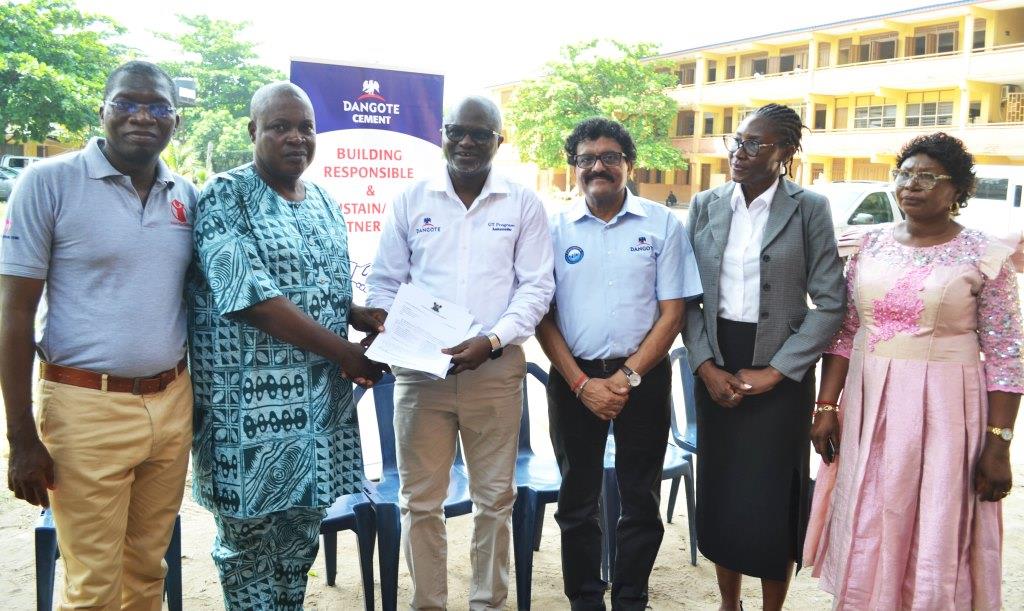
Multi-million Naira educational support projects have been donated by Dangote Cement Plc to secondary schools in Lagos as part of its social investment initiatives aimed at complementing the government’s efforts in providing quality and sustainable education in the state.

The projects, warmly received by both teachers and students, include 100 dual school desks for Ilado Community Junior High School and Wahab Folawiyo Senior High School, alongside a refurbished and fully equipped chemistry laboratory at Government Senior Secondary School, Ikoyi.

Also donated were reading tables, chairs, and bookshelves for the library at Government Junior Secondary School, Ikoyi.

The leading cement manufacturer noted that the projects align with its Sustainable Development Goals (SDGs) on education focused on ensuring inclusive, equitable, and quality education, as well as promoting lifelong learning opportunities for all.

According to the Managing Director of Dangote Cement, Mr Arvind Pathak, the company is dedicated to giving back to society and supporting the sustainable development of local communities, especially in areas where it operates.

“Education holds a pivotal role in the development and empowerment of the youths in the country. As a cornerstone for societal advancement, it serves as a critical tool for personal growth, economic development, and national progress.

“An educated youth population not only fosters individual success but also contributes significantly to the nation’s overall well-being.

“At Dangote Cement, we believe that providing quality education to our youth is vital and should not be left solely as the government’s responsibility. Thus, we aim to partner with the government to enhance educational development in this regard.

“The projects we are handing over today are part of our 2024 Corporate Social Responsibility (CSR) programme for selected schools within the neighbourhood of Dangote Cement’s head office in Ikoyi, Lagos. These projects were selected based on need assessments in collaboration with the schools,” Mr Pathak, represented by the Head of Social Performance at Dangote Cement, Mr Wakeel Olayiwola, stated.

Speaking further, he said, “This year, our plants in Ibese, Ogun State; Obajana, Kogi State; Gboko, Benue State; Okpella, Edo State; and our Pan-African operations have launched several social investment projects. These efforts contribute to the quality of life in our host communities and support sustainable national development.”

Mr Pathak thanked the Lagos State Government, the Tutor General/Permanent Secretary, and the school management teams for their collaboration in identifying the schools’ needs and ensuring the timely completion of the projects.

Responding, the Tutor General and Permanent Secretary of Education District 3, Lagos State Ministry of Education, Ms Idowu Olufunke Oyetola, who was represented by the Director of School Administration, Mr Bolaji Rotimi Ajayi, praised the long-standing partnership with Dangote Cement, noting that the schools selected for the donations were fortunate beneficiaries.

The Principal of Ilado Community Junior High School, Ikoyi, Mrs Odunlami Olubunmi, thanked Dangote Cement for the new desks, stating that the donation would significantly improve the learning environment for the students, helping to prepare them for a brighter future.

Also, the Principal of the school with the refurbished laboratory, Bamidele Ayotunde, urged other businesses to follow Dangote Cement’s example in supporting local schools, pointing out the positive impact of the laboratory’s renovation on the school’s learning environment.

Further, the Principal of Ireti Senior Grammar School, Ikoyi, whose school received the new desktop computers, described the donation as a positive development and expressed hope for more support in the future.

Pupils also shared their appreciation for their contributions. Abiola Jamaudeen, a lab prefect at Government Senior College, Ikoyi, promised that the laboratory would be used to its fullest potential and well-maintained.

Lawal Rumayzo Abdulsalam, a student at the school, said the new library equipment would foster better reading habits and create a more conducive environment for learning, ultimately preparing them for success. Some students even performed special songs to welcome the Dangote team to their schools.


Modupe Gbadeyanka is a fast-rising journalist with Business Post Nigeria. Her passion for journalism is amazing. She is willing to learn more with a view to becoming one of the best pen-pushers in Nigeria. Her role models are the duo of CNN's Richard Quest and Christiane Amanpour.

Education

Nigeria’s Samira Jibir Makes Tes Awards for International Schools 2025 Shortlist

Published

on

Hajiya Samira Jibir

By Modupe Gbadeyanka

The founder of Glisten International Academy located in Abuja, Ms Samira Jibir, has been shortlisted for the Tes Awards for International Schools 2025.

She is the only Nigerian shortlisted for the prestigious educational awards. She was listed under the Leadership category alongside Dr Nguyen Quang Minh of Nguyen Sieu School in Vietnam, Dr Rukshan Razak of Sri Lankan International School in Saudi Arabia, Francesco Banchini of European Azerbaijan School in Azerbaijan, Ildar Iliazov of Light international School in Kenya, Jacquelene Da Silva of Amstelland International School in the Netherlands, Mai Thuy of Reigate Grammar School in Vietnam, and Shoaib Raza of Nexus International School in Singapore.

The Tes Awards for International Schools celebrate excellence across the global education community.

Building on the prestige of the Tes Schools Awards in the UK, often referred to as the ‘Oscars of education’, these international awards honour the outstanding dedication, innovation, and impact of teachers and support staff teaching the British or international curricular around the world.

This year’s awards have attracted 578 entries from schools across the globe, nearly doubling from the previous year, showcasing inspiring stories of educational excellence.

The shortlisted schools represent the very best in international education, and Tes is proud to celebrate their achievements on a global stage.

The rigorous judging process is led by a panel of international school leaders, educational experts, and researchers from across the regions.

Tes is also proud to have a host of high-profile partners for the awards: British Schools in the Middle East (BSME), Council of British International Schools (COBIS), The Department for Business and Trade, the Educational Collaborative for International Schools (ECIS), the Federation of British International Schools in Asia (FOBISIA), and the International Baccalaureate (IB).

“A huge congratulations to all the schools and individuals shortlisted for these awards. The volume of entries we received, coupled with the depth of quality, meant it was no easy task for our judges to create the shortlist we are now proud to share.

“We look forward to celebrating the winners next month and saying thank you to educators everywhere for the amazing work they do day-in, day-out,” the International Editor of Tes Magazine and chair of the judges of the Tes Awards for International Schools, Dan Worth, stated.

Also commenting, the Chief Schools Officer at International Baccalaureate, Dr Nicole Bein, said, “The IB is proud to support the Tes Awards for International Schools, celebrating excellence in global education.

“These awards reflect the IB’s passion for inventive and impactful practice, shining a light on the inspiring dedication of teachers, schools, and communities around the world.

“We congratulate the schools shortlisted for this year’s honours, who are helping raise the profile of international schools while equipping their students with skills, curiosity, and open-mindedness.”

Also, the Head of International Education at the Department for Business and Trade, Sarah Chidgey, noted, “It’s inspiring to see the passion and creativity coming out of international schools this year.

“The Tes Awards shortlist is a testament to the incredible educators who go above and beyond every day to make learning meaningful and impactful. These schools are shaping futures, and it’s wonderful to see their efforts recognised on such a prestigious platform.”

See the full  nominees below;

Best Use of Technology 
Dhirubhai Ambani International School (DAIS)
India
Hamilton International School
Qatar
International School of Monaco
Monaco
JESS Dubai
UAE
King’s InterHigh
Online
Kodaikanal International School
India
Pascal Private School
Cyprus
Seth Anandram Jaipuria School
India
Community Engagement Initiative of the Year 
Agora Lledo International School
Spain
Akademeia High School
Poland
Braeside Lavington
Kenya
Haileybury Astana
Kazakhstan
International School Seychelles
Seychelles
Japanese International School
Vietnam
The British School Kathmandu
Nepal
The Olympia Schools
Vietnam
Curriculum Initiative of the Year 
Arcadia British School
UAE
Britannica International School
China
Jerudong International School
Brunei
Lüderitz Blue School
Namibia
Raha International School
UAE
Tanglin Trust School
Singapore
The Arbor School
UAE
The British School
Japan
Diversity, Equity & Inclusion Award 
British School Muscat
Oman
Dover Court International School
Singapore
GEMS Metropole School
UAE
GEMS Wellington Academy – Silicon Oasis
UAE
GEMS World Academy
UAE
Reigate Grammar School
Cambodia
United World College Maastricht
Netherlands
United World College
Thailand
Leadership Award 
Dr Nguyen Quang Minh – Nguyen Sieu School
Vietnam
Dr Rukshan Razak – Sri Lankan International School
Saudi Arabia
Francesco Banchini – European Azerbaijan School
Azerbaijan
Hajiya Samira Jibir – Glisten International Academy
Nigeria
Ildar Iliazov – Light international School
Kenya
Jacquelene Da Silva – Amstelland International School
Netherlands
Mai Thuy – Reigate Grammar School
Vietnam
Shoaib Raza – Nexus International School
Singapore
Principal/Headteacher of the Year 
Adam McRoy – Cogdel Cranleigh School
China
David Tongue – Doha College
Qatar
Dr John Knight – St George’s British International School
Italy
Fiona Cottam – Hartland International School
UAE
George Bowery – Al Mustaqbal School
Palestine
James McDonald – Wesgreen International School
UAE
Matthew Burfield – GEMS Founders School
UAE
Simon Burbury – Marlborough College
Malaysia
Specialist Provision Provider of the Year 
GEMS Metropole School
UAE
GEMS Wellington Academy – Silicon Oasis
UAE
International School of Brunei (ISB)
Brunei
Nita Mukesh Ambani International School & Dhirubhai Ambani International School
India
Pembroke House
Kenya
Sustainability Award 
Accra STEM Academy
Ghana
Dhirubhai Ambani International School
India
GEMS Wesgreen International School
UAE
Jerudong International School
Brunei
Kodaikanal International School
India
Mallorca International School
Spain
The International School @ ParkCity
Malaysia
The British School New Delhi
India
Staff Wellbeing Initiative of the Year 
Dubai College
UAE
GEMS Founders School
UAE
Nord Anglia International School
UAE
Wales International School
UAE
Student Mental Health Initiative of the Year 
Brighton College Dubai
UAE
British Vietnamese International School
Vietnam
Cambridge School of Bucharest
Romania
ELIS Villamartin
Spain
Jakarta Nanyang School
Indonesia
Peponi House School
Kenya
The International School of Kuala Lumpur
Malaysia
Viking International School
Denmark
Teaching Assistant/Support of the Year 
Amirah Casfian – King Henry VIII College
Malaysia
Delma Bagayan – Hartland International School
UAE
Intan Dewiyani – The Independent School of Jakarta
Indonesia
Ligaya Kitane – Brighton College
UAE
Naduni Horagoda – Ambassador International Academy
UAE
Sharon Tourish – International School Rheintal
Switzerland
Sumaya Abdulameer Eid – The British School of Bahrain
Bahrain
Tracey Vazz – IPS Cascais
Portugal
Teaching Initiative of the Year 
Al Rabeeh School
UAE
Brighton College
UAE
Nexus International School
Malaysia
Prem International School
Thailand
The British International School of Bratislava
Slovakia
The International School of Kuala Lumpur (ISKL)
Malaysia
TradeWinds Academy
Kenya
Wellspring Bilingual International School
Vietnam
International School of the Year 
Central Model School Khanewal
Pakistan
DESS Oud Metha (DOM)
UAE
GEMS Founders School
UAE
King Faisal School
Saudi Arabia
Navajo Preparatory School
USA
Shiv Nadar School
India
Tanglin Trust School
Singapore
Zhong Ying International School
Cambodia
Continue Reading

Education

Zoho Trains Babcock University Students on Low-Code Tools

Published

on

Babcock University Young Creators Programme

By Modupe Gbadeyanka

Over 50 students of Babcock University in Ogun State have benefitted from a programme organised by a global technology company, Zoho, to empower them on hands-on digital skills in low-code application development.

The company partnered with the higher institution of learning through the Babcock Centre for Executive Development (BCED) to set up an initiative known as the Young Creators Programme.

The participating students were chosen across disciplines—including Computer Science, Business, and Information Technology—to build business-ready applications using Zoho Creator, the company’s low-code development platform.

The three day workshop introduced students to practical problem-solving using the latest advancements in cloud technology, enabling them to design and develop custom business solutions without advanced programming knowledge. The scheme also fostered a deeper understanding of how low-code tools can support entrepreneurship and digital transformation.

It marks the beginning of a broader strategic collaboration between Zoho and BCED as both organisations will continue to work together to deliver additional training programs, interactive workshops and innovation-focused events.

Discussions are also underway to add Zoho’s apps to BCED’s entrepreneurship curriculum, ensuring that students learn how they can apply digital solutions for various business problems.

The Young Creators Programme forms part of Zoho’s global effort to promote digital literacy and support innovation among young people.

“As part of our commitment to supporting local talent development in Nigeria, we are excited to collaborate with Babcock University to equip students with future-ready digital skills.

“Through the Young Creators Program, we aim to empower young innovators to build solutions that solve real business challenges while strengthening the local technology ecosystem,” the Country Head for Zoho Nigeria, Mr Kehinde Ogundare, stated.

Also commenting, the Director of BEDC, Mr Ayodeji Ajibade, said, “We are committed to preparing our students for leadership in a rapidly evolving digital economy.

“Partnering with Zoho strengthens our mission by providing students with access to industry-standard tools and practical learning experiences that bridge the gap between classroom knowledge and real-world application.”

Launched in 2022, the Young Creators Programme has trained more than 2000 students around the world, providing them with the tools and confidence to pursue careers and entrepreneurial ventures in the technology space.

Continue Reading

Education

Why Online Engineering Education Is the Next Big Shift

Published

on

Online Engineering Education

The world of engineering is changing faster than ever, and education is evolving right along with it. With the rise of advanced digital tools and remote learning platforms, pursuing an engineering degree online has become a realistic and rewarding option for aspiring professionals. Once considered a hands-on field that required in-person labs and lectures, engineering has now entered a new era where flexibility, innovation, and technology merge to create powerful learning experiences.

Online engineering programs are no longer just a backup plan; they are now a primary pathway for students who want to balance education with personal and professional commitments. The flexibility of online learning allows individuals to study from anywhere in the world while still gaining access to top-tier faculty, modern curriculum, and interactive tools that mirror the in-classroom experience. This approach opens doors for people who might not have the time or resources to attend traditional on-campus programs.

One of the key advantages of studying engineering online is the adaptability of the coursework. Students can work through modules at their own pace, revisit complex topics, and take advantage of virtual labs that simulate real-world conditions. These digital environments are highly advanced, often using 3D modeling, data visualization, and simulation software to replicate the design and testing processes used in professional engineering. As a result, students are able to build practical skills that are directly transferable to modern industries.

Another major benefit of online engineering education is the diversity of programs available. Students can specialize in areas such as civil, electrical, mechanical, computer, or environmental engineering, among others. This variety allows learners to align their education with their career goals, whether they are interested in infrastructure development, renewable energy, robotics, or software systems. The digital nature of these programs also makes it easier to incorporate emerging technologies like artificial intelligence, sustainable design, and advanced manufacturing into the curriculum.

Online engineering degrees also promote a more inclusive learning environment. People from different backgrounds, time zones, and countries can collaborate on projects, share perspectives, and solve complex problems together. This global network of peers mirrors the international nature of the engineering industry itself, where collaboration across borders has become essential. Learning in such a diverse environment not only enhances technical skills but also strengthens communication, teamwork, and leadership abilities.

In addition to academic flexibility, online engineering programs often integrate real-world experience through internships, industry projects, and mentorships. Many institutions partner with leading companies to give students hands-on exposure to current technologies and business challenges. These experiences ensure that graduates are not only well-educated but also job-ready, with the skills needed to contribute effectively from day one.

Employers are increasingly recognizing the value of online engineering degrees. The perception that online learning lacks rigor has faded as universities and accrediting bodies have refined their programs to meet the same standards as traditional degrees. Employers today focus on the quality of education and the capabilities of the graduate, not the format through which they studied. The ability to manage time effectively, work independently, and master digital tools are all traits that online learners develop naturally and that employers highly value.

Technology continues to transform how education is delivered, and engineering is one of the fields benefiting the most. Cloud computing, virtual reality, and AI-driven simulations have made it possible to experience complex engineering processes without stepping into a physical lab. Students can run virtual experiments, test prototypes, and analyze performance in ways that are efficient, cost-effective, and environmentally friendly. This integration of digital technology ensures that graduates are not only knowledgeable but also comfortable working with the latest tools shaping the modern engineering landscape.

Online engineering degrees are particularly appealing to working professionals looking to upskill or shift career paths. Many people in related industries, such as manufacturing, construction, or IT, pursue these programs to deepen their expertise or transition into higher-level technical roles. The self-paced nature of online learning allows them to continue working while advancing their education, creating a bridge between professional experience and academic growth.

In the broader picture, online engineering programs are helping close the global skills gap. As industries expand and adopt new technologies, the demand for qualified engineers continues to rise. Online education offers a scalable way to meet this demand by making high-quality training accessible to people around the world. It empowers individuals to pursue education without geographical or financial barriers, contributing to a more skilled and innovative global workforce.

In essence, the rise of online engineering degrees marks a turning point in higher education. It demonstrates how technology can enhance, not replace, the learning experience. As the engineering profession continues to evolve, so too must the ways we prepare future engineers. Online learning is proving to be one of the most effective tools for developing the thinkers, problem-solvers, and innovators who will shape our world in the decades to come.

Continue Reading

Trending