Education
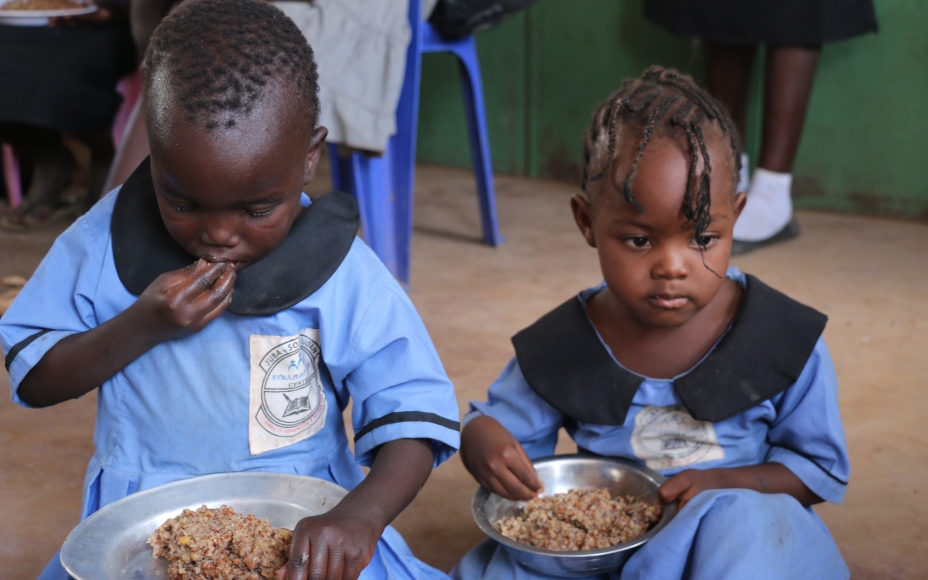
Excitement As School Meals Resume in Sudan

By Modupe Gbadeyanka
Following a more than five-year hiatus, the United Nations World Food Programme (WFP) resumed its school meals programme in Sudan’s Blue Nile State this week for more than 7,000 students in 21 schools.
Insecurity and lack of access had forced WFP to suspend the programme in September 2011. Prior to this interruption, WFP had provided school meals to around 70,000 students throughout Blue Nile State.
“I remember there were times when my sisters and I used to go home for breakfast in the middle of the school day,” said 15-year-old Ibrahim Ahmed, a student in Blue Nile State. “It is almost a one-hour walk from school to home, and we either ended up missing out on a lot by the time we got back to school, or we never went back because we were too tired to walk again.” Ibrahim was in second grade when WFP suspended the programme. Now in the seventh grade, he looks forward to eating meals again with his friends in school and not having to miss school.
Providing school meals is WFP’s longest-running programme in Sudan. Since 1969, WFP has been assisting millions of schoolchildren through its school meals programme. The programme currently provides school meals to almost one million children in Sudan, more than half of whom come from displaced and other vulnerable families in the Darfur region.
“I share the joy of children in Blue Nile who will now be having healthy meals, which we will provide in their schools. School meals not only prevent hunger among children during the school day, but they can also enhance nutrition and help improve school performance,” said WFP Sudan Representative and Country Director Matthew Hollingworth. “I am grateful to the Ministry of Education, parents, teachers, communities and the staff of our partner Mubadiroon who worked with us tirelessly in bringing this programme back to schools in Blue Nile.”
School meals provide an emergency safety net to schoolchildren and help to ensure that children, particularly girls, receive the education to which they are entitled. In the eastern states of Kassala and Red Sea, WFP has been providing take-home rations to 5,000 schoolgirls in selected schools where girls’ enrolment is extremely low. As a result, the number of girls attending school is now close to that of boys.
WFP, the Ministry of Education and the World Bank recently organised a workshop on Systems Approach for Better Education Results (SABER) for School Meals. SABER is a useful tool for assessing school meals programmes with the government and other stakeholders. The introduction of SABER is one of the key steps to the development of a national school meals policy and programme.
Sudan is one of WFP’s most complex emergencies, with recurring conflict, new and protracted displacements, insecurity, and crisis levels of malnutrition and food insecurity. In 2016, WFP plans to assist 4.6 million vulnerable people in Sudan through a mix of activities, including emergency food and cash-based transfers, nutritional support and resilience-building activities to support communities to become self-reliant.
Education
2026 Akada Children’s Book Festival Holds May 23
By Aduragbemi Omiyale
The 2026 edition of Akada Children’s Book Festival (ACBF) will take place on Saturday, May 23, at Rugby School Nigeria, Eko Atlantic, Lagos.
A statement from the organisers disclosed that this event, in its eighth year, will offer families a chance to engage their kids in fun, learning, and imagination all in one vibrant space.
The theme is Big Dreams, Brave Stories, and will feature different activities designed to move beyond passive participation, giving children the opportunity to engage actively with stories, explore their creativity, and connect with books in ways that feel natural and exciting.
Some of the rich and engaging line-up of activities designed to immerse children, parents, and educators in an interactive literary experience include author-led book readings, author meet-and-greet sessions, storytime sessions, book chats, book exhibitions and signings, workshops for children, workshops for parents and educators, writing and illustration competition announcements, scrabble and chess tournaments, theme song competition, sip and paint sessions, STEM activities, sensory play experiences, drama, music, and dance performances, and prizes and book giveaways.
The book festival encourages children to embrace courage, creativity, and self-expression. Through stories of adventure, bravery, and self-discovery, kids are inspired to dream boldly, ask questions, and see themselves as active participants in their own journeys.
As a result, some original children’s titles by Nigerian authors have been curated for the event. They include Lumi Drives from London to Lagos by Pelumi Nubi, Sim Sim Goes to the Salon by Tonye Faloughi-Ekezie, Amang Goes to the Village by Namse Udosen, and What Happened on Thursday? A Nigerian Civil War Story by Ayo Oyeku.
These books reflect diverse experiences and cultural contexts, allowing children to see themselves in the stories while exploring new worlds through literature.
Education
Controversial Nursery School English Language Textbook Not Approved—Lagos Govt
By Modupe Gbadeyanka
The Lagos State government has stressed that it did not approve the use of the controversial nursery school English language textbook in public and private schools in the state.
A mother had come online to criticise an alleged inappropriate content in her child’s textbook. It was claimed that the publisher of the book threatened to sue the woman.
Reacting to the development, the Permanent Secretary in the Lagos State Ministry of Basic and Secondary Education, Mrs Abisola Dokunmu-Adegbite, said the “textbook is not among the approved and recommended instructional materials authorised for use in public, or approved private schools across the state.”
According to her, the ministry maintains a strict policy on the selection and approval of educational materials to ensure that all learning resources are age-appropriate, morally sound, and align with the educational standards and values of the state.
She stated that based on preliminary findings, the “school featured in the video is located somewhere in Ojo Local Government, Lagos State.”
“The name of the school and publisher have been identified for further investigation and appropriate actions. The public is hereby assured of qualitative foundational education for our children in the state,” the senior government official said in a statement on Tuesday.
Mrs Dokunmu-Adegbite reiterated that only government-approved textbooks and instructional materials are permitted for use in schools in Lagos State, advising school administrators, proprietors, and teachers “to adhere strictly to these guidelines to safeguard the moral and academic development of our learners.”
She assured parents, guardians, educators, and the general public that the state government will always work hard to ensure children get quality education.
Education
Nigeria Introduces Textbook Ranking System to Improve Learning Standards
By Adedapo Adesanya
The federal government announces the introduction of a National Textbook Ranking System for Primary, Junior and Senior Secondary Schools across the country as part of ongoing efforts to strengthen quality assurance and standardisation in Nigeria’s education sector.
The development was disclosed in a Monday statement signed by Mrs Folasade Boriowo, the Director of Press and Public Relations, Federal Ministry of Education, noting that the initiative is designed to address the growing proliferation of textbooks in schools and ensure that only high-quality, curriculum-compliant learning materials are approved for classroom use.
The Implementation of the National Textbook Ranking System will commence from the September 2026 academic session, following the establishment of the Standing Subject Committees and completion of the evaluation framework.
The statement disclosed that the Minister of Education, Mr Tunji Alausa, alongside the Minister of State for Education, Professor Suiwaba Sai’d Ahmad, stated that under the new system, the Nigerian Educational Research and Development Council (NERDC) will continue to exercise its statutory authority to approve textbooks for use in Nigerian schools.
The Ministry explained that the textbooks will now be ranked through a structured national evaluation process to determine the most suitable and highest-quality options for each subject and level of education.
The statement reads, “As part of the reform, NERDC will establish Standing Subject Committees comprising experts in relevant subject areas. These committees will conduct rigorous reviews of textbooks submitted by publishers and evaluate them based on clearly defined academic and pedagogical standards.
“Following this evaluation process, only a limited number of textbooks will be ranked and approved for use in schools for each subject, ensuring improved quality control and consistency in teaching and learning materials across the country.”
The Ministry explained that the introduction of the ranking system is expected to significantly reduce the excessive number of textbooks currently in circulation in many schools, which has often created confusion for teachers, students and parents.
The statement added, “The reform also aims to bring greater transparency, order and quality assurance into the textbook approval process while aligning Nigeria’s education system with international best practices in instructional material standardisation.
“Under the new policy, NERDC will continue its responsibility of licensing textbooks. However, any textbook that is not ranked under the new system will not be permitted for use in Nigerian schools, regardless of prior licensing status.”
The statement further revealed that the Education Ministry will communicate the new ranking policy to teachers and other key stakeholders in the education sector to ensure proper awareness and compliance with the new framework.
The federal government reaffirmed that the reform forms part of broader efforts to strengthen the quality of education delivery, enhance learning outcomes and ensure that Nigerian students are equipped with the best possible learning resources.
-
Feature/OPED6 years agoDavos was Different this year
-
Travel/Tourism10 years ago
Lagos Seals Western Lodge Hotel In Ikorodu
-
Showbiz3 years agoEstranged Lover Releases Videos of Empress Njamah Bathing
-
Banking8 years agoSort Codes of GTBank Branches in Nigeria
-
Economy3 years agoSubsidy Removal: CNG at N130 Per Litre Cheaper Than Petrol—IPMAN
-
Banking3 years agoSort Codes of UBA Branches in Nigeria
-
Banking3 years agoFirst Bank Announces Planned Downtime
-
Sports3 years agoHighest Paid Nigerian Footballer – How Much Do Nigerian Footballers Earn