Education
Opay, Dolly Children Foundation Donate Facility to Ogun Secondary School
By Aduragbemi Omiyale
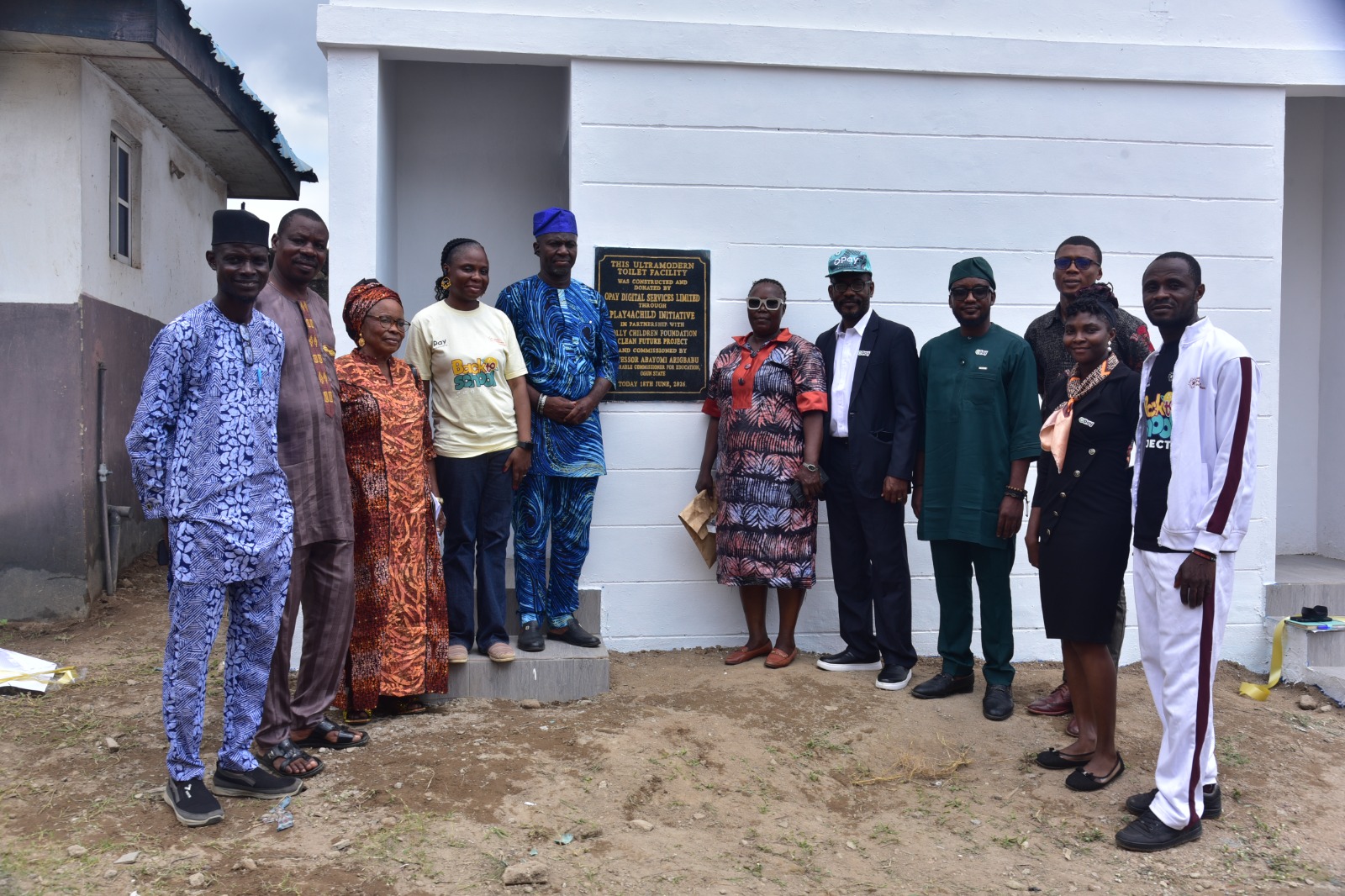
To improve sanitation and enhance the learning environment for students at Ebenezer Grammar School, Iberekodo, Abeokuta, Ogun State, a four-unit toilet facility has been built by OPay Digital Services Limited (OPay) in partnership with Dolly Children Foundation (DCF).
The project was commissioned on Thursday, June 18, 2026. It is expected to provide a safe and hygienic environment for the students and contribute to improved health outcomes.
It will also benefit hundreds of students by promoting healthier hygiene practices, reducing sanitation-related challenges, and creating a safer and more conducive environment for learning.
The OPay Clean Future Project aligns with broader national and global efforts to advance sustainable development, environmental protection, quality education, and community well-being. It further reflects OPay’s commitment to creating value beyond financial services through impactful corporate social responsibility initiatives while reinforcing Dolly Children Foundation’s mission of empowering children and strengthening underserved communities through sustainable development programmes.
At the commissioning, students were also given some educational and hygiene materials, while outstanding learners were recognised with school bags, sandals, and other learning resources in celebration of their academic excellence and exemplary conduct, underscoring the importance of supporting education while rewarding positive values and achievement.
“Education is the foundation of a brighter future, yet many children still face barriers to quality learning. Through the OPay Clean Future Project, we are improving sanitation, supporting education, and ensuring more students have the opportunity to learn in a safe and dignified environment,” the CSR Manager for OPay Digital Services Limited, Mr Itoro Udo, said.
Also, the Executive Director of Dolly Children Foundation, Adedolapo Osuntuyi, said, “Every child deserves access to a safe, healthy, and supportive learning environment. This project addresses a critical sanitation need while promoting environmental responsibility and helping students reach their full potential.”
Education
FG Raises WAEC, NECO Examination Fees by 82% to N50,000
By Modupe Gbadeyanka
The examination fees of Senior School Certificate Examinations (SSCE) conducted by the West African Examinations Council (WAEC) and the National Examinations Council (NECO) have been increased by the federal government by about 82 per cent to N50,000 from N27,500.
A circular signed by the Director of Senior Secondary Education in the Federal Ministry of Education, Mr Adeniji Ibrahim, disclosed that the new fees would become effective in 2027.
In the notice, it was disclosed that the government approved the upward review of the fees following a request by WAEC.
It was further disclosed that the decision to jack up the fees was reached after a March 31, 2026, meeting between the Minister of Education and examination bodies, where the need to review examination fees was discussed.
“You may recall that at a meeting of examination bodies held with the Minister of Education on March 31, 2026, where the need for upward review of examination fees was discussed, the Minister directed that WAEC and NECO should adopt a uniform fee for the conduct of WAEC and NECO SSCE,” the statement read.
“Consequently, I am directed to convey the Minister of Education’s approval of the sum of N50,000 only, as the new examination fee per candidate, with effect from NECO SSCE (Internal), 2027,” it added.
Education
FIRST E&P Backs Next Generation of Nigerian Engineers at Olympiad Finale
**Modibbo Adama University Emerges Grand Prize Winner, Secures N50m
A leading integrated independent exploration and production company with full-cycle upstream delivery capability, FIRST Exploration & Petroleum Development Company (FIRST E&P), has reaffirmed its commitment to developing Nigeria’s next generation of engineers.
This commitment was highlighted during the grand finale of the maiden edition of the Nigerian Engineering Olympiad (NEO), held on Tuesday, June 30, 2026, at Eko Hotel & Suites, Victoria Island, Lagos.
The event recognised outstanding student innovators whose engineering solutions addressed real-world challenges, marking the culmination of months of regional qualifiers, prototype development, mentorship and boot camp sessions that equipped students from universities and polytechnics across Nigeria with practical skills in engineering, innovation and entrepreneurship.
The Olympiad attracted 984 participants across 375 teams from more than 80 tertiary institutions representing all six geopolitical zones of the country.
Delivering the sponsor’s address, the General Manager, Engineering and Capital Projects, FIRST E&P, John Alamu, emphasised that the competition reflects the company’s commitment to equipping students with the practical knowledge and innovative mindset required to excel in engineering and strengthen Nigeria’s future workforce.
Alamu, noting that initiatives such as the Engineering Olympiad provide a structured platform for young talent to transform innovative ideas into practical solutions that contribute to the country’s technological and industrial advancement, stated that, “FIRST E&P believes that developing STEM capacity is an investment in this country’s ability to solve its own problems. The Nigerian Engineering Olympiad has taken young engineers and taught them to think beyond the drawing board, and FIRST E&P is proud to have been a funding partner for this initiative. I commend NCDMB for championing the Olympiad and Enactus Nigeria for successfully delivering a platform that is helping shape the next generation of Nigerian engineers and innovators.”
In his address, the Executive Secretary of the Nigerian Content Development and Monitoring Board (NCDMB), Engr. Felix Omatsola Ogbe, represented by the Acting Director, Planning, Research and Statistics, Silas Ajimijaye, expressed appreciation to FIRST E&P for their unwavering support in successfully delivering the Olympiad.
Ajimijaye added that the initiative aligns with the Federal Government’s Nigeria First Policy, which aims to build indigenous engineering capacity and equip young Nigerians with the knowledge and skills needed to drive industrial competitiveness, technological advancement, and sustainable national development.
The competition concluded in the awarding of prizes, with Team Mavericks of the Modibbo Adama University of Technology, Adamawa State, winning the grand prize of N50 million and a Centre of Excellence building for its Faculty of Engineering.
The team’s winning innovation, Ubuntu Sapphire, is a community-powered rapid alert system that uses affordable devices to instantly notify neighbouring households and emergency responders during emergencies, offering a practical solution aimed at strengthening community security and emergency response infrastructure.
Speaking after receiving the award, Team Lead, Dr David Patrick, expressed gratitude to the organisers and sponsors for providing a platform that fostered innovation and practical learning.
The University of Ibadan emerged as the first runner-up, receiving N30 million and N75 million worth of engineering equipment for its Faculty of Engineering. The University of Nigeria, Nsukka, secured third place and was awarded N20 million and N50 million worth of engineering equipment. The University of Jos finished fourth, receiving N10 million.
Education
UBA Foundation Inspires Savings Culture With Money Explorers Book
By Modupe Gbadeyanka
The Corporate Social Responsibility arm of the United Bank for Africa (UBA) Plc, UBA Foundation, has collaborated with Slum2School Africa to deliver a hands-on financial literacy workshop for underserved children.
At the event designed to equip participants with essential money management skills from an early age, an engaging learning companion, the UBA Money Explorers Book, was presented.
The book introduces the children to the fundamentals of financial literacy through interactive stories, practical money ledgers, games and activities.
The pupils were also introduced to the UBA Red Vault, a savings product created to encourage healthy financial habits from childhood.
This is part of UBA Foundation’s broader financial inclusion and social impact agenda, which promotes education, youth empowerment and community development through innovative learning programmes and grassroots outreach across the group’s 20 African countries of operation.
The Managing Director of UBA Foundation, Ms Bola Atta, underscored the importance of introducing children to financial education early, noting that such interventions help build lifelong habits that foster confidence, responsibility and economic independence.
“Every child deserves the tools to dream bigger and plan better, regardless of where they come from. When we teach a child to understand money, we are giving them confidence, choice and a clearer sense of what is possible.
“Our partnership with Slum2School Africa enables us to reach children who stand to benefit the most, and seeing their enthusiasm as they learn reminds us why this work is so important,” she stated.
Also commenting, UBA’s Segment Executive for Children and Youth Banking, Ozioma Obi, said, “We are creating products and experiences that make banking simple, relatable and enjoyable for children from their very first lesson.
“The Money Explorers Book and the UBA Red Vault are designed to make saving exciting rather than a task. When children begin this journey early, they develop habits that will serve them throughout their lives. That is how we nurture informed, empowered and financially responsible future generations.”
On his part, the Senior Programmes Manager for Slum2School Africa, Mr Adekunle Idowu, said, “Financial literacy is a life skill that every child deserves, regardless of their background.
“Through this partnership with UBA Foundation, we are helping children develop the confidence, knowledge and discipline to make informed financial decisions from an early age. When we empower children with these skills today, we are investing in a more financially responsible and economically resilient future.”