Education
Universities Deserve Special Funds for Research—Dangote
By Modupe Gbadeyanka
Federal government has been urged to consider allocating special funds to universities in the country to assist them with research and infrastructural upgrade.
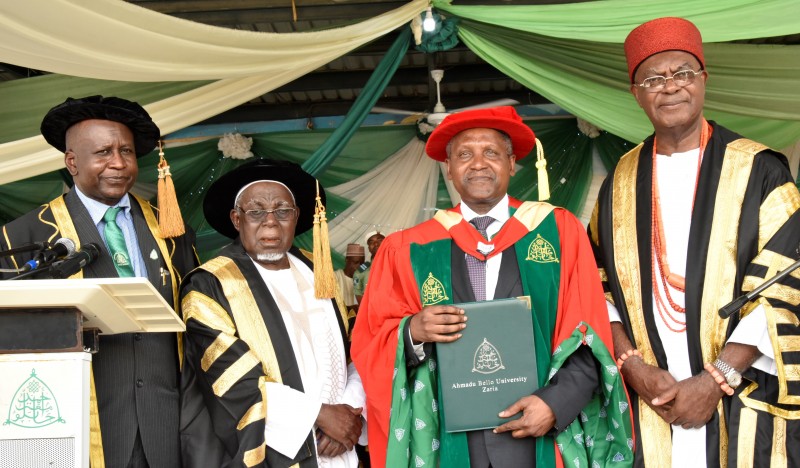
This appeal was made by Africa’s foremost businessman and Chairman of Aliko Dangote Foundation, Mr Aliko Dangote, during the 41st convocation of the Ahmadu Bello University, Zaria at the weekend.
At the convocation, Mr Dangote made yet another critical intervention in the educational sector by donating a fully equipped 2,160 bed space hostel complex to the institution.
The students’ halls of residence comprising of 10 blocks of 360 rooms built at the sum of N1.2 billion is coming after similar gestures to Bayero University, Kano and University of Ibadan, where the business mogul donated multi-billion Naira business school complexes respectively as part of his contribution to the educational development in the country.
On the occasion, the school management conferred on Mr Dangote and the renowned labour leader, Mr Hassan Sumonu, honorary Doctorate Degree. Also 15,787 graduating students were also awarded various degrees.
The President of Dangote Group on the occasion explained that he was moved to build the structure having realized that the student population at the universities have recorded significant increase without a corresponding growth in terms of infrastructure lamenting that the situation has remained a subsisting and growing major challenge as Nigerian public universities continue to grapple with underfunding.
“Thus, I will like to use this opportunity to enjoin the federal government to consider allocating special funds to the universities to enable them to improve on research and upgrade their infrastructure. Such special intervention has become imperative given the perennial funding challenges facing our universities”, he stated.
Mr Dangote posited that the federal government alone could not shoulder the entire burden of funding tertiary education due to competing needs of other sectors that also demand priority attention. This is where Public Private Partnership (PPP) can and should come in to fill the gap.
He then enjoined the private sector to adopt a new approach towards supporting the federal government in tackling the funding deficit in the higher institutions of learning.
“I strongly believe the private sector must go beyond just the payment of the 2 percent education levy and be ready to join hands with the state and federal governments in expanded funding for tertiary education in Nigeria. This will ensure that our institutions of higher learning are positioned to produce graduates who can transform this nation.
“If there are two things that I am passionate about, they are education and entrepreneurship. I believe they go hand in hand.
“Some years ago, as Chairman of the National Committee on Job Creation, my committee strived to fashion out strategies for integrating entrepreneurship into our national educational curriculum, in line with what obtains in the Western world.”
While expressing his gratitude on the award conferred on him, Mr Dangote described ABU as “an institution famed for its incredibly thorough academic tradition, the quality of faculty, and the enriching experiences of life within its walls.
“Today, the university has lived to its billing as a melting pot for ideologies by honouring a renowned socialist and champion of employees’ rights, Alhaji Hassan Sunmonu and Myself, for being a leading capitalist and investor in employment generating enterprises.”
Mr Dangote noted that, “It is also with a deep sense of fulfilment that today’s occasion is also being used for the commissioning of 10 blocks of student hostels which consists of 360 fully equipped rooms with capacity for housing 2160 students, built at a cost of N1.2 billion donated by the Aliko Dangote Foundation to Ahmadu Bello University, (ABU) Zaria.
“Our intervention is designed to lessen the plight of students who suffer acute accommodation challenges within the campus. We have brought similar intervention to University of Ibadan (UI) and Bayero University Kano (BUK) amongst other institutions.”
While commending him, Governor Nasiru El-Rufai of Kaduna State who officially opened the hostel said Mr Dangote’s philanthropic spirit should be emulated by others who have been blessed by God.
A visibly elated Governor, who is an alumnus of the university, said both government and the private sector can partner to lift the educational sector in Nigeria pointing out that if not for the efforts of the university management, the institution was already dying.
Vice Chancellor of the school, Professor Ibrahim Garba, who was very excited at the magnitude of the structures said the University is the largest in West Africa and described the Aliko Dangote hostel project as a “big relief,” saying lack of adequate accommodation is one of the nightmares of the university.
He told the audience that Mr Dangote’s kind heartedness to the university was is immeasurable, saying of the 50,000 students of the university, the institution could hardly accommodate 10,000 and that the new hostel was the first addition after 40 years to the hostels built by the university.
While commending the Aliko Dangote Foundation, Director Physical Planning and Municipal Services of the University, Engineer Muhammad Aminu Sambo, said: “This is a big relief because the university has limited accommodation in relation to the numbers of students admitted every year. This is one of our nightmares.”
He commended the Chairman of Aliko Dangote Foundation and urged all able Nigerians to emulate him and intervene in the educational sector.
National President of the Ahmadu Bello University Alumni Association, Professor Ahmed Tijani Mora, had recently noted that the contribution of the Aliko Dangote Foundation to the educational sector and more importantly to the school was unprecedented. He said it was in this regards that the University Alumni Association recently conferred a Corporate Award on Aliko Dangote.
It would be recalled that Mr Dangote through his Foundation had only recently donated a World Class Dangote Business School worth N1.2 billion to the Bayero University Kano, and built another one in University of Ibadan worth N250M. he also donated N200 million to Katsina State University.
In the same vein, funding was also provided for the construction of a 500 capacity student hostel complex at the University of Science and Technology, Wudil in Kano state. The Foundation gave N118 million for a squash complex project at the University of Nigeria, Nsukka main campus and another N50 million to the University of Port Harcourt.
Expressing the motive behind his educational intervention across the nation, Alhaji Dangote had said: “I do not only want to be known as the Africa’s richest man, but the biggest philanthropist. I will continue to use my resources and my voice to help shape a better Nigeria, and Africa as a whole,” he said.
Education
FG Slashes Textbook Ranking Fees to Support Publishers, Policy Rollout
By Adedapo Adesanya
The federal government has slashed the fees for the assessment and ranking of textbooks ahead of the implementation of the National Textbook Ranking Policy scheduled to commence in September 2026.
The reduction, approved through the Nigerian Educational Research and Development Council (NERDC), was aimed at easing the financial burden on publishers and authors while facilitating compliance with the new national textbook quality assurance framework.
The decision comes ahead of the implementation of the National Textbook Ranking Policy introduced by the Minister of Education, Mr Tunji Alausa, to improve the quality and standardisation of instructional materials used in schools across the country.
Announcing the development in a statement on Wednesday, the Executive Secretary of NERDC, Mr Salisu Shehu, said the assessment fee had been reduced from N2,000 to N1,500 per page, while the ranking fee for each textbook title had been cut from N1 million to N750,000.
He said the revised fees take immediate effect and apply to all publishers and authors submitting textbooks for assessment and ranking.
Mr Shehu also disclosed that publishers who had already paid the previous assessment fee of N2,000 per page would receive refunds of the excess payments, adding that details of the refund process would be announced in due course.
He urged all stakeholders in the publishing industry to comply with the new fee regime.
“Under the policy, only textbooks that have been assessed, approved and ranked by NERDC will be approved for use in Nigerian classrooms from September 2026, while unranked textbooks will no longer be permitted,” he said.
Meanwhile, the minister explained that the initiative was designed to tackle the proliferation of textbooks in schools and ensure that teachers and learners have access to high-quality, curriculum-compliant instructional materials.
The minister restated that NERDC will continue to exercise its statutory responsibility of approving textbooks for use in schools, but that approval alone would no longer be sufficient under the new policy.
“Instead, every approved textbook will undergo a structured national evaluation and ranking process by expert committees to determine the most suitable and highest-quality books for each subject and level of education,” he said.
The minister was optimistic that the National Textbook Ranking Policy will strengthen quality assurance in education by providing schools, teachers and parents with reliable guidance on the best instructional materials for teaching and learning.
Education
Firm, Bank Organise Free Innovators’ Camp for Children in Lagos
By Aduragbemi Omiyale
A free educational initiative to equip children with practical Science, Technology, Engineering and Mathematics (STEM) skills needed to grow, thrive and prosper in a rapidly evolving world has been put together in Lagos.
The programme, Young Innovators Camp, commenced on Monday in the Lekki area of Lagos State. It is organised by MONAT, with Fidelity Bank as the sponsor.
Participating children, who must be between 4 and 10 years, will have a hands-on learning experience focused on creativity, innovation, problem-solving and critical thinking. They will be introduced to age-appropriate STEM concepts, guided build sessions and other engaging activities designed to stimulate curiosity and encourage practical learning.
The camp will also feature small group learning with facilitators, financial literacy sessions, creative activities, and other interactive experiences that support confidence-building among participants.
Every participant will also receive a specially curated gift pack filled with educational resources and STEM learning materials to encourage continued exploration and learning at home, making the camp both a memorable and transformative experience.
The Young Innovators Camp reinforces Fidelity Bank’s ongoing investment in initiatives that prepare children and young people for the future. It builds on the bank’s education-focused interventions, including initiatives such as SWEETA, which supports children, and the lender’s broader CSR agenda, which prioritises youth empowerment, education, skills development and access to opportunities that can improve long-term outcomes for individuals and communities.
“The future will be shaped by those who can solve problems, think creatively, and harness technology to improve lives.
“At Fidelity Bank, we believe these abilities should be nurtured from an early age.
“Through the Young Innovators Camp, we are giving children the opportunity to explore science, technology, engineering and mathematics in a fun, practical and engaging way that inspires curiosity, builds confidence, and encourages innovation.
“We want every child who participates to leave believing that they have the potential not just to succeed in the future, but to help create it,” the Divisional Head of Brand and Communications at Fidelity Bank, Mr Meksley Nwagboh, said.
“As a bank committed to helping people grow, thrive and prosper, we see education, particularly STEM education, as a strategic investment in Nigeria’s future.
“Today’s young innovators will become tomorrow’s engineers, scientists, entrepreneurs, inventors and technology leaders.
“By partnering with Monat, we are investing in a generation equipped with the skills, mindset and confidence to solve real-world challenges, create opportunities, and contribute meaningfully to national development.
“This is more than a summer camp; it is about unlocking potential and inspiring the next generation of innovators,” he added.
Education
81 Students for Next Stage of 2026 InterswitchSPAK National Science Competition
By Modupe Gbadeyanka
The top 81 students of the flagship Science, Technology, Engineering and Mathematics (STEM) competition for senior secondary school students in Nigeria, InterswitchSPAK, have emerged.
They were chosen from the national pre-qualifying examinations, which attracted over 21,700 participants from secondary schools nationwide.
The chosen candidates distinguished themselves through exceptional performance in the examination, earning places in the next stage of the competition.
The organisers of the programme, Interswitch, one of Africa’s leading integrated payments and digital commerce companies, disclosed in a statement that the successful young scholars will now proceed to the next phase of the contest, where they will undergo further assessments at the highly anticipated televised stages airing from November 2026 to January 2027, gaining the opportunity to compete for tertiary education scholarships and prizes worth over N40 million.
“The emergence of these 81 exceptional students is a testament to the incredible talent, resilience and promise that exists among young Nigerians.
“At Interswitch, we believe that investing in STEM education is critical to building the innovators, problem-solvers and technology leaders who will shape Africa’s future.
“While we celebrate those advancing to the next stage, we are equally proud of every student who participated and demonstrated the courage to challenge themselves and pursue excellence,” the Divisional Head for Brands Communications, Content and CSR at Interswitch, Tomi Ogunlesi, stated.
Business Post reports that this year’s participation represents an approximated 19.7 per cent increase over the 18,200 students who registered for Season 7, further underscoring the growing national interest in STEM education and reinforcing InterswitchSPAK’s position as one of Nigeria’s foremost platforms for identifying, nurturing and rewarding exceptional young scientific talent.
Now in its eighth season, InterswitchSPAK continues to provide a national platform that rewards academic excellence while equipping outstanding students with opportunities for mentorship, exposure and life-changing educational support. Beyond the competition itself, the initiative reflects Interswitch’s long-standing commitment to advancing education, promoting innovation and developing the human capital required to drive Africa’s digital future.