Feature/OPED
Corruption Trials: The New Tactics of Evading Justice
By Omoshola Deji
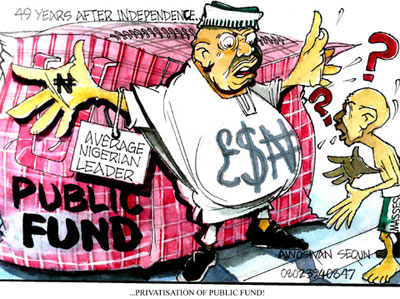
Aside ethnic bigotry and religious odium, corruption is apparently Nigeria’s ultimate challenge. Corruption is so rampant that it has unconsciously become a norm. Rights and merit are not valued anymore. Every step you take, you must always be ready to bribe your way or know someone who knows someone. No class is righteous! Almost everyone use their position, power and authority for personal aggrandizement. The educated steals with the pen, the unschooled engineer demands for thrice the price of auto-parts and the politician snaffles the public treasury.
The gains of corruption have shattered the political-will to tackle it. Nonetheless, President Buhari has valiantly expelled the usual mode of fighting corruption with articulate speeches and match words with action. Judges and prominent politicians are being investigated and prosecuted, even though there is just a single convict – Bala Ngilari, the former Governor of Adamawa State.
The apparent national attention shift from Ngilari makes this publication timely, weighty and credible. This piece had been long articulated-in-mind, but the main task of grounding the core assertion that the political elites have devised a new antics to immune themselves from incarceration necessitated a lengthy observation and research.
To achieve this, much time was needed to observe the actions and reactions of the federal government, the anticorruption crusaders, the populace and the media. Sadly, this collection of Nigerians has been underactive or unconscious of a looming danger.
On March 6, 2017, Ngilari’s popularity soared when news broke that an ex-governor has been sentenced. For awarding the purchase of 25 cars for N167 million without adhering to the State’s Public Procurement Act, Ngilari was convicted of corruption and sentenced to five years imprisonment without the option of fine by Justice Nathan Musa of the Yola High Court.
This rare, high-profile conviction generated a rain of national applauds and international accolades. The world was convinced that the likes of James Ibori would no longer be able to evade justice. Among the political class, Ngilari’s conviction sent shivers down the spine of the corrupt and they began to strategize. The outcome of their strategy exposed when the unprecedented happened. After being imprisoned for 21 days out of a five year jail term, Ngilari was released from prison under the most dubious circumstance.
In a dire conspiratorial alliance with the prison and the judiciary, Ngilari’s comrades coaxed the Prison Deputy Comptroller in charge of health, John Bukar, to issue a medical report that Ngilari needs an urgent medical attention abroad – specifically at the Canada Specialist Hospital in Dubai. The medical report stated that Ngilari is battling with insomnia, diabetes and hypertension with blood pressure rising between 180/110MMHG to 190/120MMHG.
Easily and swiftly, the same Justice Musa that convicted Ngilari awarded him a N100 million bail with two sureties, who must own landed properties in Yola, the Adamawa State capital. Without a doubt, Nigeria is a class society where the rule-of-law exists only on paper. Under the watch of an anticorruption focused government, Ngilari was released to seek medical attention abroad, while thousands of convicted and awaiting trial inmates with debilitating health are never awarded such grace.
Is Ngilari really receiving treatment abroad or has totally escaped justice? A print media once reported that when Ngilari’s release started generating controversy, he hurriedly escaped through the Cameroonian borders to an unknown destination. There is evidently more to Ngilari’s release than meets the eye. The conduct of Justice Musa and the prison officials shows that some prominent persons are determined to ensure Ngilari evades justice. Who could these powerful persons be other than his fellow politicians, party stalwarts and godfathers? Could it be that Justice Musa and the prison officials’ hands were greased? Most likely!
In denial, the Comptroller of the Nigerian Prison Service (NPS) in Adamawa State, Peter Tenkwa, declared he knew nothing about the medical report that facilitated Ngilari’s bail. Teckwa expressed that the “Nigeria Prison Service, as I stated, knows nothing about this letter; whoever wrote that letter is on his own. I have been directed to query the officers involved”. As a deterrent, the NPS suspended two prison officials and nothing more has been heard. Is that enough to deter future occurrence?
Affirming conspiracy, Teckwa (unintentionally) exposed the initial desperate move to hasten Ngilari’s freedom. He unveiled that the Adamawa State Ministry of Justice had initially written him to raise concerns about the health facilities in Ngilari’s prison. After assessing the facilities, the ministry was informed in writing that the prison facilities are up to standard. Teckwa avowed that “we have enough medical facilities to handle high-profile inmates like Ngilari”. Fellow Nigerians, if you wish to live the Nigeria of your dreams, never defend the unscrupulous release of Ngilari.
Affirming infraction, the Adamawa State Attorney General and Commissioner of Justice expressed that: “you must establish special circumstance before granting bail; pending appeal and ill health is not good enough. Before such bail would be granted, the convict must show that the ill health is of contagious nature; the convict did not meet any of the conditions required”.
Manifestly, it is unclouded that the political elites have successfully launched their new strategy of evading justice without consequence. The Buhari anticorruption administration has ignored it and Nigerians have done nothing to resist it. As has always being the case, some Nigerians boorishly defend Ngilari’s release while others condemned it – all talks, no action! The ever vocal Femi Falana and anticorruption crusader Itse Sagay – that roar when the Senate sneezes – have gone mute.
Nigerians beware! This is another Boko-Haram synonymous menace in its formative stage. The implication is that once a prominent politician is convicted, he or she would simply regain freedom on health grounds and fly abroad for ‘treatment’. Bear in mind, there is hardly any imprisoned aged person without one form of ailment or the other. Imagine Sambo Dasuki and Deziani Alison-Madueke are convicted of corruption, but later released to get medical treatment abroad. The rate of corrupt practices would surely skyrocket beyond measure. Wise is the one who first orated that “a stitch in time saves nine”. I warn! Our collective silence and “eh no concern me” attitude would blow this new tactics of evading justice out of proportion.
Without reasoning, we support these politicians blindly while they callously make our lives miserable. They care less and would continue to do anything possible to secure their political future. When MKO Abiola and Baba Gana Kingibe contested the 1993 annulled presidential election, Nigerians were not religiously sentimental. No one cared if it’s a Muslim-Muslim or Christian-Christian ticket. Today, everything has changed. Just for the sake of winning elections, some politicians desperately fused politics with religion. They have malformed our orientation that we must fight for our ethno-religious person to be in power, regardless of their competence.
These greedy politicians also converted ethnicity to political ideology. They have cajoled us to believe that it is a sin to criticize our ethnic person in power and we must fight other tribes that do such. Today, I doubt if any political party can win the presidential election without balancing the North-South and Christian-Muslim equation. That’s not enough, the next target of these politicians is to frustrate the anticorruption war and cripple justice, but Nigerians are neither observant nor resistant.
I pity the Nigerian masses, especially those who have clouded their intellectualism with ethno-religious sentiments. The corrupt politicians they fiercely defend are the ones behind their ordeals. Without a second thought, a miscreant would be the first to stone the politician using him as a terror instrument, if he realizes that the corruption and misdeeds of politicians basically made him a miscreant. That miscreant couldn’t have a quality education because the funds meant for development have been shared, while the children of those he roars “tuale all-right sir” for are schooling in the best universities abroad.
If Nigerian states are to be sold, the debt of some states is almost their value price. Oh Nigerian leaders why? Why are you obtaining loans our unborn generation cannot pay only to steal? Look around you! The roads are death traps; masses are terribly impoverished; insecurity is alarming; graduates are unemployable; youths are submitting their intellectualism to crime; our ladies are embracing prostitution and people are dying of minor diseases. For how long shall Mosquitos continue to stare at us and say ‘bless this food, Oh lord, for Christ sake’? These man-made evils are befalling us because Ngilari and associates have fleeced the funds meant for development.
Lest I forget, it is a pity that Nigerians don’t even know they are suffering. When you write objectively about any public related issues in developed nations, everyone would raise their voice for change, but in Nigeria, the same people that corruption has swallowed their convenience would rain abuses and question your right to speak.
Well-intended, this piece is a wake-up call for Buhari-Osinbajo and all Nigerians to rise against the latest ruinous antics of the political class before it is too late. If we ignore and handle it softly like Boko-haram, the situation would one day rise beyond our control and this piece would be referenced as that patriotic warning that was ignored.
Omoshola Deji is a political and public affairs analyst. He wrote in via [email protected]
Feature/OPED
Trapped Between Nigeria’s Failure and South Africa’s Xenophobic Violence
By Blaise Udunze
When the word “xenophobic” is talked about, most affected African countries tend to focus on the pains being experienced by their citizens in South Africa. For a moment, it calls for Nigeria and the rest of the African continent to pause and ask, how did we get here?
The recent happenings across the streets of Johannesburg, Pretoria, and Durban, a painful pattern continues to unfold with frightening and fearful regularity, as Nigerian-owned businesses are looted, migrants hunted, families displaced, and African nationals reduced to targets of rage. If asked, the majority would chorus that the recurring images of xenophobic violence in South Africa are disturbing enough, and no doubt, yes, but the deeper tragedy is beyond the flames and bloodshed. It lies in the silent failures back home that forced many Nigerians into vulnerable exile in the first place.
The reality, as a matter of fact, is that to understand the suffering of Nigerians in South Africa, one must first confront the uncomfortable truth that xenophobia is not merely a South African problem. It is also a Nigerian governance problem exported abroad.
Nigeria, often celebrated as the “Giant of Africa,” has now become the “Mama Africa” who has failed to nurture her many children, with the fact that behind every Nigerian fleeing hardship for survival, known as the “japa” syndrome, in another African country is a story shaped by economic frustration, failed institutions, poor leadership, unemployment, and a financial system disconnected from the realities of ordinary citizens.
One apt way to confirm these inimical factors, the South African president, Cyril Ramaphosa, recently acknowledged this uncomfortable reality when he urged African leaders to address the domestic failures driving mass migration across the continent. Speaking amid renewed anti-foreigner tensions, Ramaphosa identified “misgovernance” as one of the factors forcing Africans to seek refuge in countries like South Africa. Of a truth, his comments may have generated debate, and some “patriotic Nigerians” may also want to prove him wrong, but they reflected a painful reality many African governments would rather avoid.
Nigeria, despite its vast human and natural resources, has increasingly become a country where millions no longer see a future at home. This is a critical irony and the height of it all because a nation blessed with oil wealth and entrepreneurial energy and one of the youngest populations in the world is yet burdened by systemic corruption, policy inconsistency, infrastructural collapse, and a leadership class that has often prioritised politics over productivity, especially with the imminence of an election.
It is so detestable and at the same time fearful that the result is a generation of young Nigerians trapped between hopelessness and migration.
One regrettable experience that has continued to haunt the country for decades is that successive governments have squandered opportunities that could have transformed Nigeria into an industrial and economic powerhouse. Public resources that should have been invested in power, roads, healthcare, manufacturing, education and enterprise development have either disappeared into private pockets or become trapped in wasteful bureaucratic structures.
Reports indicating that over $214 billion in public funds may have been lost, diverted, or trapped in opaque fiscal systems over the last decade capture the scale of Nigeria’s accountability crisis. Whether exact or conservative, such figures reveal a country losing resources or funds rapidly from severe bleeding that could have changed millions of lives.
Looking intently at these developments, one would know that the tragedy is not merely corruption itself but the opportunities corruption destroyed.
Come to think of this fact that with proper governance and strategic economic planning, Nigeria could have developed a thriving SME ecosystem capable of employing millions of citizens. Instead, unemployment and underemployment have become defining realities of national life. The World Economic Forum recently identified unemployment and lack of economic opportunity as Nigeria’s greatest economic threat, yet the country continues to struggle with coherent employment data and long-term economic direction.
This economic suffocation explains why migration has become less of a choice and more of a survival strategy for many Nigerians.
At the centre of this crisis is another troubling contradiction, which is that Nigeria’s banking sector appears increasingly profitable while the real economy continues to deteriorate.
Ordinarily, banks in developing economies are expected to function as engines of growth by financing productive sectors, supporting innovation, and empowering small businesses. Across the world, SMEs are recognised as the backbone of grassroots economic development, and the tangible result is that they create jobs, stimulate local production, and expand economic participation.
In Nigeria, SMEs account for over 70 per cent of registered businesses, contribute nearly half of the country’s GDP and generate between 84 and 90 per cent of employment. Yet, despite their enormous economic importance, SMEs receive barely between 0.5 per cent and one per cent of total commercial bank lending.
This is not just a policy failure; it is an economic tragedy. Rather than financing entrepreneurs and productive enterprises, Nigerian banks have increasingly found comfort in investing heavily in government treasury securities. In 2025 alone, major Nigerian banks reportedly generated N6.68 trillion from total investment securities and treasury bills, benefiting from high-yield government debt instruments instead of supporting businesses capable of creating jobs.
The banking sector’s recapitalisation exercise, which successfully raised N4.56 trillion, was celebrated as a regulatory achievement. But the critical question remains. The recapitalisation is for what purpose?
If stronger banks continue to avoid the productive economy while SMEs remain starved of affordable credit, recapitalisation merely strengthens financial institutions without strengthening national development.
Today, private sector credit in Nigeria remains significantly low compared to many African economies. High interest rates, excessive collateral demands, weak credit infrastructure and risk-averse banking practices have created an environment where small businesses struggle to survive, and these implications are devastating.
Every denied SME loan is a denied employment opportunity. Every failed business is another frustrated entrepreneur. Every frustrated entrepreneur is another Nigerian considering migration.
This is how economic dysfunction transforms into human displacement. In a situation like this, it is noteworthy to state that South Africa naturally becomes an attractive destination because of its relatively advanced infrastructure and larger economy. Today, this has informed Nigerians and other African countries alike to migrate there, not because they hate their country but because they are searching for dignity through work and enterprise.
Yet, in a cruel twist, many become targets of xenophobic violence. Foreign nationals are accused of “taking jobs,” dominating businesses, and contributing to crime. Shops are attacked. Businesses are burned. Lives are lost.
It is not a surprise anymore that the disturbing rhetoric surrounding xenophobia has become increasingly normalised and perceived as fighting against saboteurs. Another major concern is that social media posts celebrating violence against Nigerians reveal a frightening and fearful dehumanisation of fellow Africans. This has continued to be heralded unaddressed, as some extremist anti-migrant groups now openly mobilise hostility against foreign nationals under the guise of economic nationalism.
Yet, as opposition leader Julius Malema rightly asked during one of the recent xenophobic debates. “After attacking foreigners and shutting down their businesses, how many jobs have actually been created?” If you are smart enough to know, it is glaring that this is a question that cuts through the emotional manipulation surrounding xenophobia, which also reflects the fact that destroying a Nigerian-owned shop does not solve unemployment, nor does killing migrants create prosperity. Violence against fellow Africans does not fix structural inequality.
Malema’s argument was blunt but accurate in revealing that xenophobia is not an economic strategy. It must be perceived with the right perspective as the symptom of deeper failures, poverty, inequality, weak governance, and political frustration.
Historically, just like other colonised African countries, South Africa itself carries deep old wounds. The legacy of apartheid left enduring economic inequalities, spatial segregation, unemployment, and psychological scars, but this should not continue to shape social tensions today. What is of concern is that the same people, like other African countries, experienced, were expected to remain forward-looking and forge ahead rather than dwell in the past.
It is even more pathetic that decades after the fall of apartheid, millions of Black South Africans remain trapped in poverty and exclusion; perhaps they are not to be blamed for their failures as they claimed, but the foreigners who didn’t stop them from exerting their skills become the scapegoats.
That frustration often seeks an outlet, and immigrants become easy scapegoats. This, however, does not excuse the brutality.
The stories emerging from xenophobic attacks are horrifying and very dastardly and humiliating, as African migrants have reportedly been beaten, burned alive, stoned, and hunted in communities where they once sought refuge, as two Nigerian citizens were said to have been beaten and burnt to death. To say the least, the pain becomes even more ironic when viewed against history.
Because Nigeria played a major role in supporting South Africa’s anti-apartheid struggle, ranging from financial assistance to diplomatic pressure, scholarships, activism, and cultural solidarity, Nigerians stood firmly with Black South Africans during some of apartheid’s darkest years, which was enough to prevent such ugly events. Nigeria did so much to the point that Nigerian students contributed financially to anti-apartheid campaigns. Nigerian musicians used music to mobilise continental resistance. Successive governments invested enormous diplomatic and material resources into the liberation struggle.
The children and grandchildren of those who made such sacrifices are now among those facing hostility in South Africa today.
History makes the tragedy even heavier. Yet, Nigeria must also confront its own failures honestly. The truth is, if Nigeria had invested half the energy it spent supporting external liberation struggles into building a functional domestic economy, perhaps millions of Nigerians would not be fleeing abroad in search of economic survival today.
The painful reality is that many Nigerians abroad are not economic adventurers; they are economic exiles.
The ugliest side of it all is that they are exiled by unemployment, exiled by corruption, and exiled by policy failures. Again, they are exiled by a system that has repeatedly failed to convert national wealth into shared prosperity but into embezzlement that still finds its resting place in a foreign account.
This is why solving xenophobia requires more than diplomatic protests or emotional outrage, as exuded in the National Assembly by some members like Adams Oshiomhole and others. This calls for the political actors and those in the financial space to fix the conditions that force Nigerians into vulnerable migration in the first place.
One undeniable fact is that, as a country, Nigeria must fundamentally rethink governance and economic management as it takes into consideration the following solutions.
First, public accountability must become non-negotiable and should not be compromised anywhere. Corruption and resource mismanagement are critical and have robbed generations of opportunities, and these are the major traits fueling the exile. Infrastructure, industrial development, education, and healthcare must become genuine priorities rather than campaign slogans, as all these must become a reality, not a feeble promise.
Second, the banking sector must reconnect with the real economy. Financial institutions cannot continue generating enormous profits from government securities while productive sectors collapse. The government should hold a roundtable discussion with banks, which must be incentivised and, where necessary, compelled to increase lending to SMEs and productive industries capable of generating employment.
Third, there must be deliberate and conscious investment in skills, innovation, and entrepreneurship. Young Nigerians should not have to leave their homeland merely to survive because it is an aberration for a country that is enormously rich but still has some of its best hands eloping from the country.
Finally, African governments must reject the politics of division and scapegoating. This contradiction is at its height because Africa cannot claim to pursue continental unity while Africans are hunted in other African countries.
In all of the deliberation, the truth remains the same, in the sense that the story of Nigerians suffering xenophobic violence in South Africa is ultimately a story about failed systems on both sides, one on the side of economic failures pushing migrants out and the social failures turning migrants into enemies.
Until these structural realities are confronted with honesty and urgency, the cycle will continue. More young Nigerians will leave. More migrants will become vulnerable. More African societies will turn inward against each other.
But this trajectory is not irreversible. One gift that can’t be taken away from Nigerians is that Nigeria still possesses the talent, entrepreneurial energy, and human capital necessary to build a prosperous economy that gives its citizens reasons to stay rather than flee. The truth is that what has been lacking is not potential but responsible leadership and economic vision.
The true solution to xenophobia may therefore begin far away from the streets of Johannesburg or Durban. It may begin in Abuja, with governance that works, institutions that serve, banks that invest in people, and leadership that finally understands that national dignity is measured not by speeches but by whether citizens can build meaningful lives at home.
Until then, the “japa” flag will keep flying, as many Nigerians will remain exiled, not merely by borders, but by the failures of the country they still desperately want to believe in.
Blaise, a journalist and PR professional, writes from Lagos and can be reached via: [email protected]
Feature/OPED
Why East Africa is Emerging as Africa’s Trade Growth Engine
By Elvis Ndunguru
East Africa, led by Kenya, is emerging as a powerful trade hub driven by infrastructure investment, regional integration and expanding intra-African trade. As a gateway for natural resources, it boasts rare earths, gold, nickel, cobalt, graphite, and other commodities the world needs.
Trade finance is the key to unlocking cross-border flows, supporting SMEs and enabling regional value chains, opening up economic benefits for the region.
As East African trade accelerates, better Foreign Direct Investment (FDI) policies have a stronger bearing on the Tanzanian mainland and Zanzibar, attracting capital movement. As stronger regional demand reshapes trade patterns, increased urbanisation and population growth are driving intra-African trade in fast-moving consumer goods (FMCG), construction materials, and processed goods. Improving macro-stability boosts investability as better fiscal and monetary management emerge.
But global flows demand dependence on solid infrastructure. As corridor-led infrastructure unlocks trade flows, investments in establishing ports, rail, and roads enable trade in new ways. For example, the Port of Mombasa and the Standard Gauge Railway are reducing transit times and connecting important inland markets like Uganda and Rwanda. Regional integration is being driven particularly under the East African Community (EAC) and the African Continental Free Trade Area (AfCFTA), resulting in lowered tariff and non-tariff barriers.
Between South Tanzania and North Kenya, strategically placed ports improve both inter- and intra-continental trade flow. To bolster regional connectivity, Tanzania will spend 12 trillion shillings (TZS) on port expansions. Meanwhile, the $1.4 billion Tazara (Tanzania-Zambia Railway Authority) Railway rehabilitation is underway. Kenya is investing in rail, and a new fuel pipeline is being established from Uganda to Tanzania. The Tanzania Standard Gauge Railway is indeed positioned to complement and strategically link with the Lobito Corridor, even though they originate in different parts of the continent. The strategic connection lies in creating a transcontinental logistics network for DRC: goods (especially critical minerals like copper and cobalt) can move more efficiently across Africa, either east to Indian Ocean markets or west to Atlantic routes. This reduces reliance on single export routes, improves resilience, and enhances intra-African trade under frameworks like the African Continental Free Trade Area.
These developments give life to new trade flows, like transporting fuel from Uganda to the Middle East, or moving copper from Congo to China.
In the SADC and EAC regions, comprising over half a billion people, the demand for goods and services, including fuel, is significant. Regional agreements must be fostered to harmonise customs, tariffs, regulations, and the movement of goods, people and services. Frameworks like the EAC Customs Union and AfCFTA have reduced tariffs, but the system is often plagued by border delays and inconsistent enforcement, which dilute the impact of trade.
If banks with trade finance capabilities, including institutions like Absa with a growing pan-African footprint, support infrastructure development, this will boost connectivity, lower transport costs, and improve trade opportunities. Currently, it’s cheaper to move goods from China to Dar es Salaam than to transport them from Dar es Salaam to Mwanza, a region within Tanzania.
Trade finance is most impactful in sectors with predictable cross-border demand, such as agriculture, energy, and FMCG. Structured trade finance and supply chain finance help large corporates extend terms to suppliers, indirectly supporting SME participation.
The East African economy is largely driven by SMEs. In Tanzania, 96% of our economy depends on SMEs, but they lack funding to support themselves. The majority are trade-based, with imports from the Middle East, China, India, and others, and exports like minerals or agri-commodities to other parts of the world. While banks can help support SMEs, the locals must also support them to benefit the local market.
Besides raising capital, risk perception and informality are constraints to their success. Better credit data with digital identities and scalable guarantee schemes backed by Development Finance Institutions (DFIs) helps to mitigate risk. While simplified, digital trade finance products are now available, these are still limited. Anchor-led eco-systems with stronger linkage to large corporates are manifesting in the mining, FMCG, manufacturing and agricultural sectors.
DFIs, as key stakeholders, can work alongside financial institutions to help enhance trade routes. While it might be difficult for them to be on the ground, they can collaborate with the banks in certain markets within the continent to extend their reach.
To help with digitisation, we must empower fintechs to enable much stronger platforms. In Tanzania, SME customers work together to collaborate on small platforms to submit bulk orders to China. There’s strength in numbers.
Banks have the capabilities to support trade flows and payments via digitisation in areas like Ethiopia and the DRC. While some markets like DRC are high-risk, our competitors are growing there. Last year, a regional bank made 30% of its profit in Congo, for example. We can find safe ways to play in those markets, selecting the sectors in which we can perform.
Banks with a Pan-African presence, such as Absa, which operates across key trade corridors, must bring a true corridor strategy to build sector-specific solutions like agri-value chains across multiple countries; use digital platforms to serve mid-market clients, not just large corporates; partner with DFIs to expand risk appetite in frontier markets; and position themselves as a trade enabler, not just financiers, by integrating advisory, foreign exchange, and working capital solutions.
The real differentiator will be the ability to intermediate not just capital, but meaningful connectivity, helping to link clients across markets, currencies, and the supply chain.
Elvis Ndunguru is the Managing Executive for Absa Corporate and Investment Banking, NBC, Tanzania
Feature/OPED
Africa’s Cement Industry and the Push for Energy Security
By Krzysztof Lokaja
Africa’s cement industry is expanding quickly, driven by urbanisation, infrastructure investment and rising demand for housing. Yet behind this growth lies a persistent operational challenge: reliable and affordable access to electricity.
Cement production is energy-intensive and highly sensitive to power interruptions. Kilns operate continuously, and sudden shutdowns disrupt production and increase costs. In many African markets, however, limited access to grid power and volatile energy prices leave many cement producers with no other choice but to invest in power generation capabilities on-site.
In this context, the question facing the cement industry is no longer whether to generate its own power; they often must, but which technology provides the most practical and resilient solution to do so.
The technological options typically envisaged include open-cycle gas turbines, reciprocating gas engines and sometimes even coal-fired steam turbines. But only one of these technologies offers the optimal balance of flexibility, reliability and affordability suited to highly demanding cement operations.
Flexibility in matching industrial power demand
An essential factor to take into consideration when assessing options is the way power demand fluctuates within cement plants. Although production processes often run continuously, electricity demand varies depending on grinding operations, maintenance cycles and seasonal production patterns.
By design, engine power plants are highly effective at adapting to these changing demand profiles since plant operators can simply change power output from each engine between 10% and 100% within minutes. Because they are composed of multiple engines operating in parallel, independent units can even be switched on or off to match real-time demand.
More importantly, flexible engines can operate stably at very low loads while maintaining high efficiency, giving operators a responsive tool for managing fluctuating power requirements. This capability allows the power plant to maintain very high electrical efficiency across a wide range of output levels.
This operational flexibility is also of paramount importance to support the integration of intermittent renewable energy in microgrids. As the cement industry increasingly turns to solar and wind to lower its carbon emission footprint, matching them with flexible engine capacity will provide the critical dispatch dependability needed in hybrid power plant configurations.
Open-cycle gas turbines, on the other hand, significantly lose efficiency when operating below full capacity. For industrial users that rarely operate at a constant full load, this translates into higher long-term fuel consumption, offsetting the turbines’ lower up-front cost. In a sector where energy costs represent a significant share of operating expenses, differences in efficiency over time will outweigh any initial capital cost advantages.
Unlike engines that can be turned on and off multiple times during a day and require no minimum up and down time, turbines need to operate constantly to avoid thermal stresses and, therefore, increased maintenance costs. This lack of operational flexibility will significantly undermine the efficiency, but also severely limit the performance of renewables in hybrid microgrid configurations.
Reliability and scalability as baseline requirements
For cement plants, electricity supply must be dependable above all else. Reciprocating engine power plants typically achieve availability rates over 98 per cent, making them well-suited to industrial environments where access to energy must always be dependable.
One reason for this reliability lies in the modular nature of engine-based plants. Unlike turbine power plants, their configuration allows individual units to be serviced without shutting down the entire plant. Servicing can be planned and carried out on site while the remaining engines continue to operate. Spare parts planning, local technical support and straightforward servicing procedures also help keep downtime to a minimum.
The modular structure of engine power plants also allows for new generation capacity to be expanded gradually. As cement plants increase production, additional generating units can be installed without redesigning the entire power system, whilst avoiding the need for oversized plants. This structural flexibility reduces investment risk, allowing power infrastructure to grow alongside industrial demand.
In this regard, engine power plants offer a degree of adaptability that is difficult to achieve with other generation technologies.
Coal, a cheap option with considerable downsides
Coal-fired power plants are sometimes considered as an alternative for captive power in certain countries, particularly where cheap coal resources are locally available. However, coal-based generation presents its own set of challenges for industrial users.
Much like open-cycle gas turbines, coal plants are designed primarily for steady, continuous operation and are less suited to environments where power output must adjust frequently and rapidly. Startup times can extend to many hours, and maintenance often requires large sections of the plant to be taken offline. This lack of flexibility negatively impacts project economics.
Environmental considerations also represent a major downside for coal. Financing institutions, investors and owners are paying closer attention to emissions profiles and long-term climate risks. As a result, coal-based power plants can encounter significant barriers to financing.
Preparing for an evolving energy landscape
Energy systems across Africa are evolving, with new gas infrastructure, renewable energy projects and volatile fuel markets reshaping the landscape. Industrial power solutions, therefore, need to be able to accommodate these transformations.
Of course, no single power technology is universally optimal. Yet, when sustainability, scalability, reliability, operational flexibility and long-term efficiency are considered together, engine-based power plants present a compelling option for many cement producers across the continent.
Krzysztof Lokaj is the Africa Development Manager for Wärtsilä Energy
-
Feature/OPED6 years agoDavos was Different this year
-
Travel/Tourism10 years ago
Lagos Seals Western Lodge Hotel In Ikorodu
-
Showbiz3 years agoEstranged Lover Releases Videos of Empress Njamah Bathing
-
Banking8 years agoSort Codes of GTBank Branches in Nigeria
-
Economy3 years agoSubsidy Removal: CNG at N130 Per Litre Cheaper Than Petrol—IPMAN
-
Banking3 years agoSort Codes of UBA Branches in Nigeria
-
Banking3 years agoFirst Bank Announces Planned Downtime
-
Sports3 years agoHighest Paid Nigerian Footballer – How Much Do Nigerian Footballers Earn