Connect with us

Feature/OPED

Nationwide Protest Not the Solution

Published

on

Nationwide Protest

By Kenechukwu Aguolu

The bold economic policies introduced by the Government of President Bola Ahmed Tinubu have led to a hike in inflation; making it difficult for people to meet their basic needs.

The headline inflation rate rose to 34.19% in June 2024 from 33.95% in May 2024. It has also resulted in large foreign exchange losses for businesses, among other issues. However, given the state of the economy when the Government took office, these measures were necessary.

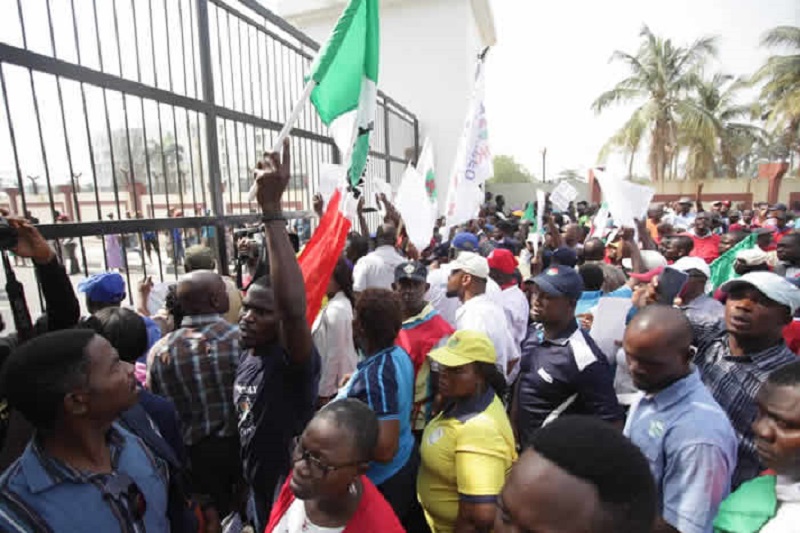
There was a need for transformational, big-bang changes in economic policies, often referred to as ”shock therapy”. The planned protest is unnecessary, as the government is fully aware of the short-term pains the Nigerian people are experiencing and is working around the clock to alleviate them. It is therefore important to highlight some of the major interventions and achievements of the present administration.

The Federal Government introduced a wage award of N35,000 for federal civil servants, pending the implementation of a new minimum wage. Some state governments followed suit and paid wage awards to civil servants in their states at different rates.

The good news is that a new national minimum wage of N75,000 has been approved by the Federal Government and will be implemented once passed by the National Assembly signed into law by Mr President. The new national minimum wage represents a 133% increase from the current national minimum wage of N30,000. While it could have been more, considerations of affordability and sustainability were taken into account.

The government also made conditional direct cash transfers targeted at millions of households to improve their standard of living. Thousands of metric tons of foodstuffs have also been distributed to alleviate hardship. Many doubt the effectiveness of these interventions; therefore, the government needs to conduct independent audits on the efficacy of these intervention programs from time to time.

To deal with the soaring prices of foodstuffs, President Bola Ahmed Tinubu approved the suspension of duties, tariffs, and taxes for the importation of certain food commodities, including husked brown rice, wheat, maize, and cowpeas, through land and sea for 150 days.

He also approved the importation of 250,000 metric tonnes of wheat and maize, respectively. These measures are not intended to undermine the efforts of domestic farmers but to address the issue of scarcity that has led to soaring prices. Many believe that the government should have acted earlier.

The student loan scheme launched by this government is laudable. It will enable children from poor families to attend tertiary education, thereby increasing their chances of having a bright future and making them more useful to society instead of becoming miscreants and a burden and security risk. The introduction of a consumer credit scheme is another great achievement of this administration. This will help stimulate household consumption and the economy as a whole.

The clearance of a seven-billion-dollar forex backlog by this government has led to increased foreign investor confidence, which is very commendable. The government has also been able to stabilize the exchange rate to a good extent and reduce the arbitrage between the parallel market and the official market. Exchange rate stability is important for businesses as it facilitates proper planning. The government should ensure that this stability is sustained.

The removal of the fuel subsidy, though causing hardship for Nigerians as transportation has become very expensive, has helped free up resources for the government to invest in critical areas of the economy, infrastructure, and security. It has also reduced pressure for borrowing. In the long run, fuel price is expected to decrease as domestic refineries commence production. The government should ensure that domestic crude is supplied to these refineries.

While protests are not the solution to Nigeria’s challenges and therefore unnecessary, there is still room for improvement on the part of the Federal Government. It should demonstrate care for the plight of the people through its actions and words.

The government’s achievements should be properly publicized, emphasizing their importance. Just as the government has intervened in the food crisis, it would also be beneficial for the government to do all it can to reduce the cost of transportation, as it is a major driver of inflation.


Feature/OPED

How Policy Flip-Flops Are Making Nigerians Poorer

Published

on

Policy Flip-Flops

By Blaise Udunze

Nigeria’s deepening poverty crisis is no longer speculative; it is now statistically inevitable. Although the latest Consumer Price Index figures released by the National Bureau of Statistics (NBS) suggest that headline inflation is cooling and growth indicators show tentative improvement, regrettably, more Nigerians are slipping below the poverty line. Reviewing the recent projections from PwC’s Nigeria Economic Outlook 2026, it is alarming, which reveals that no fewer than two million additional Nigerians are expected to fall into poverty next year. This is expected to push the total number of poor people to about 141 million, roughly 62 percent of the population and the highest level ever recorded in the country’s history.

This grim outlook persists despite eight consecutive months of easing inflation and modest economic recovery, and as one can perceive, the contradiction is telling. The fact remains that macroeconomic signals are improving on paper, yet lived reality continues to deteriorate. It is glaring that the widening gap between policy metrics and human outcomes exposes a deeper truth in the sense that Nigeria’s poverty crisis is not simply the product of external shocks or temporary adjustment pains. It is the cumulative result of fragile policymaking, inconsistent reforms, weak institutional coordination, and a failure to sequence economic changes with adequate social protection. With these, it becomes clearer that poverty in Nigeria is no longer an unintended side effect of reform; it is increasingly its most visible outcome as identified today.

It would be recalled that the current administration in 2023, when it assumed office, promised a bold economic reset. At this point, the nation witnessed the fuel subsidy removal, exchange-rate liberalisation, and tighter fiscal discipline being introduced swiftly and applauded internationally for their courage and long-term logic. Notably, these reforms unleashed an economic storm whose aftershocks continue to batter households and currently resulting to the cost of a bag of rice that sold for about N35,000 two years ago now costs between N65,000 and N80,000, while a crate of eggs has risen from N1,200 to over N6,000 and basic staples like garri, tomatoes, and pepper have drifted beyond the reach of ordinary Nigerians. For millions, the economy did not reset; it snapped.

Inflation, often described by economists as a “silent tax,” has punished productivity, mocked thrift, and rewarded speculation.

Reports from the NBS’s December 2025 disclosed that headline inflation eased to 15.15 percent and according to it, this is due to a rebasing of the Consumer Price Index, down sharply from 34.8 percent a year earlier, this statistical moderation has brought little relief to households. Food inflation, at 10.84 percent year-on-year, and a marginal month-on-month decline may look reassuring on spreadsheets, but for families spending 70 to 80 percent of their income on food, such figures feel detached from reality. These figures are not only implausible but also insulting to those whose lives have been torn apart by the skyrocketing prices. With the realities facing the larger populace, Nigeria must be using another mathematics.

Nigeria may have changed its base year, but it has not changed the harsh arithmetic of survival.

PwC’s data underscores this disconnect, as nominal household spending rose by nearly 20 percent in 2025, real household spending contracted by 2.5 percent, reflecting the erosive impact of rising food, transport, and energy costs. The painful part of it, is that Nigerians are spending more money to consume less, and this is to say that growth, hovering around 4 percent, is not strong enough to absorb shocks or lift households meaningfully. As analysts note, Nigeria would require sustained growth of 7 to 9 percent to make a significant dent in poverty. That is to say that anything less merely slows the descent.

The structural weakness of the economy is compounded by policy inconsistency. Nigeria’s economic landscape is littered with abrupt shifts, subsidy removals without buffers, currency reforms without stabilisation mechanisms and trade policies that oscillate between restriction and openness. For households and small businesses, which employ most Nigerians, this unpredictability makes planning impossible. The economy has constantly being faced with price volatility, income shocks, and lost jobs because these are the ripple effects of every policy reversal. Uncertainty itself has become a poverty multiplier.

Nowhere is this fragility more evident than in food systems and rural livelihoods, and this has been where insecurity has merged with policy failure to create a new poverty spiral. Across farmlands in the North and Middle Belt, crops rot unharvested as banditry and insurgency force farmers off their land. Nigeria’s largely agrarian economy has been crippled by violence that disrupts planting cycles, destroys infrastructure, and displaces communities. The result is both income poverty for farmers denied access to their livelihoods and food inflation that erodes purchasing power nationwide.

For record purposes, earlier last year, the NBS Multidimensional Poverty Index showed that 63 percent of Nigerians, about 133 million people, are multidimensionally poor, with poverty heavily concentrated in insecure regions. Findings showed that about 86 million of the poor live in the North, and this is where insecurity is most severe. This record showed that rural poverty stands at 72 percent,c compared to 42 percent in urban areas, and while the states most affected by banditry and insurgency record poverty rates as high as 91 percent. Insecurity is no longer just a security problem; it is one of Nigeria’s most powerful poverty drivers.

The economic cost of insecurity in Nigeria today is staggering. This is because the conservative estimates suggest Nigeria loses about $15 billion annually, which is roughly equivalent to N20 trillion, due to insecurity-induced disruptions across agriculture, trade, manufacturing, and transportation. At the same time, security spending now consumes up to a quarter of the federal budget. In just three years, over N4 trillion has been spent on security, which crowded out investment in health, education, power, and infrastructure. Every naira spent managing perpetual violence is a naira not invested in preventing poverty, even as poverty deepens, the state’s fiscal response reveals a troubling misalignment of priorities. The 2026 federal budget, estimated at N58.47 trillion, ironically allocates just N206.5 billion to projects directly tagged as poverty alleviation and this only amounts to about 0.35 percent of total spending and less than one percent of the capital budget. In a country where over 60 percent of citizens live below the poverty line, this allocation borders on policy negligence.

Worse still, over 96 percent of this already meagre poverty envelope sits under the Service Wide Vote through the National Poverty Reduction with Growth Strategy, largely as recurrent provisions. All ministries, departments, and agencies combined account for barely N6.5 billion in poverty-related projects. This fragmentation reflects a deeper institutional failure, that is to say, poverty reduction exists more as a line item than as a coherent national mission.

Where MDA-level interventions exist, they are largely palliative and scattered, grain distribution in select communities, tricycles and motorcycles for empowerment, and small scale skills acquisition for women and youths. The largest such project, a N2.87 billion tricycle and motorcycle scheme under a federal cooperative college, accounts for nearly half of all MDA-based poverty spending. The fact remains that the various interventions may offer temporary relief, and they do little to address structural drivers of poverty such as job creation, productivity, market access and human capital development.

Even the Ministry of Humanitarian Affairs and Poverty Alleviation illustrates the problem just as its budget jumped sharply in 2026, much of the increase went into administrative and capital items, office furniture, equipment, international travel, retreats, and systems automation rather than direct poverty-fighting programmes. This reflects a familiar Nigerian paradox: institutions grow, but impact shrinks.

International partners have been blunt in their assessments. The World Bank estimates that Nigeria spends just 0.14 percent of GDP on social protection, which is far below the global and regional averages. Only 44 percent of safety-net benefits actually reach the poor, rendering the system inefficient and largely ineffective. PwC similarly warns that without targeted job creation, productivity-focused reforms, and effective social protection, poverty will continue to rise, undermining domestic consumption and straining public finances further.

Fiscal fragility compounds the crisis. The N58.18 trillion 2026 budget carries a deficit of N23.85 trillion, with debt servicing projected at N15.52 trillion, nearly half of expected revenue. The public debt has ballooned to over N152 trillion. The contradiction here is that Nigeria is borrowing not to expand productive capacity but to keep the machinery of government running. The truth is not far-fetched because, as debt crowds out development spending, households are forced to pay privately for public goods, education, healthcare, water, deepening inequality and entrenching poverty across generations.

To be clear, not all signals are negative. This is because opportunities exist if reforms are sustained and properly sequenced. Regional trade under the African Continental Free Trade Area could diversify exports and create jobs. But reform momentum without inclusion and institutional capacity risks becoming another missed opportunity.

This is the central tragedy of Nigeria’s moment. The country is attempting necessary reforms in an environment of weak buffers, fragile institutions, and low trust. Poverty is therefore not accidental. It is the predictable outcome of inconsistency, reforms without protection, stabilisation without security, and budgets without people.

Nigeria faces an undeniable choice. It can continue down a path where fragile policies deepen deprivation and erode trust, or it can build a disciplined, coordinated framework that aligns reforms with social protection, security, and inclusive growth. Poverty is not destiny. But escaping it requires more than courage in reform announcements; it demands consistency, compassion, and the political will to place human welfare at the centre of economic strategy.

Blaise, a journalist and PR professional, writes from Lagos and can be reached via: [email protected]

Continue Reading

Feature/OPED

Political Uncertainty: Can the ADC Afford a Wolf Politician?

Published

on

african democratic congress ADC

By Abu Mahmud

The recent realignment within the African Democratic Congress (ADC) is a direct response to its founding promise of transparency, accountability, and people-centered politics, free from money politics, godfatherism, and elite domination. The party seeks to harness a powerful opposition coalition while safeguarding its founding ideals from elite capture. Success will depend on how rigorously the ADC enforces its transparency and accountability mechanisms as the 2027 race intensifies.

As the 2027 elections approach, that promise is being put to the test. The ADC’s realignment is a high-stakes balancing act. The party must decide whether to open its doors to opportunistic politicians whose primary currency is personal ambition. Such “wolves” may bring short-term numbers, but they threaten the party’s credibility, cohesion, and long-term legacy. The ADC’s true strength lies in shared values, not in the whims of any single individual.

If the ADC admits politicians driven more by personal ambition than by shared ideals, it risks undermining its very foundation. As electioneering draws nearer, the party stands at a crossroads: either remain faithful to its principles or sacrifice them for short-term political advantage. Its credibility, cohesion, and long-term relevance depend on choosing the former.

As Nigeria moves toward the 2027 general elections, the country needs leaders of integrity—visionary, unifying, and committed to national development above sectional or personal interests. Such leaders must be accountable, open to competent new talent, and committed to institution-building, job creation, poverty reduction, and national cohesion, rather than divisive, self-serving politics.

At this critical moment, Nigerians cannot afford leadership captured by individuals who exploit poverty and emotion through populist rhetoric while pursuing narrow ambitions. Citizens must distinguish between politicians who seek power and wealth for themselves and those who serve with integrity, transparency, and a genuine commitment to community development.

A political party is bigger than any individual. It is built on shared values and collective purpose, not personal ownership. When individuals attempt to dominate a party, democracy weakens and godfatherism thrives.

Even before the election season, there is a real possibility that the ruling establishment could attempt to weaken opposition forces through proxy infiltration, sowing discord within emerging coalitions.

This concern is heightened as the PDP faces what may be its weakest moment since inception.

Atiku Abubakar has emerged as a central figure in a new opposition coalition that has adopted the ADC as its platform for 2027.  The coalition includes figures such as former Senate President David Mark (interim national chairman), former Osun State Governor Rauf Aregbesola (interim secretary), Nasir El-Rufai, Rotimi Amaechi, and others. They have held consultations on party structure and strategy, advocating transparent primaries and urging members—including Peter Obi—to fully transition into the ADC. Atiku’s exit from the PDP and registration with the ADC signal a coordinated effort to challenge the APC government.

This context raises a critical question: can the ADC afford to admit politicians whose entry is conditioned on personal guarantees?

One recurring feature of some Kano-based politicians is the tendency to conflate local dominance with national relevance. Through emotionally charged rhetoric, such figures mobilize loyal supporters while mistaking regional popularity for nationwide appeal. More troubling is the practice of setting conditions even before joining a party.

Rabiu Musa Kwankwaso, has openly stated that he would only defect to another party if offered the presidential or vice-presidential ticket for 2027. He argued that his decades-long political career entitles him to such consideration, insisting that his supporters would accept nothing less. Yet this posture contrasts sharply with the conduct of other coalition members who have subordinated personal ambition to collective negotiation. To demand special concessions while others make sacrifices raises serious questions about motive, sensitivity, and commitment to a shared cause.

This article is not rooted in personal animosity or partisan loyalty. Rather, it examines a political style defined by populism, personality-driven movements, and frequent party migration motivated by immediate ambition rather than ideology. Kwankwaso commands a loyal base in Kano, where he is celebrated as a champion of the masses.

Beyond that stronghold, however, his career is marked by serial defections—from PDP to APC to NNPP—each aligned with personal calculations rather than consistent principles. Supporters describe this as pragmatism; critics call it political nomadism.

Recent developments in Kano have punctured the myth of Kwankwaso’s invincibility. Political ruptures within the state have exposed a reality long obscured by propaganda: his influence depends heavily on access to state power.

Without control of institutional machinery, his dominance diminishes. Electoral outcomes reinforce this limitation. In the last presidential election, Atiku Abubakar secured over seven million votes, Peter Obi over six million, while Kwankwaso garnered just 1.14 million—nearly all from Kano.

Governor Abba Yusuf’s anticipated defection to the APC further signals a shift in Kano’s political landscape. While the Kwankwasiyya movement remains relevant, its grip on state power is weakening. This moment calls for recalibration, not confrontation. Politics is not a do-or-die affair, and clinging to power at all costs risks eroding both dignity and legacy.

Reports of behind-the-scenes meetings involving Kwankwaso and former President Olusegun Obasanjo, along with speculation that he could be used to destabilize opposition parties, only deepen concerns about his role in any coalition. As his influence wanes, he increasingly portrays himself as a victim of betrayal, rallying supporters with narratives that elevate personal loyalty above political evolution.

In a political maneuver aimed at self-preservation, reports claimed that the former NNPP presidential candidate sought the intervention of Chief Bisi Akande to arrange a direct meeting with President Bola Ahmed Tinubu to negotiate his defection. Akande reportedly declined, stressing that he could not bypass established party structures, and instead referred Kwankwaso to the party’s official high-level negotiation committee.

The NNPP has also stated that, according to its constitution, the Kano State governor is the party leader, being its only sitting governor. Kwankwaso, they noted, was merely the party’s 2023 presidential candidate—an arrangement that ended after the election when the Memorandum of Association between the party and the Kwankwasiyya Movement expired.

Despite his anxiety about his political future, Kwankwaso has been unable to explain to the youths—whose blind loyalty he still relies on—why many long-standing allies dating back to 1999 have walked away. Absent from his narrative is any reckoning with his habit of discarding those who helped build his career: Senator Hamisu Musa, Musa Gwadabe, Abubakar Rimi, among others. Political independence is not betrayal; it is a legitimate pursuit.

When Abdullahi Ganduje parted ways with Kwankwaso, he endured ridicule and abuse. In my view, Kwankwaso and his supporters should at least appreciate Abba Gida-Gida’s restraint in not publicly recounting the unpleasant experiences surrounding his emergence as governor under the NNPP. While the Kwankwaso–Abba conflict is fundamentally political—a struggle for solutions and self-determination—there remains a clear distinction between betrayal, the pursuit of solutions, and the quest for independence from total submission. Madugo’s recent speeches, laden with symbolism and coded language aimed at Governor Abba Yusuf, reflect nothing more than a troubling lack of restraint.

For Atiku, other heavyweight politicians, and the ADC, the lesson is clear: no serious political party should mortgage its future on conditional loyalty or personal ambition. The party’s strength lies in its principles, not in accommodating politicians who seek to bend its vision to their own ends.

At this stage, Kwankwaso’s political control appears to have reached its limits. History shows that successful politicians understand timing, terrain, and temperament. They fight when the cause is just, support is solid, and victory is achievable. They retreat when the odds are stacked, when emotion outweighs reason, or when temporary withdrawal can prevent permanent defeat. It may be time for him to step aside gracefully, preserve his dignity, and protect his legacy. When an ant becomes arrogant, it grows wings.

Power is not bestowed by any individual; it is granted by Allah alone, who gives and withdraws authority as He wills. Both Islam and Christianity affirm this truth: power is a divine trust, not personal property. Any posture that suggests authority flows from personal will contradicts both faith and reality.

Mahmud writes from Hadejia Road, Kano

Continue Reading

Feature/OPED

Anthony Chiejina: Africa’s Quiet Architect of Global Corporate Reputation

Published

on

Anthony Chiejina

By Abiodun Alade

In a year shaped by geopolitical tension, technological disruption and intensifying scrutiny of corporate conduct, Anthony Chiejina has once again secured a place among the world’s most influential communications leaders.

In the orchestration of influence, some leaders make themselves heard; others, like Chiejina, make themselves felt. As Group Chief, Branding and Corporate Communications, Dangote Industries Limited, Africa’s largest industrial conglomerate, he operates not in the glare of the spotlight, but in the rarified space where strategy, trust and perception converge. Influence, in Chiejina’s world, is not performative. It is deliberate, calibrated and sustained.

His inclusion on the 2025 Influence 100 for the fifth consecutive year confirms his standing as one of the most consequential in-house communicators globally—and the only Nigerian on this year’s list.

Now in its 13th year, the Influence 100 has become a benchmark for leadership at the intersection of reputation, strategy and power. Compiled annually by PRovoke Media’s senior editorial team, the list recognises communications, corporate affairs and marketing executives whose judgement shapes organisational credibility, agency relationships and public trust. Selection is based on organisational influence, strategic remit, thought leadership and the capacity to lead through complexity.

Chiejina’s sustained presence on the list signals something deeper than recognition. It reflects a style of leadership defined not by volume, but by judgement.

Leadership Beyond Messaging

In today’s corporate environment, communications is no longer a support function. It is a leadership discipline. For Chiejina, that evolution has long been reality. His remit extends from strategic counsel at the highest level to internal alignment across a vast workforce, crisis navigation, regulatory engagement and long-term brand stewardship across sectors.

Dangote Group’s footprint spans cement, energy, agriculture, manufacturing and infrastructure—sectors that sit at the heart of national economies and global supply chains. Every decision, every word, carries weight beyond the corporation itself.

That responsibility has intensified as Dangote Group has undertaken some of the most ambitious industrial projects in Africa, drawing global attention and regulatory scrutiny. Managing reputation at this scale demands more than messaging. It requires institutional memory, political literacy and an acute understanding of how public legitimacy is earned and sustained.

Under his stewardship, Dangote Group has maintained its position as Africa’s most admired company while navigating periods of heightened public debate and international visibility. His work consistently connects corporate ambition with public confidence, ensuring that growth is matched by credibility.

Institutional Memory and Strategic Calm

More than 15 years within the Dangote Group have given Chiejina a rare asset: deep institutional memory. That continuity has proven invaluable during periods of expansion, regulatory change and market volatility. While others respond to headlines, he focuses on coherence, consistency and long-term trust.

Those who work with him describe a leader who privileges preparation over performance and clarity over drama. His approach is measured and analytical, grounded in the belief that reputation is not built in moments, but through years of disciplined engagement.

Chiejina’s fifth consecutive appearance on the Influence 100 places him among a peer group that includes communications chiefs from Apple, Google, Coca-Cola, Nike, Ford, Emirates, Reliance and other global giants. Yet he remains the only Nigerian on the 2025 list and one of the few Africa-based executives consistently recognised.

That distinction reflects both the scale of his responsibility and the growing global relevance of African corporate leadership. As Africa’s industrial champions assume a larger role in global supply chains and energy markets, the standards by which they are judged have become unmistakably international. Chiejina has helped ensure that Dangote Group meets those standards not through imitation, but through coherence, transparency and confidence in its own narrative.

Before joining Dangote Group, Chiejina built a career across banking, manufacturing and journalism, with senior roles at Zenith Bank, Oceanic Bank, Seven Up Bottling Company, African Economic Digest and African Concord—publications from the famed Concord Group that shaped a generation of African journalists. That breadth of experience continues to inform his leadership: commercially grounded, media-literate and alert to the political and economic realities that frame corporate action in emerging markets.

Quiet Authority

Anthony Chiejina’s leadership is marked by restraint. He is not a public-facing executive in the conventional sense, yet his counsel influences decisions at the highest level. In an era where reputations can be destabilised overnight, his value lies in foresight, discretion and strategic calm.

As global business becomes more exposed, more questioned and more accountable, leaders like Chiejina represent a new model of executive authority—one rooted in trust, institutional credibility and long-term thinking.

In that sense, his continued presence on the Influence 100 is not merely a personal milestone. It is a signal: that African enterprise, guided with discipline and clarity, belongs confidently at the centre of global leadership.

And in a world that increasingly confuses noise for power, Chiejina’s career offers a reminder: the most enduring influence is rarely the loudest.

Abiodun, a communications specialist, writes from Lagos

Continue Reading

Trending