

Feature/OPED
Nigeria’s N3,000 Certificates and Rise of a Nation of Fake Credentials

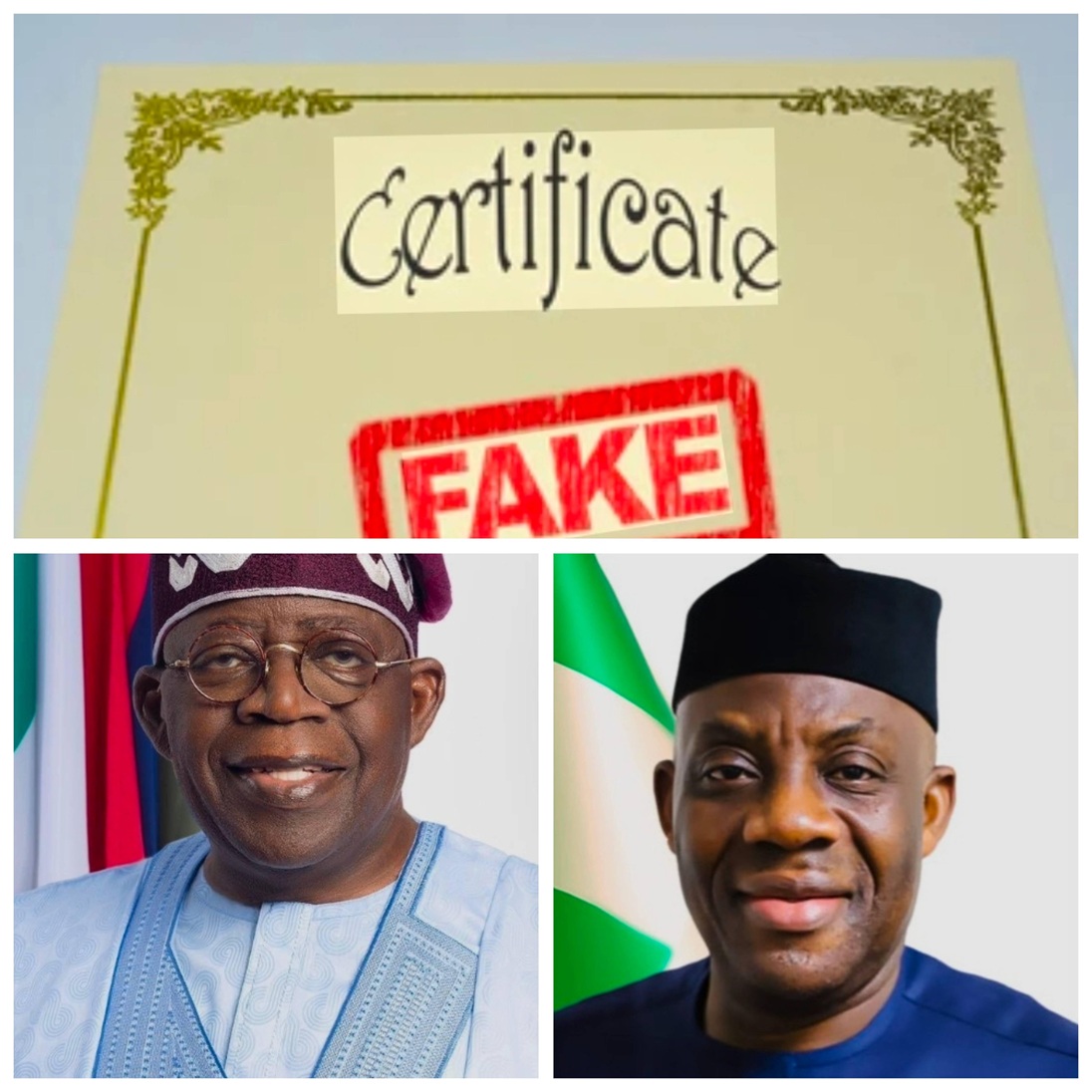
By Blaise Udunze
Nigeria should be deeply ashamed. Not merely embarrassed. Not mildly concerned. Ashamed.
A country that claims to be preparing millions of young people for the future has reached a point where, according to the Minister of Education, Dr Tunji Alausa, examination questions could allegedly be purchased for as little as N3,000 before candidates entered the examination hall.
N3,000 is the frightening price allegedly attached to the integrity of a Nigerian examination. For N3,000, a student who did not study could potentially compete with another who spent months reading. For N3,000, merit could be defeated by money. For N3,000, the meaning of an examination could be reduced to a commercial transaction.
But perhaps Nigerians should stop pretending that the problem begins and ends with secondary school students. It does not. The student who buys examination questions did not create Nigeria’s culture of shortcuts. He was born into it. The teenager who cheats in an examination did not invent the country’s obsession with certificates. He inherited it.
The society must understand that a student who believes success can be purchased rather than earned is simply learning from the society around him. For this reason, the revelation that NECO questions were allegedly sold before examinations should trigger a much deeper national conversation.
Nigeria is not merely suffering from examination malpractice. Nigeria is suffering from a national crisis of credibility.
An examination is supposed to be one of the simplest tests of fairness. You study. You prepare. You enter the examination hall. You answer questions based on what you know. You pass or fail based on your performance. That is the theory.
But Nigeria’s reality has increasingly become something else. Once an examination question becomes a commodity, education becomes a marketplace. The wealthy child can buy advantage. The connected child can obtain assistance. The school proprietor can advertise impressive results. The parent can celebrate distinctions. And the honest student is left wondering whether intelligence, discipline and hard work still matter.
This is how a nation quietly murders merit. Not with a gun. Not with a military coup. But through the gradual normalisation of dishonesty.
The student who studies honestly begins to feel foolish. The student who cheats begins to feel smart. Eventually, the entire system becomes corrupted because integrity appears to place people at a disadvantage. And when honesty becomes a disadvantage, society is already in serious trouble.
Nigeria must stop placing all the blame on children. Parents are involved. Teachers are involved. School proprietors are involved. Principals are involved. Invigilators are involved. Officials may be involved.
The Nigerian child is therefore often the smallest player in a much larger ecosystem of fraud. Adults teach children to cheat. Then those same adults condemn the moral decay of young people.
Parents who publicly preach honesty may pay for “special centres” where examination malpractice is facilitated. School proprietors desperate for high pass rates may prioritise results over learning. Teachers entrusted with developing young minds may become merchants of answers. Invigilators paid to protect examination integrity may look away.
Then everyone gathers to celebrate excellent results. Photographs are taken. Certificates are framed. The student becomes a success story. Nigeria applauds. But what exactly are we celebrating? A brilliant child? Or a successful fraud? This is where Nigeria’s conversation about fake certificates becomes politically uncomfortable.
The country has witnessed repeated controversies involving the credentials of politicians and senior public officials. Some cases have resulted in resignation, prosecution or conviction. Others remain matters of allegation, political controversy or ongoing legal proceedings. But together, they expose a troubling national culture.
Consider Salisu Buhari, the former Speaker of the House of Representatives. His certificate scandal became one of the defining political embarrassments of Nigeria’s early democratic era. He resigned after revelations concerning his claimed educational credentials and was subsequently convicted in connection with forgery and false declaration.
The significance of that episode went beyond one politician. The man occupying one of the highest offices in Nigeria’s legislature had become entangled in a scandal involving credentials.
The question should have shaken the country permanently. How thoroughly does Nigeria verify those who seek to govern it? Decades later, the country is still asking essentially the same question that has refused to go away.
It would be recalled that a former Minister of Finance, Kemi Adeosun, for similar reasons, resigned in 2018 following the controversy surrounding an NYSC exemption certificate submitted as part of her official credentials. This episode became one of the most significant credential scandals, which involved a senior government official in Nigeria’s recent political history.
Then there is the more recent case involving former Minister of Innovation, Science and Technology, Uche Geoffrey Nnaji. The Independent Corrupt Practices and Other Related Offences Commission (ICPC) announced in 2026 that it was investigating allegations involving academic credentials and an NYSC discharge certificate.
More concerning is that there are other politicians and senior public officials who have faced allegations or controversies concerning certificates and academic qualifications. One fact is that, with these trends, it is important to distinguish between cases that have been established through conviction or official findings and those that remain allegations or matters before the courts.
That distinction, however, does not erase the larger national question. Why does Nigeria repeatedly find itself confronting controversies over the educational credentials of people entrusted with public power?
This is not merely a problem of individual politicians. It is evidence of a system that appears to value certificates so highly that some people may be tempted to manufacture them, manipulate them or misrepresent them.
Perhaps Nigeria’s greatest educational tragedy is that the country has confused education with certification. Nigeria does not always ask, What can you do? It asks, Which certificate do you have?
The obsession begins early. Parents want distinctions. Schools want impressive percentages. Universities want graduates. Employers want credentials. Government agencies demand qualifications. Professional bodies demand certificates. Politicians decorate their biographies with academic achievements. Everybody wants paper.
But who is asking whether the paper represents knowledge? This is why Nigeria can produce graduates who struggle to write coherent reports. It is why organisations complain about unemployable graduates. It is why employers spend enormous resources retraining university graduates.
It is why a person can possess several certificates and still lack the competence to solve a practical problem. Nigeria is producing qualifications faster than it is producing knowledge. And that is a national disaster.
A certificate without competence is simply expensive paper. A degree without knowledge is decoration. An examination passed through fraud is not an achievement. It is evidence of a system that has failed.
Here is where the conversation becomes even more uncomfortable. Nigeria is a country that places enormous importance on certificates when dealing with ordinary citizens.
A young person can be rejected for employment because of insufficient qualifications. A civil servant may be denied promotion because of academic requirements. A job applicant may be disqualified because a certificate is missing, and the same is said of a graduate who may be considered unemployable because his qualifications do not meet the required standard.
Controversies involving the credentials of politically powerful people often generate a completely different conversation. Suddenly, Nigerians are told certificates are not important; to them, experience is more important than qualifications. Suddenly, competence becomes the only relevant issue.
But which Nigeria is correct? The Nigeria that demands certificates from job seekers? Or the Nigeria that dismisses concerns about verification when powerful individuals are involved? This double standard is dangerous.
No, a certificate does not automatically make anyone intelligent. No, a university degree does not automatically produce good leadership. No, every successful person needs a PhD.
But there is a fundamental difference between saying formal education is not the only measure of intelligence and suggesting that claimed educational qualifications should never be questioned or verified.
Where a certificate is claimed, it should be verifiable. Where an educational qualification is presented to the public, it should withstand scrutiny. Where public office requires documentation, those documents should be transparent and credible.
That is not persecution. That is accountability. This is perhaps the most politically sensitive part of the conversation. Nigeria cannot afford to maintain two standards of integrity.
The student sitting for NECO must prove that he genuinely passed. The university applicant must prove that his result is authentic. The job seeker must present verifiable credentials. The civil servant must submit authentic documentation.
Yet the moment Nigerians ask legitimate questions about the credentials submitted by people seeking the country’s highest political offices, the conversation becomes politically explosive. That should not be so.
President Bola Tinubu has faced controversies and legal challenges concerning his academic records and credentials. In 2026, a fresh court action reportedly sought his disqualification from a future presidential election over allegations concerning academic and NYSC credentials. Such allegations, it would be said, remain matters for judicial determination and should not conclusively be presented as established findings without a final legal verdict.
But the broader democratic principle remains unchanged. No Nigerian should be above scrutiny. Not a student. Not a civil servant. Not a minister. Not a governor. Not a legislator. And certainly not a president.
In all fairness, it would be agreed that a democracy cannot demand verification from the powerless while discouraging scrutiny of the powerful. The fact remains that a country cannot build integrity from the classroom while tolerating a lack of transparency and accountability in the corridors of power.
Children learn from what adults do, not merely from what adults say. Come to think of it, if the Nigerian child watches powerful people escape accountability, he learns that rules are negotiable, which is nothing but the truth. If he watches wealth purchase influence, he learns that success is transactional. If he sees connections defeat competence, he learns that merit is optional. And when he eventually enters an examination hall, purchasing leaked questions may not even appear immoral to him. It may simply appear Nigerian. That should worry us.
The consequences of examination malpractice do not end when students leave school. The student who cheats through secondary school may eventually cheat through university. The graduate who never truly learned may become a teacher. The teacher may produce another generation of poorly educated students.
The graduate may become a banker without understanding risk. An engineer without sufficient competence could design dangerous structures. A healthcare professional without adequate knowledge could endanger lives. A public servant without intellectual capacity could make decisions affecting millions.
This is why examination malpractice is not a harmless shortcut. It is the beginning of national incompetence. Every fraudulent result is a potential problem waiting somewhere in the future. Somewhere, a person who cheated his way through school may eventually be responsible for someone’s money. Someone’s health. Someone’s building. Someone’s business. Someone’s future. Perhaps even the affairs of the nation.
And Nigeria will then ask why its institutions are failing. The answer may have started in an examination hall. Nigeria must understand that the alleged sale of examination questions for N3,000 is bigger than education.
It is an economic problem. It is an institutional problem. It is a governance problem. And ultimately, it is a national development problem.
Nigeria cannot build a globally competitive economy with fraudulent certificates. It cannot develop advanced technology with graduates who did not genuinely learn. It cannot industrialise with technicians whose qualifications exceed their competence. It cannot reform healthcare with professionals produced by compromised institutions. It cannot transform public institutions while rewarding paper qualifications above intellectual capacity.
Today, with the level of evolution, the world is moving towards artificial intelligence, biotechnology, advanced manufacturing, cybersecurity and digital economies. What a shame for Nigeria, as it is still fighting to ensure that examination questions do not appear on phones before candidates enter examination halls. The truth is that it should be humiliating.
The government’s renewed efforts to strengthen examination controls are necessary. Technology must be deployed to protect examination materials. Schools must complete their curricula. Teachers must be properly trained and supported.
But Nigeria does not merely need better methods of protecting examination papers. It needs a cultural revolution. One thing still revealed here is that the country has yet to deal with this, because schools involved in organised examination malpractice must face severe consequences. Teachers who participate in fraud should face professional sanctions. School proprietors who operate centres built around cheating should be punished. Officials who leak examination questions should face prosecution. Parents who finance examination fraud must understand that they are not helping their children. They are destroying them.
But Nigeria must go further. Employers should increasingly test skills rather than relying blindly on certificates. Universities must be held accountable for the quality of their graduates. Professional bodies must enforce competence. Public institutions must reward performance. And political leaders must accept that accountability applies to everyone. Not merely poor students caught cheating in an examination hall.
The most dangerous thing about Nigeria’s educational crisis is that its consequences may not be immediately visible. The country may continue conducting examinations. Schools may continue producing excellent pass rates. Graduates may continue attending convocation ceremonies. Certificates may continue being printed. Politicians may continue presenting credentials.
But beneath all the celebration lies one dangerous question. Are Nigerians actually learning, and are Nigerians consistently telling the truth about who they are? Because one day, the children being taught today will become tomorrow’s teachers, doctors, engineers, bankers, judges, entrepreneurs, journalists, legislators and political leaders.
They will inherit Nigeria. And they will govern it with the values Nigeria taught them. If Nigeria teaches them that cheating is acceptable, the truth be told, they will cheat, and the same applies to this: Nigeria teaches them that certificates matter more than competence; they will chase certificates, which is becoming a norm in society. If Nigeria teaches them that powerful people are exempt from scrutiny, nothing can change their perspective, as they will seek power rather than accountability.
That is why the education crisis is not tomorrow’s problem. It is today’s emergency. The alleged N3,000 price tag attached to a leaked examination question may appear small. But Nigeria should understand what is really being sold.
It is not merely an examination question. It is merit. It is integrity. It is competence. It is trust. And ultimately, it is the future of a country that desperately needs educated citizens but appears increasingly comfortable producing people with certificates instead.
Nigeria must decide what it wants. A nation of educated people? Or a nation of certified people? Because there is a difference.
For now, until Nigeria understands that difference, it may continue to produce graduates, celebrate distinctions, and print certificates while the foundations of genuine education quietly collapse beneath its feet.
Perhaps that is the ultimate irony of the N3,000 examination question. Nigeria may be desperately fighting to stop students from buying answers while refusing to confront a much bigger national question: How can a country genuinely demand integrity from its children when integrity is not consistently demanded from everyone, including those at the very top?
Until Nigeria answers that question honestly, the examination hall will remain only a reflection of the country outside it. And if the nation outside the classroom does not respect truth, transparency, competence and accountability, no amount of examination reforms will save Nigerian education. Because the problem is no longer simply that examination questions are allegedly being sold for N3,000.
The problem is that Nigeria has become dangerously comfortable with the idea that almost everything can be bought, manipulated or explained away, including success, credentials and accountability. And perhaps that is the most frightening certificate Nigeria has ever issued itself: A certificate of national hypocrisy.
Blaise, a journalist and PR professional, writes from Lagos and can be reached via: [email protected]


