Connect with us

Feature/OPED

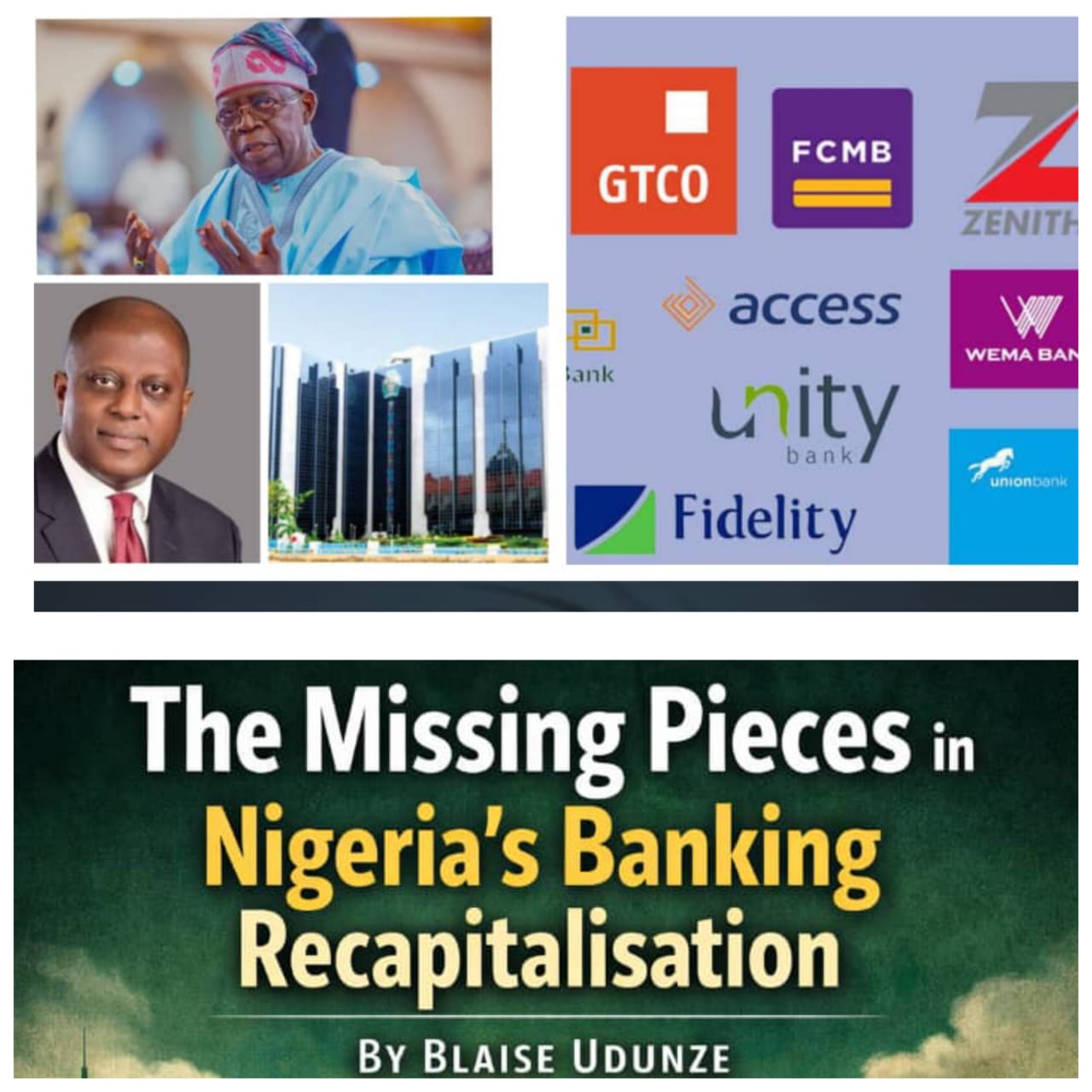
The Missing Pieces in Nigeria’s Banking Recapitalisation

Published

on

Nigeria’s Banking Recapitalisation

By Blaise Udunze

Nigeria’s economy will be experiencing yet another round of reform; after the new tax implementation, the banking sector recapitalisation exercise will begin within less than three months until the March 31, 2026, deadline. The Central Bank of Nigeria (CBN) Governor, Olayemi Cardoso, disclosed that 27 banks have tapped the capital market via public offers and rights issues.

The figures show that of 21 the 37 commercial, merchant, and non-interest banks in the country have met or exceeded the revised minimum capital thresholds of N500 billion for internationally authorised banks, N200 billion for national banks, N50 billion for regional banks, and N10-20 billion for non-interest banks. With the developments above, policymakers are betting that stronger balance sheets will help banks withstand macroeconomic shocks, finance growth, and restore confidence in the financial system. On the surface, the logic is sound, capital matters. But history warns us that capital alone is not a cure-all.

Nigeria has been here before, going by the 2004-2005 era of the then-governor of CBN, Charles Soludo, whose banking consolidation dramatically reduced the number of banks from 89 to 25 and created national champions. Yet barely five years later, the system was back in crisis, requiring regulatory intervention, bailouts, and the creation of the Asset Management Corporation of Nigeria (AMCON) to absorb toxic assets. The lesson here is clear, which revealed that recapitalisation that ignores structural weaknesses merely postpones failure.

If the current exercise is to succeed, the CBN must use it not only to raise capital but to repair the deeper fault lines that have long undermined the stability, credibility, and effectiveness of Nigeria’s banking sector.

More Capital isn’t Always Better Capital

The first and most critical issue is the quality of capital being raised. Disclosures made by the banks have shown that the combined capital base of about N5.142 trillion is already locked in by lenders across the different licence categories. Bigger numbers on paper mean little if the capital is not genuinely loss-absorbing. In past recapitalisation cycles, concerns emerged about funds being raised through related parties, short-term borrowings disguised as equity, or complex arrangements that ultimately recycled the same risks back into the system.

This time, the CBN must insist on transparent, verifiable sources of capital. Every naira raised should be traceable, free from conflicts of interest, and capable of absorbing real losses in a downturn. Otherwise, recapitalisation becomes an accounting exercise rather than a resilience-building one.

Why Corporate Governance Remains the Achilles’ Heel

Perhaps the most persistent weakness in Nigeria’s banking sector is corporate governance failure. Many bank crises have not been caused by macroeconomic shocks alone, but by poor board oversight, insider abuse, weak risk culture, and excessive executive power.

Recapitalisation provides a rare regulatory leverage point. The CBN should use it to reset governance standards, not just capital thresholds. Boards must be independent in substance, not just in form. Being one of the critical aspects of the banking challenge, insider lending rules should be enforced without exception. Risk committees in every financial institution must be empowered, not sidelined by dominant executives.

Without the apex bank fixing governance, new capital risks become fresh fuel for old excesses.

The Unresolved Burden of Non-Performing Loans (NPLs)

Data from the CBN’s latest macroeconomic outlook showed that the banking industry’s Non-Performing Loans ratio climbed to an estimated 7 percent, pushing the sector above the prudential ceiling of 5 percent. Nigeria’s banking sector continues to be drowned with high volumes and recurring non-performing loans (NPLs), and this is often concentrated in sectors such as oil and gas, power, and government-linked projects. Though with the trend of events, one may say that regulatory forbearance has helped maintain surface stability in the sector, no doubt it has also masked underlying vulnerabilities.

The truth is that a credible recapitalisation exercise must confront this reality head-on. Loan classification and provisioning standards should reflect economic truth, not regulatory convenience. Banks should not be allowed to carry impaired assets indefinitely while presenting healthy balance sheets to investors and the public.

Transparency around asset quality is not a threat to stability; it is a foundation for it.

How Foreign Exchange Risk Quietly Amplifies Financial Shocks

Few risks have damaged bank balance sheets in recent years as severely as foreign exchange volatility. Many banks continue to carry significant FX mismatches, borrowing short-term in foreign currency while lending long-term to clients with naira revenues.

During periods of FX adjustment, these mismatches can rapidly erode capital, no matter how well-capitalised a bank appears on paper. Recapitalisation must therefore be accompanied by tighter supervision of FX exposure, stronger disclosure requirements, and realistic stress testing that assumes adverse currency scenarios, not best-case outcomes.

Ignoring FX risk is no longer an option in a structurally import-dependent economy.

Concentration Risk and the Narrow Credit Base

Another long-standing weakness is excessive concentration risk. A disproportionate share of bank lending is often tied to a small number of large corporates or government-related exposures. While this may appear safe in the short term, it creates systemic vulnerability when those sectors face stress.

At the same time, the real economy, particularly SMEs and productive sectors, remains underfinanced because, over the years, Nigeria’s banks faced significant concentration risk, particularly in the oil and gas sector and in foreign currency exposure, while grappling with a narrow credit base characterised by limited lending to the private sector. This is due to high credit risk and tight monetary policy. Owing to this trend, recapitalisation should therefore be in alignment with policies that encourage credit diversification, improved credit underwriting, and smarter risk-sharing mechanisms, and not the other way round.

Therefore, it will be right to say that banks that grow larger but remain narrowly exposed do not strengthen the economy; they amplify its fragilities.

Risk Management in a Volatile Economy

The recurring inflation shocks, interest-rate swings, fiscal pressures, and external shocks are frequent features, not rare events, which show that Nigeria is not a low-volatility environment.

Currently, the Nigerian banking sector’s financial performance and investment returns are equally affected by various risks, including credit, liquidity, market, and operational risks.

Today, many banks still operate risk models that assume stability rather than disruption. Time has proven that risk management is essential for mitigating these risks and ensuring stability and profitability.

The apex bank must ensure that the recapitalisation process mandates robust, Nigeria-specific stress testing, and banks must demonstrate resilience under severe but plausible scenarios. This includes sharp currency depreciation, interest-rate spikes and sovereign stress. It must evolve from a compliance function to a strategic discipline.

Transparency and Financial Reporting

Investors, depositors, and analysts must be able to understand banks’ true financial positions without navigating a lack of transparent disclosures or creative accounting. Hence, public trust in the banking sector depends heavily on credible financial reporting.

The CBN should use recapitalisation to strengthen the International Financial Reporting Standard enforcement, disclosure standards, and audit quality. In championing this course, banks’ financial statements should clearly reflect capital adequacy, asset quality, related-party transactions, and off-balance-sheet exposures. Transparency is to enable confidence, not about exposing weakness.

Regulatory Consistency and Credibility

Policy credibility has been one of the greatest challenges for Nigeria’s financial regulators.

Abrupt changes, unclear timelines, and inconsistent enforcement undermine investor confidence and weaken reform outcomes.

Recapitalisation must be governed by clear rules, predictable timelines, and consistent enforcement. Both domestic and foreign investors need assurance that the rules of the game will not change midstream. Regulatory credibility is itself a form of capital.

Consumer Protection and Banking Ethics

While recapitalisation focuses on banks’ balance sheets, the public experiences banking through fees, service quality, dispute resolution, and ethical conduct. Persistent complaints about hidden charges and poor customer treatment erode trust in the system and a stronger banking sector must also be a fairer and more accountable one. It must be noted that strengthening consumer protection frameworks alongside recapitalisation will help rebuild public confidence and reinforce financial inclusion goals.

Too Big to Fail and How to Resolve Failure

Looking at what is obtainable in the system, larger, better-capitalised banks can also become systemically dangerous if failure resolution frameworks are weak. This requires that recapitalisation should therefore be accompanied by credible plans for resolving distressed banks without destabilising the entire system or resorting to taxpayer-funded bailouts, which has been the norm in the Nigerian banking sector today. The cynic might say that recapitalisation simply made big banks bigger and empowered dominant shareholders. However, a more prospective approach invites all stakeholders, including regulators, customers, civil society and bankers themselves, to co-design the next chapter of Nigerian banking; one that balances scale with inclusion, profitability with impact, and stability with innovation.

Clear resolution mechanisms reduce moral hazard and reinforce market discipline.

A Moment That Must Not Be Wasted

Recapitalisation is not merely a financial exercise; it is a governance and trust reset opportunity. If the CBN focuses solely on capital numbers, Nigeria risks repeating a familiar cycle of apparent stability followed by crisis.

The banking sector can lay a solid foundation that truly supports economic transformation if recapitalization is used to address governance failures, asset quality, FX risk, transparency, and regulatory credibility.

Nigeria does not just need bigger banks. It needs better banks, institutions that are resilient, transparent, well-governed, and trusted by the public they serve. Hence, it must be a system that creates a more robust buffer against shocks and positions Nigerian banking as a global competitor capable of funding a $1 trillion economy, as the case may be.

This recapitalisation moment must be about building durability, not just size. The cost of missing that opportunity would be far greater than the cost of getting it right.

Blaise, a journalist and PR professional, writes from Lagos and can be reached via: bl***********@***il.com

Click to comment

Leave a Reply

Your email address will not be published. Required fields are marked *

Feature/OPED

Building 234 Solutions: A Response to Everyday Workforce Challenges

Published

on

Owoloye Emmanuel 234 Solutions

By Owoloye Emmanuel

Every business starts with a problem. For us, that problem was hiding in plain sight.

Across organisations, we kept seeing HR professionals, payroll teams, and business leaders spend significant time navigating processes that should be simpler. Employee records sat across multiple systems, payroll processes required manual intervention, and routine workforce tasks often became more complicated than they needed to be.

As businesses grow, workforce operations naturally become more complex. Yet many organisations still rely on disconnected tools and workflows that create unnecessary friction for both employers and employees.

The consequence is more than operational inefficiency. HR teams spend valuable time managing systems instead of supporting people. Business leaders struggle to access timely workforce insights, while employees experience delays in processes that should be seamless.

These weren’t isolated challenges. They were recurring realities across workplaces, regardless of industry or size.

That observation led us to a simple question: what if workforce management could be easier?

What if HR, payroll, and workforce operations could work together within a single, connected experience?

That question became the foundation for 234 Solutions.

We are building 234 Solutions with a clear belief that workplace technology should reduce complexity, not add to it. Our goal is to help organisations spend less time navigating processes and more time focusing on productivity, growth, and people.

As we prepare for launch, our focus remains simple: building practical solutions for real workplace challenges and helping organisations create better experiences for the people who power them every day.

Owoloye Emmanuel is the founder of 234 Solutions

Continue Reading

Feature/OPED

The Role of TV in Preserving African Stories and Identity

Published

on

Preserving African Stories

Scroll through social media today, and you will notice something interesting: everyone is either reacting to a series, quoting a movie line, or debating a character as though they personally know them. Beneath the memes and binge-watch culture, however, lies something deeper. Television remains one of the most powerful tools shaping how Africans see themselves, remember their history, and tell their own stories. In a continent as diverse and expressive as Africa, that matters more than ever.

TV as a Cultural Archive, Not Just Entertainment

Long before streaming algorithms began shaping our viewing habits, television was already preserving African identity. From Nollywood dramas that capture the rhythm of everyday Lagos life to documentaries exploring Maasai traditions and Ghanaian folklore, TV has served as a living archive of the continent’s stories.

It preserves more than entertainment; it preserves language, culture, humour, values, and shared experiences. Unlike fleeting social media content, television allows stories to unfold with depth, exploring the realities of family, tradition, ambition, and modern African life without reducing them to stereotypes. That is the power of TV: preserving not just stories, but perspective.

Why Representation on TV Still Matters

There is a subtle but important truth: if people do not see themselves on screen, they may begin to believe their stories are not worth telling. This is why African TV content is more than entertainment; it is affirmation.

Seeing a character who speaks like you, struggles like you, or celebrates like your community does something powerful. It validates identity and challenges outdated narratives that have historically defined Africa through external lenses.

This is where MultiChoice Group, through platforms such as DStv and GOtv, plays an important role. They do not simply broadcast content; they help distribute cultural memory at scale.

GOtv, DStv, and the Everyday African Viewer

Think about a typical evening in many African homes: the TV is on in the background, someone is laughing at a comedy show, another person is watching a local series, and someone else is catching up on the news. That shared viewing experience remains very real.

Through platforms such as DStv and GOtv, African households are exposed to a blend of local storytelling and global content. More importantly, they have helped amplify African-produced content by bringing Nollywood films, African reality shows, talk shows, and documentaries into mainstream rotation.

It is not just about access. It is about visibility.

A young filmmaker in Lagos today is more likely to believe their story matters because they have seen similar stories broadcast widely. A child in Accra grows up hearing familiar accents and seeing environments that look like their own on screen, not as exceptions, but as the norm.

TV Is Also Shaping Modern African Identity

African identity is not static; it is evolving. Television reflects that evolution in real time.

Today, audiences see:

  • Young Africans balancing tradition and modern dating culture

  • Stories tackling mental health in African households

  • Fashion and music influences spreading through TV series

  • Political satire shaping public conversation

Conversations that were once confined to homes are now being explored on screen, giving audiences the language to discuss issues that were previously unspoken.

In many ways, television is doing what oral tradition has always done: passing stories, values, humour, warnings, and history from one generation to the next. The difference is that today’s griots are writers, directors, and broadcasters.

The Future: From Watching to Owning Our Narratives

The next stage of African storytelling is not just about being seen; it is about ownership.

As more African creators produce content and platforms continue to invest in regional storytelling, television becomes more than a mirror. It becomes a tool for shaping how Africa is represented to itself and to the world.

While streaming continues to grow, television, particularly accessible platforms such as GOtv, remains one of the most effective ways to reach everyday audiences across different income levels and regions. After all, storytelling only matters if people can access it.

African stories are not new. They have always existed in families, on streets, in markets, in history books, and through oral traditions. What television has done, and continues to do, is give those stories a stage wide enough for millions to experience them at once.

The next time you watch a local series or documentary on DStv or GOtv, remember that you are not just being entertained. You are participating in the preservation of African identity itself.

Continue Reading

Feature/OPED

The Future of AI in Nigerian SMEs: Overcoming Barriers to Implementation

Published

on

Kehinde Ogundare 2025

By Kehinde Ogundare

Ask a tech entrepreneur in San Francisco what AI means for their business, and they are likely to talk about competitive advantage, product differentiation, and scale. Ask a small business owner in Kano or Onitsha the same question, and the conversation shifts entirely.

For many Nigerian SMEs, the priority is keeping the lights on, managing costs, and finding sustainable ways to grow in a challenging economic environment. This difference in perspective explains why the global AI conversation, often shaped by assumptions about stable infrastructure, deep capital, and abundant technical talent, frequently fails to address the realities facing Nigerian SMEs.

This matters because Nigerian SMEs are not a peripheral concern. In 2024 alone, MSMEs contributed 46.32% to Nigeria’s GDP, accounting for 96.9% of businesses and 87.9% of employment. These businesses are the backbone of the Nigerian economy, and if AI is going to mean anything for Nigeria’s development, it has to work for them in the daily conditions they actually operate in.

However, research drawing on empirical data from 144 Nigerian SMEs found that inadequate infrastructure, low digital literacy, skills shortages, and regulatory gaps are collectively preventing them from meaningfully engaging with AI. Awareness of AI is high and growing. What is missing is a clear and honest conversation about what adoption actually requires in this specific context. The barriers are real, but none of them are insurmountable. The question is whether the tools, pricing models, and support structures being offered to Nigerian SMEs are designed with those barriers in mind, or whether they have been built for another market entirely.

Subscription models making AI affordable for small businesses

When most small business owners hear “AI,” they imagine expensive software, specialist consultants, and a hefty upfront bill.

That assumption is not entirely wrong, but it describes a particular way of buying technology, not AI itself. The shift that makes AI genuinely accessible at the SME level is the move away from large, one-time capital purchases towards tools that charge a predictable monthly subscription. Businesses can pay for what they use, scale back when necessary, and avoid the debt that a major technology investment can create.

The deeper opportunity here is consolidation. Many SMEs are already spending money across multiple disconnected tools—one for invoicing, another for customer records, another for stock tracking—none of which talk to each other. An integrated platform that handles several of these functions together, with AI built in, can actually cost less than the sum of those separate subscriptions while giving business owners a clearer picture of their operations.

With margins already under pressure, any technology a business adopts needs to visibly show an increase in productivity or bottom line. Subscription-based, integrated platforms, priced transparently and honestly, are the model that best fits this reality.

Infrastructure challenges demand a mobile-first approach

No conversation about technology in Nigeria is complete without confronting the infrastructure problem, and AI is no exception. Nigeria continues to face major infrastructure barriers, including limited broadband access, unreliable power supply, and high data costs, all of which constrain deeper AI adoption. These are structural features of the operating environment that any sensible technology strategy must account for today.

The electricity situation alone is significant. The World Bank estimates that the lack of stable electricity costs Nigeria’s economy approximately $26.2 billion annually, equivalent to about 2% of GDP, forcing many businesses to run on expensive diesel generators. That cost ripples outward.

In practical terms, AI tools built for Nigeria cannot assume a stable broadband connection or a computer that is always powered on. The tools that will actually get used are the ones that work on a smartphone, consume minimal data, and can function offline when connectivity drops, syncing back up when it returns. The mobile phone is already how many Nigerian SME owners run their businesses. AI that meets them there, rather than demanding infrastructure they do not have, is AI that has a genuine future in this market.

The direction is clear: build capability from within, using tools that make that possible. Recent AI performance research reveals that 64% of African workers are already actively using AI at work, signalling massive grassroots readiness and driving forward-thinking organisations across Nigeria, Kenya, and South Africa to aggressively prioritise internal upskilling frameworks to bridge the talent gap.

As the policy groundwork is being laid, the commercial ecosystem is beginning to respond. What remains is a clear-eyed acceptance that AI tools built for this market need to look different from those built for markets with different realities. Low cost, low bandwidth, and usability for non-technical people are not modest ambitions; they are the actual requirements. Build for those realities, and AI has a real future in Nigeria’s SME economy.

Continue Reading

Trending