Connect with us

General

Aisha Buhari Accuses ADC of Diverting Her N2.5b

Published

on

By Premium Times

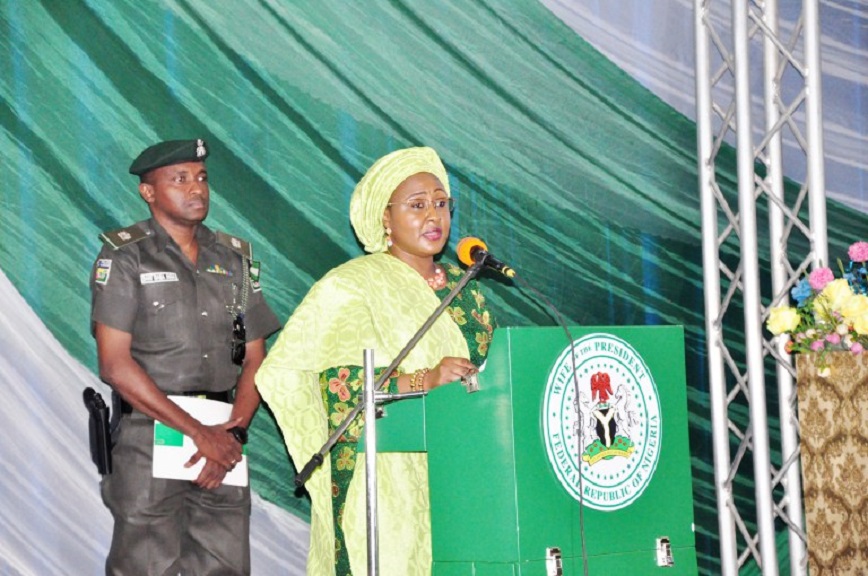
A scandal is brewing within the household of President Muhammadu Buhari.

His wife, Aisha, has caused the arrest of her own Aide De Camp, after accusing him of defrauding her, those familiar with the matter have told PREMIUM TIMES.

The president’s wife is alleging that Sani Baba-Inna, a chief superintendent of police, received huge donations from politicians and business people on her behalf and then kept the cash to himself.

Mrs Buhari therefore requested the Inspector General of Police, Ibrahim Idris, to arrest and compel Mr. Baba-Inna to refund the money, put at over N2.5billion.

The police officer was arrested Friday and has remained in detention ever since, with relatives having no access to him, family members say.

It is unclear how the president’s wife came about the allegation, but one source said another aide working for Mrs Buhari originated the claim.

An associate of the embattled police officer said Mr. Baba-Inna strongly denied the allegation, saying he received no donation from anyone on behalf of his boss.

Outcome Of Police Investigation

Immediately the police received the petition from Mrs Buhari, the ADC was arrested on Friday last week and investigation launched.

“The IG said the matter must be investigated immediately and the house of the ADC was raided,” one of our sources said.

“Shockingly, investigators only found N1,200 cash in the House. His bank account was also investigated and had only a balance of N30,000 while the transaction records showed that most credits to the account were his salaries and allowances.”

The police, it was gathered, concluded that Mrs Buhari must have been wrongly informed as there was nothing to show or prove that such huge sums of money was in the custody of Mr Baba-Inna.

An associate of Mr. Baba-Inna said the police contacted those named as donors of the controversial funds but that they all denied making the donations attributed to them.

“For instance, one of those named was the IG of Police himself,” the source said. “But the IG said he has never passed any money through Baba-Inna.”

When Mrs Buhari was informed of the outcome of police investigation, the source said the first lady flared up and accused the police of colluding “to protect one of their own”.

She then reportedly asked the State Security Service (SSS) to take over the case and get her money back”.

SSS Wades In?

On the orders of the wife of the president, SSS operatives reportedly took custody of Mr Baba Inna.

However, the spokesperson for the SSS, Peter Afunanya told PREMIUM TIMES he was not aware of Mr Baba-Inna’s arrest by his agency.

“You are just telling me now, I am not aware, but if there is anything like that I will get back to you,” he said.

In the same vein, the spokesperson of the police, Jimoh Moshood, said “I am not aware.”

But Hassana, the wife of Mr Baba-Inna confirmed her husband’s arrest.

She also said she “has not been able to speak with him since he was taken away”.

When contacted, the spokesperson of the wife of the president, Suleiman Haruna, said although he heard about the matter, he was trying to get details from Mrs Buhari, who he said is currently travelling in New York.

However, as at the time of posting this story on Business Post, spokesperson of the DSS, Mr Peter Afunanya, kept his words and called Premium Times on Tuesday afternoon to confirm that Mr Baba-Inna was in custody at the headquarters of his agency in Abuja.

“He was handed over by the Police and investigation is ongoing,” he said.

A member of the Baba-Inna family also informed us that the SSS allowed Hassana, the wife of the ADC to meet him today.


Dipo Olowookere is a journalist based in Nigeria that has passion for reporting business news stories. At his leisure time, he watches football and supports 3SC of Ibadan. Mr Olowookere can be reached via [email protected]

Click to comment

Leave a Reply

Your email address will not be published. Required fields are marked *

General

Court Grants Ex-Warri Refinery MD N500m Bail in Money Laundering Case

Published

on

Jimoh Yisawu

By Adedapo Adesanya

Justice Inyang Ekwo of the Federal High Court, Abuja, has granted bail to the former Managing Director of the Warri Refining and Petrochemical Company Limited, Mr Jimoh Yisawu, in the sum of N500 million.

Mr Yisawu is standing trial on an eight-count charge bordering on alleged money laundering.

He pleaded not guilty to all eight counts after they were read to him. The charge, dated and filed on June 22, 2026, was brought by the Federal Government.

The prosecution, led by Mr Ekele Iheanacho, a Senior Advocate of Nigeria (SAN), told the court that the defendant allegedly committed offences contrary to the Money Laundering (Prevention and Prohibition) Act, 2022.

In the first count, the Federal Government alleged that Mr Yisawu “indirectly converted the aggregate sum of over $789,950… being proceeds of unlawful activity”, contrary to Section 18(2)(b) and punishable under Section 18(3) of the Act.

In the second count, the prosecution alleged that he made cash payments exceeding $789,950 to one Samaila Bala without using a financial institution, contrary to the provisions of the anti-money laundering law.

In the fourth count, the government further alleged that Yisawu made cash payments totalling $122,600 through one Rasheed Olaitan Yusuf outside the banking system and due process, in violation of the anti-money laundering law.

Following the defendant’s plea, Iheanacho applied for a trial date.

Counsel for the defendant, Wale Balogun (SAN), informed the court that he had filed a bail application.

Responding, Mr Iheanacho said the prosecution had filed a counter-affidavit opposing the application and urged the court to refuse bail.

Balogun, however, argued that the prosecution had earlier granted Mr Yisawu administrative bail and had already seized his international passport. He urged the court to maintain the existing bail terms.

After adopting their respective processes, both counsel argued for their applications.

In a ruling, Justice Ekwo held that the defendant was entitled to bail.

The judge said, “Going by Section 162 of the Administration of Criminal Justice Act (2015)… I therefore grant bail in the sum of ₦500m with one surety in like sum.”

Justice Ekwo ordered that the surety must be a responsible Nigerian with landed property in Abuja and must submit proof of ownership to the court registrar.

The judge also directed the defendant to deposit his international passport with the court and barred him from travelling outside Nigeria without the court’s permission.

Pending the perfection of the bail conditions, the court ordered that Mr Yisawu should remain in the custody of the prosecution.

The case was adjourned until October 25, 26, and 27, 2026, for trial.

Continue Reading

General

IPMAN Urges FG to Review Fuel Import Licences Amid Rising Petrol Prices

Published

on

Petrol Prices

By Adedapo Adesanya

The Independent Petroleum Marketers Association of Nigeria (IPMAN) has urged the federal government to review the fuel import licences recently issued to some marketers, saying the policy is driving up fuel prices, putting pressure on foreign exchange and creating instability in the downstream petroleum sector.

Speaking in Abuja, IPMAN’s National Publicity Secretary, Mr Chinedu Ukadike, said the current import regime has not achieved its goal of making fuel more affordable. Instead, he argued that it has encouraged the importation of more expensive petrol while increasing the country’s dependence on foreign exchange.

According to Mr Ukadike, some importers plan to sell Premium Motor Spirit (PMS), also known as petrol, for about N1,350 per litre, which is higher than the ex-depot price offered by the Dangote Petroleum Refinery.

The IPMAN official questioned the need to import fuel at higher prices when locally refined products are available at lower costs, noting that the situation has made it difficult for independent marketers to plan their businesses because import costs continue to fluctuate.

Mr Ukadike also raised concerns about the quality of some imported fuel and called on regulators to ensure that only products that meet Nigeria’s standards are allowed into the country.

The association warned that continued fuel imports also increase demand for the US Dollar since importers pay for products in foreign currency. This, the association said, puts additional pressure on the naira and contributes to higher fuel prices.

The association stressed that Nigeria should focus on supporting local refining to improve energy security and reduce reliance on imported petroleum products.

It noted that the Dangote Petroleum Refinery has helped maintain steady fuel supply despite global disruptions, including tensions in the Middle East.

According to IPMAN, greater use of locally refined fuel would reduce FX demand, strengthen the refining industry, create jobs and improve economic stability. It also said producing enough fuel for local consumption while exporting excess output would help Nigeria earn more foreign exchange.

The association called on the federal government, the Nigerian Midstream and Downstream Petroleum Regulatory Authority (NMDPRA), the Nigerian National Petroleum Company (NNPC) Limited and the Presidential Committee on downstream reforms to engage stakeholders and adopt policies that support domestic refining.

IPMAN said strengthening local refining remains the best long-term solution for affordable fuel, stable supply and improved energy security in Nigeria.

Continue Reading

General

NAICOM Insists July 31 Insurance Recapitalisation Deadline Sacrosanct

Published

on

NAICOM Conplaint Management Portal

By Adedapo Adesanya

The National Insurance Commission (NAICOM) has reiterated that the July 31, 2026, deadline for insurance companies to meet the new minimum capital requirements remains firm, warning operators against treating it as a mere formality.

The Commissioner for Insurance of NAICOM, Mr Olusegun Ayo Omosehin, who gave this warning, urged companies that have yet to meet the new minimum capital requirements to act with urgency.

Speaking on Friday at the investiture of Mr Akinjide Oluwarotimi-Orimolade as the 53rd President and Chairman of Council of the Chartered Insurance Institute of Nigeria (CIIN) in Lagos, Mr Omosehin said the recapitalisation exercise remained a critical pillar of the Commission’s ongoing reforms aimed at building a stronger, more resilient and consumer-focused insurance industry.

According to him, the new minimum capital requirement is designed to improve insurers’ claims-paying capacity, strengthen their balance sheets, support higher domestic risk retention and prepare the industry for a risk-based capital regime.

“With about 14 days to the July 31 deadline, we commend operators that have made significant progress in raising capital, engaging investors, strengthening governance and submitting for the Commission’s verification process.

“However, the deadline is not symbolic; it is regulatory, and the industry must treat it with the urgency it deserves,” he said.

The Commissioner assured stakeholders that the insurance sector regulator would maintain a transparent, fair and firm process, stressing that every operator must demonstrate financial soundness, regulatory compliance and operational readiness.

He added that stronger capitalisation must ultimately translate into better service delivery, prompt settlement of claims, improved consumer protection and greater public confidence in insurance.

Mr Omosehin noted that the Nigerian Insurance Industry Reform Act (NIIRA) 2025 has provided a stronger legal framework for a more resilient, better-governed and responsive insurance market, adding that NAICOM’s reform agenda is focused on market conduct, policyholder protection, governance, insurance penetration, financial inclusion and responsible innovation.

He described professionalism as the foundation of a trusted insurance market, saying the industry’s growth depends not only on adequate capital and effective regulation but also on ethics, competence, innovation and public confidence.

“The strength of insurance depends not only on capital and regulation but also on professionalism, ethics, innovation and public confidence. A trusted insurance market cannot be built on capital alone. It requires competent professionals, ethical institutions, credible advice and fair treatment of policyholders,” he stated.

Continue Reading