Connect with us

General

Anambra Re-Elects Soludo as Governor for Second Term

Published

on

Soludo Anambra

By Adedapo Adesanya 

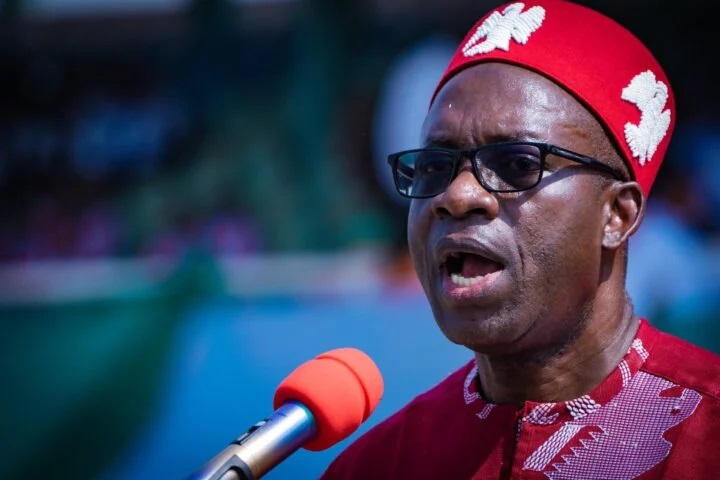
Governor Chukwuma Soludo has secured a second term in office, keeping him at the government house in Akwa until 2030, after being declared the winner of the November 8 Anambra State governorship election by the Independent National Electoral Commission (INEC).

According to the results announced by INEC in the early hours of Sunday, Mr Soludo won by a landslide in the 21 local government areas of the South-East state.

The State Returning Officer and Vice Chancellor of the University of Benin, Mr Omoregie Edoba, declared Mr Soludo as the winner of the exercise after the collation of results from the local government areas of the state where the election was held.

“I hereby declare that Soludo Charles Chukwuma of the APGA, having satisfied the requirements of the law, is hereby declared the winner and is returned elected,” Mr Edoba, a professor, told a gathering at the state headquarters of INEC in Awka, the state capital, where the election results were collated.

The electoral umpire said out of a total number of 2,788,864 registered voters, 598,229 were accredited for the election. It also said that of the total number of 595,298 votes cast in the election, 584,054 were valid while 11,244 were rejected.

Mr Soludo, the candidate of the All Progressives Grand Alliance (APGA), secured 422,664 votes to trounce his closest rival, the All Progressives Congress (APC)’s Nicholas Ukachukwu, who polled 99,445 votes.

Mr Paul Chukwuma of the Young Progressives Party (YPP) came third with 37,753 votes, while Mr John Nwosu of the African Democratic Congress (ADC) scored 8,208 votes.

Mr George Moghalu of the Labour Party (LP) and Mr Jude Ezenwafor of the Peoples Democratic Party (PDP) scored 10,576 votes and 1,401 votes, respectively.

Shortly after the results were announced, there was jubilation at the residence of the governor in Isoufia community, Aguata LGA.

In a statement personally signed by him, President Bola Tinubu congratulated Mr Soludo and described his re-election as a testament to his visionary leadership and the significant progress recorded under his administration.

“Governor Soludo, the Solution, has demonstrated that knowledge is indeed power and that academic principles can be applied in serving the people, undergirding accountability, transparency, and prudent management of people and resources.

“I visited Anambra State in May this year, where I inaugurated some projects executed by the Soludo administration. I highlighted the good thinking behind the landmark projects embarked upon by Mr Solution. That experience is indeed remarkable and will remain indelible in my mind.

“I commend Governor Soludo for bringing discipline, grace, brilliance, and a fresh perspective to governance in Anambra. Under him, Anambra is living up to its motto as the Light of the Nation.

“I urge Governor Soludo to be magnanimous in victory and to seek the cooperation of his opponents in the just-concluded election.

“I assure Governor Soludo of my unwavering support, and I look forward to continued collaboration between Anambra and the Federal Government.

“The victory of the opposition All Progressives Grand Alliance in the election again demonstrates the vitality of our political system and the fact that victory for any progressive and hardworking leader can hardly be encumbered or denied,” the President said.

President Tinubu also commended the new INEC Chairman, Professor Joash Amupitan, and his team for conducting what he described as a credible election, based on reports received.

He charged the commission to maintain high standards and continue to improve its performance “so we can strengthen and deepen our electoral system.”


Adedapo Adesanya is a journalist, polymath, and connoisseur of everything art. When he is not writing, he has his nose buried in one of the many books or articles he has bookmarked or simply listening to good music with a bottle of beer or wine. He supports the greatest club in the world, Manchester United F.C.

Click to comment

Leave a Reply

Your email address will not be published. Required fields are marked *

General

Tinubu Confirms Killing of Abu-Bilal Al-Manuki by Nigerian, US Forces

Published

on

Tinubu kill Abu-Bilal Al-Manuki

By Modupe Gbadeyanka

President Bola Tinubu on Saturday confirmed the killing of a senior ISIS leader, Mr Abu-Bilal Al-Manuki, in an overnight operation carried out by the United States and Nigeria.

President Donald Trump had earlier announced the elimination of the notorious terrorist via a post on his Truth Social.

Later, in a statement today, Mr Tinubu praised the action, describing it as “a significant example of effective collaboration in the fight against terrorism.”

“Our determined Nigerian Armed Forces, working closely with the Armed Forces of the United States, conducted a daring joint operation that dealt a heavy blow to the ranks of the Islamic State,” he said in the statement.

According to him, early assessments confirm the elimination of the wanted IS senior leader, Abu-Bilal Al-Manuki, also known as Abu-Mainok, along with several of his lieutenants, during a strike on his compound in the Lake Chad Basin.

He commended the partnership between Nigeria and America in waging war against terrorists, thanking his US counterpart “for his leadership and unwavering support in this effort.”

“I commend the personnel involved on both sides for their professionalism and courage, and I look forward to more decisive strikes against all terrorist enclaves across the nation,” the Nigerian leader added.

Continue Reading

General

Nigeria Steps up AI Surveillance, Anti-Drone Systems for National Security

Published

on

Anti-Drone Systems

By Adedapo Adesanya

Nigeria is set to strengthen its defence architecture by deploying artificial intelligence-powered surveillance systems and advanced anti-drone technology as part of efforts to modernise the country’s military capabilities, according to the Minister of Defence, Mr Christopher Musa.

He disclosed this during a high-level visit to Monaco, where he led a Nigerian delegation to conclude discussions on the multi-domain Hybrid Intelligence Shield (HIS) project.

According to Mr Musa, the initiative is designed to enhance border security, protect urban centres and improve the country’s response to emerging security threats.

The project is expected to introduce AI-driven surveillance systems capable of identifying threats rapidly through smart algorithms, while anti-drone technology will be deployed to intercept and neutralise unmanned aerial threats.

The government also plans to establish national and regional command-and-control centres to improve real-time coordination and response to security incidents across the country.

Mr Musa said the initiative would place strong emphasis on technology transfer and local capacity development through the establishment of a military Centre of Excellence in Nigeria.

He added that the federal government would leverage partnerships with international firms, including Marss UK Ltd, while simultaneously building indigenous capabilities to address insurgency, illegal mining, piracy and other security threats.

Nigeria has continued to battle multiple security challenges in recent years, including insurgency in the North-East, banditry and kidnappings in the North-West, farmer-herder clashes in the North-Central region, crude oil theft in the Niger Delta and piracy in the Gulf of Guinea.

Nigeria is stepping up its defence as the border region of Nigeria, Benin and Niger on the southern edge of the Sahel region is becoming a new stronghold for jihadists, as militants turn forests and pastoral networks in West Africa into bases for recruitment and international attacks.

Attacks in Nigeria have also risen, with data from the website of the Armed Conflict Location & Event Data (ACLED), a conflict-monitoring group, affirming that the number of suicide bombings in Nigeria by March already matched the annual average over the past six years.

The Nigerian military has also been dealt a blow to its military bases and senior figures targeted. In April, Brigadier-General Oseni Omoh Braimah was killed when Islamist fighters attacked a base in Borno State.

To also meet the defence goal, Nigeria is stepping up efforts to build domestic arms-manufacturing capacity.

Continue Reading

General

Nigeria, Morocco to Seal Atlantic Gas Pipeline Deal by Q4 2026

Published

on

nigeria morocco

By Adedapo Adesanya

Nigeria and Morocco are set to sign a major intergovernmental agreement later this year to push forward the long-delayed Nigeria-Morocco Gas Pipeline project, a multi-billion-dollar energy corridor expected to reshape gas trade across West Africa and Europe.

The agreement, expected to be signed in the fourth quarter of 2026 by President Bola Tinubu and King Mohammed VI of Morocco, follows the completion of preliminary technical studies for the ambitious project, according to officials from both countries.

The pipeline, also known as the African Atlantic Gas Pipeline, is projected to stretch about 6,900 kilometres along offshore and onshore routes across West Africa, making it one of the largest gas infrastructure projects on the continent.

With an estimated cost of $25 billion, the pipeline is designed to transport up to 30 billion cubic metres of gas annually once completed.

Discussions on the project gained fresh momentum during a telephone conversation between Nigeria’s Minister of Foreign Affairs, Mr Bianca Odumegwu-Ojukwu, and her Moroccan counterpart, Mr Nasser Bourita.

The project would not only strengthen energy cooperation between the two countries but also improve regional economic integration and expand Africa’s access to European energy markets.

According to Morocco’s hydrocarbons and mining agency, ONHYM, part of the gas supply will support Morocco’s domestic energy demand, while large export volumes will be directed to Europe.

The project, first proposed about a decade ago, is seen as a strategic alternative gas supply route amid rising global energy security concerns and Europe’s search for more diversified energy sources.

Beyond the pipeline, Nigeria and Morocco are also exploring broader economic partnerships, particularly in fertiliser production and distribution to support food security across Africa.

Both countries also agreed on the need to revive the Nigeria-Morocco Business Council to strengthen trade and investment relations under the African Continental Free Trade Area framework.

Analysts noted that the project could significantly boost gas monetisation opportunities for Nigeria, expand regional infrastructure development, and deepen economic ties between West African nations and Europe if successfully executed.

Continue Reading

Trending