Connect with us

General

Buhari Backs Giadom’s Fight for APC Leadership

Published

on

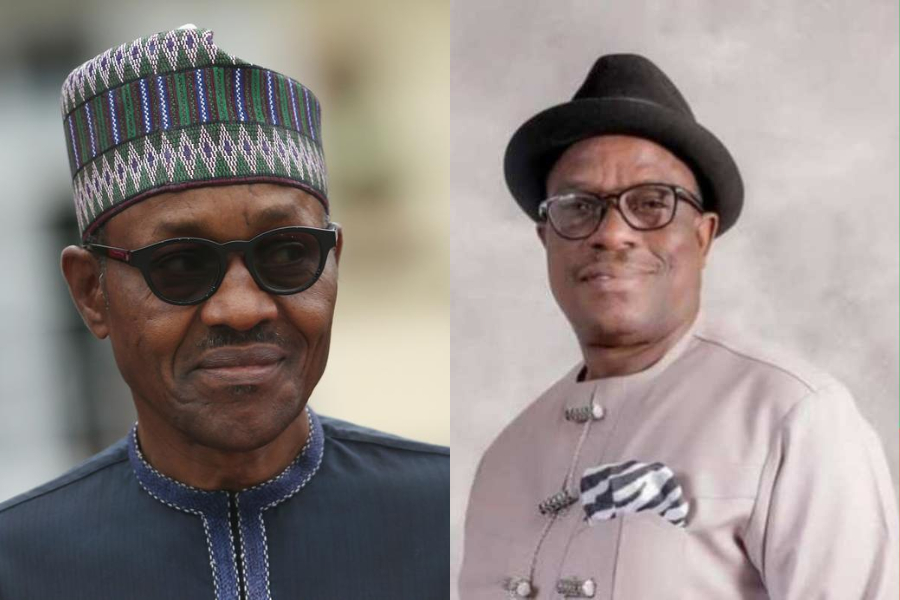
Victor Giadom Buhari

By Chubi Eze

In a surprise move, Nigeria’s President, Mr Muhammadu Buhari, has announced that he will attend a meeting to be convened today, Thursday, June 25, 2020, by Mr Victor Giadom, one of the two men laying claim to the leadership of the All Progressives’ Congress (APC), which controls the presidency and both houses of parliament.

In a series of Tweets, the president’s spokesperson, Mr Garba Shehu, said that: “The president has received very convincing advice on the position of the law as far as the situation in the party is concerned and has determined that the law is on the side of Victor Giadom as Acting National Chairman. And because he will always act in accordance with the law, the President will be attending the virtual meeting called for tomorrow afternoon.

“We urge the media to stop promoting manufactured controversies and to not give any further room for mischievous interpretations of the law on this matter.

“In addition to the president, the Giadom meeting will hopefully, be attended by our governors and leaders of the National Assembly.”

A former Commissioner of Works in the southern oil-rich state of Rivers, Mr Giadom is a political disciple of the Minister of Transport, Mr Chibuike Amaechi, himself a former two-time governor famed for being a vocal maverick.

There has been a growing rift between the factions within the APC since a Court of Appeal announced the suspension of the APC’s erstwhile chairman, Mr Adams Oshiomhole, a combative ex-unionist and former governor of Edo, who has presided over a tumultuous state of affairs at the party.

Mr Oshiomhole, perceived by critics to be a pugilistic politician who shuns consensus-building, has been locked in a fierce battle with a group of governors, who oppose his style and are perceived to be hell-bent on neutralizing him.

Mr Oshiomhole’s opponents say that he has repeatedly flouted the party’s guidelines by refusing to convene meetings of the party’s National Executive Committee, paying bloated salaries to members of the National Working Committee, and appointing unelected officers into the party’s National Working Committee (NWC).

Party insiders say that the president’s surprising show of support for Mr Giadom means that Mr Oshiomhole is almost certainly going to be expelled from the party’s NWC.

After Mr Oshiomhole’s shock ouster by a federal appeal court a few weeks ago, the party’s NWC endorsed the appointment of a former Oyo governor, Mr Abiola Ajimobi, to act in his stead. This was resisted by Mr Giadom who relied on an earlier court judgement to declare himself the party’s acting National Chairman.

Mr Ajimobi is gravely ill and while most observers saw the NWC’s coronation of Mr Ajimobi as an attempt by Mr Oshiomhole and his allies to run the party by proxy, Mr Giadom’s aggressive push to take over the party jolted the party’s hierarchy who tried, albeit unsuccessfully to expel him from the party through court judgements in his home state of Rivers.

The impasse effectively led to a schism, and a proxy battle between the chairman of the Nigerian Governors’ Forum, Mr Kayode Fayemi, Transport Minister, Mr Chibuike Rotimi Amaechi, Aviation Minister, Mr Hadi Sirika, Kaduna’s governor, Mr Nasir el-Rufai and the Bola Tinubu/Oshiomhole faction of the party.

A scrum of governors, upset at the manner in which one of their colleagues the governor of Edo State, Mr Godwin Obaseki, was humiliated out of the party by his predecessor, Mr Oshiomhole, his estranged predecessor, also joined the anti-Oshiomhole camp.

Since Mr Ajimobi was critically ill, after reportedly contracting coronavirus, the party’s executive committee settled on Mr Hilliard Eta, a little-known Cross River politician, who is believed to owe fealty to Mr Oshiomhole.

However, Mr Giadom refused to budge, using the courts and the law enforcement authorities to continue in his disputed role as the APC’s acting National Chairman. And while acknowledging that this was a temporary position, Mr Giadom has repeatedly said that he will only accept decisions taken by the party’s larger decision-making organ, the National Executive Committee (NEC).

Only one member of the party’s NWC, Mr Salisu Mohammed, the APC’s National Vice-Chairman (North-East), himself an avowed critic of Mr Oshiomhole, had supported Mr Giadom.

Mr Buhari’s public declaration of support for Mr Giadom has suddenly changed the APC’s internal dynamics. While the president is perceived as not being a natural politician, no party member would want to publicly challenge the president or oppose his choice of party chief.

Mr Eze Chukwuemeka Eze, an APC leader in Rivers and a supporter of Mr Giadom, praised the president for taking a position on the contentious leadership tussle.

He said that the APC’s NEC should confirm Mr Giadom as the National Chairman while it works towards organising a new executive for the party. He asked party members to sheathe their swords and coalesce around Mr Giadom to strengthen the party.

Mr Giadom’s ascendancy also poses a problem to the APC’s governorship candidate in Edo state, Mr Osagie Ize-Iyamu. Mr Iyamu is backed by Mr Oshiomhole who had ensured that his former enemy-turned protege had a clear path to the party’s nomination in Edo.

Mr Ize-Iyamu now finds himself in a bit of a quandary since Mr Giadom had publicly rejected the party primaries that led to Mr Ize-Iyamu’s coronation, raising questions about their legality.

Analysts believe that Ekiti’s Governor, Dr Kayode Fayemi, the cerebral head of the Nigerian Governorship Forum and Mallam Nasir el-Rufai, one of the president’s most vociferous supporters are the arrowheads of a larger group of powerful governors that counts Jigawa’s Badaru, Kebbi’s Bagudu and Ondo’s Akeredolu as members.

The group, which includes other less-visible members, is said to be wary of Mr Oshiomhole’s combative style and his unwavering loyalty to the party’s “National Leader” Ahmed Bola Tinubu, a former governor of Lagos, who is one of Nigeria’s most polarizing svengalis.

Mr Tinubu, one of the most powerful men in Nigerian politics, is widely believed to be eyeing the presidency in 2023 and a formidable coalition of politicians and intellectuals has been trying to stop him. The word in political circles is that powerful Northern dynasts do not want a Tinubu presidency.

President Buhari’s decision to back the faction of the party opposed to former Chairman Adams Oshiomhole and his benefactor, Ahmed Bola Tinubu, has effectively altered the balance of power within the APC and suggests that a clearer picture is emerging in the battle for the presidency in 2023.


Click to comment

Leave a Reply

Your email address will not be published. Required fields are marked *

General

Nigerian Oil and Gas Park to Start Operations Q4 2026

Published

on

Nigeria oil and gas park scheme NOGaPS

By Adedapo Adesanya

The Nigerian Content Development and Monitoring Board (NCDMB) has reaffirmed that the anticipated Nigerian Oil and Gas Park Scheme (NOGaPS) will become operational by the fourth quarter of 2026.

According to a statement by the General Manager of Corporate Communications Division at NCDMB, Mr Obinna Ezeobi, ahead of the target date for the park located at Emeyal-1, in Ogbia Local Government Area of Bayelsa State,  the NCDMB is set to install a 2.5-megawatt Com- pressed Natural Gas (CNG) power plant at the park.

He added that the power plant is one of the key steps to getting the facility operational, as it will provide a reliable and sustainable electricity supply to support industrial operations within the park.

Mr Ezeobi gave the assurance after an assessment visit to the facility by key personnel of the Board.

According to the statement, the tour revealed significant progress across key infrastructure and support systems designed to position the facility as a major industrial hub for Nigeria’s oil and gas industry.

It added that the Nigerian Oil and Gas Park Scheme was conceived to deepen Nigerian Content by providing a conducive environment for the manufacturing of components, equipment and other inputs required by the oil and gas industry, while creating employment opportunities for over 2000 persons when fully operational, and stimulating economic growth.

The oil and gas park scheme is a purpose-built industrial park with manufacturing shop floors and factories, warehouses, training centres, mini estates, truck parking and holding spaces, fire stations, administrative blocks, and security services, among other things, and is a critical initiative of the board geared towards in-country capacity development through local manufacture of equipment components and spare parts required in the oil and gas industry.

Six parks have been conceptualised and are located in different parts of the country, and they form a key part of NCDMB’s strategy for sustainable local content development and industrialisation. Two of the parks at Odukpani, Cross River State, and at Emeyal 1, Bayelsa State, have been completed, and interested companies have begun to take up shop floors, preparatory to the commencement of operations.

Continue Reading

General

Yuno, Onafriq to Unlock Pan-African Payments for Global Merchants

Published

on

yuno Onafriq

By Modupe Gbadeyanka

A partnership for the integration of Onafriq’s leading pan-African payment network into Yuno’s orchestration platform has been entered into between the two organisations.

This collaboration gives merchants a single connection to Africa’s most expansive payments infrastructure, bringing the continent’s most expansive payments infrastructure to merchants worldwide.

Through this integration, Yuno’s clients gain instant access to Onafriq’s network spanning 43 African markets, nearly one billion mobile wallets, 500 million bank accounts, and 2,000 cross-border payment corridors, all through Yuno’s single, developer-friendly API.

The partnership is part of Yuno’s broader strategy to build a truly global platform that connects merchants to every meaningful payment method and network, regardless of geography. Following successful expansion in the Middle East, Europe, and Asia, Africa is a key pillar of Yuno’s next phase of growth.

For Onafriq, the integration with Yuno extends its reach to an entirely new segment of global merchants who now benefit from a streamlined entry point into African markets. The partnership reinforces Onafriq’s mission of making borders matter less, bringing together mobile money operators, banks, fintechs, and enterprises into one connected payment ecosystem.

“Africa represents one of the most exciting growth opportunities in global commerce, and yet too many merchants are still locked out by payment infrastructure that wasn’t built for scale.

“Our partnership with Onafriq changes that. By bringing their unmatched African network into our infrastructure layer, we’re giving our clients a single path to a continent-wide ecosystem with the reliability, compliance, and local depth they need to grow with confidence,” the chief executive of Yuno, Mr Juan Pablo Ortega, stated.

Also commenting, the chief executive of Onafriq, Mr Dare Okoudjou, said, “Africa’s payment landscape has never lacked ambition or momentum; what it needed is the right infrastructure that matches its pace.

“Our partnership with Yuno changes the equation for global merchants who want to be part of this growth story. Through a single connection, global merchants can reach consumers and businesses across Africa more seamlessly than ever before, while more people across the continent gain access to the digital economy on their own terms. For us, this is what making borders matter less looks like in practice.”

Onafriq’s infrastructure supports the full payment lifecycle, from real-time disbursements and omnichannel collections to card issuance, treasury management, and stablecoin settlement, all underpinned by local regulatory licences and ISO 27001 and CMML3-certified security.

For Yuno’s merchant base, this means the ability to pay out to mobile wallets, bank accounts, or cash pickup points, and accept payments across channels, without managing multiple integrations or compliance frameworks independently.

The integration is now live and available across Egypt, Ghana, Kenya, Nigeria, Cameroon, Côte d’Ivoire, and Uganda. Yuno’s clients can access Onafriq’s capabilities, including mobile money disbursements and collections, card issuance, and FX treasury services, directly from the Yuno dashboard with no additional contract or integration required.

Continue Reading

General

SERAP Sues NNPC Over Alleged N5.9bn Rebranding Expenditure

Published

on

serap nnpc

By Adedapo Adesanya

The Socio-Economic Rights and Accountability Project (SERAP) has dragged the Nigerian National Petroleum Company (NNPC) Limited to court over its alleged failure to account for N5.9 billion reportedly spent on its rebranding and transitioning from a corporation to a liability company.

In the suit filed at the Federal High Court in Abuja, SERAP is seeking an order compelling the national oil firm to explain how the funds were spent and disclose the officials and contractors involved in the process.

According to the organisation, the NNPC allegedly spent N2.9 billion from petroleum product proceeds on incorporation expenses, while the National Petroleum Investment Management Services (NAPIMS) reportedly charged another N2.9 billion to crude oil revenue for the same purpose, bringing the total expenditure to about N5.9 billion.

SERAP said it is seeking “an order of mandamus to direct and compel the NNPCL to account for about N5.9 billion allegedly spent on the rebranding of the NNPC to the NNPCL.”

The group also asked the court to compel the company to provide “a comprehensive reconciliation statement detailing the specific financial transactions relating to the N5.9 billion expenditure, including the identities of the contractors involved and how the funds were utilised.”

It further requested the disclosure of the names and official positions of government officials who authorised and approved the expenditure, as well as clarification on whether the spending complied with procurement laws and due-process requirements.

The suit, marked FHC/ABJ/CS/1248/2026, was disclosed in a statement issued on Sunday by SERAP Deputy Director, Kolawole Oluwadare.

The legal action was filed on behalf of SERAP by lawyers, Ms Oluwakemi Agunbiade, Ms Kehinde Oyewumi and Mr Andrew Nwankwo.

According to SERAP, the Senate Committee on Public Accounts had reportedly raised concerns over the expenditure categorised as incorporation and transition costs during the transformation process.

“The Committee described the spending of the ₦5.9 billion as excessive, unjustifiable and deserving of further explanation, investigation and legislative scrutiny in the public interest,” the organisation stated.

SERAP argued that the public has a right to know how the funds were spent, insisting that transparency and accountability must guide the operations of the state-owned oil company.

“The NNPCL has a legal responsibility to explain whether the ₦5.9 billion expenditure represents value for money, constitutes lawful spending of public funds, and complies with applicable due-process requirements,” SERAP said.

“There ought to be full transparency and accountability regarding the reported ₦5.9 billion spent on rebranding NNPC to NNPCL. Nigerians have the right to know who approved the expenditure, who received the funds, the nature of the services rendered, and whether due process and procurement requirements were strictly followed.”

The organisation added that disclosing the identities of the officials involved and the approval process would enable Nigerians to assess whether the expenditure was properly authorised and in line with extant laws.

SERAP further argued that the alleged failure to account for the funds reflects broader accountability concerns within the NNPCL.

“The failure to account for the spending of the ₦5.9 billion on the rebranding from NNPC to NNPCL reflects a broader failure of accountability and is directly linked to the institution’s continuing inability to uphold transparency and accountability principles,” it stated.

Continue Reading

Trending