General
Buhari Grants Financial Autonomy to State Legislature, Judiciary
By Adedapo Adesanya
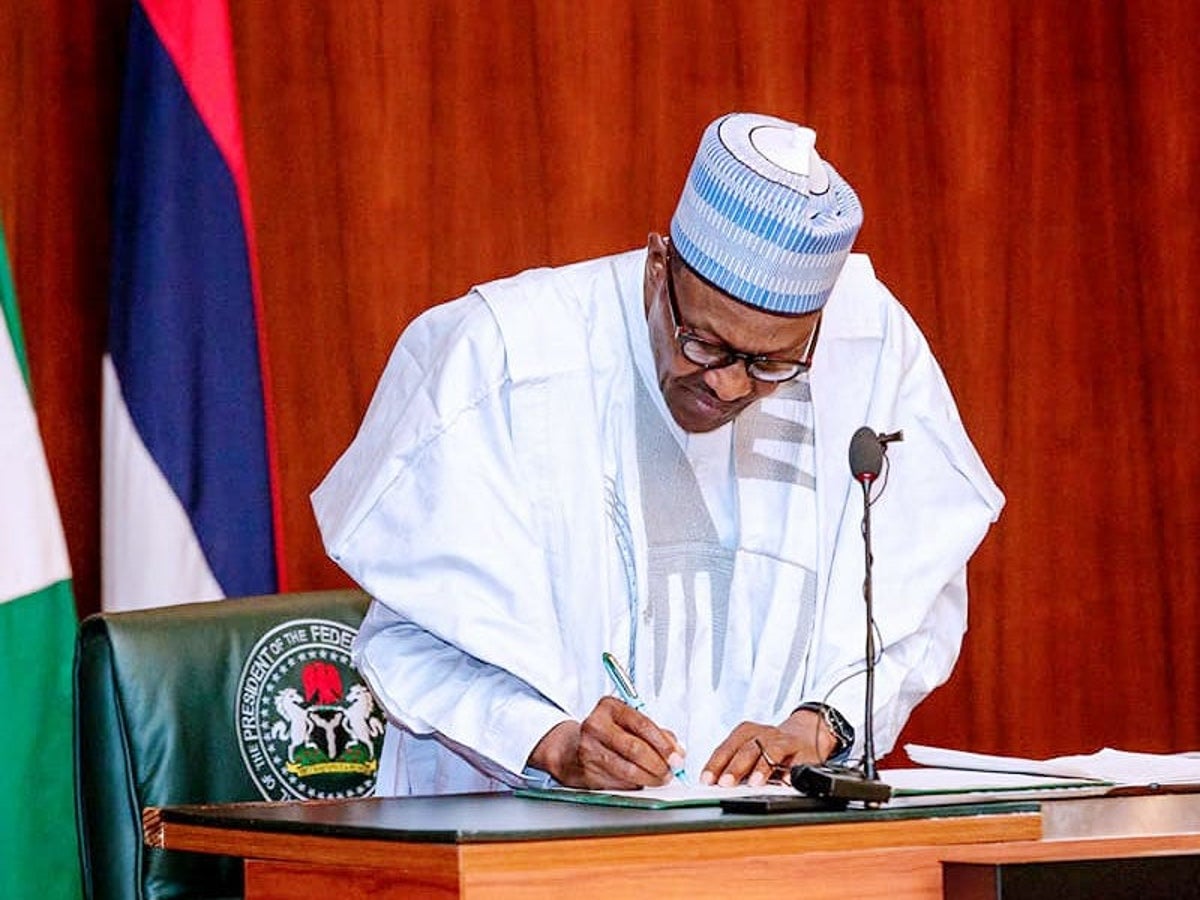
President Muhammadu Buhari on Friday signed into law the Executive Order Number 10 of 2020 for the implementation of financial autonomy of state legislature and state judiciary.
This was disclosed by Mr Umar Gwandu, Special Assistant to the Mr Abubakar Malami, the Attorney General of the Federation and Minister of Justice on Media and Public Relations in a statement on Friday in Abuja.
The President signed the Executive Order based on the powers vested in him as the President of the Federal Republic of Nigeria under Section 5 of the Constitution of the Federal Republic of Nigeria 1999 (as Amended).
This extends to the execution and maintenance of laws made by the National Assembly (including but not limited to Section 121(3) of the 1999 Constitution (as Amended), which guarantee financial autonomy of the State Legislature and State Judiciary.
He noted that a Presidential Implementation Committee was constituted to fashion out strategies and modalities for the implementation of financial autonomy for the state legislature and state judiciary.
This is in compliance with section 121(3) of the Constitution of the Federal Republic of Nigeria, 1999 (as Amended).
“The amendment took into consideration all other applicable laws, instruments, conventions and regulations, which provide for financial autonomy at the State tier of Government,” the statement said.
According to him, “the implementation of financial autonomy of the State Legislature and State Judiciary will strengthen the institutions at that tier of Government and make them more independent and accountable”.
This would be in line with the tenets of democracy as enshrined in the Constitution of the Federal Republic of Nigeria 1999 (as Amended).
“The Order Provides that, `the Accountant-General of the Federation shall by this Order and any such other Orders, Regulations or Guidelines as may be issued by the Attorney-General of the Federation and Minister of Justice, authorise the deduction from source in the course of Federation Accounts Allocation from the money allocated to any State of the Federation that fails to release allocation meant for the State Legislature and State Judiciary in line with the financial autonomy guaranteed by Section 121(3) of the Constitution of the Federal Republic of Nigeria 1999 (as Amended)”.
“Based on the Executive Order at the commencement of this Order for implementation of financial autonomy for State Legislature and State Judiciary in line with section 121(3) of the 1999 Constitution of the Federal Republic of Nigeria (as Amended), all States of the Federation shall include the allocations of the two Arms of Government in their Appropriation Laws.
“Article 6 (1) also provides that `notwithstanding the provisions of this Executive Order, in the first three years of its implementation, there shall be special extraordinary capital allocations for the Judiciary to undertake capital development of State Judiciary Complexes, High Court Complexes, Sharia Court of Appeal, Customary Court of Appeal and Court Complexes of other Courts befitting the status of Courts,’” the statement concluded.
General
Petrol Prices in Nigeria Rise 22.55% in March 2026 on Hormuz Closure
By Adedapo Adesanya
The National Bureau of Statistics (NBS) has said that the average retail price of a litre of Premium Motor Spirit (PMS), otherwise known as petrol, rose by 22.55 per cent or N237.07 per litre to N1,288.54 in March 2026 from N1,051.47 in February.
In the Premium Motor Spirit (Petrol) Price Watch for March released on Tuesday, the NBS said on a year-on-year basis, the average retail price of fuel also increased by 2.13 per cent from N1,261.65 recorded in March 2025.
This surge in fuel prices could be linked to global disruptions brought on by the US-Israel war on Iran, which triggered the closure of the Strait of Hormuz and sent prices of crude oil above $100 per barrel.
While the country was not heavily hit by the impact, it felt the ripple effect of crude prices increasing, particularly as Dangote Refinery imported crude from other markets to cover for local feedstock shortfalls.
The data noted that by state, Anambra recorded the highest average retail price of N1,441.22 per litre, followed by Sokoto at N1,377.55 and Borno at N1,375.16.
However, the price was cheapest in Lagos at N1,162.71, followed by Ogun at N1,169.78 and Kaduna state at N1,193.40.
By zone, it was most expensive in the North East at N1,336.50 last month, while the South-West recorded the lowest at N1,232.46.
A look at the Diesel Price Watch Report for March showed that the average retail price paid by users rose by 16.05 per cent on a month-on-month basis to N1,648.08 per litre from N1,420.17 per litre a month earlier.
“On state profiles analysis, the highest average price of diesel in March was recorded in Ebonyi at N2,262.29 per litre, followed by Akwa Ibom at N1,895.72 and Osun at N1,872.15.
“On the other hand, the lowest price was recorded in Kogi at N1,383.40 per litre, followed by Katsina State at N1,438.25 and Enugu at N1,480.06,” parts of the report said.
General
Datti Baba-Ahmed Dumps Labour Party, Joins PRP
By Modupe Gbadeyanka
The vice-presidential candidate of the Labour Party (LP) in the 2023 general elections, Mr Datti Baba-Ahmed, has left the party to join the Peoples Redemption Party (PRP).
Speaking on Channels Television’s Politics Today, the politician said he’s no longer interested in the way the Labour Party was being run.
He disclosed that there is no more peace in the political party he flew its flag in the last general elections because of greed.
He accused the ruling All Progressives Congress (APC) of destabilising opposition political parties to ensure President Bola Tinubu does not have a credible opponent in the 2027 presidential poll.
“What the Labour Party stood for is not the same now. We have a government of today which is interested in destroying other political parties,” he said.
“I am leaving the Labour Party tomorrow (today) by 12 midnight,” Mr Baba-Ahmed said when asked about his plans for next year.
I am leaving the Labour Party [at] midnight, and I am joining PRP. PRP is the new destination. PRP is the one with a history. It’s about 75 years old,” he further stated.
He further said, “When there was real peace in the Labour Party, someone was redeployed to the Labour Party and because of the antecedents of the person, [I don’t see things getting better].
PRP, a progressive Nigerian political party, was established in 1978 by Mallam Aminu Kano. It is rooted in social democratic principles and populist ideology, often focusing on the empowerment of the talakawa (common people).
Its current National Chairman, according to data obtained from the website of the Independent National Electoral Commission (INEC), is Mr Falalu Bello, while the National Secretary is Mr Babatunde F. Alli.

General
We Prioritised Personal Pension Plan, Others for Robust Pension System— PenCom
By Modupe Gbadeyanka
The Director General of the National Pension Commission (PenCom), Ms Omolola Oloworaran, has highlighted strategies deployed by her organisation to ensure pension coverage is deepened in Nigeria.
Speaking at the ISSA Technical Seminar in Abuja recently, she said the steps taken were to build a more inclusive, transparent, and responsive pension system, where communication serves not just as information, but as a bridge to trust, accessibility, and sustained industry growth.
According to her, the Contributory Pension Scheme (CPS) has, over more than two decades, built a strong institutional foundation, but true inclusion goes beyond coverage to require trust and clear communication.
For this reason, PenCom has prioritised the Personal Pension Plan, strengthened stakeholder engagement, and invested in digital channels that reach contributors in accessible and relatable ways, she stated.
Ms Oloworaran further stressed that, “Effective communication is not a soft complement to regulation; it is a core instrument of coverage expansion, compliance, and public confidence.
“Every circular we issue, every benefit we pay, and every reform we introduce ultimately succeeds or fails on whether our members can understand it and act on it.”
The ISSA Technical Seminar, themed Improving Inclusivity and Accessibility of Social Security Services Through Effective Communication, was organised in collaboration with the International Social Security Association (ISSA).
It brought together key stakeholders across West Africa to advance dialogue on strengthening social security systems through clearer, more inclusive engagement.
-
Feature/OPED6 years agoDavos was Different this year
-
Travel/Tourism10 years ago
Lagos Seals Western Lodge Hotel In Ikorodu
-
Showbiz3 years agoEstranged Lover Releases Videos of Empress Njamah Bathing
-
Banking8 years agoSort Codes of GTBank Branches in Nigeria
-
Economy3 years agoSubsidy Removal: CNG at N130 Per Litre Cheaper Than Petrol—IPMAN
-
Banking3 years agoSort Codes of UBA Branches in Nigeria
-
Banking3 years agoFirst Bank Announces Planned Downtime
-
Sports3 years agoHighest Paid Nigerian Footballer – How Much Do Nigerian Footballers Earn