General
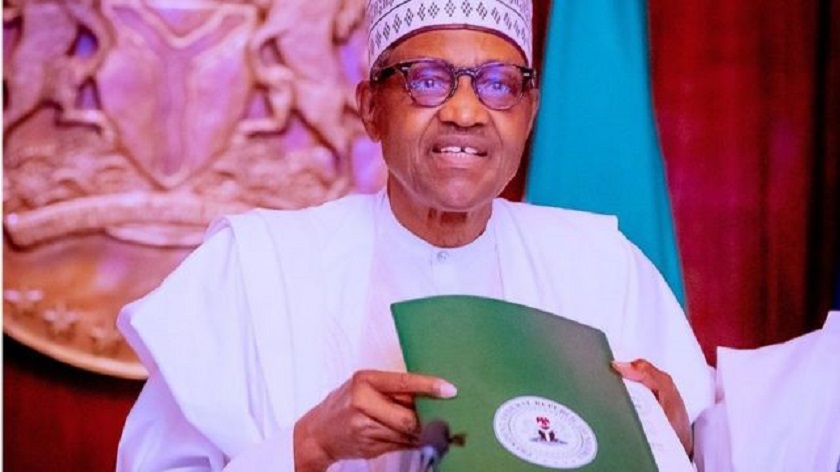
Buhari Loses Suit to Challenge Electoral Act at Supreme Court
By Adedapo Adesanya
The Supreme Court has struck out a suit filed by President Muhammadu Buhari and the Attorney General of the Federation (AGF), Mr Abubakar Malami, challenging Section 84(12) of the Electoral Act.
On Friday, the case was expunged on the grounds that it lacks the jurisdiction to entertain it and is an abuse of the court process.
A notice for the judgment delivery was served on President Buhari and the National Assembly on Thursday, inviting them to appear before the court today for the judgment.
The President and the Minister of Justice had filed a suit at the Supreme Court, seeking an interpretation of the controversial clause in the Electoral Amendment Act 2022.
In the suit filed on April 29, President Buhari and Mr Malami, who are the plaintiffs, listed the National Assembly as the sole defendant.
There have been several debates regarding Section 84 (12) of the amended Electoral Act 2022 which was assented to in February.
Upon assenting to the act, President Buhari had asked the National Assembly to delete the contended clause, however, the parliament declined the president’s request.
Section 84 (12) of the legislation holds that “no political appointee at any level shall be a voting delegate or be voted for at the convention or congress of any political party for the purpose of the nomination of candidates for any election.”
In their suit marked SC/CV/504/2022 and filed on April 29, 2022, President Buhari and Mr Malami sought an order of the apex court to strike out the section of the Electoral Act, which they argue was inconsistent with the nation’s constitution.
According to the court document, the plaintiffs contend that the Section 84(12) of the Electoral (Amendment) Act, 2022 is inconsistent with the provisions of sections 42, 65, 66, 106, 107, 131, 137, 147, 151, 177, 182, 192 and 196 of the Constitution of Federal Republic of Nigeria, 1999, (as amended), as well Article 2 of the African Charter on Human and People and Peoples Rights.
The plaintiffs further contended that the constitution already makes provisions for qualification and disqualification for the offices of the President and Vice President, Governor and Deputy Governor, Senate and House of Representatives, House of Assembly, Ministers, Commissioners, and Special Advisers.
They urged the Supreme Court to make: “A declaration that the joint and or combined reading of section 65, 66, 106, 107, 131, 137, 147, 151, 177, 182, 192 and 196 of the constitution of the Federal Republic of Nigeria, 1999, (as amended), the provision of Section 84 (12) of the Electoral Act, 2022 which also ignores Section 84(3) of the same Act, is an additional qualifying and/or disqualifying factors for the National Assembly, House of Assembly, Gubernatorial and Presidential elections as enshrined in the said constitution, hence unconstitutional, unlawful, null and void”.
However, in its decision on Friday, the Supreme Court held that President Buhari, having assented to the bill on February 25 2022, cannot turn around to challenge the same act.
In a unanimous judgement delivered by Justice Emmanuel Agim, the court said allowing the suit to have its way will amount to approbating and reprobating at the same time and no court of law shall allow that.
The apex court unanimously agreed that President Buhari lacked the jurisdiction to bring the suit before it because of the nature of the reliefs sought.
General
FCCPC Denies Approval of New Airtime Credit Operators
By Adedapo Adesanya
The Federal Competition and Consumer Protection Commission (FCCPC) has dismissed reports claiming that President Bola Tinubu has approved the entry of nine new operators into Nigeria’s airtime credit market, insisting it had no knowledge of, or involvement in, such claims.
In a statement issued by its Director of Corporate Affairs, Mr Ondaje Ijagwu, the commission described the reports as inaccurate, stressing that it did not submit any list of Fintech companies to the presidency for approval as part of reforms in the sector.
The reports, which circulated in several national newspapers (excluding Business Post), alleged that the President endorsed proposals by the FCCPC to restructure the airtime credit market and approved a number of Nigerian financial technology firms to operate within the space.
However, the agency clarified that the regulatory framework under which such approvals were reportedly granted remains suspended, following a court order.
Mr Ijagwu explained that the implementation of the DEON Consumer Lending Regulations 2025 was halted after an interim injunction was issued by the Federal High Court in Lagos on April 15, 2026.
The case was instituted by the Wireless Application Service Providers Association of Nigeria (WASPA), which challenged aspects of the regulation and secured a judicial restraint pending the determination of the substantive suit.
The FCCPC said as a law-abiding institution, it remains bound by the court’s directive and cannot enforce or act on the suspended framework until the matter is resolved.
Reacting to the development, WASPA also raised concerns about how approvals could be granted under a regulatory regime that is currently under judicial review and administrative suspension.
The controversy has left unanswered questions about the origin of the reports, which included detailed policy proposals and named specific companies allegedly cleared to operate in the sector. The case is scheduled for further hearing on July 20, 2026.
This newspaper reports that with the suspension, lending services such as Globacom’s Borrow Me Credit and Airtel airtime advances have been restored, allowing subscribers to get airtime or data during emergencies or temporary cash shortages. Meanwhile, MTN has yet to restart the service.
General
NUPRC, NNRA Harmonise Processes to Cut Compliance Costs in Oil Sector
By Adedapo Adesanya
The Nigerian Upstream Petroleum Regulatory Commission (NUPRC) has commenced moves to harmonise regulatory processes with the Nigerian Nuclear Regulatory Authority (NNRA) as part of efforts to strengthen radiological safety in oil and gas operations and reduce the cost of doing business in the upstream petroleum sector.
The initiative emerged from a recent meeting between the Chief Executive of the NUPRC, Mrs Oritsemeyiwa Eyesan, and the Director-General and Chief Executive Officer of the NNRA, Mr Yau Idris, at the commission’s headquarters in Abuja.
According to a statement issued by the Head of Corporate Communications and Media at the NUPRC, Mr Eniola Akinkuotu, on Sunday, the collaboration is expected to address overlapping regulatory requirements, close existing gaps in oversight, and create a more efficient compliance framework for operators in the industry.
The statement read, “The Nigerian Upstream Petroleum Regulatory Commission is partnering with the Nigerian Nuclear Regulatory Authority in order to enforce radiological safety in oil and gas operations and reduce the overall cost of operations.”
The latest partnership comes as the Federal Government intensifies efforts to boost investment in the petroleum sector, increase production, and enhance operational efficiency following the implementation of the Petroleum Industry Act (PIA).
While the NUPRC regulates the technical, commercial, and operational aspects of oil and gas exploration and production, the NNRA is responsible for regulating the possession, use, transportation, and disposal of radioactive materials and radiation-emitting equipment across the country.
Speaking during the meeting, Mrs Eyesan stressed the need for greater collaboration among regulators to eliminate duplication and improve the investment climate in Nigeria’s oil and gas sector.
She noted that excessive regulatory requirements often translate into additional costs for operators, ultimately affecting the competitiveness of the industry.
“The only way we can safeguard investments is to reduce our cost of operations, and when you have a multiplicity of laws, the likelihood is that you will have higher costs because each law normally will come with its own fees and charges,” the NUPRC boss said.
Mrs Eyesan nominated senior officials from the commission who will work closely with the NNRA on the task ahead.
“We have identified critical areas on both sides, and we believe that, as we collaborate, we can close existing gaps,” she said.
On his part, Mr Idris said the cooperation of the NUPRC was crucial because the upstream petroleum industry remains one of the largest users of radioactive sources and radiation-emitting equipment in Nigeria.
According to him, radioactive technologies are widely deployed in well logging, industrial radiography, and nuclear gauging activities that support oil and gas exploration and production.
He explained that the partnership would enable both agencies to share information and simplify compliance procedures for operators.
“The goal is a single-window approach, where both agencies share information rather than requiring operators to submit the same data twice,” he said.
Mr Idris further stated that, since oil and gas extraction often brings Naturally Occurring Radioactive Materials (NORM) to the surface, the NNRA seeks the assistance of the commission to ensure that operators conduct radiological impact assessments as part of their broader Environmental Impact Assessments, while NORM management protocols are incorporated into the NUPRC’s environmental guidelines for the upstream sector.
The two agencies also agreed to deepen collaboration in training, capacity building, and knowledge sharing on radiation protection and safe operational practices.
General
Nigerian Army Rescues 360 from Boko Haram Captivity
By Adedapo Adesanya
The Nigerian Army on Sunday said the troops of Operation Hadin Kai (OPHK), a joint task force in the North-east, have rescued 360 abducted persons from a Boko Haram camp in the Mandara mountain axis of Gwoza, Borno State.
Recall that Boko Haram insurgents abducted 416 people, including minors, when they invaded Ngoshe in March.
Following the raid, the group released a video filmed inside Ngoshe in which a commander boasted that it would hold the community through Ramadan and observe Eid-el-Fitr prayers at the Ngoshe Central Mosque. It sent a series of other videos in the next couple of weeks after that.
Then, in another video released on April 19, a Boko Haram commander identified as Mallam Abu issued a 72-hour ultimatum demanding a N5 billion ransom and warned against any military rescue attempt.
On May 17, the captives appeared in another video, lamenting their ordeal in the mountainous terrain and pleading for help from government authorities.
In a statement on Sunday, the acting spokesperson for Operation Hadin Kai, Mr Haruna Sani, said the rescue mission was the result of weeks of intelligence gathering, surveillance and operational planning.
According to him, the operation was launched after security agencies received credible intelligence pinpointing the location of the hostages and identifying an insurgent support network sustaining the camp.
He said military intelligence personnel subsequently combined human intelligence, signals intelligence, and surveillance operations using unmanned aerial systems and long-range reconnaissance patrols to map the area, monitor insurgent activities and assess the condition of the captives.
Mr Sani, a lieutenant colonel, said a breakthrough came after intelligence operatives successfully penetrated the terrorist network, providing detailed information on the exact location of the abductees, the disposition of insurgent commanders and planned movement routes.
He added that coordinated information and psychological operations also created confusion within the insurgents’ ranks, weakening their command structure ahead of the assault.
Acting on the intelligence, troops launched a multi-axis operation under the cover of darkness, isolating the objective area and blocking potential escape routes.
“The operation achieved complete tactical surprise, overwhelming the terrorists before an organised response could be mounted,” he said.
The army spokesperson said several insurgents fled into the surrounding mountainous terrain while others surrendered as troops advanced on the enclave.
Following the assault, soldiers secured and evacuated the hostages, who were subjected to medical screening before being moved to safe locations for treatment and humanitarian assistance.
However, Mr Sani disclosed that two infants died from exhaustion caused by the difficult terrain and the harsh conditions they endured during their captivity.
He described the rescue as one of the most significant hostage recovery operations conducted in the North-east in recent times and a major setback for the terrorist group.
Mr Sani said the military high command commended the troops involved in the mission, noting that the success demonstrated the effectiveness of intelligence-led operations and the growing coordination among security agencies.
He added that the high command also assured the public that follow-up clearance operations are ongoing to track down fleeing insurgents, dismantle remaining support networks and prevent future abductions in the region.
-
Feature/OPED6 years agoDavos was Different this year
-
Travel/Tourism10 years ago
Lagos Seals Western Lodge Hotel In Ikorodu
-
Showbiz3 years agoEstranged Lover Releases Videos of Empress Njamah Bathing
-
Banking8 years agoSort Codes of GTBank Branches in Nigeria
-
Economy3 years agoSubsidy Removal: CNG at N130 Per Litre Cheaper Than Petrol—IPMAN
-
Banking3 years agoSort Codes of UBA Branches in Nigeria
-
Banking3 years agoFirst Bank Announces Planned Downtime
-
Sports3 years agoHighest Paid Nigerian Footballer – How Much Do Nigerian Footballers Earn