General
Buhari Threatens Ballot Box Snatchers With Death
By Modupe Gbadeyanka
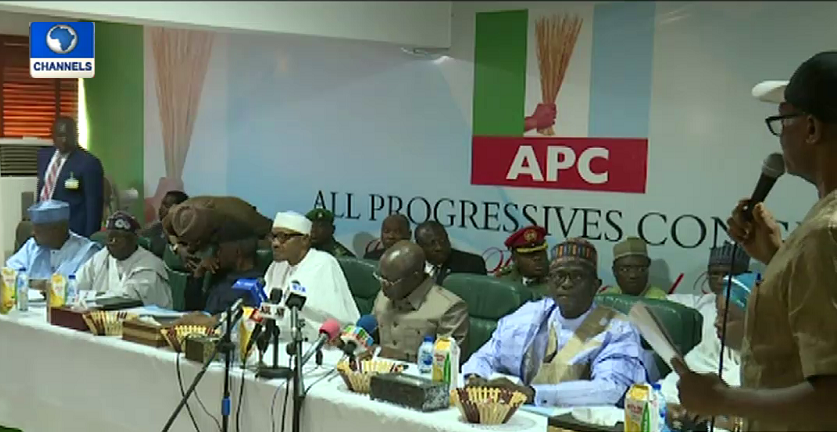
President Muhammadu Buhari on Monday warned those planning to frustrate the success of the 2019 general elections to have a second thought because his administration will not hesitate to ruthlessly deal with troublemakers.
Mr Buhari, while addressing chieftains of the ruling All Progressives Congress (APC) in Abuja this afternoon, said his aim is to have the independent National Electoral Commission (INEC) conduct a free, fair and credible election under his government.
The President called on the electoral umpire to ensure it remains upright and not work to favour one party over the other.
He said anyone planning to snatch ballot boxes during the polls may have to pay with his life, warning that those nursing such to quickly have a rethink.
“I want Nigerians to be respected. Let them vote whoever they want across parties. I am not afraid.
“Like you said (referring to the APC National Chairman, Mr Adams Oshiomhole), I have been to the 36 states of the federation to canvass for votes from Nigerians.
”INEC must behave responsibly. The military and the police will be well mobilized to stamp out rigging and thuggery.
“I am going to warn anybody who thinks he has influence in his locality to lead a body of thugs to snatch ballot boxes or disrupt voting process, he will do it at the expense of his own life,” Mr Buhari declared at the APC Caucus meeting on Monday.
On Saturday, February 16, 2019, INEC announced that the presidential and National Assembly elections were no longer holding on that day. The electoral body shifted the polls to Saturday, February 23, 2019, while the governorship election was postponed to March 9 from March 2.
General
NSIA Plans Renewable Energy Platform to Bridge Financing Gap
By Adedapo Adesanya
The Nigeria Sovereign Investment Authority (NSIA) is developing a platform to aggregate small and distributed renewable energy projects across Nigeria into larger investment opportunities capable of attracting institutional investors.
The initiative seeks to address a major financing challenge in Nigeria’s energy transition, where individual renewable energy projects are often too small or fragmented to attract large-scale institutional capital.
By pooling the projects into a single investment structure, the wealth fund aims to create assets with greater scale and clearer risk profiles, making them easier for institutional investors to assess and finance.
The approach could also help attract international capital by placing domestic institutional funding alongside private and foreign investments, while providing investors with greater confidence in projects exposed to Nigeria’s regulatory, currency, infrastructure and commercial risks.
The financing need is significant, with Nigeria’s Energy Transition Plan estimating that about $410 billion will be required by 2060 to support the country’s transition to cleaner energy.
The NSIA’s aggregation model therefore seeks to move beyond financing individual projects towards building renewable energy portfolios that can unlock deeper pools of institutional capital.
The initiative will be relevant to discussions at the Nigeria NOW! Global Investors Expo, scheduled for November 19 and 20 at the Bola Ahmed Tinubu International Conference Centre in Abuja, where mining, infrastructure, finance and fiscal reforms will be among the key investment themes.
The expo will focus on mining, infrastructure, finance and Nigeria’s fiscal reforms, reflecting the broader conditions that determine whether investment opportunities can move from proposals to commercially viable projects.
General
Six Nigerian News Creators for Google’s Emerging News Voices Growth Lab
By Modupe Gbadeyanka
The sextet of Onlinebanker, Adetunji Films, More Branches TV, Wearegst, Iswellthecapitalist and The Republic have been selected for the Emerging News Voices Growth Lab organised by Google News Initiative (GNI).
The six Nigerian independent news creators are among roughly 20 emerging news creators from across the region taking part in the multi-month virtual programme, which runs through late September 2026.
Over the course of the programme, participants work directly with Google trainers and product experts across four areas:
AI in the newsroom: hands-on integration of Google’s AI tools, including Gemini, NotebookLM, Google Trends and SynthID, into daily workflows for research, transcription, translation and verification.
Video and audience growth: practical frameworks for building YouTube channels, using both Shorts and long-form video to reach new audiences.
Direct reader relationships: strengthening open web presence and newsletters to build first-party audiences the newsroom owns.
Sustainable revenue: sessions on monetisation strategy, product differentiation and audience growth models.
“Independent news creators and digital-native newsrooms are shaping how Africans, and Nigerians in particular, find and understand the news.
“The Growth Lab gives these creators what growing newsrooms need most: practical AI skills, a clear video and audience strategy, direct relationships with their readers and a path to sustainable revenue.
“When emerging voices build capability and financial independence, the whole news ecosystem becomes more resilient, diverse and sustainable,” the News Partnerships Lead for the Middle East and Africa at Google, Marianne Erasmus, stated.
Commenting on being part of the cohort, the Editor-in-Chief of The Republic, Mr Wale Lawal, said, “Google’s Emerging News Voices Growth Lab is giving us practical ways to combine audience insight, product thinking and the responsible use of AI as we build a more sustainable future for The Republic’s journalism.”
Also speaking, his counterpart at MoreBranches, Mr Nasir Achile Ahmed, said, “The program has been valuable to our newsroom, providing information that validates observations we’d made previously, as well as access to tools and the knowledge to use them effectively. Beyond that, engaging with experts and fellow journalists has created a supportive environment that is helping us strengthen our storytelling.”
Creator-led digital journalism is changing how Nigerians, especially younger audiences, find and consume news. Social-first channels and digital-native platforms increasingly drive news discovery, yet the newsrooms behind them often run lean, with limited access to the tools, training and revenue expertise available to established publishers. The GNI Growth Lab is built to close that gap.
The Growth Lab grew out of the Global News Gap Project, a continent-wide mapping of independent African news creators conducted with Project Oasis and Code for Africa, which identified where emerging newsrooms most need support.
The Growth Lab is the latest step in Google’s continued support for Nigerian media. Since 2018, Google has funded newsroom transformation projects through the GNI, helped publishers grow advertising revenue through the Ad Manager Academy, and shared ad revenue with Nigerian publishers through Google AdSense and Google Ad Manager.
Since 2024 alone, Google has trained more than 1,500 Nigerian journalists and editors in online safety, advanced Search, digital verification and audience analytics. Google also supports media skilling through its collaboration with the MTN Media Innovation Programme, where fellows receive hands-on sessions on AI as a productivity partner and on newsroom technology, from News Consumer Insights to Gemini.
General
NERC Takes Over Kaduna DisCo, Dissolves Board Over N456.5bn Debt
By Adedapo Adesanya
The Nigerian Electricity Regulatory Commission (NERC) has dissolved the board of Kaduna Electricity Distribution Plc over the company’s cumulative market obligations of N456.5billion and prolonged financial and operational challenges.
The regulator also appointed an interim board of special directors and directed the commencement of a transparent process for selecting a new core investor for the electricity distribution company.
The decisions were contained in Order No. NERC/2026/086, titled Order on the Regulatory Intervention in Kaduna Electricity Distribution Plc Pursuant to the Electricity Act 2023, which took effect on Monday, August 10, 2026.
NERC said the intervention followed an inquiry and consultations with key industry stakeholders, including the Bureau of Public Enterprises, and was necessitated by KAEDC’s prolonged regulatory and market defaults, inadequate investment and weak operational and commercial performance.
The commission said KAEDC’s cumulative market obligation since privatisation stood at approximately N456.5 billion as of May 2026, comprising N415.5 billion owed to the Nigerian Bulk Electricity Trading (NBET) Plc and N41 billion due to the Nigerian Independent System Operator (NISO)
The company also had other non-market statutory and third-party obligations amounting to N14.26billion, according to the regulator.
NERC said that since ASI Engineering Limited took over operations of KAEDC in June 2024, the company had accrued additional market debt of more than N118.6 billion as of May 2026.
The Commission described the company’s situation as grave, citing prolonged regulatory and market defaults, inadequate investment, weak operational and commercial performance, insufficient assets relative to liabilities and the absence of a credible pathway to sustainable recovery.
NERC said KAEDC paid only 41.93 per cent of its adjusted market invoices in 2025, resulting in a market shortfall of approximately N46.71bn during the year.
It linked the poor remittance performance to the company’s high aggregate technical, commercial and collection losses, which stood at 71.88 per cent in 2025.
The regulator explained that the losses meant KAEDC could account for only 28.2 per cent of the electricity received and delivered to end-use customers during the review period.
NERC also said ASI failed to meet its capital injection commitments towards recapitalising the utility.
According to the commission, KAEDC’s actual capital expenditure in 2025 was approximately N2.48 billion, against a minimum provision of N24.51 billion, representing only 10 per cent performance.
The regulator further noted that KAEDC’s meter coverage had remained between 33.26 per cent and 35.54 per cent since ASI took over the company, despite several interventions aimed at supporting meter deployment across distribution companies.
NERC said the company’s financial difficulties persisted despite approximately N6.58billion in regulatory derogations granted between January 2024 and May 2026 and aggregate Federal Government intervention disbursements of approximately N53.79 billion since July 2018.
It warned that the continued underperformance posed a material risk to electricity consumers, creditors, market stability and the continuity of electricity services.
NERC said it had previously notified KAEDC’s major shareholders and Afreximbank of the imminent intervention and required them to present a credible plan to address the company’s financial situation.
Representatives of ASI, NERC, BPE, Afreximbank and Fidelity Bank subsequently met on June 11, 2026, to discuss proposals for rescuing the company.
According to the commission, the parties agreed that ASI had not complied with conditions prescribed for its acquisition of a 60 per cent majority shareholding in KAEDC and had also failed to comply with BPE requirements for finalising the shareholding arrangements.
NERC said ASI subsequently requested an extension of up to 24 months to stabilise KAEDC’s cash flow, prioritise critical investments and deliver measurable performance improvements, including a pathway to full market remittance.
The regulator, however, rejected the request, saying ASI had been in effective control of KAEDC since June 2024 without a corresponding improvement in its financial and operational performance.
NERC subsequently resolved to exercise its powers under Sections 75 to 79 of the Electricity Act 2023 to dissolve the KAEDC board, preserve the company as a going concern and facilitate a transparent transition to a credible core investor within 12 months.
Consequently, the commission ordered the dissolution of KAEDC’s board and removal of all its directors from office.
“KAEDC’s board of directors is HEREBY DISSOLVED. All directors of KAEDC are removed from office, and the existing board stands dissolved pursuant to section 75 of the EA,” the order stated.
NERC appointed seven special directors to constitute the interim board for the transition period, with Dr Abdullahi Garba as chairman. Other members are Engineer Francis Agoha, Mr Aliyy Aliyu, retired Major General Henry Ayamasaowei, Dr Haliru Dikko, Mr Ayodeji Gbeleyi, representing the BPE, and Dr Abubakar Umar Hashidu.
The commission also appointed the incumbent Managing Director and Chief Executive Officer, Dr Abubakar Umar Hashidu, as administrator for an initial six-month term, subject to review.
NERC said the administrator would oversee the company’s day-to-day operations, ensure continuity of electricity services, implement interim board resolutions, comply with regulatory directives and safeguard the company’s assets and records.
The commission also withdrew the Know-Your-Licensee approvals issued to members of KAEDC’s management team and directed affected management staff to present themselves for revalidation.
Meanwhile, NERC directed Afreximbank to coordinate an open, competitive and transparent process for securing a replacement core investor for KAEDC.
The preferred investor is to be presented to NERC for approval, with the process expected to be completed within 12 months from the commencement of the order, unless the commission grants a written extension.