Connect with us

General

BVN-Generated NIN Can’t be Used for SIM Integration—NIMC

Published

on

BVN-Generated NIN

By Aduragbemi Omiyale

The National Identity Management Commission (NIMC) has disclosed that the National Identification Number (NIN) generated during the registration for the Bank Verification Number (BVN) cannot be used to link SIM cards of telecommunications subscribers.

Last month, the Nigerian Communications Commission (NCC) directed GSM service providers to disconnect any phone number on their database not link to NIN from December 31, 2020.

This made many Nigerians to rush to the offices of NIMC across the country to enable them to retain their phone numbers.

Following an outcry from Nigerians, the deadline was shifted to January 19, 2021.

For some who already had their unique 11-digit number, they were given USSD codes they could use to link their SIM cards with the NIN.

Those who got their NINs during the BVN registration were also happy that they will not have to go through the stress of queuing at the NIMC offices, but their hopes were dashed today when the agency said such NINs cannot be used for the purpose.

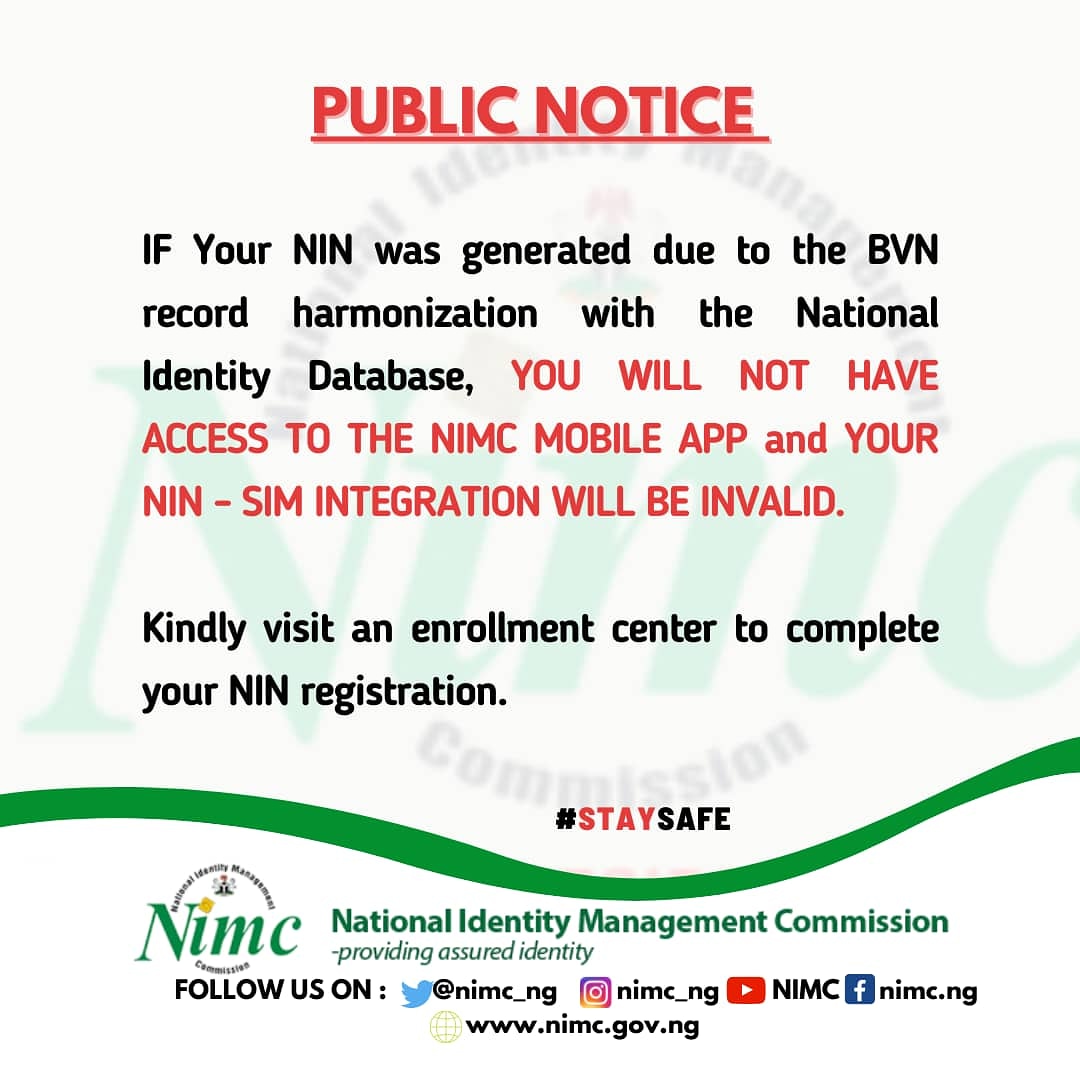
In a message on Tuesday, NIMC emphasised that those who got their NINs via BVN must go to its offices to complete the registration process.

“If your NIN was generated due to the BVN record harmonisation with the National Identity Database, you will not have the access to the NIMC mobile app and your NIN-SIM integration will be invalid,” the notice from the agency said.

It further emphasised in another message that, “You must complete your NIN registration even if your BVN has generated a NIN.”


Aduragbemi Omiyale is a journalist with Business Post Nigeria, who has passion for news writing. In her leisure time, she loves to read.

Click to comment

Leave a Reply

Your email address will not be published. Required fields are marked *

General

Datti Baba-Ahmed Dumps Labour Party, Joins PRP

Published

on

datti baba-ahmed

By Modupe Gbadeyanka

The vice-presidential candidate of the Labour Party (LP) in the 2023 general elections, Mr Datti Baba-Ahmed, has left the party to join the Peoples Redemption Party (PRP).

Speaking on Channels Television’s Politics Today, the politician said he’s no longer interested in the way the Labour Party was being run.

He disclosed that there is no more peace in the political party he flew its flag in the last general elections because of greed.

He accused the ruling All Progressives Congress (APC) of destabilising opposition political parties to ensure President Bola Tinubu does not have a credible opponent in the 2027 presidential poll.

“What the Labour Party stood for is not the same now. We have a government of today which is interested in destroying other political parties,” he said.

“I am leaving the Labour Party tomorrow (today) by 12 midnight,” Mr Baba-Ahmed said when asked about his plans for next year.

I am leaving the Labour Party [at] midnight, and I am joining PRP. PRP is the new destination. PRP is the one with a history. It’s about 75 years old,” he further stated.

He further said, “When there was real peace in the Labour Party, someone was redeployed to the Labour Party and because of the antecedents of the person, [I don’t see things getting better].

PRP, a progressive Nigerian political party, was established in 1978 by Mallam Aminu Kano. It is rooted in social democratic principles and populist ideology, often focusing on the empowerment of the talakawa (common people).

Its current National Chairman, according to data obtained from the website of the Independent National Electoral Commission (INEC), is Mr Falalu Bello, while the National Secretary is Mr Babatunde F. Alli.

PRP Data INEC

Continue Reading

General

We Prioritised Personal Pension Plan, Others for Robust Pension System— PenCom

Published

on

Personal Pension Plan PenCom DG

By Modupe Gbadeyanka

The Director General of the National Pension Commission (PenCom), Ms Omolola Oloworaran, has highlighted strategies deployed by her organisation to ensure pension coverage is deepened in Nigeria.

Speaking at the ISSA Technical Seminar in Abuja recently, she said the steps taken were to build a more inclusive, transparent, and responsive pension system, where communication serves not just as information, but as a bridge to trust, accessibility, and sustained industry growth.

According to her, the Contributory Pension Scheme (CPS) has, over more than two decades, built a strong institutional foundation, but true inclusion goes beyond coverage to require trust and clear communication.

For this reason, PenCom has prioritised the Personal Pension Plan, strengthened stakeholder engagement, and invested in digital channels that reach contributors in accessible and relatable ways, she stated.

Ms Oloworaran further stressed that, “Effective communication is not a soft complement to regulation; it is a core instrument of coverage expansion, compliance, and public confidence.

“Every circular we issue, every benefit we pay, and every reform we introduce ultimately succeeds or fails on whether our members can understand it and act on it.”

The ISSA Technical Seminar, themed Improving Inclusivity and Accessibility of Social Security Services Through Effective Communication, was organised in collaboration with the International Social Security Association (ISSA).

It brought together key stakeholders across West Africa to advance dialogue on strengthening social security systems through clearer, more inclusive engagement.

Continue Reading

General

Nnaji Expresses Worry Over Lack of Power Plant Financing

Published

on

Gas Power Plant

By Adedapo Adesanya

Former Minister of Power, Mr Barth Nnaji, has run to the rooftop to declare that Nigeria has not secured financing for any major power plant in more than a decade, blaming policy reversals and weak government commitment for the prolonged investment drought.

Speaking at the Nigerian Association for Energy Economics conference in Lagos, Mr Nnaji said the country’s power sector lost momentum after a promising financing framework introduced under his watch was abandoned following a change in administration.

According to him, the partial risk guarantee instrument developed jointly with former Finance Minister, Mrs Ngozi Okonjo-Iweala, had begun attracting international investors by reducing the risks associated with power projects in Nigeria.

“The world was galloping to us to finance power plants because we were getting a service guarantee,” he said, noting that the framework helped secure funding for the Azura-Edo Power Station, one of Nigeria’s most significant independent power projects.

However, he said the policy was scrapped after the administration changed, abruptly halting investor interest.

“Till today, we have not financed any new major power plant in Nigeria. That’s about 11 years ago,” he said.

Mr Nnaji argued that policy inconsistency remains one of the biggest obstacles to power sector growth, without clear, stable and bankable policies.

He said Nigeria will continue to struggle to attract the long-term capital required for large-scale electricity projects.

He also urged Nigeria to adopt a pragmatic approach to energy transition, stressing that natural gas should remain the backbone of the country’s power strategy. With more than 210 trillion cubic feet of proven gas reserves, he said Nigeria is well-positioned to use gas as a bridge fuel for industrialisation and economic growth over the next two decades.

Yet, despite these vast reserves, inadequate infrastructure continues to constrain supply.

Mr Nnaji noted that the Nigeria LNG Limited is operating at only about 60 per cent of capacity due to insufficient gas availability, highlighting the urgent need for greater investment in gas production, processing and transportation.

He also cited the long-delayed Mambilla Hydroelectric Power Station as a symbol of Nigeria’s execution failures. Although technically viable, the project has remained on the drawing board for more than 40 years because of weak political will and inconsistent implementation.

He noted that Nigeria’s power challenge is not a lack of resources but a failure of execution. With an installed generation capacity of about 13,000 megawatts, the country still produces only 4,000 to 5,000 megawatts on average. Until policy becomes consistent and infrastructure investment accelerates, reliable electricity will remain frustratingly out of reach for millions of Nigerians.

Continue Reading

Trending