General
Court Remands Ex-Code of Conduct Tribunal Chair Danladi Umar in Kuje Prison
By Adedapo Adesanya
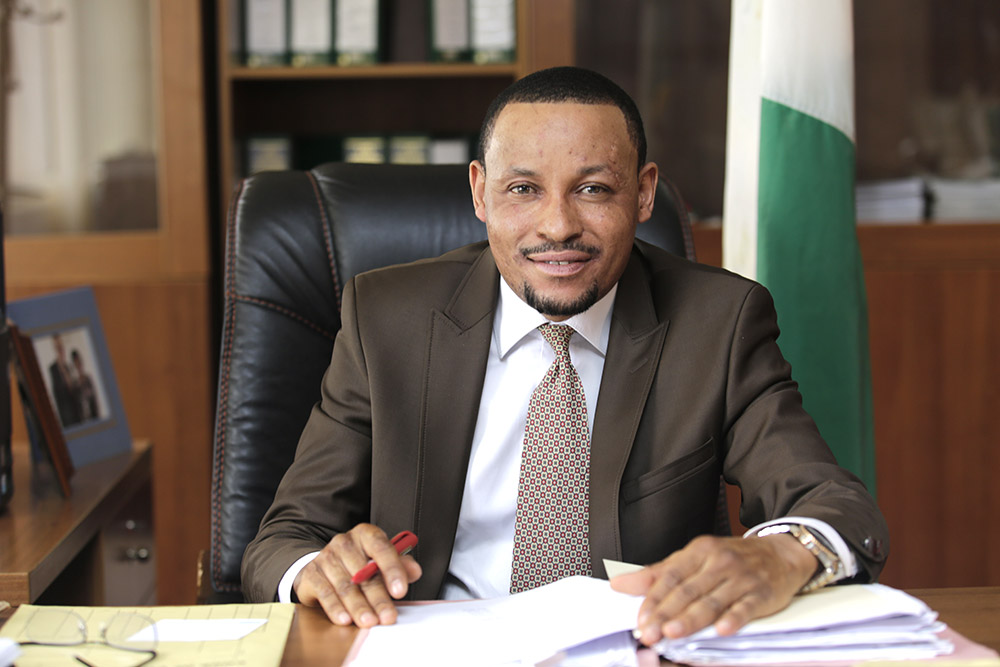
The Federal Capital Territory (FCT) High Court sitting in Maitama, Abuja, has remanded the former Chairman of the Code of Conduct Tribunal (CCT), Mr Danladi Umar, at the Kuje Custodial Centre after he was arraigned on corruption charges brought by the federal government.
Justice Peter Kekemeke on Thursday ordered Mr Umar’s remand following his arraignment on a four-count charge bordering on alleged abuse of office and corruption.
According to the prosecution, investigations revealed that the former CCT Chairman used his position to obtain financial benefits from contractors while in office.
The federal government alleged that in 2021, Mr Umar received N5.5 million through his wife’s bank account from a contractor engaged to repaint the CCT headquarters in Abuja.
The prosecutors further claimed that on January 25, 2024, he also received N6 million, again through his wife’s account, from a contractor responsible for the digitisation of the tribunal’s records.
In another allegation, the government accused Mr Umar of directing a contractor to pay N2.43 million as tuition fees for his daughter at Baze University, Abuja.
The alleged offences are said to contravene Section 19 of the Corrupt Practices and Other Related Offences Act, 2000.
Mr Umar pleaded not guilty to all four charges. Following his plea, prosecuting counsel, Christopher Mshelia, asked the court to remand the defendant to a correctional facility and fix a date for trial.
The counsel of defence, however, urged the court to admit him to bail pending the hearing of the case.
The prosecution opposed the request, informing the court that it had only just been served with the bail application and required time to file its response.
Justice Kekemeke subsequently adjourned proceedings until July 15 for the hearing of the bail application and ordered that the defendant be remanded in Kuje Custodial Centre pending the determination of the application.
Mr Umar served as Chairman of the Code of Conduct Tribunal and presided over several high-profile cases during his tenure, including the 2019 trial of former Chief Justice of Nigeria, Justice Walter Onnoghen.
Mr Umar was responsible for issuing the ex parte order that paved the way for Mr Onnoghen’s suspension, after which the late President Muhammadu Buhari appointed Justice Tanko Muhammad as Acting Chief Justice of Nigeria.
Although Mr Onnoghen later resigned from office, Mr Umar proceeded to convict him over allegations of false asset declaration and ordered the forfeiture of funds in several of the former CJN’s bank accounts while also removing him from key judicial positions.
General
C&S Worldwide Supreme Leader Emmanuel Alogbo Dies
By Modupe Gbadeyanka
The spiritual father and chairman of the Cherubim and Seraphim Movement Church Worldwide, Ayo Ni O, His Most Eminence Prophet Emmanuel Adewale Abiodun Alogbo, has died at the age of 93.
The revered cleric, whose demise was announced today, Thursday, July 30, 2026, via a circular from the church, was the Supreme Head of C&S Unification Church of Nigeria.
In the notice signed by CSMC Secretary-General, Snr. Sp. Ap. Prophet Anthony Olusesan Samaye, disclosed that the church leader breathed his last peacefully in the early hours of today, “surrounded by his family members and all his domestic staff at his residence.”
It was stated that his passing occurred at about 2:10 am at his residence in Ijaiye Ojokoro, Lagos.
“With gratitude to God Almighty for a life well spent, on behalf of the Board of Trustees and the entire church, I write to inform you all that our Spiritual Father, His Most Eminence, Prophet (Dr.) Emmanuel Adewale Abiodun Alogbo, was called to glory in the early hours of today, July 30, 2026, at around 2:10 am,” a part of the disclosure, addressed to the church’s management committee, district chairmen, conference supervisors, mission directors, church elders, zonal secretaries and ministers-in-charge of parishes worldwide, said.
The statement, which prayed for God to grant the “church the fortitude to bear the irreparable loss,” said daily prayer sessions would be held for seven days from 5 pm at the late cleric’s residence located at Plot 1, Alogbo Close, off Ahmadiyya Bus Stop, Ijaiye Ojokoro, Lagos, noting that burial arrangements would be announced later.
General
Taking the Pulse of Rural Kaduna
By Sani Abdulrazak, PhD
Thrilling it is to realise that some journeys answer questions you never knew you were asking. Mine happened with no political prism through which to interpret every urban developmental project. Instead, it manifested with a simple curiosity: what does rural Kaduna look like today vis-à-vis three years prior? That part of Kaduna where press conferences are neither held nor dominate social media timelines, but the Kaduna where dawn breaks over farmlands, where markets awaken to the aroma of roasted maize, where children trek to school, and where government is not judged by eloquent speeches but by tangible presence.
If there is one thing I have learned from my travel experience to most rural communities within the 23 local government areas of Kaduna state, it is the fact that these communities have an uncanny way of telling the truth. They have little patience for rhetoric. A bridge either exists or it doesn’t. A classroom either shelters learning or it doesn’t. A health centre either treats patients or remains another neglected structure awaiting the next campaign season. These places are bluntly earnest; poor custodians of propaganda, I call them. They will always remain refreshingly fascinating because evidence is a currency there and it strips governance of embellishment.
One transformational change you can’t miss in the last three years in almost all the rural communities within Kaduna state is education. We speak of schools in cities through the prism of budgets and policies, but in villages, they speak of the child who no longer studies under the tree, the teacher who finally has a conducive classroom, and the parent whose greatest inheritance is no longer a prayer alone. It will interest us to know that across Kaduna State, more than 736 new classrooms have been constructed, while over 1,200 others have been rehabilitated. Add to this the completion of 62 secondary schools, another 50 under construction, and the establishment of 102 new schools alongside the rehabilitation of 170 existing ones under the Reaching Out-of-School Children programme, and the picture begins to assume clearer contours. Statistics, however, are notoriously reticent. They seldom tell you what they have witnessed.
A visit to Tudun Biri will surely convince you. For many Nigerians, the community became known through an episode everyone wished had never happened. Yet communities, like human beings, deserve the opportunity to write new chapters. Today, a new school stands there, as a quiet repudiation of despair. Watching children gather where sorrow once held sway, I was reminded that development is sometimes the art of replacing painful memories with hopeful possibilities. The good people of Kwoi today are living their dream, all thanks to the Proverbial Lannister of Kaduna State, Governor Uba Sani. Roads like Hospital Road, Sabon Gari Road, Audu Tilo Road, Doctor Sani Road, Kpop Ham Palace Road and the Kwoi-Gora Road have done more than alter the landscape of Kwoi; they have recalibrated daily life. They shorten journeys, connect communities and restore the simple dignity of movement. Kwoi residents, within the last three years, describe this giant developmental stride in minutes saved, transport fares reduced, and opportunities regained.
Furthermore, across the 23 local government areas of Kaduna State, 255 Primary Healthcare Centres have been upgraded to Level II status. Another 23 Centres of Excellence and 15 General Hospitals have equally received significant upgrades. These are figures easily read and quickly forgotten. Yet behind every digit lies a heartbeat. Somewhere, an expectant mother reaches skilled care without travelling impossible distances. In another village, a child receives treatment before a preventable illness becomes irreversible. Good healthcare is rarely dramatic; its greatest triumphs are the tragedies that never happen.
Nothing intrigued me the most like the philosophy underpinning Project 255. There is something profoundly democratic about the notion that every one of Kaduna State’s 255 wards deserves visible development. It is an acknowledgement that governance should not become an urban monopoly. Whether in Dogon Dawa, where schools have been rehabilitated, Zonzon, where classrooms have regained life, or other communities benefiting from roads, bridges, electrification and boreholes, the underlying message remains unmistakable: development should travel the last mile. The ancient heartbeat of rural Kaduna is undoubtedly agriculture, and it appears to be rediscovering its rhythm as well. Improved security has encouraged many farmers to return to lands once abandoned, while better rural infrastructure is gradually easing access to markets. Free fertiliser distribution to rural farmers is now becoming an annual event. Governor Uba Sani believes that Rural development, in truth, is not a peripheral conversation; it is the fulcrum upon which sustainable development balances.
None of this suggests that rural Kaduna has arrived at some idyllic destination. Far from it. There are still communities yearning for potable water, better electricity, additional schools, more healthcare personnel and improved infrastructure. Development has never been a destination reached by a single administration; it is an enduring pilgrimage requiring consistency, courage and continuity. But objectivity demands something equally important: the willingness to acknowledge progress where it is evident. Taking the pulse of rural Kaduna left me with an impression that statistics alone could never adequately convey.
That, for most objective students of governance and policy, is the most reliable way to measure a government’s impact, not by the eloquence of its promises nor the intensity of political debates, but by the ordinary experiences of ordinary people. The pulse of rural Kaduna is not yet the pulse of perfection. But it is steady. It is discernible. And, for anyone willing to leave the comfort of assumptions and listen closely, it tells a story worth hearing.
Sani Abdulrazak, PhD, is a writer, researcher and public affairs analyst based in Zaria, Kaduna State
General
NPA Launches Movement Code to Ease Apapa Port Truck Congestion
By Adedapo Adesanya
The Nigerian Ports Authority (NPA) has introduced a movement code to streamline the movement of empty containers into seaport terminals and reduce traffic congestion caused by container trucks along the Apapa and Tin Can Island port corridors.
Under the new policy, the movement code will serve as a unique identifier generated by a holding bay for every empty container uploaded to the Electronic Call-Up (ETO) platform.
The code must correspond with the details captured on the ETO system before trucks are granted access to port terminals.
In a notice issued to stakeholders, the port authority said the movement code had become a mandatory requirement for completing the truck-container matching process. Truck drivers are required to obtain the code from designated holding bays before proceeding to the ports.
According to the NPA, the initiative is designed to ensure that each truck is matched exclusively to its designated empty container, eliminate multiple allocations, improve traffic management and enhance operational efficiency within the port corridor.
The port regulator explained that the new requirement forms part of ongoing efforts to strengthen the electronic call-up system, facilitate the seamless evacuation and return of empty containers, and improve compliance with port access protocols.
“Following our recent engagement with holding bays, we wish to inform all stakeholders of the introduction of the movement code for empty container matching on the ETO platform.
“This update is designed to ensure that trucks are matched only to the specific empty container they are authorised to convey. It will also help prevent the practice of matching trucks to unrelated containers to secure an earlier position, followed by requests for container changes closer to port entry,” the notice reads.
The NPA, in recent years, has been trying to reduce congestion and make accessibility to Nigeria’s busiest ports easier, but many of the solutions have not been fruitful.