Connect with us

General

Cross River to Review Performances of 50 MDAs

Published

on

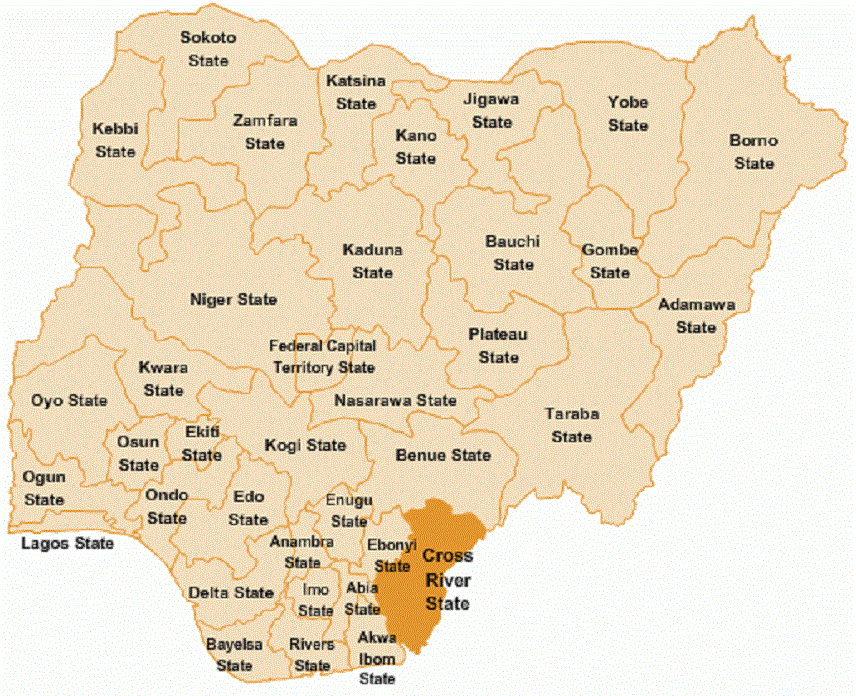
cross river state map

By Adedapo Adesanya

The Cross River State Government has begun the review of the performance of the state’s top 50 revenue generating ministries, departments, and agencies (MDAs).

The activity will be carried out by the state’s ministry of finance and its internal revenue services and will be combined with a strategy session to appraise the performance of the revenue generation capacity of the MDAs in the state and offer propositions at raising the revenue profile.

The revenue-generating review was ordered by Governor Ben Ayade, with a view to strategize on improving stakeholder engagements towards increasing revenue for Cross River State.

The MDAs engagements are scheduled to hold over a two week period starting this October in Calabar with the state ministry of education cluster led by the commissioner, Mr Godwin Amanke, with the provosts and bursars of colleges and schools in the state, as well as directors and deputy directors from the Secondary Education Management Board (SEMB) and the Technical Education Board (TEB) in the state.

According to a government statement, the MDAs agreed on synergies required to improve the revenue profile of the sectors. Revenue targets were mutually agreed upon and the resources required achieving the same.

Other sectors key to the revenue profile of the state includes the ministries of health cluster, transport, agriculture, lands, among others.

According to the data from the National Bureau of Statistics (NBS) in the first half of 2020, the state was able to generate N8.05 billion, sitting 17th out of all 36 states and the Federal Capital Territory between January and June compared to H1 2019, the state generated N16.7 billion and was among the top ten states with high IGR generation.


Adedapo Adesanya is a journalist, polymath, and connoisseur of everything art. When he is not writing, he has his nose buried in one of the many books or articles he has bookmarked or simply listening to good music with a bottle of beer or wine. He supports the greatest club in the world, Manchester United F.C.

Click to comment

Leave a Reply

Your email address will not be published. Required fields are marked *

General

NMDPRA Launches App to Track Fuel Consumption Across Filling Stations

Published

on

fuel consumption

By Adedapo Adesanya

The Nigerian Midstream and Downstream Petroleum Regulatory Authority (NMDPRA) has launched a mobile application designed to monitor fuel consumption patterns in real time across retail outlets nationwide.

The NMDPRA, established under the Petroleum Industry Act (PIA) 2021, is responsible for the technical and commercial regulation of Nigeria’s midstream and downstream petroleum operations. The deployment of the mobile application aligns with the authority’s broader efforts to leverage technology to improve regulatory compliance and strengthen accountability.

The pilot phase of the project began on August 1 in Abuja and its six Area Councils, the authority said in a statement published on X.

As part of the rollout, the Executive Director for Distribution Systems, Storage and Retailing Infrastructure (DSSRI), Mr Ogbugo Ukoha, led a team alongside officials from the Abuja Regional Office to assess the readiness and operational performance of the digital platform at participating retail outlets.

According to the NMDPRA, the application captures inventory and compliance data in real time, enabling regulators to monitor fuel distribution more effectively while improving operational efficiency across the sector.

The authority said the platform would generate reliable, data-driven insights to support evidence-based decision-making, strengthen national energy security planning and enhance transparency in the downstream petroleum industry.

It added that the initiative is expected to provide significant value to government, investors, operators and other stakeholders by improving access to accurate fuel consumption and compliance data.

Nigeria’s downstream petroleum sector has undergone significant changes since the deregulation of the petrol market and the removal of fuel subsidies, with regulators placing greater emphasis on data-driven supervision to ensure product availability, prevent supply disruptions and discourage sharp regional disparities in distribution.

Continue Reading

General

Onafriq, Privy to Build Regulated Stablecoin Infrastructure for B2Bs

Published

on

Onafriq Privy

By Modupe Gbadeyanka

No doubt, moving money among African markets remains a slow, fragmented process that relies on multiple intermediaries and prolonged settlement cycles.

To solve this issue and drive the development of stablecoin-enabled payment services for businesses across the continent, Onafriq has joined forces with a leading stablecoin infrastructure provider, Privy.

The collaboration will enable Onafriq to create and manage embedded digital asset solutions for its partners and, in time, institutional clients where regulation allows. The initial phase focuses on cross-chain stablecoin transfers and treasury and settlement workflows, creating the foundation for future cross-border payment and liquidity solutions.

Integrating Privy’s secure infrastructure enables Onafriq to build the capabilities required to support a new generation of efficient digital payment services for banks, fintechs, and mobile money operators.

This partnership is a key component of Onafriq’s broader strategy to modernise pan-African payment infrastructure, enabling secure multi-modal wallets and more efficient movement of value across the continent.

The outcome will support a range of future institutional use cases, including stablecoin-enabled settlement, treasury management and liquidity services, as it reflects Onafriq’s commitment to driving Africa’s digital transformation agenda by investing in technologies that make financial services more efficient, connected and accessible.

It was gathered that Onafriq selected Privy for its enterprise-grade infrastructure to enable the seamless integration of digital asset wallet capabilities into its products, subject to regulatory approval, and deliver a simple user experience while abstracting the complexity of blockchain technology.

“At Onafriq, we keep investing in technology that makes payments faster and more accessible. Privy gives us a building block for faster settlement and better liquidity management. As demand for digital asset services grows, our goal is to ensure Africa’s payment ecosystem benefits securely and in line with regulatory frameworks,” the Group Chief Product and Innovation Officer at Onafriq,” Mr Luke Kyohere, said.

The chief executive of Privy, Mr Henri Stern, said, “Stablecoins will play an increasingly important role in the future of global payments, but real-world adoption depends on infrastructure that is secure, scalable and simple to implement. Working with Onafriq allows us to help build that foundation across Africa and beyond.”

Continue Reading

General

Osun Threatens Lawsuit as EFCC Freezes State Accounts Ahead of August 15 Guber Election

Published

on

osun state

By Adedapo Adesanya

The Osun State Government has announced plans to institute legal action against the Economic and Financial Crimes Commission (EFCC), following an alleged freezing of the state’s bank account, describing the action as unlawful and capable of disrupting governance.

The Governor of the state, Mr Ademola Adeleke, through the state’s Attorney General and Commissioner for Justice, Mr Oluwole Jimi-Bada, made this disclosure on Wednesday.

According to the statement, Governor Adeleke has directed him to challenge the anti-graft agency’s decision at the Federal High Court.

It was widely reported that the anti-graft agency issued a “Post No Debit” directive to the management of First Bank, where the state’s accounts are domiciled, effectively restricting transactions.

He argued that while the commission has the authority to investigate financial records, it cannot freeze a state government’s accounts without first obtaining a court order.

“I have the mandate of the governor to proceed to the Federal High Court to challenge this move. EFCC can investigate the accounts, but it can’t freeze the accounts without an order of court.

“This step will affect government running, but we will challenge the move and ensure that the agency acts within the ambit of the law,” Mr Jimi-Bada said.

Also speaking, the Commissioner for Finance, Mr Sola Ogungbile, alleged that police officers stormed the main branch of First Bank in Osogbo and arrested some members of the bank’s staff.

Mr Ogungbile maintained that Governor Adeleke was not deploying state resources for his re-election campaign and urged the EFCC to consider the potential impact of its actions on public services and the welfare of residents.

Governor Adeleke had earlier raised concerns over an alleged plan by the EFCC to freeze all Osun State Government accounts, including those of senior government officials.

In a statement issued by the Commissioner for Information and Public Enlightenment, Mr Kolapo Alimi, the governor described the reported move as unlawful and politically motivated.

He alleged that the planned freezing of the accounts was intended to cripple government operations ahead of the August 15 governorship election.

Governor Adeleke further insisted that there was no legal justification for freezing the state’s accounts, arguing that the EFCC lacks the authority to take such action against a state government without due legal process.

The EFCC had not issued an official response to the allegations as of the time of filing this report.

Continue Reading