General
Defence Minister Musa Warns Mali Conflict May Destabilise West Africa
By Adedapo Adesanya
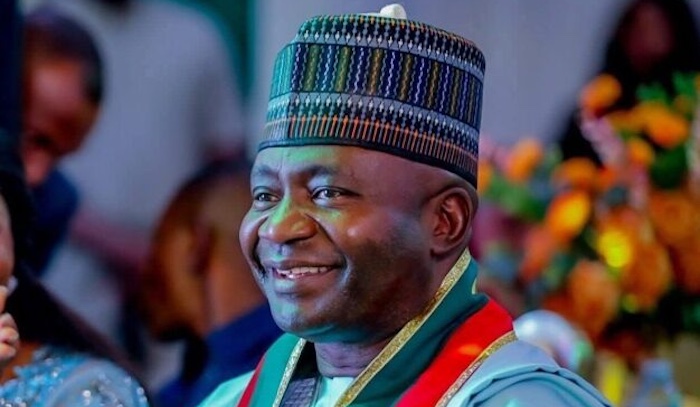
Nigeria’s Minister of Defence, Mr Christopher Musa, says the capture of a key Malian town by rebels poses a threat to West Africa that requires foreign intervention to prevent the insurgency from spreading.
A series of coordinated attacks by militants in late April left Mali’s Defence Minister dead and forced Malian and Russian mercenary forces to withdraw from the northeastern stronghold of Kidal.
Mr Musa, a retired army general, said in an interview with Bloomberg that the international community must come together to deal with the insurgents before they wreak havoc on the region.
The deteriorating situation in Mali may trigger a wider regional crisis, the defence minister said.
His admittance comes as the border region of Nigeria, Benin and Niger on the southern edge of the Sahel region is becoming a new stronghold for jihadists, as militants turn forests and pastoral networks in West Africa into bases for recruitment and international attacks.
“If they allow them to get any foothold in Mali, completely, they are not stopping there,” he warned.
He called for a joint campaign style like that of the United States against the Islamic State in Syria as a way to root out terrorists in West Africa.
General Musa noted that the collapse of states across the region has been the main driver of arms proliferation, with coastal West African states, including Ghana and Togo, becoming increasingly vulnerable.
He cited the fall of former Libyan dictator Muammar Gaddafi in 2011 as a turning point that released vast stockpiles of weapons into circulation, a problem compounded by ongoing instability in Sudan.
The combined crises have created an open corridor across the Sahel, allowing small arms, light weapons and ammunition to flow largely unchecked.
He added that this has worsened due to weak border controls and the ease of movement across the region.
Attacks in Nigeria have also risen, with data from the website of the Armed Conflict Location & Event Data (ACLED), a conflict-monitoring group, affirming that the number of suicide bombings in Nigeria by March already matched the annual average over the past six years.
The Nigerian military has also been dealt a blow to its military bases and senior figures targeted. In April, Brigadier-General Oseni Omoh Braimah was killed when Islamist fighters attacked a base in Borno State.
The minister said disruptions linked to global conflicts, including the war in Ukraine, as well as the ongoing war in Iran, have made it harder to source weapons even when funding is available. To meet its defence goals, Nigeria is stepping up efforts to build domestic arms-manufacturing capacity.
General
Customs Agents Ask Tinubu to Halt Planned Shipping Charge Hike
By Adedapo Adesanya
The National Council of Managing Directors of Licensed Customs Agents (NCMDLCA), the umbrella body of customs agents in Nigeria, has petitioned President Bola Tinubu to compel the Nigerian Shippers’ Council (NSC) to suspend the planned increase in shipping charges pending the review by the standing committee.
According to Mr Lucky Amiwero, the president of the body, in a letter to the President, the increase is a clear contravention of the Memorandum of Understanding (MOU) signed in respect of local shipping charges between providers and users of shipping/Port and related service approved by the federal government.
The MoU under Articles 2(b)&4 clearly states that any other charges shall require agreement between the Parties concerned through the Nigerian Shippers Council, which must be complied with.
“In line with the provisions of Articles 2 and 4 of the Memorandum of Understanding, there is a need to follow the prescribed procedure as contained in the MOU. First is by submitting the information of the increase to the standing committee, including the detailed information, why the increase, and the percentage, to the standing committee for consideration and review of any increase
“We hereby request the suspension of any Local Shipping Charges increase, pending the review by the standing committee, which entails the detailed information of the increase, the Percentage (%), and if the Increase is necessary, to be sent to the standing Committee as approved by the Federal Government,” he said.
The official said the NSC were supposed to forward all detailed information on the increase in the local shipping charges to the standing committee, who are signatory to the MOU, and then to review in line with the approved federal government directive.
“We refer the government to the usual procedure of initiating an increase in local shipping charges. Notification of increase as proposed is always forwarded to the standing committee, reference 2003 NSC/TOD/FPS/011/VOL.V/54 OF 20TH JUNE, and NSC/TOD/FPS/011/VOL.35 OF 14TH April 2003 in line with article 2(b)&4 of the MOU.
“In line with Article 2(b)&4 of the memorandum of understanding, the request made by Shipping Association of Nigeria (SAN), which was forwarded to the Shippers Council and the Shippers Council forwarded the same to the technical standing committee for review,” he added.
General
Presidency Raises Alarm Over Politically Motivated Deepfake Campaigns
By Adedapo Adesanya
The presidency has raised alarm over what it described as a growing pattern of digitally manipulated content aimed at exploiting religious sentiments for political purposes.
In a public service announcement issued by the Office of Digital Engagement and Strategy, it was disclosed that “deliberate attempts” to mislead Nigerians through deep fake videos and false narratives across online platforms had been identified.
According to the statement, a manipulated video surfaced on Tuesday, featuring altered audio and false attributions designed to portray President Bola Tinubu in a negative light.
It noted that a similar attempt followed shortly after, involving a fabricated video linked to a religious leader, allegedly intended to incite Muslim communities against the President.
The presidency said the recurring pattern suggests a coordinated effort to inflame religious tensions and sow division, particularly as political activities begin to intensify ahead of future elections.
It warned that “desperate actors” are likely to continue deploying misinformation tactics, including distorting religious messages, manipulating context, and spreading provocative content through social media and messaging platforms.
The presidency urged Nigerians to exercise caution before sharing sensitive or inflammatory content, encouraging citizens to question the motives behind such materials and to verify information through credible sources.
Describing the trend as “coordinated manipulation at scale,” it stressed that such actions are neither patriotic nor reflective of genuine political engagement.
The statement further warned that individuals and groups involved in the creation and dissemination of false information would be held accountable under relevant Nigerian laws, including those relating to cybercrime, incitement, and threats to public peace and national security.
It concluded by calling on citizens to remain vigilant and united in safeguarding the country’s social cohesion against digital disinformation.
General
Tinubu Says Next Phase of Reforms Will Directly Impact Nigerians
By Adedapo Adesanya
President Bola Tinubu has said his administration plans to prioritise translating ongoing economic reforms into tangible improvements in the daily lives of Nigerians as citizens continue to grapple with the effects of subsidy removal and foreign exchange reforms.
In a nationwide broadcast to mark the third anniversary of his administration, the President acknowledged the hardship caused by the removal of the fuel subsidy and foreign exchange reforms, but insisted that the measures were necessary to stabilise the economy and prevent a deeper national crisis.
He was sworn in on May 29, 2023, and immediately declared the removal of the fuel subsidy — a decision that sent petrol prices up immediately and had an effect on food and transportation.
He promised that the government would continue efforts to keep food prices low, noting that prices had already dropped from their peak levels in 2023 and 2024.
Mr Tinubu also promised lower transportation costs as commercial vehicle operators convert from petrol engines to compressed natural gas and electric vehicles.
The President said when his administration assumed office in 2023, Nigeria was facing severe economic and structural challenges, including mounting fiscal pressures, unsustainable fuel subsidies, declining revenues, exchange-rate distortions, rising debt-servicing costs, insecurity, energy constraints and weakening public confidence in institutions.
President Tinubu said when his administration assumed office in 2023, Nigeria was facing severe economic and structural challenges, including mounting fiscal pressures, unsustainable fuel subsidies, declining revenues, exchange-rate distortions, rising debt-servicing costs, insecurity, energy constraints and weakening public confidence in institutions.
According to him, the country was spending as much as N18.4 billion daily on petrol subsidy payments at the peak of the regime, with over N4 trillion spent on subsidy in 2022 alone.
He also said multiple exchange-rate windows and forex arbitrage led to massive distortions, with the country losing more than N8 trillion within three years to speculative activities and rent-seeking.
“The situation demanded urgent and courageous action. Difficult but necessary decisions had to be taken to stabilise the economy and prevent a deeper national crisis. The easy choices would have been politically convenient. But leadership demands courage, especially when the right decisions are difficult.
“Had we refused to act, our nation would have drifted towards fiscal breakdown, worsening poverty and severe economic uncertainty. Together, we chose reform over ruin and decisiveness over hesitation. We chose long-term national recovery over short-term comfort,” he said.
The President admitted that the reforms triggered a sharp rise in the cost of living and placed enormous pressure on families, workers and businesses, while many young Nigerians seeking jobs became discouraged.
“I remain deeply conscious of those sacrifices, and I assure you: your sacrifice has not been in vain,” he stated.
-
Feature/OPED6 years agoDavos was Different this year
-
Travel/Tourism10 years ago
Lagos Seals Western Lodge Hotel In Ikorodu
-
Showbiz3 years agoEstranged Lover Releases Videos of Empress Njamah Bathing
-
Banking8 years agoSort Codes of GTBank Branches in Nigeria
-
Economy3 years agoSubsidy Removal: CNG at N130 Per Litre Cheaper Than Petrol—IPMAN
-
Banking3 years agoSort Codes of UBA Branches in Nigeria
-
Banking3 years agoFirst Bank Announces Planned Downtime
-
Sports3 years agoHighest Paid Nigerian Footballer – How Much Do Nigerian Footballers Earn