General
Fortune Magazine Names Dangote 11th Greatest Leaders on Earth
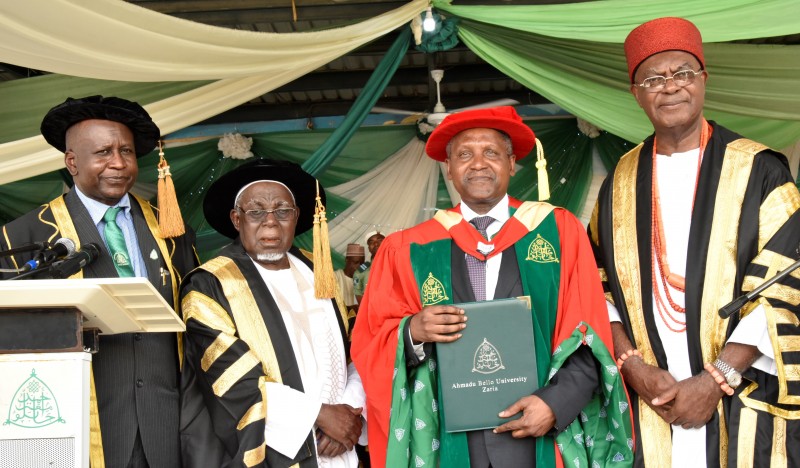
Foremost philanthropist and richest man in Africa, Mr Aliko Dangote, has been rated 11th of the 50 World’s Greatest leaders for 2019.
The rating carried out by the Fortune Magazine, an American multinational business magazine headquartered in New York City, United States, was released recently and focused mainly on the businesses run by the men and how they have used it to impact their society positively.
The time-tested magazine, which first edition was published in February 1930, said the world’s greatest leaders both men and women are transforming the world and inspiring others to do so in business, government, philanthropy and the arts.
“These thinkers, speakers, and doers make bold choices and take big risks- and move others to do the same”, the magazine declared.
This is the first time Fortune magazine is recognizing and including Aliko Dangote in the annual ranking. Specifically, Dangote having popped up in the magazine’s radar earned nomination after being adjudged as having used business to acquire wealth and who is now converting his wealth into impactful philanthropy through his Aliko Dangote Foundation.
The top 10 greatest men and women, according to Fortune are: Bill and Melinda Gates, Jacinda Ardem (Prime Minister, New Zealand), Robert Mueller (Special Counsel, Department of Justice), Pony Ma (Founder and CEO, Tencent), Satya Nadella (CEO, Microsoft), Greta Thunberg (Student and climate activist, Sweden), Margrethe Vestager (Commissioner for Competition, European Union), Anna Nimiriano (Editor-in-Chief, Juba Monitor), Jose Andres (Chef/Founder, World Central Kitchen), and Dough Mcmillon and Lisa Woods (CEO; Senior Director, Strategy & Design for U.S. Benefits, Walmart).
The ranking of Mr Dangote as one of the greatest business leaders has attracted comments by eminent persons around the world who described him as worthy of the nomination going by his business acumen and philanthropic gestures.
Global business giant and founder of Bill and Melinda Gates Foundation, Mr Bill Gate extolled the efforts of Mr Dangote in making businesses play roles in provision of sound public health through his various interventions in health care issues especially in the fight against malnutrition and routine polio.
Mr Gates, who himself was ranked along with Dangote, said “Aliko Dangote, through his leadership at the Aliko Dangote Foundation, is a key partner in the Polio eradication effort, strengthening routine immunisation and fighting malnutrition in Nigeria and across Africa. Aliko bridges the gap between private business and public health in a unique way and our shared belief that Nigeria will thrive when every Nigerian is able to thrive drives our partnership.”
Renowned activist and co-founder of ONE, Paul David Hewson, popularly called Mr Bono said he was not surprised at Mr Dangote’s feat globally, saying his vision is as big as the African continent.
Mr Bono, a global campaigner on taking action to end extreme poverty especially in Africa said: “Aliko has a vision just the size of his continent, but with humility of somebody who has just started his first job. It’s no surprise to me that Fortune would recognise his leadership because we have seen first-hand, through his service on ONE’s Board, the benefits of his wise counsel and grace.”
Also, the popular Economic analyst, Mr Bismark Rewane stated that “Aliko remains understated but very potent and Africa’s most successful and decorated entrepreneur. He is a global financial and managerial behemoth.”
Mr Dangote as the Africa’s richest – worth $16.4 billion, according to Bloomberg – and the four publicly traded companies under the umbrella of his Dangote Industries now account for about a third of the value of the Nigerian stock exchange.
That wealth is based on a big bet on Nigeria’s economic independence: Dangote’s peers give him credit for helping the country become self-sufficient in the sectors in which his companies compete (cement, agriculture and mining).
The Aliko Dangote Foundation (ADF) is the Philanthropic endeavor of Aliko Dangote. The main objective of the Foundation is to reduce the number of lives lost to malnutrition and disease.
The Foundation is poised to combat Severe Acute Malnutrition (SAM) in children, as the core of its programming. It has also resolved to use its investments in health, education, and economic empowerment to help lift people out of poverty.
It would be recalled that Dangote was last year ranked among 75 most powerful persons on the planet, ahead of the Vice-President of the United States of America, Mike Pence.
Aliko Dangote has been named among most powerful persons in the world for the past five consecutive years. According to the Forbe’s 2018 ranking of the World Powerful people, Dangote ranked among world leaders like Xi Jinping, the Chinese President, Vladimir Putin the Russian President and Donald Trump, the President of the US, all of whom were ranked first, second and third respectively.
He was the only Nigerian on the list and one of the only two Africans who made the list with the other being the Egyptian President, Abdel Fattah el-Sisi, who was ranked 45thmost powerful.
In the same vein, he was named among the 100 most influential personalities in the world in 2018 by Time Magazine, leading business broadcast organisation. The CNBC had earlier in same year ranked Mr Dangote as one of the 25 people which have had most profound impact on business and finance worldwide.
He was rated the most influential African by Jeune Afrique in their classification of the most influential 50 Africans in 2018, and was also named the 6th most charitable person in the world in the same year according to Richtopia, a United Kingdom-based digital platform. He is, in addition, the richest African, according to Forbes.
Mr Dangote stepped up his humanitarian activities recently spending billions of Naira to build hospitals and critical hospital equipment, the lack of which has forced Nigerians of means to seek medical attention abroad.
He also donated a N1.2 billion Business School complex to Bayero University in Kano and another one for the University of Ibadan Business School. Last month he donated 10 blocks of hall of students’ hostel that can accommodate 2,160 beds to the Ahmadu Bello University, Zaria, Kaduna state.
The business mogul has continued through the Foundation by disbursing N10 billion to vulnerable women across the 774 local governments in the country.
Mr Dangote made a donation of $2 million to the World Food Programme as part of efforts to help Pakistani nationals devastated by floods in the year 2010.
Mr Aliko Dangote was made the chairperson of the Presidential Committee on Flood Relief, which raised in excess of N11.35 billion, of which Dangote himself contributed N2.5 billion, an amount higher than the entire contribution from the 36 state governors in Nigeria.
So far, the Foundation has spent over N7 billion in the troubled North Eastern part of Nigeria to see that the Internally Displaced Persons as a result of the activities of insurgents, are re-integrated back to the bigger society.
General
Military Must Apologise for Disrupting Nigeria’s Democratic Path—Banwo
By Modupe Gbadeyanka
For disrupting Nigeria’s democratic path and weakening its institutions, the military must tender an apology to the nation, foremost public commentator, Mr Ope Banwo, has submitted.
The legal practitioner, who called for a national reckoning, insisted that an apology would acknowledge the harm caused by repeated military interventions and reaffirm the supremacy of the constitution.
Speaking on the recently commemorated Armed Forces Remembrance Day, Mr Banwo argued that decades of political intervention by the military disrupted the country’s democratic growth.
According to him, repeated military takeovers did not rescue the country from early post-independence challenges but instead deepened instability and entrenched authoritarian governance.
While acknowledging that Nigeria’s early civilian leaders contributed to political chaos through electoral malpractice and ethnic tensions, he maintained that military coups worsened the situation, noting that the first coup in 1966 triggered a cycle of interventions that culminated in civil war, institutional breakdown, and long-term political trauma.
He emphasised that successive military regimes promised to fight corruption, restore discipline, and sanitise governance, but failed to deliver lasting reforms.
“Rather than ending corruption, they professionalised it,” he posited, adding that military rule created a powerful elite class that continues to wield influence in politics and business long after the return to civilian rule.
Mr Banwo further argued that the military never fully relinquished power, but merely exchanged uniforms for civilian attire, leaving behind a culture where constitutional authority is often treated as optional, stressing that in democratic societies, the armed forces must remain subordinate to civilian leadership, warning against any renewed appetite for military intervention in governance.
“The military is not Nigeria’s emergency solution to political failure,” he disclosed, urging the armed forces to focus on their constitutional responsibility of securing the country amid rising insecurity.
General
Housing Deficit: FG to Prioritize Use of Local Materials
By Adedapo Adesanya
The federal government has said it would prioritize the use of local materials to drive its new reform agenda that will close the housing deficit in the country.
This was disclosed by the Minister of Housing and Urban Development, Mr Ahmed Musa Dangiwa, at the 14th National Council on Lands, Housing and Urban Development meeting on Monday in Ilorin, the Kwara State capital.
He said Nigeria’s housing deficit, estimated in tens of millions, remains one of the most pressing social and economic challenges, driven by rapid urbanisation, population growth and rising construction costs, noting that the new policy framework is expected to shape housing delivery, land administration and urban development planning across the federation in the coming years.
Speaking at the event, the Minister, represented by the Director of Planning, Research and Statistics of the ministry, Mr Mukhtar Ilyasu, said the government has placed effective land management at the centre of its housing delivery strategy, describing land administration as the foundation for expanding access to affordable housing nationwide.
According to him, urban renewal and regeneration have now been adopted as national policy tools for modernising Nigerian cities, addressing uncontrolled urban growth and responding to population pressure and climate challenges.
He said the government is also prioritising the large-scale adoption of locally sourced building materials and technologies as a cost reduction strategy aimed at making housing more affordable while strengthening domestic construction industries.
“Effective land management remains the foundation of housing delivery in Nigeria. Without fixing land administration, it will be difficult to close the country’s housing deficit.
“Urban renewal and regeneration have been adopted as national policy tools for rebuilding Nigerian cities, addressing uncontrolled urban growth and improving the quality of life of our citizens.
“The promotion of locally sourced building materials and technologies is now a policy priority to reduce construction costs, deepen local industry and improve housing affordability.”
“Federal and state governments are being aligned under a unified housing and urban development agenda to ensure coordinated implementation and results driven execution”, he said.
Mr Dangiwa added that public private partnerships will serve as the main engine for mass housing and urban infrastructure delivery across the federation.
The government, he noted, will provide policy support, land governance reforms and investment frameworks to attract private capital into the sector.
To support the new direction, he said the FG is strengthening national land governance frameworks to promote inclusive urban growth and remove long standing bottlenecks in land administration that have slowed housing development.
The minister said the new policy thrust further includes innovative housing finance and investment strategies designed to unlock long term funding for real estate development and bridge Nigeria’s widening housing gap.
He stressed that federal and state governments are being aligned under a unified housing and urban development agenda to ensure coordinated implementation and results driven execution.
General
DSS Arrests ex-AGF Malami After Release from Kuje Prison in EFCC Case
By Adedapo Adesanya
The Department of State Service (DSS) has arrested former Attorney-General of the Federation (AGF) and Minister of Justice, Mr Abubakar Malami, shortly after his release from Kuje prison in Abuja on Monday.
He was reportedly arrested to face a fresh probe over arms allegedly discovered in his house in Birnin-Kebbi, the Kebbi State capital, last December.
Recall that two weeks ago, Justice Emeka Nwite of the Federal High Court in Abuja granted the former AGF and two others bail in the sum of N500 million.
The Economic and Financial Crimes Commission (EFCC) had filed a 16-count alleged money laundering charge against Mr Malami, his son, Abdulaziz Malami, and his wife, Mrs Asabe Bashir.
The DSS operatives reportedly arrested him as he was exiting the Kuje Correctional Centre in Abuja, where he had been held since December 30, 2025, over the pending N8.7 billion money laundering charges filed by the anti-graft agency.
Monday’s arrest followed weeks of reports of surveillance by the secret police in front of the prison facility since the time Mr Malami, his wife and son were remanded there over the money laundering charges.
As per reports, Mr Malami had gathered that he would be picked up upon regaining his temporary freedom decided to wait. However, after his eventual emergence, the DSS operatives took the ex-AGF into detention again.
In a press statement by Mr Malami’s aide, Mr Mohammed Doka, shared on the former AGF’s Facebook page on January 7, the planned arrest of the legal practitioner was confirmed.
The post, the latest on the Facebook page as of Tuesday morning, said the former minister’s camp had been “reliably informed of plans by government security agencies to rearrest him immediately upon his release, despite being granted bail by a court of competent jurisdiction.”
“This development is deeply troubling and raises grave concerns about due process, the rule of law, and personal safety,” the statement added, describing the allegations informing the planned arrest as “trumped-up charges”.
Mr Malami’s arrest on Monday began the third phase of his ongoing detention by various agencies since December 8, 2025.
The EFCC detained him from 8 December 2025 to 30 December 2025, when the Federal High Court in Abuja where he and his family members face money laundering charges transferred him to the Correctional Centre in Kuje, Abuja, following his arraignment.
The trial court granted him bail on 7 January but only for him to be rearrested by the SSS upon his release after meeting the bail conditions on Monday.
-
Feature/OPED6 years agoDavos was Different this year
-
Travel/Tourism9 years ago
Lagos Seals Western Lodge Hotel In Ikorodu
-
Showbiz3 years agoEstranged Lover Releases Videos of Empress Njamah Bathing
-
Banking8 years agoSort Codes of GTBank Branches in Nigeria
-
Economy3 years agoSubsidy Removal: CNG at N130 Per Litre Cheaper Than Petrol—IPMAN
-
Banking3 years agoFirst Bank Announces Planned Downtime
-
Banking3 years agoSort Codes of UBA Branches in Nigeria
-
Sports3 years agoHighest Paid Nigerian Footballer – How Much Do Nigerian Footballers Earn