Connect with us

General

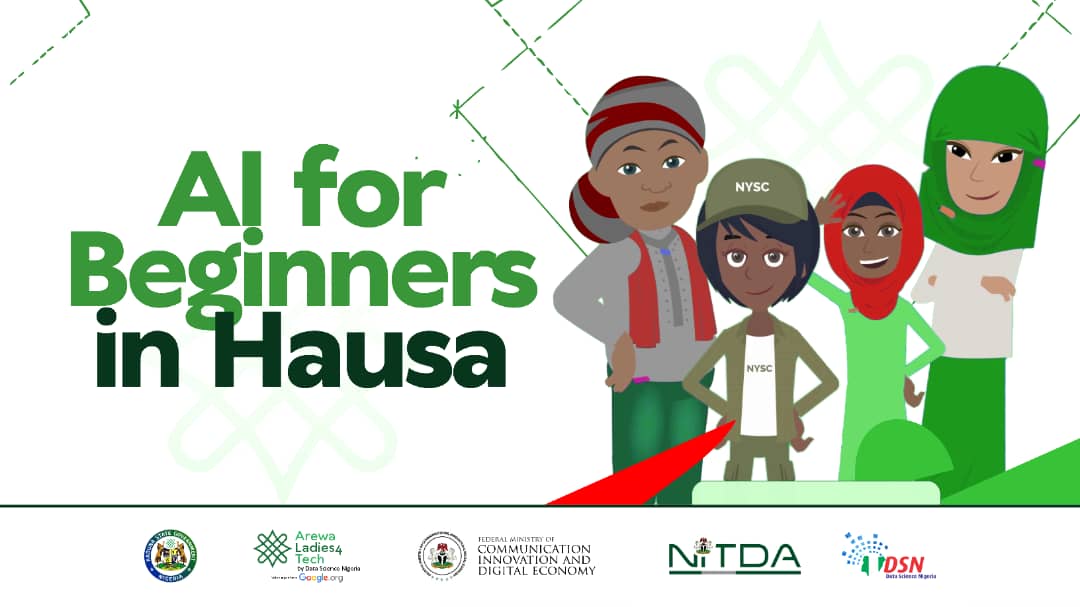
Google Partners Kaduna Govt to Launch Hausa Language AI Learning Series

Published

on

Hausa language AI learning series

By Modupe Gbadeyanka

The first Hausa-language artificial intelligence (AI) learning series has been introduced courtesy of a partnership among Google, Data Science Nigeria and the Kaduna State government.

This Hausa language AI learning series is aimed at empowering women in Northern Nigeria through AI education, and it presents AI concepts in Hausa, making complex technology more accessible and culturally relevant for the region.

The unveiling of this initiative took place at the Umaru Musa Yar’Adua Hall in Kaduna, and a celebration of technology, education, and the immense potential of Northern Nigeria’s women, with the state governor, Mr Uba Sani, in attendance.

The event also featured speeches from representatives of NITDA and the Ministry of Communications, Innovation and Digital Economy, who underscored the national significance of the initiative and the government’s support for fostering a vibrant tech ecosystem.

The AI for Beginners Learning Video Series is now available on YouTube via the Data Science Nigeria platform, on the NITDA education portal, and for download.

To further aid in accessibility, the series has also been deployed on USB drives for distribution and direct peer-to-peer copy at all primary and secondary schools, including public video content-copying centres across Kaduna State.

In Northern Nigeria, various challenges can impact access to tech education and career opportunities. These include diverse socio-cultural dynamics, infrastructural limitations, and language barriers.

The AI for Beginners Learning Video Series, through its engaging animations and culturally relevant imagery, is designed to make complex digital concepts more accessible and relatable, fostering inclusivity and participation in the growing tech sector.

“AI is not just the future; it’s the present,” Governor Sani declared, noting, “By equipping our people, especially our women, with AI skills, we’re not only paving the way for a more prosperous and innovative Northern Nigeria but also laying the foundation for Kaduna to become a thriving tech hub.”

Also speaking at the launch, the Director of Google West Africa, Mr Olumide Balogun, said, “We believe that technology can be a powerful force for change and are committed to making learning resources available in local languages to empower more people.

“This series marks a new milestone in our ongoing efforts to enhance AI knowledge across Northern Nigeria, fostering a broader understanding and application of AI technologies that drive innovation and create new job opportunities.”

On his part, the chief executive of Data Science Nigeria, Mr Bayo Adekanbi, submitted that, “By making AI education accessible in Hausa, we’re opportunities for innovation, entrepreneurship, and social impact.

“These women are the future leaders and innovators of Northern Nigeria, and AI is the tool that can amplify their potential.”


Modupe Gbadeyanka is a fast-rising journalist with Business Post Nigeria. Her passion for journalism is amazing. She is willing to learn more with a view to becoming one of the best pen-pushers in Nigeria. Her role models are the duo of CNN's Richard Quest and Christiane Amanpour.

Click to comment

Leave a Reply

Your email address will not be published. Required fields are marked *

General

Dangote Refinery to Produce Key Detergent Inputs

Published

on

Fifth Crude Cargo Dangote Refinery

By Adedapo Adesanya

African business mogul, Mr Aliko Dangote, plans to expand his refinery by producing key chemicals used in detergents and cleaning products.

Mr Dangote, who is the major stakeholder in the Dangote Petroleum Refinery and Petrochemicals FZE, will use Honeywell International Inc.’s technology to produce 400,000 metric tons a year of linear alkylbenzene (LAB), the US-based industrial conglomerate said in a statement on Monday.

The refinery, which has a capacity to process 650,000 barrels of crude a day, is now targeting another import-dependent Nigerian market and positioning the business as a major player in the global supply chain.

The project will produce Linear Alkyl Benzene (LAB), the chemical used to make the surfactants, the active cleaning agents in soaps and detergents. This is not a consumer detergent, but the raw material that detergent manufacturers rely on.

The plant is expected to be completed within the next 30 months and produce 400,000 tonnes annually, far exceeding Africa’s current capacity.

Mr Dangote had already hinted at the plan during a tour of the refinery with Mr Bayo Ojulari, the Group Chief Executive Officer of the Nigerian National Petroleum Company (NNPC) Limited, in February.

“And that raw material for detergent will be sufficient for the entire African continent. It’s 400,000 tonnes, which we don’t have. The only two are one in Algeria, 100,000 tonnes, and Egypt, 50,000. But we are going 400,000. And we will deliver all this in the next 30 months,” Mr Dangote said at the time.

Africa currently depends heavily on imports of LAB, with only two existing plants on the continent, Algeria (100,000 tonnes) and Egypt (50,000 tonnes).

Dangote’s facility could meet the continent’s entire demand, reduce import dependence, and support local detergent manufacturing.

The LAB project also deepens the conglomerate’s broader petrochemical footprint, complementing its operations in fertiliser, cement, oil refining, agriculture, and industrial manufacturing.

Continue Reading

General

$83m IFC-Backed Funding Boosts Nigeria’s Off-Grid Electricity Drive

Published

on

Off-Grid Electricity

By Adedapo Adesanya

Nigeria has secured $83 million in fresh financing to expand off-grid electricity supply as the country continues to shift towards decentralised power solutions to boost accessibility and alternative solutions.

The funding, backed by the International Finance Corporation (IFC) under the Distributed Access through Renewable Energy Scale-Up programme, is targeted at private developers deploying solar mini-grids and standalone systems in rural and underserved communities.

The agreement was signed during the 2026 Spring Meetings of the World Bank Group and IMF in Washington, marking a transition from small pilot projects to large-scale execution.

This intervention comes at a critical time, when Nigerians are tapping into solar alternatives as petrol prices continue to rise amid current Middle East disruptions.

According to the World Bank, about 85 million Nigerians, roughly 40 per cent of the population, still lack access to electricity. Even among those connected to the grid, supply remains unreliable. National output continues to hover between 4,000 and 5,000 megawatts, a level widely considered inadequate for an economy of Nigeria’s size.

The Head of the Nigeria Electrification Programme, Mr Olufemi Akinyelure, made it clear that the market is evolving beyond experimentation.

“This marks a shift from programme design to execution at scale. Distributed renewable energy in Nigeria is now a bankable market, not a pilot segment,” he said.

The $83 million facility is designed as a revolving debt model, combining concessional and commercial funding to provide long-term capital to developers. This approach reduces risk, improves access to finance, and allows projects to scale across multiple locations without repeated funding bottlenecks.

In practical terms, the first phase will support companies such as Darway Coast, PriVida Power, Prado Power, GVE Projects and StarTimes Smart Energy, while another group of developers is already lined up for the next round. The fund will allow the shortlisted firms to deploy power faster to communities that have waited decades for reliable electricity.

Backed by a $750 million World Bank facility, the initiative aims to reach over 17.5 million Nigerians by 2028 and deliver about 465 megawatts of distributed renewable energy capacity. Current data from the Nigeria Electrification Programme shows that more than 4.1 million people have already benefited, alongside the installation of over 175 mini-grids and 1.1 million solar home systems.

For many rural communities, it will help boost small businesses, healthcare delivery, and education. Traders can extend operating hours, clinics can preserve vaccines, and students can study beyond daylight. In areas where petrol and diesel generators dominate, the shift to solar also cuts fuel costs and reduces exposure to volatile energy prices.

According to the IFC Managing Director, Mr Makhtar Diop, the role of blended finance in unlocking scale helps address long-standing barriers within the energy ecosystem.

Special Adviser to the President on the Economy, Ms Sanyade Okolie, who represented the Minister of Finance and Coordinating Minister of the Economy, Mr Wale Edun, said the federal government sees investment as critical to lifting millions of Nigerians out of poverty.

She added that the focus remains on attracting capital that delivers measurable improvements in living standards.

“For Mr President, the priority is to transform the Nigerian economy in a way that lifts people out of poverty. People must feel the difference,” she said.

On his part, the Minister of Communications, Innovation and Digital Economy, Mr Bosun Tijani, linked the programme to Nigeria’s ambition of building a one trillion-dollar economy, stressing that infrastructure, particularly power and digital systems, will determine how fast that target can be reached.

Continue Reading

General

Terra to Expand Defence Tech Manufacturing Footprint with New Ghana Facility

Published

on

Terra Industries

By Adedapo Adesanya

Nigerian defence technology startup, Terra Industries, is constructing a drone manufacturing facility in Accra, Ghana, as it continues its expansion.

The plant, designated Pax-2, will cover 34,000 square feet and serve as the company’s primary production base for drone and counter-drone systems in the region. The company has a mega-factory of a 15,000-square-foot Pax-1 plant located in Abuja.

The Ghana facility is expected to be operational by the end of June 2026 and will create 120 engineering jobs, running on a continuous production schedule. At full capacity, it is projected to manufacture 50,000 units annually across the company’s aerial systems portfolio.

The company said the expansion is part of a broader plan to scale manufacturing capacity across the continent. The need for security architectures has risen in recent years, as groups such as Islamic State and al-Qaeda are gaining ground in Africa, converging along a swathe of territory that stretches from Mali to Nigeria.

The startup produces long- and mid-range drones, autonomous sentry towers and unmanned ground vehicles to help secure infrastructure assets.

It will be looking at building a range of systems, including the Archer VTOL, a long-range surveillance and strike platform; the Iroko UAV, built for tactical deployment; and Kama, a counter-drone interceptor capable of speeds up to 300 kilometres per hour. The Kama system is designed for high-volume production to meet demand for kinetic drone interception.

Speaking on the latest development, Mr Nathan Nwachuku, co-founder and CEO of Terra Industries, said the only way Africa can have lasting peace is by uniting to build sovereign defence, not by relying on foreign security architecture, which instructed the choice of Ghana for the next phase of its expansion.

“We chose Ghana for Pax-2 because of its talent, strategic position, and political will to become a serious defence exporter,” he said.

In February, Terra extended its funding round to $34 million after securing an additional $22 million from investors, after an initial $11.75 million in January. Among its investors are 8VC, founded by the co-founder of Palantir Technologies Inc., Mr Joe Lonsdale, Lux Capital, with injections from the chief executive officer of Lagos-based unicorn Flutterwave, Mr Gbenga Agboola, as well as angel investors such as American actor Jared Leto and Jordan Nel, among others.

In the same month, the firm and the Defence Industries Corporation of Nigeria (DICON) signed a Memorandum of Understanding (MoU) for the establishment of a joint venture company (JVC) to boost the country’s defence industrial capacity and advance indigenous high-technology development.

Continue Reading

Trending