Connect with us

General

Harnessing Potentials of Youths Towards Achieving Sustainable Peace, Development in Nigeria

Published

on

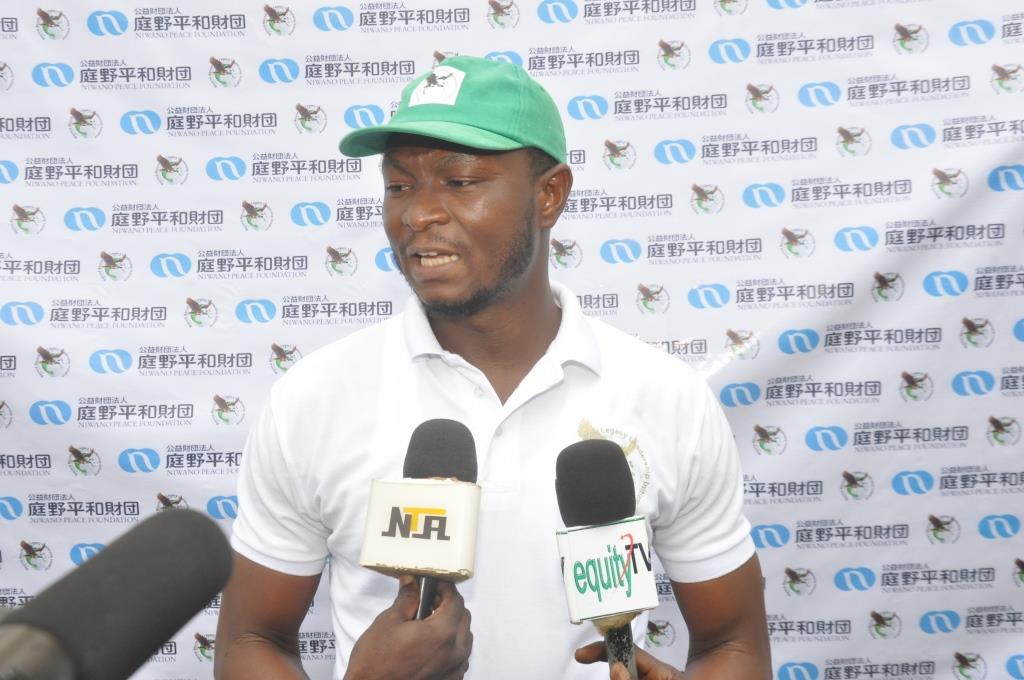
Being text of a speech delivered by the Executive Director of  Beyond Boundaries Legacy Leadership Initiative, Comrade Omaga E. Daniel on the occasion of the Diversity for Peace and Development (DPDP) Ambassadors Recognition on August 12, 2018 in Keffi, Nasarawa State.

Al Protocols Duly Observed.

Ladies and gentlemen of the press, invited guests, BBLLI team members and volunteers, I welcome you to today’s epoch making event!

In the last three years, the BBLLI has in line with its core mandate consistently sought partnerships with relevant organizations be they government, educational, religious, security and even international that share in our belief that mass literacy is an effective tool for fighting and conquering diverse social ills, economic imbalance and social injustice.

Within the same period, our sense of unity as Nigerians came under severe attacks by series of avoidable events which attempted to distort our sense of oneness as a people. Whereas some of these events failed; others recorded a measure of success.

It is clear that every incidence of restiveness in the world over thrives on the tripods of illiteracy, high unemployment ratio and little or no access to civil orientation – the Nigerian scenario is therefore not an exception.

There is however a social school of thought which clearly suggests that for any society to enjoy peace, such a society must build the peace it wants to enjoy. It is in recognition of this statement of fact that the BBLLI with sponsorship from the NIWANO Peace Foundation has promoted peaceful coexistence among Nigerians in Nasarawa state through the Diversity for Peace and Development Project (DPDP) which we commenced in December, 2017.

This synergy was geared towards complementing efforts of the Nigerian government and her agents towards achieving peaceful co-existence among Nigerians irrespective of their ethnic or religious beliefs. On the strength of this partnership, our organization, the Beyond Boundaries Legacy Leadership Initiative successfully trained fifteen (15) youth leaders and community influencers in Nasarawa State on the need for peace as a panacea for economic growth and development. The aim of the training was to equip these youth leaders with sufficient knowledge they require to retrain their subordinates at the grassroots along the same lines using the languages they best understand through the Participatory Infrastructure Development (PAID) programs which was sustained for a period of six months across communities in Nasarawa State.

Today, being the United Nation’s International Youth Day, we are here to celebrate those who have distinguished themselves in the course of executing their projects as Diversity for Peace and Development  Ambassadors.

It is our belief at BBLLI that the current government of the Federal Republic of Nigeria may have invested heavily on national security via purchase of hardware, training and retraining of security personnel, intelligence gathering, knowledge sharing and technology transfer.

We however believe that there is room for more to be done especially as youths. We strongly believe that if the Federal Government and its agents in the security cycle forge more alliances with organizations which enjoy goodwill and have capacity to embark on civil orientation and education of Nigerians, a stronger peace will be achieved.

Pockets of incidences of unrests have been recorded in recent times across the country. Notwithstanding the fact that there are various forms of contradicting information on the media space, there is a common denominator which suggests that the government must reach out to the people of the affected communities, local farmers and cattle breeders because they hold the ace to build and achieve sustainable peace in Nigeria.

We want to use this opportunity to call on all parties to show restraint and work towards achieving lasting peace within already laid down legal frameworks. We equally call on natives and indeed youth of the affected communities to refrain from embarking on any form of reprisal attacks. While commending security agents for their intervention so far, we urge them to be prepared and willing to do more because no price is too high to be paid for the peace and stability of Nigeria.

2018 is a significant year for Nigeria in view of the forthcoming general elections in 2019. This is therefore the best time to take the message of peace and national unity to Nigerians at their various door steps. We at the BBLLI are ready, available and will build alliances with individuals, groups, agencies, communities and organizations that share these ideals. The youth are our core assets as a people. They hold the ace for the future. All hands must therefore be on deck to ensure they are heard.

We thank our DPDP Ambassadors for agreeing to avail themselves as agents of peace and we encourage them to further imbibe the various attributes expected of them as genuine advocates of peaceful coexistence along religious and tribal lines in Nasarawa State.

We express our deepest appreciation to the NIWANO PEACE FOUNDATION for their support and the Emir of Keffi, HRH Alh. Dr. Shehu Chindo Yamusa III for his fatherly role. To the various religious bodies, government agencies, media partners, consultants, facilitators, BBLLI team members, volunteers and community groups which have partnered with us in the course of this project, we say THANK YOU!

Long Live BBLLI!

Long Live NIWANO PEACE FOUNDATION!!

Long Live NASARAWA STATE!!!

Long Live NIGERIA!!!!

Dipo Olowookere is a journalist based in Nigeria that has passion for reporting business news stories. At his leisure time, he watches football and supports 3SC of Ibadan. Mr Olowookere can be reached via [email protected]

Click to comment

Leave a Reply

Your email address will not be published. Required fields are marked *

General

AFC Mobilises $2bn From Global Lenders for African Infrastructure Projects

Published

on

African Infrastructure Projects

By Adedapo Adesanya

The Africa Finance Corporation (AFC) has raised $2 billion via a syndicated loan, with considerable participation from Asian and European banks seeking to capitalise on growing demand for infrastructure projects across the continent.

Barclays Bank, Commerzbank, First Abu Dhabi Bank PJSC, and FirstRand Bank led the debt facility. Other participating lenders include Export-Import Bank of India, Bank of Communications, Industrial and Commercial Bank of China, and Industrial Bank of Korea, among others.

Each region accounted for about 35 per cent of the creditors, according to a statement by AFC.

AFC chief executive, Mr Samaila Zubairu, said the money would enable more master planning around infrastructure and industrial planning for economies, regions and economic corridors across the continent.

According to Mr Zubairu, the lender is also in discussions to invest in a proposed oil refinery to be built by billionaire Aliko Dangote in East Africa.

The financer initially sought $1.6 billion via the facility but scaled it up to $2 billion amid strong demand from Asian financial institutions.

“In this round, we saw a lot more of Asian banks. We have banks from China, Hong Kong, and Korea. They are a lot more engaged,” he said.

Mr Zubairu said the loan underscored AFC’s strong track record, pointing to its financing for projects including Nigeria’s 650,000 barrels per day Dangote oil refinery and Africa’s largest copper smelter in the Democratic Republic of Congo.

“There’s a lot more confidence, a lot more partners,” Mr Zubairu said of those participating in the loan. “We are constantly demonstrating that Africa is executing. Africa is building.”

“The capital that we raise goes into African infrastructure build out, African industrialisation build up – essentially creating jobs for Africans,” Mr Zubairu said.

The AFC chief said the lender is also working to reform capital rules and create structures that will allow more African money to stay on the continent and be invested in crucial infrastructure projects.

AFC, founded in 2007, has assets surpassing $19 billion and counts 48 African countries as members.

In January, the infrastructure-focused multilateral lender secured an A rating from S&P. It has an A3 rating from Moody’s, an AAAspc rating from S&P Ratings (China) and an A+ rating from the Japan Credit Rating Agency.

Continue Reading

General

NERC Orders DisCos to Pay 20% Compensation to Affected Band A Customers

Published

on

Prepaid Meters DisCos

By Adedapo Adesanya

The Nigerian Electricity Regulatory Commission (NERC) has ordered electricity distribution companies (DisCos) to pay 20 per cent compensation to eligible Band A customers who were affected by power shortfalls between February and March 2026.

In Directive No. NERC/2026/002, the commission said, generation constraints, which were largely caused by inadequate gas supply and vandalism of gas and transmission infrastructure, prevented DisCos from meeting committed service levels for some Band A feeders.

NERC Mandated that for feeders that supplied less than 18 hours per day, affected Band A feeders will not be downgraded during the covered period, and eligible customers will receive special compensation equal to 20 per cent of approved energy figures for February 2026.

However, for Band A feeders that recorded an average daily supply of between 18 and 20 hours, the existing compensation framework under Addendum No. NERC/2024/003 applies to both Maximum Demand (MD) and Non-Maximum Demand (Non-MD) customers.

MD customers are high-consumption users who typically have their own dedicated transformer and operate with a load of 45 kVA and above; they include large residential estates, banks, hotels, supermarkets, industrial facilities and oil and gas complexes.

Non-MD customers do not have a dedicated transformer and instead share public transformers, and they generally consume less, often below 45–50 kVA.

For Non-MD customers, compensation is set at 20 per cent of the approved February 2026 energy cap applicable to the affected feeder.

For MD customers, compensation is 20 per cent of the average energy billed per MD customer in February 2026.

According to NERC, prepaid customers will receive their compensation as token credits, while postpaid customers will receive bill adjustments.

The commission said that compensation for February must be completed by 31 May 2026, while compensation for March must be completed by 30 June 2026.

The commission prohibited Distribution companies from using compensation credits to offset any existing customer debt, adding that customers must be clearly informed of the value and period of the compensation they receive.

NERC said it will monitor implementation and verify compliance to ensure all eligible customers receive what they are due.

The commission reaffirmed its commitment to protecting electricity consumers while ensuring the stability and sustainability of the electricity market.

Continue Reading

General

TCN Confirms Destruction of Six Transmission Towers in Nasarawa

Published

on

Transmission Towers

By Adedapo Adesanya

The Transmission Company of Nigeria (TCN) has confirmed the destruction of six transmission towers along the Apir–Lafia 330kV line in Nasarawa State, causing significant disruption to electricity supply in parts of the country.

In a statement issued on Wednesday, TCN spokesperson, Mrs Ndidi Mbah, said the incident occurred on May 30 at about 1:15 a.m. during a heavy downpour.

She explained that the transmission line initially tripped, prompting operators to attempt a trial reclosure of Line II at about 2:08 a.m., but the effort failed.

A subsequent inspection of the transmission corridor, however, revealed extensive damage to key components of towers T125 to T130, confirming that the infrastructure had been vandalised.

“The tripping of the lines prompted a physical line trace to determine the fault, which revealed damage to critical components of towers T125 to T130, confirming vandalism on the affected sections of the transmission corridor,” Mbah said.

The incident has forced both Apir–Lafia 330kV Transmission Lines I and II out of service pending the reconstruction of the damaged towers.

TCN said its engineers have been deployed to the site to assess the extent of the damage and determine the materials required to restore normal transmission along the corridor.

As an interim measure, the Lafia 330kV Transmission Station is being supplied through an alternative line to minimise the impact on electricity consumers within the franchise areas of Abuja Electricity Distribution Company (AEDC) and Jos Electricity Distribution Company (JEDC).

The company condemned the persistent vandalism of power infrastructure, warning that such acts undermine investments in the electricity sector and threaten the stability of the national grid.

It also urged residents and host communities to remain vigilant and report suspicious activities around transmission installations to security agencies or the nearest TCN office.

TCN stressed that safeguarding critical national infrastructure requires collective responsibility to ensure a reliable and uninterrupted electricity supply nationwide.

Continue Reading

Trending