Connect with us

General

Heritage Bank Celebrates International Men’s Day

Published

on

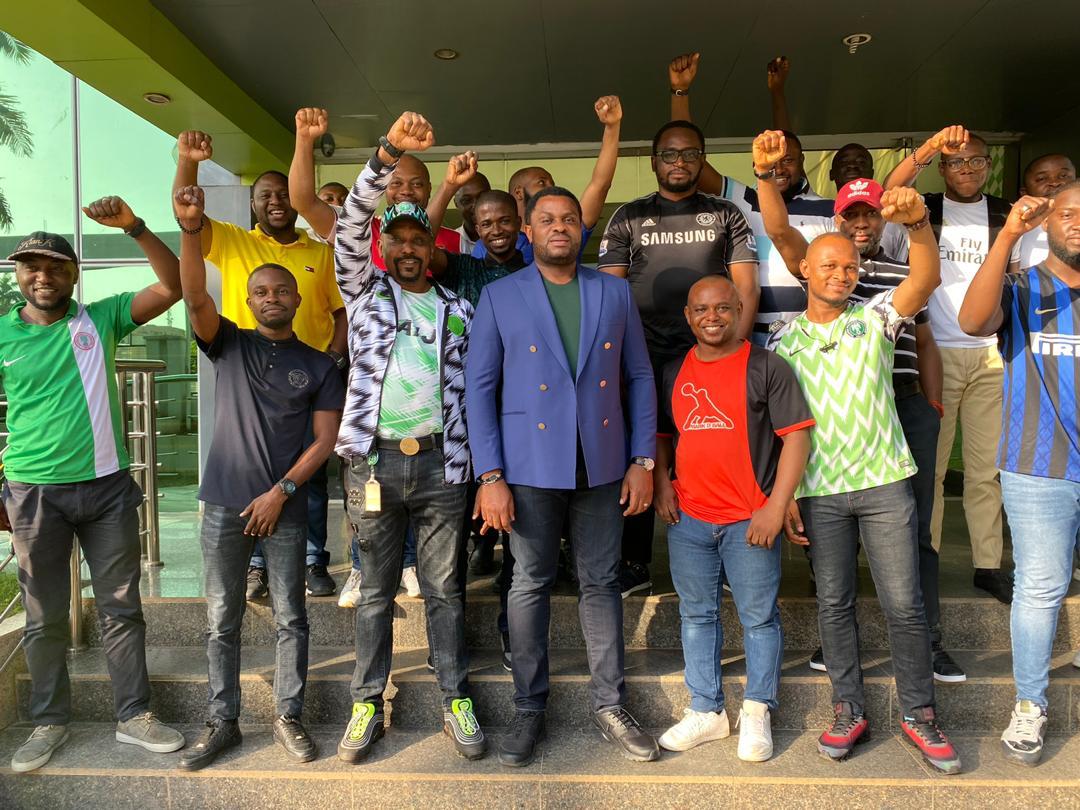
Heritage Bank International Men’s Day

Heritage Bank Plc, Nigeria’s Most Innovative Banking Service Provider, celebrated International Men’s Day 2019 themed Making a difference for Men and Boys, with event held at every Experience Centres- ECs (branches) of the bank across the country.

The financial institution leveraged on this theme and coined a personal theme, which is “Break the Ice; Inspire another Man”.

To help chart a path that will champion gender parity in grand style, the male staff had engaging activities which include a men’s bonding/mentorship session with various appealing subject of discussions in the ECs, where the senior colleagues initiated the talks alongside other male staff contributed freely to break into the parity ice; pry into how to excel in their homes, career, mental health, politics, family, education, sports and other endeavours of life. Also, as part of the activities are a themed dressing for the men (Club Jerseys or Polo Shirts on Jeans or Beige Chinos) and a celebration of the men by their female colleagues.

Commemorating the International Men’s Day celebrated annually in various countries around the world, the MD/CEO of Heritage Bank Plc, Ifie Sekibo emphasized that its serves as an opportunity to highlight the issues affecting the male gender and to also appreciate the men around us.

“At the core of our services, we recognise the need for gender equality. As we know that International Women’s Day is observed on 8 March globally. In the same way, there is a day for Men’s on 19th Novembers, which is also observed worldwide. This day highlight the positive difference that men bring to the world, communities and to their families. It also raises awareness about men’s well-being and issues that men face on a global scale,” he explained.

Addressing the Management and staff of the institution, Sekibo who recognised the immense contributions of the male counterparts, noted, “we are proud to affirm that having you men in different capacities working to imbed a difference in this organization have proved you worthy to be celebrated.

“Strong yet supportive, tough yet so kind…You sacrifice all your life for the family to bring a smile on their faces…You toil in the office just to support your colleagues and the organization.”

He, however, assured the staff, “we also understand that having a family and a career can be a balancing act and strive to support all our staff to ensure that each person is able to reach their full career potential while maintaining a good work-life balance. Maintaining a fulfilled workforce is important to us, whilst we conversely ensure that all our clients have the best possible experience.

“So, here’s a special thank you to all our male brilliant staff who are helping to create a more gender-inclusive world.”

Heritage bank did not fail to celebrate its loyal male customers with the bank helmsman, Sekibo via deploying special messages acknowledged their positive contributions to society, community, family, marriage, childcare and to the environment.


Modupe Gbadeyanka is a fast-rising journalist with Business Post Nigeria. Her passion for journalism is amazing. She is willing to learn more with a view to becoming one of the best pen-pushers in Nigeria. Her role models are the duo of CNN's Richard Quest and Christiane Amanpour.

Click to comment

Leave a Reply

Your email address will not be published. Required fields are marked *

General

Lokpobori to Highlight Nigeria’s Oil, Gas Investment Gains at AEW 2026

Published

on

Heineken Lokpobiri oil fields dispute

By Adedapo Adesanya

The Minister of State for Petroleum Resources (Oil), Mr Heineken Lokpobiri, is expected to outline Nigeria’s accelerating upstream transformation and its expanding role as one of Africa’s leading oil and gas investment destinations at the African Energy Week (AEW) 2026, scheduled to hold October 12-16 in Cape Town, South Africa.

Nigeria’s energy sector has recorded one of its strongest investment cycles in a decade, driven by regulatory reforms under the Petroleum Industry Act (PIA), improved fiscal incentives and renewed confidence from international oil companies (IOCs) and indigenous operators.

In 2025 alone, Nigeria approved 28 new Field Development Plans valued at $18.2 billion, unlocking an estimated 1.4 billion barrels of crude oil reserves, according to government disclosures. These approvals mark a decisive shift toward accelerating project execution timelines and reversing years of stalled upstream development.

Mr Lokpobiri has consistently credited this momentum to reforms under the PIA, alongside faster licensing processes and investment-friendly fiscal adjustments.

Speaking in Abuja earlier this year, he noted that Nigeria secured four of seven major Final Investment Decisions (FIDs) in Africa between 2024 and 2025, positioning the country as a leading upstream investment hub on the continent.

A central pillar of this resurgence is Shell’s Bonga deepwater complex, where the company has taken a $5 billion final investment decision on the Bonga North project, a subsea tie-back expected to add over 300 million barrels of recoverable resources and significantly boost long-term output from the FPSO hub. The development is widely viewed as a benchmark for Nigeria’s renewed deepwater competitiveness.

Meanwhile, ExxonMobil’s planned investment in the Usan deepwater oil field is expected to inject up to $1.5 billion between 2025 and 2027, supporting production revitalisation through new drilling and infrastructure upgrades.

Alongside IOC-led expansion, Nigeria’s indigenous producers are increasingly central to near-term output growth, with Heirs Energies targeting up to 100,000 barrels per day as it ramps up development across its onshore Niger Delta portfolio, including OML 17.

According to a statement from the African Energy Chamber (AEC), this momentum is complemented by Seplat Energy’s optimisation of its expanded onshore portfolio following the ExxonMobil acquisition, reinforcing the growing role of local operators in stabilising production and driving Nigeria’s short-term output gains.

Mr Lokpobiri is also expected to highlight Nigeria’s broader energy transition framework at AEW 2026, which seeks to balance oil production growth with gas monetisation, domestic refining expansion and increased local content participation. His policy messaging has consistently emphasised that Nigeria’s oil and gas sector is structured to accommodate both IOCs and a growing base of indigenous operators.

“Nigeria is once again proving what is possible when policy meets execution,” said NJ Ayuk, Executive Chairman of the African Energy Chamber. “Under leaders like Heineken Lokpobiri, we are seeing renewed seriousness about production, investment and getting projects across the line – from deepwater developments to indigenous-led growth. This is exactly the kind of momentum Africa needs: not promises, but barrels, projects, and bankable deals.”

Continue Reading

General

Atiku Abubakar Secures ADC Ticket for Seventh Presidential Bid

Published

on

Atiku Abubakar press conference

By Adedapo Adesanya

Former Vice President, Mr Atiku Abubakar, has won the presidential ticket of the African Democratic Congress (ADC), setting up his seventh presidential run for the 2027 general elections.

He defeated former Minister of Transportation, Mr Rotimi Amaechi, and businessman, Mr Mohammed Hayatu-Deen, in the party’s primary election held on Monday.

The returning officer, Mr Tunde Ogbeha, declared Mr Abubakar as the winner after the final collation of the results from the 36 states and the Federal Capital Territory (FCT).

He said Mr Abubakar emerged after polling 1,846,370 votes to defeat Mr Amaechi, who came second with 504,117 votes, and Mr Hayatu-Deen, who secured 177,120 votes.

The primary election was conducted through direct voting across the country. The collation began on Tuesday and continued on Wednesday at the Transcorp Hilton in Abuja.

Mr Amaechi and Mr Hayatu-Ddeen rejected the process on Tuesday, alleging widespread irregularities before the final collation of results began.

Mr Amaechi described the results as “concocted,” alleging massive voter disenfranchisement and manipulation during the exercise. Mr Hayatu-Deen also accused party officials of rigging and compromising the credibility of the process.

Despite the protests, the ADC proceeded with the collation and declaration of results in Abuja, formally returning Atiku as the party’s presidential candidate for the 2027 general election.

The victory marks another presidential bid for the former vice president, who previously contested under the platform of the Peoples Democratic Party in the 2019 and 2023 elections.

Mr Abubakar dominated the contest across many northern states, recording landslide victories in Adamawa, Kano, Gombe, Bauchi, Kaduna, Borno, Sokoto, Kebbi, and Zamfara.

In Adamawa State, his home state, he polled 177,141 votes against Mr Amaechi’s 1,896 votes and Mr Hayatu-Deen’s 18,949 votes. He also secured 155,595 votes in Kano, 136,933 in Gombe, 115,410 in Bauchi, and 108,784 in Kaduna.

Mr Amaechi, however, performed strongly in parts of the South-south, winning Rivers, Bayelsa, Delta, Akwa Ibom, and Ebonyi states.

In Rivers State, the former Rivers governor recorded one of the biggest margins of the election, polling 115,650 votes against Atiku’s 912 votes. He also defeated the former vice president in Bayelsa with 21,404 votes to 1,470 and in Delta with 35,325 votes to 10,023.

Mr Hayatu-Deen failed to win any state but posted notable numbers in Borno, Benue, Adamawa, Katsina, and Niger states.

With Mr Abubakar’s emergence, this will be his seventh opportunity to win the coveted presidency after running in 1993 under the Social Democratic Party (SDP) presidential primaries, 2007 as the Action Congress (AC) presidential candidate, and 2011 under the Peoples Democratic Party (PDP).

In 2015, he contested the All Progressives Congress (APC) presidential primaries, losing to the late eventual winner Muhammadu Buhari, and then returned as the PDP presidential candidate in 2019 and 2023.

Continue Reading

General

CBN Reveals Loans to FG Surge 65.6% Amid 2026 Budget Financing Needs

Published

on

Nigerian government

By Adedapo Adesanya

The Central Bank of Nigeria (CBN) has revealed that credit extended to the government rose by 65.6 per cent year-on-year to N39.6 trillion in April 2026 from N23.9 trillion in April 2025, driven by increased borrowing to finance the 2026 budget deficit.

In its latest Money and Credit Statistics, the apex bank showed that the federal government increased borrowing from domestic investors by 7.4 per cent to N8.1 trillion in the first quarter of 2026 from N7.5 trillion in the same period of 2025.

The CBN data also showed that credit to the private sector rose by 3.25 per cent to N80.6 trillion in April 2026 from N78.06 trillion in April 2025.

Consequently, net domestic credit rose by 17.8 per cent to N120.2 trillion in April 2026 from N102 trillion in the corresponding period last year.

Following the same trend, Nigeria’s broad money supply (M2) increased by 4.8 per cent YoY to N124.98 trillion in April 2026 from N119.2 trillion recorded in April 2025, reflecting improved liquidity in the financial system.

Further breakdown of the money supply components showed that currency outside banks declined by 12.2 per cent to N5.08 trillion in April 2026 from N5.7 trillion in the corresponding period of 2025, indicating increased use of banking channels and electronic payment systems.

However, demand deposits (current accounts) increased by 6.3 per cent to N38.7 trillion from N36.4 trillion during the review period.

Also, quasi-money increased by 3.8 per cent to N81.2 trillion in April 2026 from N78.2 trillion in April 2025. Quasi money includes money in savings accounts, time deposits, treasury bills and other money market instruments.

Narrow money, which includes currency in circulation and current accounts, also grew by 7.09 per cent to N43.8 trillion from N40.9 trillion.

This comes as the federal government plans to borrow N29.2 trillion to fund the gap between the revenue of N68.32 trillion and expenditure of N36.87 trillion, according to the Appropriation Act 2026.

Continue Reading

Trending