General
I Don’t Own Fidelity Bank—Peter Obi
By Aduragbemi Omiyale
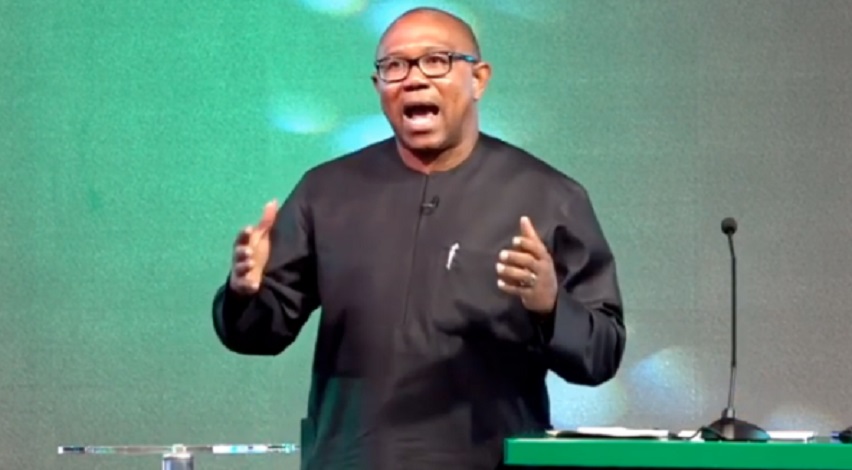
The presidential candidate of the Labour Party in the 2023 general elections, Mr Peter Obi, has denied owning Fidelity Bank Plc, saying he only became the Chairman of the lender like the others.
Mr Obi was reacting to reports that he was in Rome recently for the installation of Pope Leo XIV in the Vatican over the weekend to plead with President Bola Tinubu over a purported N225 billion Supreme Court judgement involving the bank.
In a statement posted on his X (formerly known as Twitter) on Thursday morning, the former Governor of Anambra State disclosed that he was in Italy for the event as a member of the Catholic Church.
“It’s obvious that the biggest business for blackmailers now is talking about Peter Obi from every negative perspective. Even my solemn spiritual trip to Rome has been twisted into yet another blackmail campaign by merchants paid ostensibly to propagate anything negative against Obi.
“One such individual, whose entire life revolves around blackmail, falsely claimed that I went to Rome to have a private meeting with President Bola Ahmed Tinubu regarding a purported N225 billion debt crisis involving Fidelity Bank. These claims are not only baseless, malicious, but entirely false.
“Let me categorically state that I have never sought an audience with, nor met, President Tinubu since he assumed office, except about 1 minute meeting at the arena of Saint Peter’s Basilica Rome during the inauguration Mass of Pope Leo XIV, where I was seated behind, and had to respectfully greet him, and other dignitaries present.
“I was previously in Rome on the 9th of May for the lying in state of Pope Francis. Immediately after the mass and exchanging pleasantries, I went straight from Vatican City to London, and then back to Nigeria.
“The self-proclaimed blackmailer-in-chief and others who thrive on spreading pain and falsehoods have also claimed that I own Fidelity Bank. For the record, I do not. Throughout my career, I have served as Chairman/Director of 3 banks/Financial institutions, of which Fidelity is one of them. Fidelity has over 500,000 shareholders, none of whom hold a majority stake. What this blackmailer seeks is to harm these hard-working Nigerians and cause them needless distress.
“To those peddling these falsehoods, and engaging in blackmail, I offer a simple prayer: May God grant you the virtues of gratitude and understanding to know that we came here with nothing and will go with nothing, that they cannot profit from their evil ways,” he wrote.
General
Nigerian Army Arrests 18 Illegal Miners, Recovers N2.47m in Niger State
By Adedapo Adesanya
The Nigerian Army has arrested 18 suspected illegal miners at a mining site in Izom, Gurara Local Government Area of Niger State, recovering equipment and N2.47 million in cash from the operation.
The suspects were arrested by troops of the 102 Guard Battalion during a routine operation in the area, where the soldiers reportedly discovered unauthorised mining activities.
Following the arrests, the army handed over the suspects and recovered items to the headquarters of the Nigerian Security and Civil Defence Corps Mining Marshals in Sauka, Abuja, in line with established inter-agency procedures.
The operation is part of intensified efforts by security and regulatory agencies to curb illegal mining, which has been linked to revenue losses, environmental degradation and the unlawful exploitation of Nigeria’s mineral resources.
Reacting to the development, the Commander of the NSCDC Mining Marshals, Assistant Commandant of Corps John Onoja Attah, commended the Nigerian Army for what he described as a strong demonstration of professionalism and commitment to protecting the country’s mineral wealth.
“The Nigerian Army has once again distinguished itself through professionalism, discipline and patriotism. The swift arrest of the suspects and their prompt handover to the Mining Marshals reflect a commendable commitment to the rule of law and the protection of Nigeria’s solid mineral resources,” he said.
Preliminary investigations by the Mining Marshals indicated that the suspects allegedly operated without licences, permits or any affiliation with a registered mining company. Investigators also said they could not produce evidence of valid mineral titles or authorisation from the relevant regulatory authorities.
Items recovered from the mining site included motorcycles, pumping machines, crusher engines, communication devices and cash totalling N2,468,750.
Mr Attah said the Mining Marshals would continue to pursue individuals involved in illegal mining and strengthen intelligence-led operations against activities that undermine the formal mining industry and deprive government of legitimate revenue.
He added that the Corps, under its Commandant-General, Mr Ahmed Audi, remained committed to enforcing the provisions of the Nigerian Minerals and Mining Act and protecting Nigeria’s mineral resources from unlawful exploitation.
The Mining Marshals said the investigation had been concluded and that the 18 suspects were being processed for prosecution under the relevant provisions of the Nigerian Minerals and Mining Act, 2007.
General
NAPTIP Seals Port Harcourt Maternity Facility Over N13.5m Baby Sale
By Adedapo Adesanya
The National Agency for the Prohibition of Trafficking in Persons (NAPTIP) has sealed a suspected illegal maternity facility in Port Harcourt, Rivers State, and arrested three people over an alleged N13.5 million baby sale involving a Liberian national residing in Belgium.
The agency said the suspects included the owner of the facility, an alleged facilitator of the baby sale and a member of staff.
According to a statement issued on Thursday by NAPTIP’s Head of Press and Public Relations Unit, Mr Vincent Adekoye, the facility, located in the Elelenwo area of Port Harcourt, was allegedly operating from a residential apartment.
The operation was carried out jointly by NAPTIP operatives from Abuja and Rivers State, in collaboration with officials of the Rivers State Ministry of Health, following intelligence about a suspected child-trafficking syndicate involved in the procurement, sale and unlawful transfer of children.
NAPTIP said preliminary investigations indicated that the Liberian national arrived in Nigeria without evidence of pregnancy but allegedly took custody of three children within about one month.
The agency said intelligence available to it suggested that approximately ₦13.5 million changed hands in connection with the transfer of the three children.
Investigators are now working to establish the identities, whereabouts and welfare of the children, as well as determine their biological and legal parentage.
The investigation will also trace the financial transactions linked to the alleged transfers and establish the roles played by medical personnel and other individuals who may have facilitated the suspected criminal activity.
NAPTIP said the facility was sealed to preserve potential evidence while investigations continue.
The agency said the operation formed part of its nationwide crackdown on fraudulent maternity and healthcare facilities allegedly operating as so-called baby factories.
NAPTIP Director-General, Mrs Binta Bello, expressed concern over the alleged activities of some maternity and health facilities, particularly their suspected involvement in illegal adoption, child sales and trafficking.
She said, “I am particularly disturbed that foreign nationals now come to Nigeria to patronise these suspected criminal elements and procure children like a common object of trade across the border. This is sad and totally unacceptable.
“We have spread our dragnet to fish out all those involved in this case, and they shall be made to face the full wrath of the law,” she said.
She further said the investigation remained active and that anyone found culpable would be prosecuted in accordance with the law.
“I wish to reaffirm that the matter remains under active investigation and that all persons found connected to it will be subjected to due process under the law. The Agency will ensure that anyone found culpable is brought to justice, while the safety and welfare of the affected children remain its foremost priority,” she added.
The NAPTIP chief urged members of the public to remain vigilant and report suspected cases of child trafficking, illegal adoption, baby-selling and other forms of exploitation to the agency through its nearest zonal or state command.
NAPTIP said the latest operation followed an earlier directive by Bello to intensify surveillance of suspected maternity facilities across the country after intelligence suggested that some had become centres for fertility scams, child sales and trafficking.
General
Afreximbank Now Africa’s Largest Oil, Gas Financier—Wale Tinubu
By Adedapo Adesanya
The chief executive of Oando Plc, Mr Wale Tinubu, says the African Export-Import Bank (Afreximbank) is now the largest financier of oil and gas projects on the African continent.
Mr Tinubu said the bank has committed over $25 billion in Africa’s oil and gas sector while speaking at the Royal African Society’s conference in London on the next 125 years of mining, oil and gas in Africa, according to a social media post on Wednesday.
“Afreximbank is now the largest financier of oil and gas on this continent, with more than twenty-five billion dollars committed,” he wrote on X.
Mr Tinubu said 20 years ago, when Oando wanted to list on the Johannesburg Stock Exchange, “we were told what would be required of us”.
He said the company was directed to adopt International Financial Reporting Standards (IFRS), while the board was also asked to appoint independent directors who could tell the founder “no”.
“Get on a plane and explain ourselves, quarter after quarter, to people who had never set foot in Lagos. It was uncomfortable. It was also the most valuable thing we ever did to ourselves,” he said.
“I returned to that experience in London at the Royal African Society’s (@royafrisoc) discussion on the next 125 years of mining, oil and gas in Africa, where I was asked what African companies need in order to scale.
“The answer begins at home. Much of African enterprise started out fractured; family-held, informally governed, structurally invisible to anyone underwriting a twenty-year risk. Global capital hesitates over what it cannot examine.”
The Oando CEO said governance is more than a compliance exercise, describing it as an instrument that makes a company legible to the world.
“The second half of the answer sits with the world. When European lenders withdrew from African hydrocarbons in pursuit of their own net zero commitments, they did not end demand for African energy,” he said.
“They ended their participation in it. African institutions stepped into that space.”
Mr Tinubu said African firms have done the harder work “of making ourselves investable”, noting that what does not get financed does not get built, and “there is still much to build in Africa for those willing to build it with African companies”.
In Nigeria, the bank has been a major financier of the 650,000 barrels-per-day Dangote Petroleum Refinery, including a $1.35 billion facility in 2025 to refinance construction costs and a further $2.5 billion underwriting commitment in 2026.
The bank has also supported the development of the 200,000 barrels-per-day Lobito Refinery in Angola, the 60,000 barrels-per-day Cabinda Refinery, and the refurbishment of Nigeria’s 210,000 barrels-per-day Port Harcourt Refinery. It has additionally approved financing for the BUA and Azikel refineries in Nigeria and supported Société Ivoirienne de Raffinage in Côte d’Ivoire.
Beyond refining, Afreximbank committed up to $400 million in guarantees and direct lending to Mozambique’s Area 1 LNG project, one of Africa’s largest LNG developments, to support the extraction, processing and liquefaction of offshore gas.
In Angola, the bank helped arrange a $1.75 billion syndicated facility for Sonangol to support the national oil company’s operating and capital expenditure requirements. It has also been mandated to advise on raising capital for Equatorial Guinea’s $4.5 billion EG-27 LNG project, which is expected to produce about 2.4 million tonnes of LNG annually. In the Democratic Republic of Congo, the lender is supporting preparations for a 200MW reservoir-based hydropower project along the Lufira River, designed to provide electricity to mining operations.


Pingback: Peter Obi's Business Empire: How Nigeria's Leading Entrepreneur Builds Wealth and Legacy - AClasses Media