General
Ikeja Electric Explains How to Get Prepaid Metres via MAP
By Modupe Gbadeyanka
As part of efforts to close the metering gap in the country, the federal government, through the Nigerian Electricity Regulatory Commission (NERC), came up with the Meter Asset Providers (MAPs).
This platform gives third-party companies licenced by the government to provide metres to customers of electricity in the country, and the scheme has since commenced on May 1, 2019.
One of the leading electricity distribution firms, Ikeja Electric, embraced the MAPs so as to serve its customers better and more efficiently.
The company, in its efforts to make the process of obtaining a prepaid metre hassle-free for its customers, has explained in simple terms how to go about it.
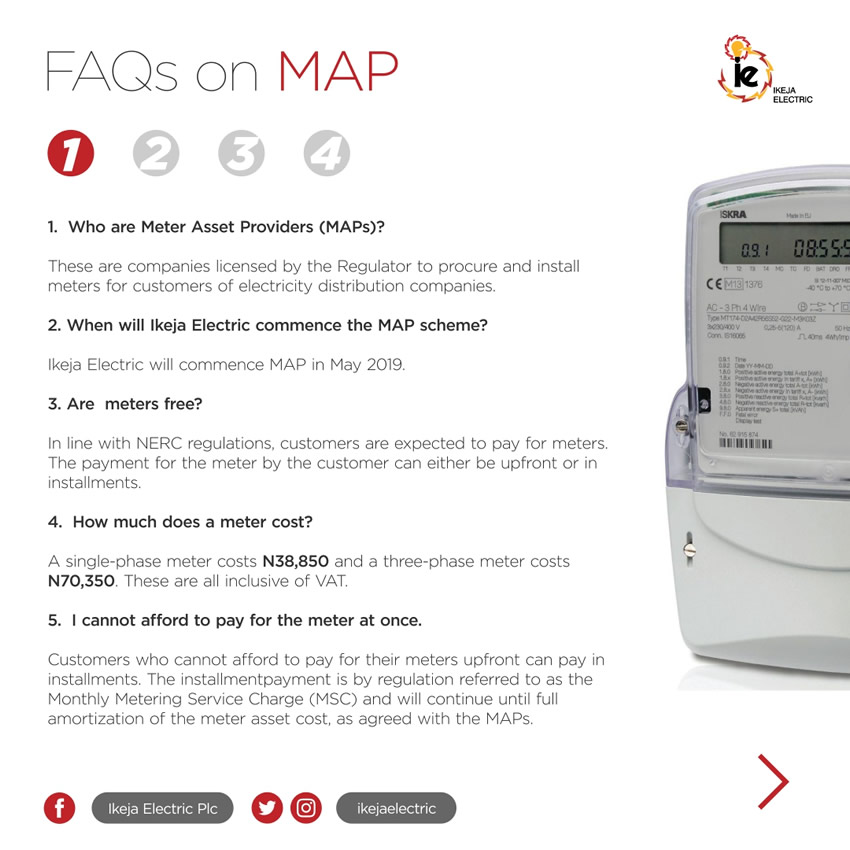
In its Frequently Ask Questions (FAQs) sector of its website, Ikeja Electric said, “In line with NERC regulations, customers are expected to pay for meters. The payment for the meter by the customer can either be upfront or in instalments.”
It further noted that a single-phase prepaid metre costs N38,850 and a three-phase meter costs N70,350. These are all inclusive of VAT.”
Ikeja Electric explained that, “Customers who cannot afford to pay for their meters upfront can pay in instalments. The instalment payment is by regulation referred to as the Monthly Metering Service Charge (MSC) and will continue until full amortization of the meter asset cost, as agreed with the MAPs.”
It stated that, “A meter is for one customer account only. However, customers with more than one account can have multiple meters.
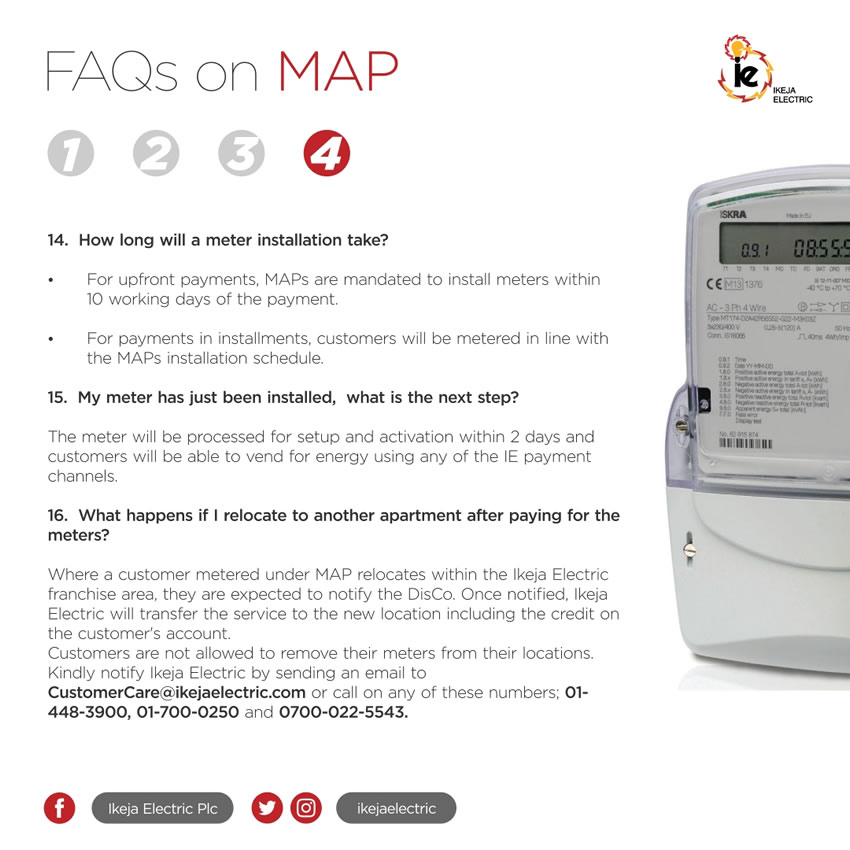
Ikeja Electric also said for customers who made upfront payments for acquiring the metres, the meters will be provided and installed within 10 working days of the payment, and for payments in instalments, customers will be metered in line with the MAPs installation schedule.
It further said after installation, the meter would be processed for setup and activation within two days, and customers will be able to vend for energy using any of the IE payment channels.
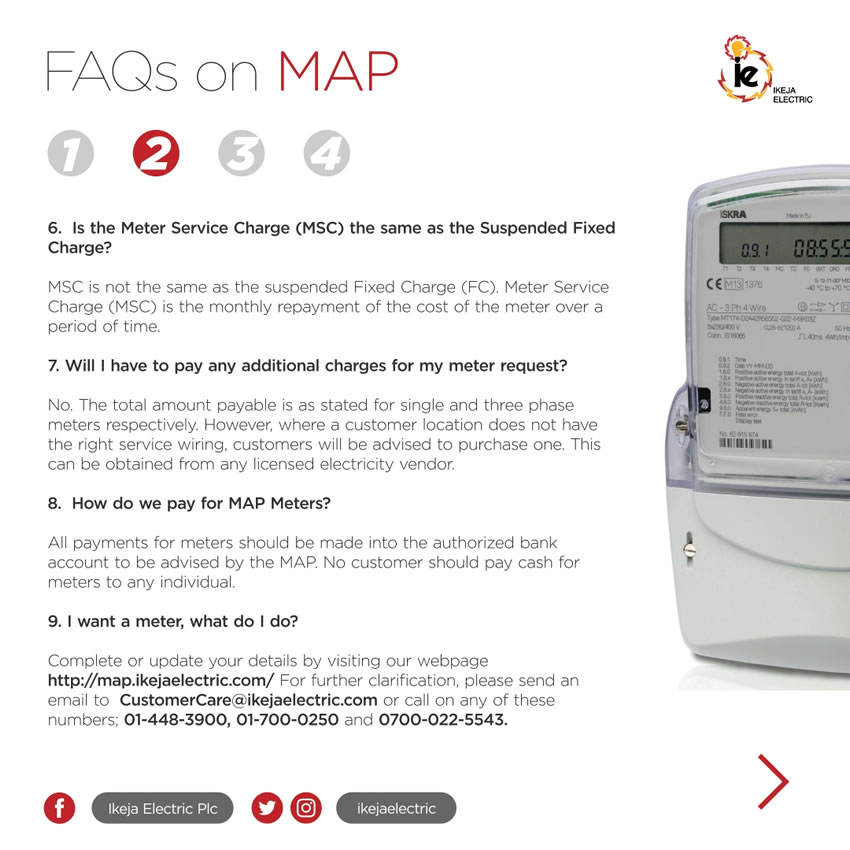
On if customers will have to pay any additional charges for meter requests, Ikeja Electric simply said, “No. The total amount payable is as stated for single and three-phase meters, respectively. However, where a customer location does not have the right service wiring, customers will be advised to purchase one. This can be obtained from any licensed electricity vendor.”
On how customers can pay for the MAP Meters, the firm said, “All payments for meters should be made into the authorised bank account to be advised by the MAP. No customer should pay cash for meters to any individual.”
Commenting on how to obtain the prepaid metres, Ikeja Electric advised customers to complete or update their details by visiting http://map.ikejaelectric.com/. It also said customers could send an email to [email protected] or call on any of 01-448-3900, 01-700-0250 and 0700-022-5543 for further information.
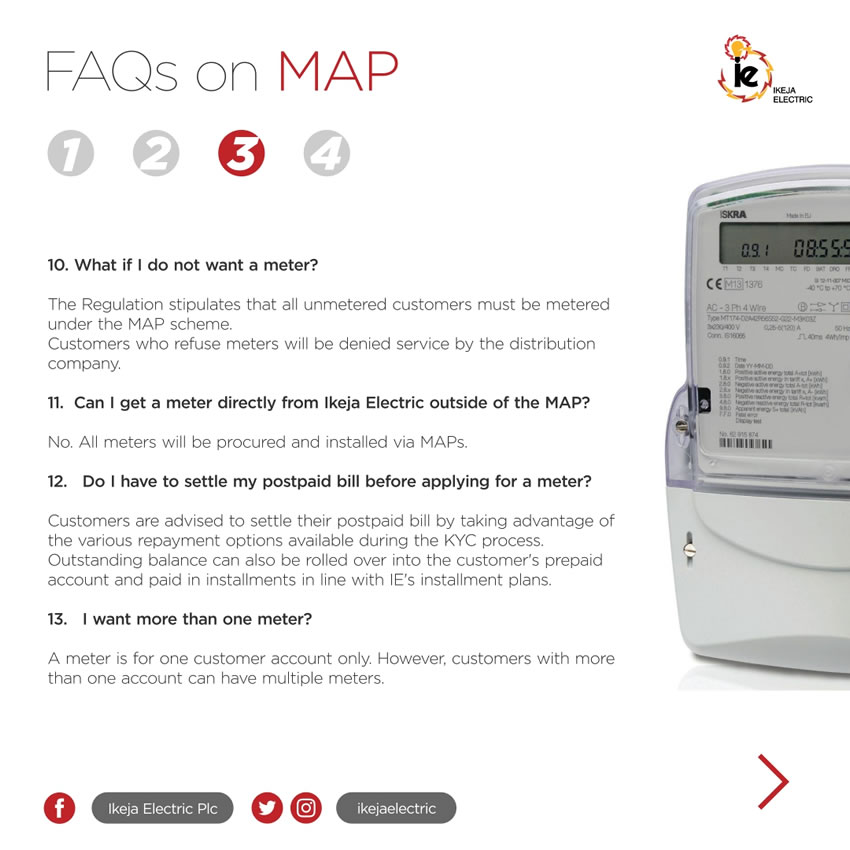
On if a customer decides not to get a meter, the company stressed that, “The regulation stipulates that all unmetered customers must be metered under the MAP scheme. Customers who refuse meters will be denied service by the distribution company,” adding that all meters will be procured and installed via MAPs.
Speaking on customers having unsettled post-paid bill before applying for a meter, the electricity firm advised that the bill be cleared by taking advantage of the various repayment options available during the KYC process.
“Outstanding balance can also be rolled over into the customer’s prepaid account and paid in instalments in line with IE’s instalment plans,” it said.
Answering question as to whether the Meter Service Charge (MSC) is the same as the Suspended Fixed Charge, the company said, “MSC is not the same as the Suspended Fixed Charge (CFC), noting that the MSC is the monthly repayment of the cost of the meter over a period of time.
On the event of customer’s relocation to another apartment after paying for the meters, Ikeja Electric said if the relocation is within its franchise area, the customer is expected to notify the DisCo and once notified, the company will transfer the service to the new location including the credit on the customer’s account.
“Customers are not allowed to remove their meters from their locations,” Ikeja Electric emphasised.
General
Dangote Refinery Cuts Petrol to N1,250 Per Litre, Diesel N1,700 Per Litre
By Dipo Olowookere
The ex-depot prices of two major petroleum products, Premium Motor Spirit (PMS), otherwise known as petrol, and Automotive Gas Oil (AGO), also known as diesel, have been slashed by Dangote Petroleum Refinery and Petrochemicals.
The company announced the reduction in prices of the products in a statement on Saturday evening.
The Lagos-based private refinery said its latest action was to reinforce its commitment to making refined petroleum products more affordable and supporting economic activities across Nigeria.
The cut in the prices of petrol and diesel by Dangote refinery comes as the global crude oil prices continue to moderate, amid expectations that the United States of America and Iran will agree on a ceasefire very soon and reopen the Strait of Hormuz.
This narrow vessel passage accounts for 20 per cent of the world’s crude oil consumption. It has been closed for more than two months because of the Middle East crisis.
On February 28, 2026, America and Israel launched airstrikes in Iran, killing its Supreme Leader and other top government officials.
Iran fought back by attacking US bases in the Middle East, including in Saudi Arabia, Qatar, the United Arab Emirates and others. It also shut down the Strait of Hormuz, causing the price of oil to almost hit $120 per barrel.
The crisis faraway in the Middle East, rather than becoming a blessing to Nigeria, put citizens under untold hardship, as the price of petroleum products, especially PMS, jumped from around N800 per litre to almost N1,500 per litre.
On Friday, the price of Brent crude was about $94 per barrel, while the West Texas Intermediate (WTI) crude was about $89 per barrel.
Ostensibly in response to this, the Dangote refinery has reduced the ex-depot price of petrol to N1,250 per litre from N1,275 per litre, while the price of diesel has been cut to N1,700 per litre from N1,800 per litre.
Since commencing operations, the 650,000 barrels per day refinery has increasingly supplied the domestic market with refined products aimed at eliminating the country’s dependence on imported fuels.
The company claimed it decided to slash the price to improve supply efficiency, deepen domestic refining, and provide cost relief to consumers and businesses that depend heavily on petroleum products for transportation, power generation and industrial operations.
General
Customs Agents Ask Tinubu to Halt Planned Shipping Charge Hike
By Adedapo Adesanya
The National Council of Managing Directors of Licensed Customs Agents (NCMDLCA), the umbrella body of customs agents in Nigeria, has petitioned President Bola Tinubu to compel the Nigerian Shippers’ Council (NSC) to suspend the planned increase in shipping charges pending the review by the standing committee.
According to Mr Lucky Amiwero, the president of the body, in a letter to the President, the increase is a clear contravention of the Memorandum of Understanding (MOU) signed in respect of local shipping charges between providers and users of shipping/Port and related service approved by the federal government.
The MoU under Articles 2(b)&4 clearly states that any other charges shall require agreement between the Parties concerned through the Nigerian Shippers Council, which must be complied with.
“In line with the provisions of Articles 2 and 4 of the Memorandum of Understanding, there is a need to follow the prescribed procedure as contained in the MOU. First is by submitting the information of the increase to the standing committee, including the detailed information, why the increase, and the percentage, to the standing committee for consideration and review of any increase
“We hereby request the suspension of any Local Shipping Charges increase, pending the review by the standing committee, which entails the detailed information of the increase, the Percentage (%), and if the Increase is necessary, to be sent to the standing Committee as approved by the Federal Government,” he said.
The official said the NSC were supposed to forward all detailed information on the increase in the local shipping charges to the standing committee, who are signatory to the MOU, and then to review in line with the approved federal government directive.
“We refer the government to the usual procedure of initiating an increase in local shipping charges. Notification of increase as proposed is always forwarded to the standing committee, reference 2003 NSC/TOD/FPS/011/VOL.V/54 OF 20TH JUNE, and NSC/TOD/FPS/011/VOL.35 OF 14TH April 2003 in line with article 2(b)&4 of the MOU.
“In line with Article 2(b)&4 of the memorandum of understanding, the request made by Shipping Association of Nigeria (SAN), which was forwarded to the Shippers Council and the Shippers Council forwarded the same to the technical standing committee for review,” he added.
General
Presidency Raises Alarm Over Politically Motivated Deepfake Campaigns
By Adedapo Adesanya
The presidency has raised alarm over what it described as a growing pattern of digitally manipulated content aimed at exploiting religious sentiments for political purposes.
In a public service announcement issued by the Office of Digital Engagement and Strategy, it was disclosed that “deliberate attempts” to mislead Nigerians through deep fake videos and false narratives across online platforms had been identified.
According to the statement, a manipulated video surfaced on Tuesday, featuring altered audio and false attributions designed to portray President Bola Tinubu in a negative light.
It noted that a similar attempt followed shortly after, involving a fabricated video linked to a religious leader, allegedly intended to incite Muslim communities against the President.
The presidency said the recurring pattern suggests a coordinated effort to inflame religious tensions and sow division, particularly as political activities begin to intensify ahead of future elections.
It warned that “desperate actors” are likely to continue deploying misinformation tactics, including distorting religious messages, manipulating context, and spreading provocative content through social media and messaging platforms.
The presidency urged Nigerians to exercise caution before sharing sensitive or inflammatory content, encouraging citizens to question the motives behind such materials and to verify information through credible sources.
Describing the trend as “coordinated manipulation at scale,” it stressed that such actions are neither patriotic nor reflective of genuine political engagement.
The statement further warned that individuals and groups involved in the creation and dissemination of false information would be held accountable under relevant Nigerian laws, including those relating to cybercrime, incitement, and threats to public peace and national security.
It concluded by calling on citizens to remain vigilant and united in safeguarding the country’s social cohesion against digital disinformation.
-
Feature/OPED6 years agoDavos was Different this year
-
Travel/Tourism10 years ago
Lagos Seals Western Lodge Hotel In Ikorodu
-
Showbiz3 years agoEstranged Lover Releases Videos of Empress Njamah Bathing
-
Banking8 years agoSort Codes of GTBank Branches in Nigeria
-
Economy3 years agoSubsidy Removal: CNG at N130 Per Litre Cheaper Than Petrol—IPMAN
-
Banking3 years agoSort Codes of UBA Branches in Nigeria
-
Banking3 years agoFirst Bank Announces Planned Downtime
-
Sports3 years agoHighest Paid Nigerian Footballer – How Much Do Nigerian Footballers Earn

125 Comments